
The First Shenandoah Apple Blossom Festival May 3, 1924

Here the parade participants circle the racetrack as spectators view the parade from a grandstand. There was no caption on this photo, but I’m guessing it might possibly be the VMI Regimental Band. Photo by Lewis Reed, 1924
The first Apple Blossom Festival in Winchester was held 95 years ago on May 3, 1924. It was a one-day event featuring a parade, the crowning of Queen Shenandoah, and a program of interpretative dance. To kick off the celebration, the parade assembled at the old fairgrounds just off Fairmont Avenue and marched through the streets of Winchester to the Royal Pavilion on the grounds of Handley High School.
Beginning in 1925, the first of three pageants was professionally produced by the John B. Rogers Production Company and staged on a dais at the fairgrounds. In 1928 the outdoor pageants were moved to the steps and esplanade of Handley High School. The pageant earned a reputation as being one of the most beautiful outdoor extravaganzas in the nation. The festival was suspended during World War II, and resumed in 1946 with its first celebrity grand marshals, Bing Crosby in 1948 and Bob Hope in 1949.
Since its beginnings in 1924, the festival has grown over the years to a ten-day celebration with over 30 events, including two huge parades, a carnival, dances, concerts, a 10K race, wine festival, golf tournament, and much more.
These photos from Lewis Reed’s album are what appears to be some of the very first photos of the Shenandoah Apple Blossom Festival held at the old fairgrounds in Winchester, Virginia. As always, click on an image to enlarge.

The B&O Railroad had a float in the Apple Blossom Parade. Photo by Lewis Reed, 1924
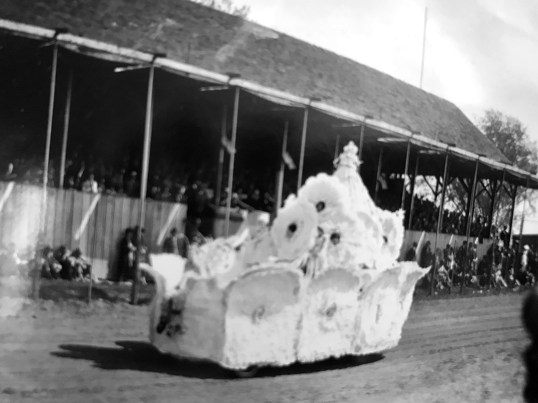
Photo by Lewis Reed, 1924
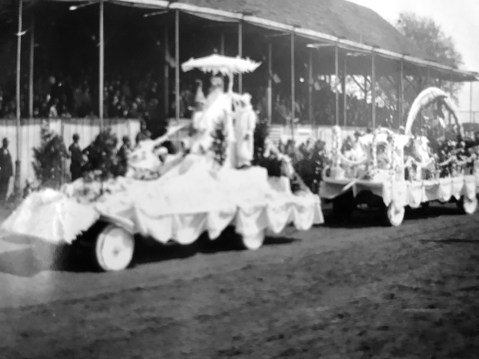
Photo by Lewis Reed, 1924

Photo by Lewis Reed, 1924
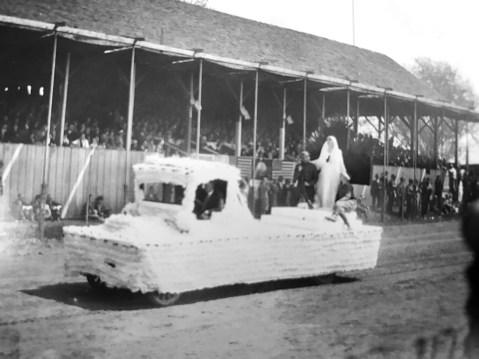
Photo by Lewis Reed, 1924
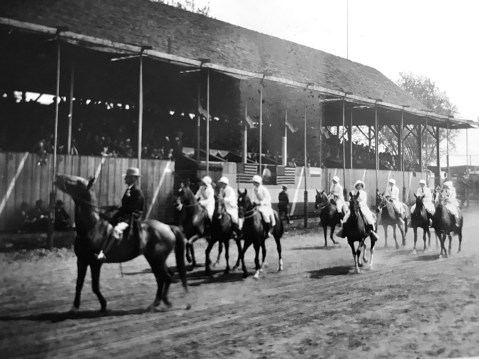
Photo by Lewis Reed, 1924

Photo by Lewis Reed, 1924
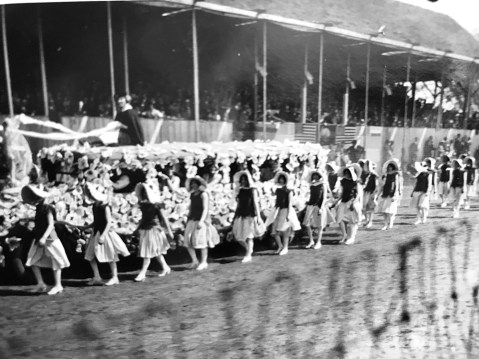
Photo by Lewis Reed, 1924
Source: thebloom.com
Story for the Day … Snow!
Early motorists weren’t afraid to drive in the snow simply because they didn’t have 4-wheel drive and electronic assistance; they just got out and did it. In 1920, the year that Lewis Reed took this photo, automobiles were equipped with windshields, but they did not yet have windows—you know, those pieces of glass above the doors of the car that keep stuff out. So snow removal was a back-breaking exterior and interior job. The radiator badge on the front of the car in this phto identifies it as a Hudson. The Hudson and Oldsmobile were sold at Reed Brothers from roughly 1917 through 1921.
In the spirit of yesterday’s snow, here is a photo that gives a good look at how Reed Brothers Dodge got its new model cars from the rail yard back to Rockville — they drove them — caravan-style through the snow. These new cars all with dealer license plates, are stopped along a snowbound Goshen Road in rural Gaithersburg on their way back to the dealership.

Circa 1920 Hudson Six with Maryland Dealer License Plate No. 618 on front. There weren’t heaters in these old cars, so motorists had to really bundle up. Photo by Lewis Reed
Who would dare go out in these conditions today without an AWD SUV and heated seats?
Evolution of Reed Brothers Gas Stations
Before the advent of the service station more than a century ago, fueling up was an adventure for our ancestors. Pioneering motorists had to take a bucket to the general store, hardware dealer, drugstore or local refinery and fill up from a gasoline barrel. In 1905, gas pumps begin to replace the bucket and funnel method for refueling. Early gas pumps were generally deployed curbside in front of general stores, pharmacies, hardware shops and even blacksmith shops.
Reed Brothers Dodge was the first Gulf gasoline dealer in the Washington, D.C. area. In 1915, they began selling gas at their original location in Old Rockville at the triangle at Veirs Mill Road and Rockville Pike. Their first “gas station” consisted of a single pump. Motorists in Rockville could stop at Lewis Reed’s Rockville Garage to buy Fisk tires and auto supplies, and then fill up at the single pump at the curb. Later, in addition to gas, they carried a full line of Gulf lubricants, Firestone and Goodyear tires, Willard batteries, complimentary road maps, free air and water, and many other well known brands of merchandise to meet their patrons needs.

1915 — Motorcyclists filling up at Rockville Garage first “gas station” – a single pump. Photo by Lewis Reed
In circa 1917, Reed Brothers became an authorized Texaco Filling Station and sold Texaco gasoline, also from a single pump. The photo below is the original Rockville Garage located at the intersection of Veirs Mill Road and Rockville Pike. To the right is a Texaco Gasoline Filling Station sign. One very tall Texaco branded fuel pump can be seen in this photo along with two Texaco Petroleum refueling trucks.

1917 — Original Rockville Garage with 2 story addition. Note the Texaco Filling Station signage and the Texaco Petroleum fuel truck refilling the single pump in front. Photo by Lewis Reed
At some point prior to 1920, Reed Brothers Dodge changed over from selling Texaco and became a Gulf Gasoline dealer. By this time, gasoline retailers had determined that placing gas pumps on an “island” in front of the station, where drivers could approach from either side, provided the most efficient station layout. Reed Brothers got a new facelift and remodel in 1921, and an island with three new modern gas pumps were added. Visible pumps like these, used a graduated glass cylinder to show customers the quality and quantity of gas being purchased. Glass globes, like Good Gulf, usually topped the pumps and advertised the company’s brand and name.

1921 — Reed Brothers Dodge got a new facelift and remodel. Note the island with three new Gulf gas pumps. Photo by Lewis Reed
The first uniformed gas station attendants appeared at Reed Brothers around 1920. The Gulf station included a manager and four attendants. Attendants worked long hours in all weather, possessed a thorough knowledge of service requirements for various automobile makes and models, improvised quick repairs on the spot, provided directions to lost travelers, and did it all with a smile. The four men dressed in uniforms and caps in the photo below were Gulf Gasoline Station attendants. Three of the original gas station attendants were Walter (Bud) Beall, Otis Beall and John Burdette.

Rockville Garage Sales & Service Staff circa 1920s. Photo by Lewis Reed
In the 1920s, the Gulf Refining Co. adopted a brick and tile roof station with canopy supported by four brick columns covering two front driveways. Below are architectural changes in the Reed Brothers Dodge front that were taken in the late 1920s. A modern drive-through canopy was added along with new gasoline pumps. A close-up view can be seen of the new gasoline pump-island with four pumping units along with the motor oil dispensers used at that time. The old pump island can be seen to the left along with a new “That Good Gulf Gasoline” sign.

Late 1920s — That Good Gulf Gasoline drive-through filling station with canopy and gasoline pumps were added in the late 1920s. Photo by Lewis Reed
Below is a circa 1940 photo of Reed Brothers Dodge full service Gulf Gasoline Station with two gas station attendants standing in front. Professional service was very important in the first half of the twentieth century, so it was common for gas station attendants to wear the company uniform.
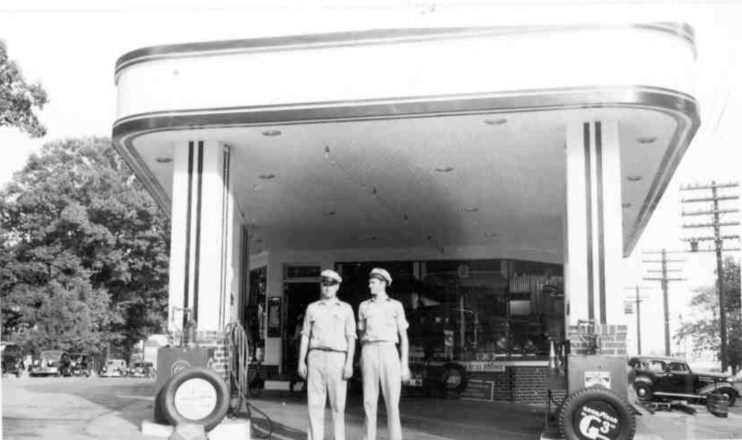
1940 — Reed Brothers Dodge canopied full service Gulf Gas Station. Photo by Lewis Reed
Reed Brothers Service Station provided restrooms for the traveling public. Patrons wanted clean and safe facilities. In addition to the Gulf signage there is a small, barely visible sign below that promotes, “Clean Rest Rooms” which assured the traveler that the restrooms were well maintained.

1936 — Reed Brothers Dodge canopied Gulf Gas Station. A closer look reveals the price of gasoline as 15 cents. On the right attached to a telephone pole is a sign pointing the way to Olney. In addition to the Gulf signage there is a small, barely visible sign below that promotes, “Clean Rest Rooms”. Photo by Lewis Reed
Due to changes in the highway, Reed Brothers began an extensive remodeling and rebuilding program. Two-thirds of the original location at the junction of then Route 240 and Veirs Mill Road was razed and a modern Gulf Service Station was erected.
The photo below is a circa 1968 photo of the Reed Brothers Dodge Gulf Gasoline station. The famous Gulf “ice box” design dates back to late 1930’s and there were probably more of these built than any single one of the later Gulf designs. A Coca Cola machine is visible in front of the white Dodge Dart parked in front of the service bay. The sign in the grass to the right of the blue ’58 Plymouth (Belvedere?) reads, “We’re Making Deals on Gulf Tires”.
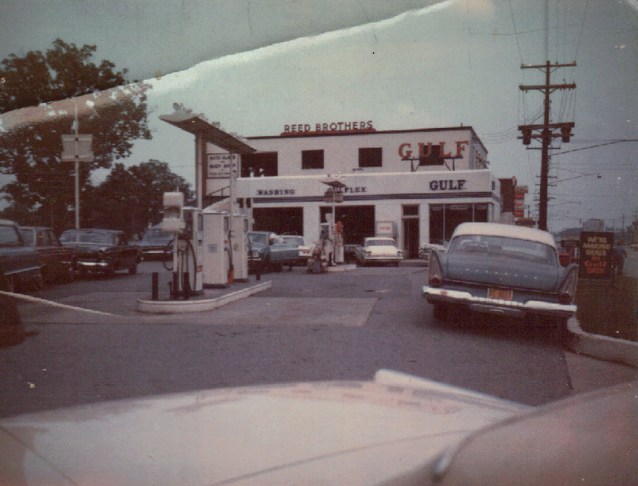
1960s — Reed Brothers Dodge Full Service Gulf Station. Photo by Lewis Reed
Reed Brothers Dodge discontinued offering Gulf Gasoline when they relocated to their new facility in November 1970.
Darnestown One-Room Schoolhouse (1898)
Have you ever wondered what it would be like to attend a one-room school, to be in the same classroom as your older brother or younger sister, where all the kids, no matter how old, are in the same class? One-room schoolhouses are all but a memory now. But at the turn of the 20th century, they were where most rural students received their educations. One room schoolhouses were the pioneers of the early education period. At the period’s peak, just under 100 one- and two-room schools existed in Montgomery County.
One of the most amazing photographs in Lewis Reed’s collection is of the one-room schoolhouse where he and his brother, Edgar, went to school. This photograph is the only one known to exist of this school. The schoolhouse, now long gone, was located on Thomas Kelley’s Farm at Pleasant Hill (which today, would be located in the center of the Spring Meadows community). Lewis Reed grew up on a farm in rural Darnestown and for much of his young life had no running water or electricity. His father was an early settler and worked as a Cabinetmaker and Blacksmith. The Reed family farmhouse and blacksmith shop was located in off Route 118 in Darnestown.

Darnestown One-Room Schoolhouse. The chimney was probably to a wood-burning stove that was used to heat the building. Note the outhouse on the left. Photo from the Lewis Reed Collection
This small, one-room schoolhouse was within walking distance of my grandfather’s farmhouse. In those days, walking distance generally meant within a few miles. Lewis Reed attended this school with his brother, Edgar. First through sixth grades were taught by one teacher (Minnie McAtee) to about thirty or more students. Few students went beyond sixth or seventh grade; in fact, Lewis Reed’s education stopped after the sixth grade. He would later be home-schooled by his wife, Ethelene Thomas, who was a teacher in the Maryland public school system.
The age range for students was 6 to 16. The students were separated roughly by level of study in each particular subject, rather than by age as they are now: a child might have studied 3rd grade math while also doing 6th grade reading or history. Gender separation was maintained by seating girls and boys on opposite sides of the room. The larger boys were expected to help bring in the wood or coal and carry out the ashes. Misbehavior begot corporal punishment.
School usually took place between the hours of 8 a.m. and 4 p.m. The youngest children sat in the front, while the oldest students sat in the back. The teacher usually taught reading, writing, arithmetic, history, and geography. Students memorized and recited their lessons. The teacher’s desk may have been on a raised platform at the front of the room, however, and there would have been a wood-burning stove since there was no other source of heat. The bathroom would have been outside in an outhouse.

Circa 1898 class photo taken at Lewis and Edgar Reed’s one-room schoolhouse (Darnestown School). There were six grades in the school with one teacher. Minnie McAtee, teacher (right rear). Photo from the Lewis Reed Collection.
As for Minnie McAtee, according to The Baltimore Sun (Baltimore, Maryland) 05 June 1901, Miss McAtee resigned from the Montgomery County school system in 1901.
Born in Darnestown, Miss McAtee attended the Andrew Small Academy in Darnestown, after which she completed correspondence courses to further her education. For eight years, she taught in the one-room schoolhouse at Pleasant Hill, Darnestown.
The undated “Get Well Story” below was posted on the Find A Grave website in her memory. Anybody who took such good care of flowers as she did, most certainly must have been a great school teacher.
 At least 34 schoolhouses of this bygone era still stand today in Montgomery County, an astounding total considering how developed Montgomery County is today. The five schoolhouses in Montgomery County restored as museums — Boyds, Brookeville (one-room school), Kingsley, Seneca, and Smithville — are open to the public at various times during the year. Most are open during Heritage Days; check www.heritagemontgomery.org for the schedule.
108 Years Ago at Rockville High School

1911 Originally known as Montgomery County High School, later as Rockville High School. Photo by Lewis Reed
In honor of this year’s commencement, here is a look back at some 1910 class photos from Montgomery County High School that were taken by Lewis Reed. This is a collection of group photos of school children, some with the teacher, taken in 1910 from Montgomery County High School (Old Rockville High School). I wanted to share these photographs, because they offer a visual history of a part of Rockville’s past taken more than 100 years ago.
Most of the photos are labeled with only the year, so if you have corrections to the names or can identify other individuals, please contact me or leave a comment below. Several students have been identified by the Montgomery County Historical Society, which I have included.
In this era, students from grades one through eleven attended the public school at Montgomery Avenue and Monroe Street. Named Montgomery County High School with the addition of upper grades in 1892, as the school board opened other facilities it became Rockville High School and then, in 1935, Richard Montgomery High School. Students came to the school by train, trolley, and later by school bus from all corners of the county.
Step back in time into a much simpler past and get a look at class photos of Rockville High School students from over 108 years ago. As always, click the photos to get a better look. Some of the expressions on these students faces are priceless!
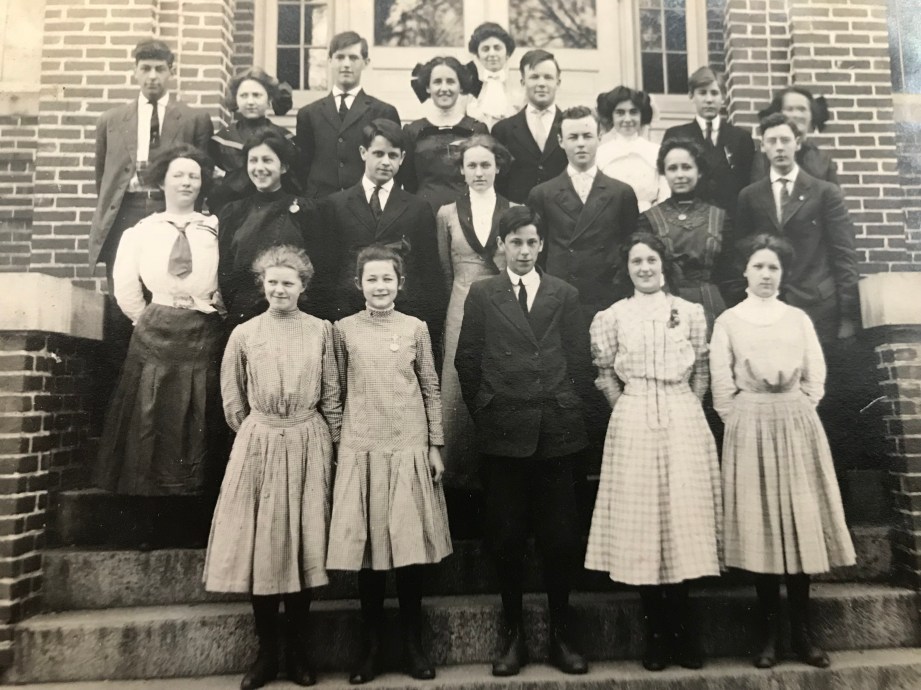
Old Rockville High School class c. 1910. Photo by Lewis Reed
Back row: Edward Story, Lena Ricketts, Tom Young, Louise Larcombe, Miss Ford, Fred Hays, Lucius Lamar, name unknown, name unknown.
Middle Row: name unknown, name unknown, Jesse Wathen, Jesse Higgins, name unknown, name unknown, Mary Hyatt, name unknown, name unknown.
Front Row: Maude England, Rebecca Lamar, (first name unknown) Garrett, Helen Pumphrey, (first name unknown) Lehman.
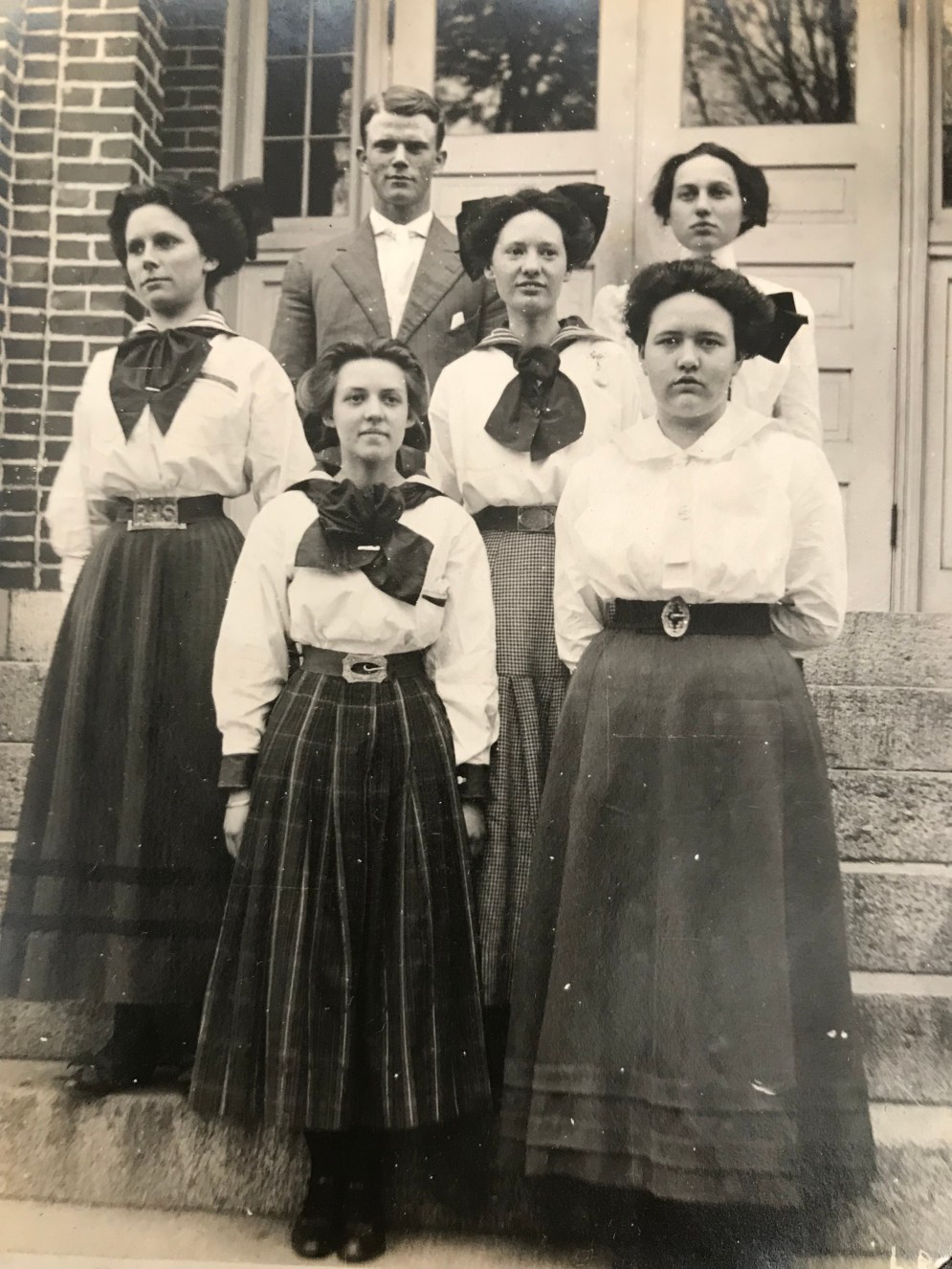
Old Rockville High School graduates 1910. Photo by Lewis Reed
Back: Harry Beall, Katherine Hughes.
Middle: names unknown
Front: Edith Prettyman, (first name unknown) Darby

Old Rockville High School First Baseball Team 1910. Photo by Lewis Reed
Front: Billy Beck, Tom Young, Ed Storey, Harry Beall, Roy Warfield.
Back: (first name unknown) Hicks, Lucius Lamar, name unknown, name unknown, Jesse Higgins, name unknown, name unknown, Fred Hays, Roger Whiteford.
Holding pennant: Griffith Warfield
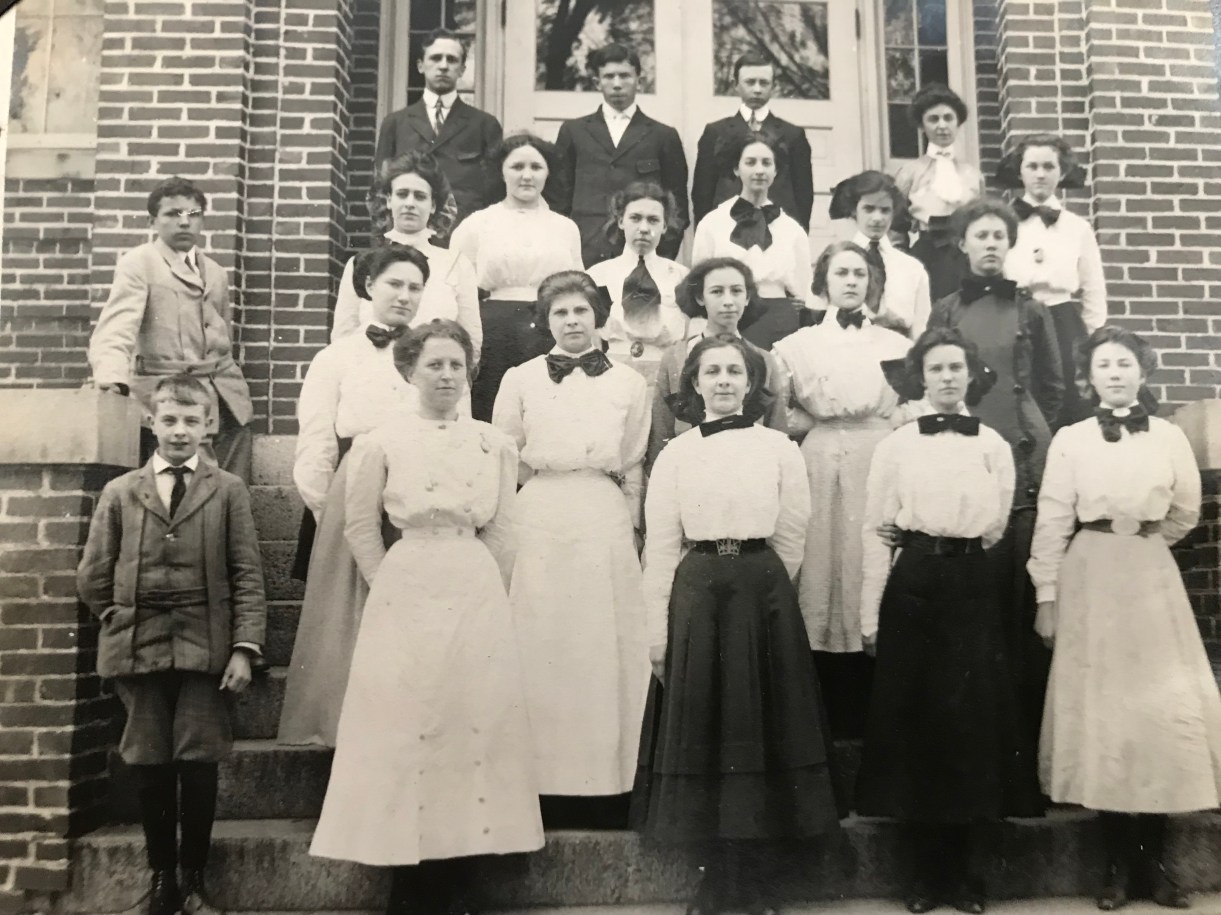
Montgomery County High School 1910

Montgomery County High School 1910

Montgomery County High School 1910
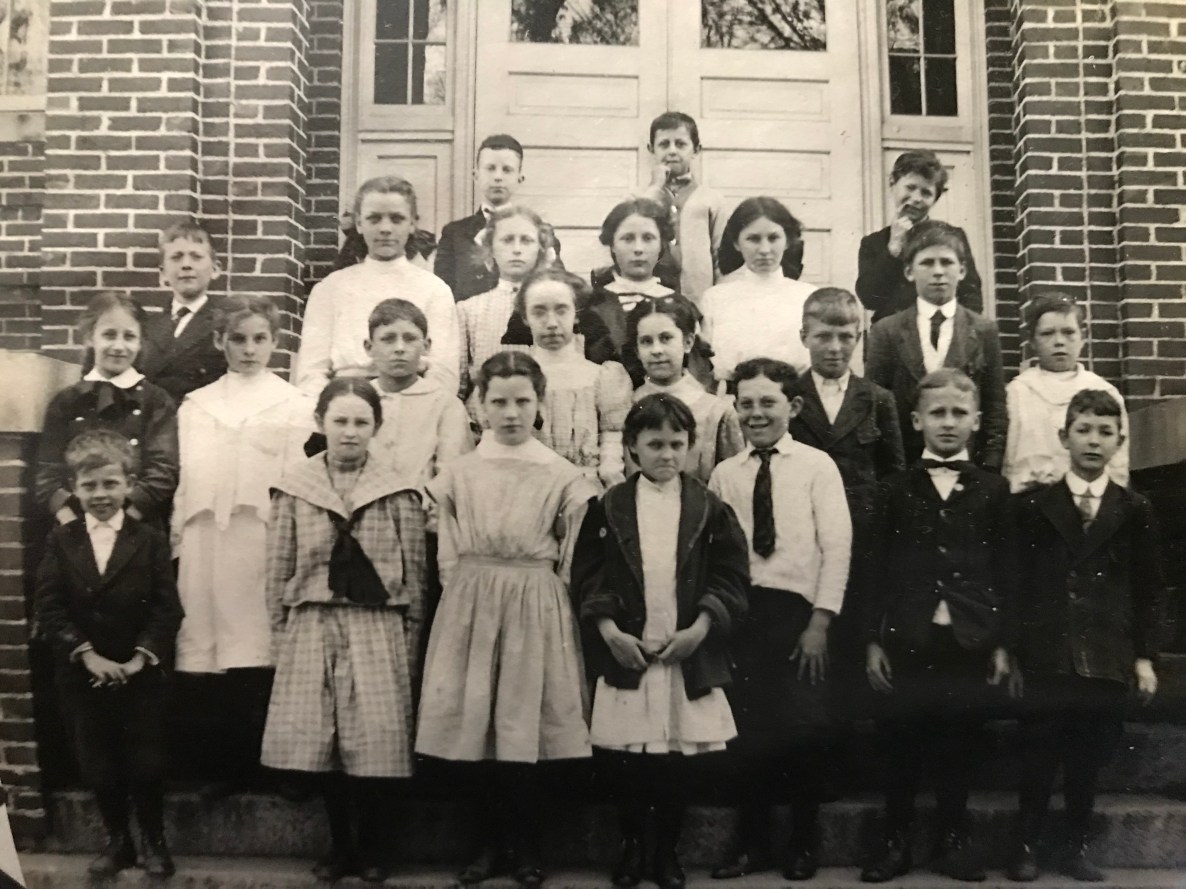
Montgomery County High School 1910
Books

Related Resources


Copyright Notice

Reed Brothers Dodge History (1915-2012) by Jeanne Gartner is licensed under a Creative Commons Attribution-NonCommercial 3.0 Unported License.
 Reed Brothers Dodge History 1915 – 2012
Recent Comments