
Lewis Reed’s ‘Ghost’ Photograph

Surrealistic, ghost-like effect of Lewis Reed (right) standing next to a tree in the middle of train track. From Lewis Reed’s Photograph Collection
Lewis Reed had a passion for photography and had the know-how to try out a few of the trick shots that were popular at the time — including creating double exposures that made it look as if there were ghosts in the picture.
When I saw this photograph — which is slick enough to fool anyone not paying attention to detail — I became curious. How on earth did he do that? So I did some research to get some information on what went into this type of photography. This technique often left a telltale vertical line along the center of the image — a fuzzy stripe separating the two exposures.
Supernatural effects were mainly accomplished using double exposure. When developing the photos, a pre-prepared glass plate would be used which already had the image of a person on it. This would be the ‘ghost’. It would then be inserted into the camera in front of an unused plate which was used to shoot the photo. The developed negative comes out with both images on it — an incompletely exposed ghostly image as well as a sitter, looking perfectly unaware.
I think it’s really amazing how Lewis Reed’s early photography shows such versatility and creativity.
Lewis Reed Photos to Appear on Science Channel ‘Impossible Engineering’
 I recently received an e-mail from the researcher on the new Science Channel series ‘Impossible Engineering’. They found Lewis Reed’s collection of early dirt track race photos that were taken at the Rockville Fairgrounds and asked permission to use a couple of them in an upcoming episode they are making on the development of the race car.
The following 1923 dirt track race shots taken by Lewis Reed will be used on the program.
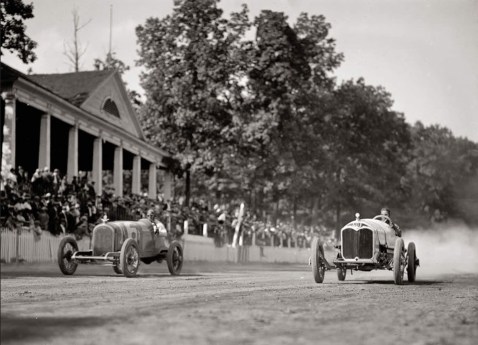
Rockville Fair, August 1923. Photo by Lewis Reed
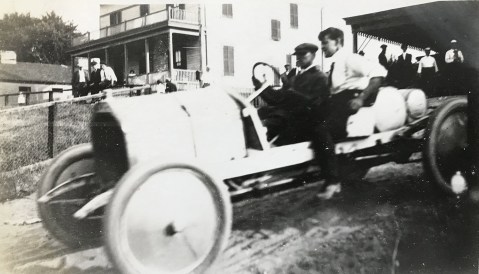
Rockville Fair, August 1923. Photo by Lewis Reed
About Impossible Engineering
Behind every seemingly impossible marvel of modern engineering is a cast of historic trailblazers who designed new building techniques, took risks on untested materials and revolutionized their field. Brand new series, ‘Impossible Engineering’, is a tribute to their achievements. Each episode details how giant structures, record-beating buildings, war ships and space crafts are built and work. As the show revels in these modern day creations, it also leaps back in time to recount the stories of the exceptional engineers whose technological advances made it all possible. How would they have ever existed without the historical work of their ancestors? Interviews with their great advocates bring engineering history to life and retell how these incredible accomplishments shaped the modern world.
“Impossible Engineering” is produced for Science Channel by Twofour Broadcast. No mention of when it will be aired, so stay tuned!
Then & Now: Thomas Hardware Store, Gaithersburg
Looking at old photographs is like peering through an open window back into history. Not only do they give you a sense of wonder from traveling back in time, but also a staggering feeling of awe from seeing just how much things have changed. For this post, I have used one of Lewis Reed’s original photographs for “then” and a Google Maps street view image from today for “now”.
Thomas Hardware Store (THEN): This photo was taken by Lewis Reed when the first system of water mains and sewers were installed by the WSSC in Gaithersburg, circa 1926-1928. The store in the background is the Thomas Hardware Store, originally built and operated by Thomas Iraneous Fulks. The water pipes to be laid are resting by the side of the road. The child on the right in the photograph is Lewis Reed’s daughter, Mary Jane (Reed) Gartner.
T. I. Fulks was a businessman and farmer. He worked as a bookkeeper for the Gaithersburg Milling and Manufacturing Company and then opened a hardware store at 219 East Diamond Avenue.

Thomas Hardware Store, originally built and operated by Thomas I. Fulks. Photo by Lewis Reed, ca. 1928
Thomas Hardware Store Location (NOW): The same view 90 years later. The old hardware store is enclosed in the present brick building (Gaithersburg Rental Center) at 219 East Diamond Avenue.
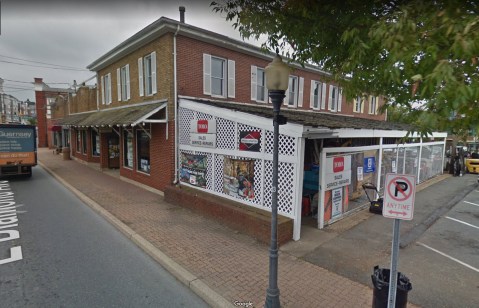
219 East Diamond Avenue today
Source: Gaithersburg: History of a City
Then & Now: Howard House Hotel, Ellicott City
This post is a continuation of a series of “Then & Now” images that will show photographs of buildings, street scenes, and other historical locales from Lewis Reed’s Photo Collection alongside photographs of how they appear today.
Howard House Hotel (THEN): The Howard House Hotel, built in 1840, contained a bar and dining room in addition to 14 bedrooms. The hotel featured fine German cooking and was the first place in town to offer ice cream — which was made on Wednesdays only and was a real draw. The hotel and restaurant was a popular stop for mid-19th-century travelers headed west on the National Road, and a day-trip destination for urban dwellers. In the 1940s, the decorative wrought iron on its second-floor porch was sold for scrap metal for the war effort.
The trolley tracks on main street were originally part of the Catonsville and Ellicott City Electric Railway Company trolley line that shuttled passengers between Ellicott City and Baltimore from the late 1890s to the mid-1950s.

Howard House Hotel Ellicott City, Maryland, circa 1914. Note the signs over the entrance read, “ICE CREAM” below it “OYSTERS” Photo by Lewis Reed
Howard House Hotel (NOW): The same view 105 years later, restored to its original grandeur as 10 “luxury” rental apartments which includes panel doors, moldings and much of the original woodwork.

Howard House Apartments today
New Blog Feature: Then & Now
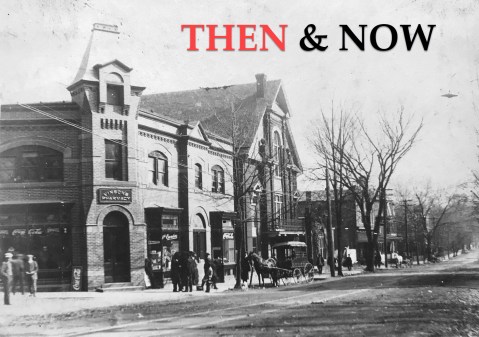
Looking back at photography from the past is a fascinating experience for me, and with a newfound interest in history, it occurred to me that with the vast number of historical photographs in Lewis Reed’s Collection, that this blog would be a great place to feature a series of Then & Now photography. I started doing this about a year ago as a research tool, now I mostly do it because of my passion for history and fascination with the subject. With that in mind, I will occasionally be spotlighting some “Then & Now” images from his collection that will show photographs of buildings, street scenes, and other historical locales alongside photographs of how they appear today.
Some of the historic locations in this series includes the Smithsonian, Capitol, Union Station, Old Post Office, Library of Congress, Raleigh Hotel, Key Bridge and other important sites in and around the Maryland, Virginia, and Washington, D.C. area. There are also photographs of many non-Maryland locations including the historic landmark “Lucy the Elephant”, Gettysburg Battlefield, Mount Vernon, Pennsylvania Monument and United States Regulars Monuments under construction, and Quebec Bridge (the 8th Wonder of the World).
I have no formal history training, just a general interest in local history where I grew up. I will post one of Lewis Reed’s photographs matched with a corresponding contemporary shot of the same area, and supply a few sentences of context. All of them will in some way will offer a visual history of how things have changed over the years. I look forward to sharing them with you.
Books

Related Resources


Copyright Notice

Reed Brothers Dodge History (1915-2012) by Jeanne Gartner is licensed under a Creative Commons Attribution-NonCommercial 3.0 Unported License.
 Reed Brothers Dodge History 1915 – 2012
Recent Comments