
Happy Valentine’s (and Ferris Wheel) Day!

Ferris Wheel at Rockville Fair, circa 1920s. Photo by Lewis Reed
Did you know that February 14th is not only Valentine’s Day, but also Ferris Wheel Day? This unofficial national holiday is held on this day to honor the birth of the inventor of the Ferris Wheel, George Washington Gale Ferris, Jr. What better way to celebrate Ferris Wheel Day than enjoying this old photograph of the Ferris Wheel taken at the Rockville Fairgrounds, courtesy of Lewis Reed. The fairgrounds were just outside Rockville, about where Richard Montgomery High School is today. The Fair lasted four days, from August 21st to the 24th, and drew visitors from local counties, Washington, and Baltimore.
For the singles and the “enough already with the Valentines”, here is your perfect alternative excuse. Go wish all your friends and family a Happy Ferris Wheel Day!
Before There Was Photoshop, There Was Lewis Reed…
If you take a look at the state of photography today, such as the advances of digital cameras and the artful image manipulation by Photoshop, it is easy to forget that back in the 1900s photographers couldn’t just go into a computer program and change their images any way they wanted. They did what they could with the tools they had. Double image exposure was one tool Lewis Reed had in his photography tool belt. He was doing crazy things to images and creating humorous effects over 100 years ago. With double exposure technique, you could create certain effects like placing the same person on both sides of a picture simultaneously. Photographs were pieced together in the darkroom from separate photographs.
Spotting these manipulated photos in Lewis Reed’s extensive collection has been both easy and difficult. It wasn’t until I viewed the high resolution scan that the modification jumped out at me. The photograph below taken at Black Rock Mill, highlights Lewis Reed’s photo manipulation. (click image to enlarge)

This is a double exposure photograph of Lewis Reed and the same two ladies with bundles of flowers appearing twice – standing on a bridge over Seneca Creek at Black Rock Mill – and on the left at the foot of the bridge. Photo by Lewis Reed, ca. 1905
With double-exposure technique, Lewis Reed learned how to make a subject appear twice in a frame, as if they had an identical twin. To capture these images, he would snap a picture of the subject in one position. Then, he would have to move into another pose before the following photo was shot. Rotating lens caps and special glass plates (the precursor to film) were also part of the process. The final image was then pieced together and developed in the darkroom from the separate photographs. The result was a playful and surreal approach to early photographs.
Double exposure technique often left a telltale vertical line running down the center of the image that is lighter than the left and right sides — a fuzzy stripe separating the two exposures. This is the area where the two exposures overlapped. The picture is lighter where the images overlap because the exposure value is doubled (causing over-exposure) in that specific vertical area. The left half of the image (standing at the foot of the bridge) ends where the light band becomes dark on the right side. And vice versa for the right half of the image (standing on top of the bridge).
Today we are accustomed to Photoshop and people manipulating images, but back in the early 1900’s photo manipulation was used as a form of whimsy.
Thomas Kelley’s Pumpkin Patch, Early 1900s
When the leaves begin to change and the air takes on a chill that means it’s time for one thing – pumpkin picking! This is a rare photograph of three well-dressed men pumpkin picking in Thomas Kelley’s field of pumpkins in Pleasant Hills, circa early 1900s. Tom Kelley farmed much of the land around the Pleasant Hills homestead and was famous for his “Kelley Corn” farm wagon of fresh dairy produce during the summer months, as well as the corn that fed visitors to the Montgomery County Fair each August and, of course, his pumpkin patch in the fall.
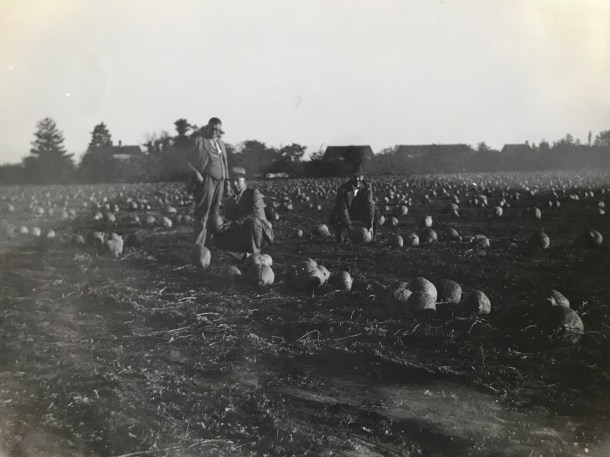
Pumpkin picking in Thomas Kelley’s Pumpkin Patch, Darnestown, Maryland circa. early 1900s. Photo by Lewis Reed
Happy Valentine’s (and Ferris Wheel) Day!
Ferris Wheel at Rockville Fair, circa 1920s. Photo by Lewis Reed
Did you know that February 14th is not only Valentine’s Day, but also Ferris Wheel Day? This unofficial national holiday is held on this day to honor the birth of the inventor of the Ferris Wheel, George Washington Gale Ferris, Jr. What better way to celebrate Ferris Wheel Day than enjoying this old photograph of the Ferris Wheel taken at the Rockville Fairgrounds, courtesy of Lewis Reed. The fairgrounds were just outside Rockville, about where Richard Montgomery High School is today. The Fair lasted four days, from August 21st to the 24th, and drew visitors from local counties, Washington, and Baltimore.
For the singles and the “enough already with the Valentines”, here is your perfect alternative excuse. Go wish all your friends and family a Happy Ferris Wheel Day!
Rare Images of Early Rockville from Lewis Reed’s Collection
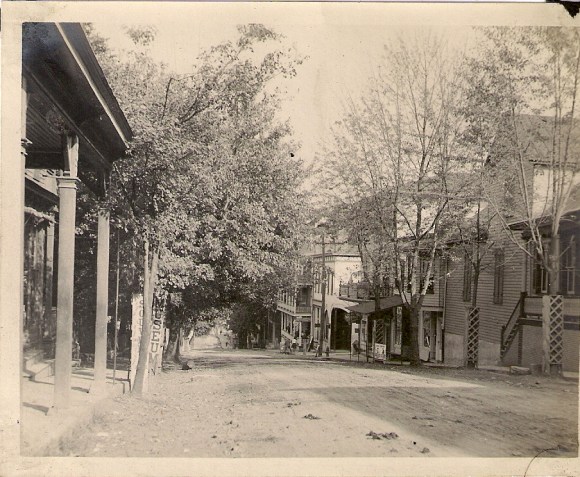
This photograph was marked only “Rockville.” Note that the sidewalks are board planks elevated from street level. Photo by Lewis Reed ca, 1912
What makes Rockville such an interesting place? It’s interesting history! Old photos have an amazing way of showing us what life was like years ago and depicting how our communities once looked. You might not realize how much things have changed until you look back and see what it looked like in the past.
A bit of Rockville history: More than 250 years ago, land grants to European settlers formed the nucleus for today’s Rockville, Maryland. By the 1750s local farmers were transporting tobacco to market in Georgetown down a road formerly used by Indians. The tiny settlement was designated as the seat of the new Montgomery County in 1776. Known as Rockville by 1803, the town’s life centered on Courthouse activity. More homes and shops were built, and the town of nearly 600 was incorporated in 1860. The dynamics that created Rockville in the 18th and 19th centuries are still the same ones attracting newcomers today: the presence of county government, a favorable location close to the nation’s capital, converging transportation routes that bring people here, and identity as an independent municipality.
Take a journey back in time through the lens of Lewis Reed and see what Rockville looked like more than one hundred years ago. As always, click the photos to get a better look.

North side of East Montgomery Avenue near the courthouse, ca. 1914. Note the trolley car on the left. Photo by Lewis Reed
Shops sold groceries, baked goods, sewing machines, hats, lumber, and hardware. Families lived above their stores, renting rooms to others.

Court House Triangle. The large white house behind the Confederate Statue is the Hicks House. The Montgomery House Hotel is to the right of the Hicks House, just out of the image. Photo by Lewis Reed, 1914
On September 28, 1917 a draft for World War I began and the first 40 men reported for duty at the Montgomery County Court House in Rockville, Maryland. In the photograph below, cars are parked around the court house during the speech-making in the court room to drafted men. Montgomery County’s first recruits left Rockville by train for Camp Meade, Maryland on this same day. They each received a package of smoking tobacco and a rousing send-off from two thousand people after speeches at the courthouse, dinner at the Montgomery House Hotel, and a parade to the depot. About 160 Rockville men served in the eighteen-month war. One of those men was Rockville resident, Edgar Reed. Edgar was fortunate enough to survive World War I and to settle back in Rockville and enjoy a successful life and career in the automobile business.

Montgomery County Court House. Photo by Lewis Reed, 1917.
Notice that most of the cars in the above photo have two license plates: at this time, you needed a separate tag to drive a car in the District of Columbia. There is also horse dung in the dirt road (E. Montgomery Avenue), suggesting buggies had been by recently as well. Barely visible in the background left is the Maryland National Bank building, which was demolished during urban renewal in the late 1960s.

Suburban Electrical Company on Montgomery Avenue in Rockville. Photo by Lewis Reed, ca.1914
The upper story of this building was the living quarters of Mr and Mrs B. F. Hicks. The building was later acquired by W. Valentine Wilson, who tore it down and replaced is with the “SECO” for Mr Wilson’s Suburban Electric Company. The ground floor was made into a moving picture theater.

W. Hicks General Store on Montgomery Avenue Rockville. Photo by Lewis Reed, ca. 1914
Washington Hicks operated this general or dry goods store in Rockville from the late 19th century until 1940. His son W. Guy Hicks continued to run the store until his retirement in the late 1950s. The photo above shows the storefront in 1914.

H. Reisinger Lunch Room on Montgomery Avenue Rockville 1914. Photo by Lewis Reed, ca. 1914
H. Reisinger Bakery, Confectionery, Ice Cream and Lunch Room, 5 and 10-cent Bargain Store on Montgomery Avenue, Rockville.
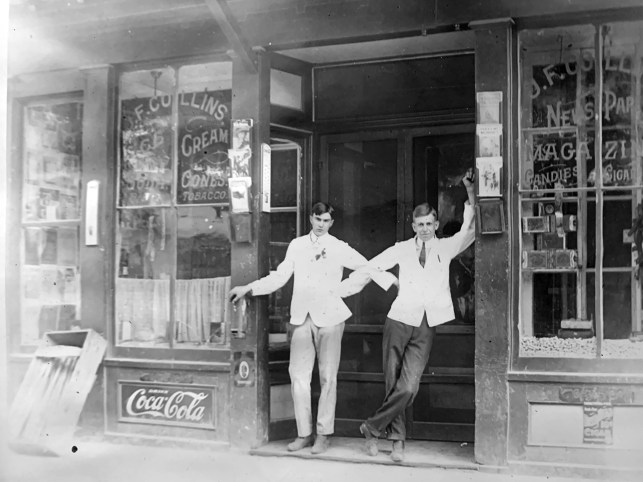
Clerks at J. F. Collins General Store on East Montgomery Avenue. Photo by Lewis Reed, ca, 1914
On a bleak night in February 1921, a pistol shot was fired while others yelled, “Fire!”. From John Collin’s store on East Montgomery Avenue — beloved by local children for Cracker Jacks and penny candy — flames reached toward the sky. Volunteers arrived with buckets while others operated the hose reels and hook and ladder truck. The main street was saved with help from men and equipment of Washington, D.C., but Collins’s store was a smouldering ruin. A few weeks later, fifty concerned townspeople elected officers of the newly formed Rockville Volunteer Fire Department.

Rockville looking east down Montgomery Avenue at Perry Street (now Maryland Avenue); Vinson’s Pharmacy is on the corner. Photo by Lewis Reed, ca. 1906.
Most roads in Montgomery County, even those running though towns, were dirt. In the photo above, taken in downtown Rockville, a delivery wagon can be seen at the curb, as well as advertisements for Coca-Cola, which would have been a product only 20 years old at that time, having been invented and trademarked in 1887. Trolley tracks bisect Montgomery Avenue. Today, the view down this street ends with stairs to the pedestrian overpass, which leads over Hungerford Drive into the Rockville Metro Station.
The drugstore was built in the 1880s and was run by Robert William “Doc” Vinson from 1900 until his death in 1958. The drugstore was also a popular gathering place for city politicians, and that President Woodrow Wilson once personally traveled there to buy Wolfhound tablets. The building was torn down in 1962, and replaced with an office building during Rockville’s “urban renewal”.

Vinson’s Drug Store Fearon’s Pharmacy (as named in the window; also Owen’s and Vinson’s at other times). L to R Tom Talbott, Wardlow Mason, Otho Talbott, unknown, Dr. Fearon. Photo by Lewis Reed, ca. 1898.

Rockville Town Hall. Photo by Lewis Reed, 1912
Rockville Town Hall was incorporated in 1881 to “improve the educational, moral, scientific, literary and social condition of the community. Stock sold at ten dollars per share raised most of the six thousand dollars needed to erect a handsome two-story brick building on Montgomery Avenue. The Town Hall opened on Tuesday evening, July 18,1882. For the next half century, the Town Hall operated as a small-town cultural center, with a four hundred-seat auditorium on the second floor, a stage, balcony, and dressing rooms, a ticket office on the lower level and seven leased offices. The community used the facility for visiting lectures, theatrical and musical performances, dances, and other suitable “instruction and amusement”.

Rockville Court House. Photo by Lewis Reed, ca. 1914
For most of Montgomery County’s history, a single building, familiarly known as “The Courthouse,” served all functions of local government. The Red Brick Courthouse is the county’s third on this site, constructed in 1891 at a cost of $50,000. Roads were crude, daily trains connected county commuters and farmers with the nation’s capital, and trolley tracks were planned between Rockville and Georgetown. The county’s 27,185 residents visited the courthouse as litigants and jurors, to pay taxes, buy dog tags, probate wills, obtain marriage and business licenses, record deeds, speak to County Commissioners, and request law enforcement from the Sheriff. Designated a historic building on July 19, 1965 by the Montgomery County Historical Society.

St Marys Catholic Church. Photo by Lewis Reed, c. 1914.
Founded in 1813, historic St. Mary’s Church led the way for Catholics in Montgomery County. The cemetery in front of the chapel is the final resting place of literary legend F. Scott Fitzgerald and his wife Zelda.
Sources:
75 Years of Rockville, Maryland
As remembered by William F. Prettyman
Rockville: Portrait of a City by Eileen S. McGuckian
Books

Related Resources


Copyright Notice

Reed Brothers Dodge History (1915-2012) by Jeanne Gartner is licensed under a Creative Commons Attribution-NonCommercial 3.0 Unported License.
 Reed Brothers Dodge History 1915 – 2012
Recent Comments