
Then & Now: Wilson Bridge Hagerstown 105 Years Apart
Looking at old photographs is like peering through an open window back into history. Not only do they give you a sense of wonder from traveling back in time, but also a staggering feeling of awe from seeing just how much things have changed. For this post, I have used one of Lewis Reed’s original photographs for “then” and a Google stock image for “now”.
Wilson Bridge (THEN): Built in 1819, this five arch structure named for nearby village was the first stone bridge built by Washington County. Erected by Silas Harry at cost of $12,000, it was a major improvement to the road system between Baltimore and Cumberland, providing continuous smooth surface from eastern seaboard to western wilderness. Wilson Bridge carried traffic until seriously damaged by storm flood in 1972. It was placed in the National Register of Historic Places in 1982.
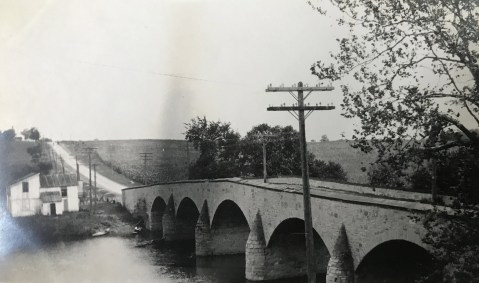
Wilson Bridge Hagerstown, Maryland. Photo by Lewis Reed, 1914
Wilson Bridge (NOW): The bridge was beautifully restored in 1984 by LeRoy E. Myers. The bridge is one of numerous still standing stone bridges in central and western Maryland.
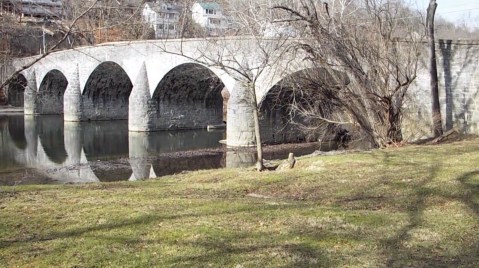
Restored Wilson Bridge today
Then & Now: Saylorsburg Lake House & Hotel of Horror
With Halloween just around the corner, I thought it would be fun to feature a photograph that Lewis Reed took of the Saylorsburg Lake House Hotel, now the site of Hotel of Horror. The aging Lake House Hotel in Saylorsburg, Pennsylvania, once a vibrant Poconos retreat, was a popular hotel for the region’s tourists who were looking for fun on nearby Saylors Lake. During the hotel’s heyday, its staff was booking rooms a year in advance. Today, the former hotel’s fame is generated from its annual Halloween haunted-house attraction.
Lake House Hotel (THEN): The legend of the Lake House Hotel spans more than two-hundred years. According to local folklore, during World War II, many of the employees at the Lake House were called to assist in the Pennsylvania National Guard, leaving the local asylum with one lone security guard to watch over the entire building. The inmates escaped, made their way to the hotel and took it over. The insane patients performed experiments on the guests. What was once a renowned resort for the rich and famous, became a torture chamber.

Saylorsburg Lake House Hotel. Photo taken by Lewis Reed, 1915.
Hotel of Horror (NOW): This 2018 season will celebrate the 26th year that the Hotel of Horror has been fascinating and horrifying legions of fans from the far reaches of the United States and even internationally. To all the readers of this blog: Have a spooky, enjoyable and very safe Halloween!

Welcome to The Hotel of Horror, The Pocono Mountains Premier Haunted House Attraction

Then & Now: Quebec Bridge (8th Wonder of the World)
The Quebec Bridge (Pont de Québec in French) has been an icon of Canada for more than a century. But did you know that the Quebec Bridge collapsed twice (1907 & 1916) before it was completed, making it the world’s worst bridge construction disaster. Taken approximately 90 years apart, these photos show the Quebec Bridge (8th Wonder of the World) then and now.
Quebec Bridge (THEN): Hailed at the time as the 8th wonder of the world, the Quebec Bridge was the first bridge over the St. Lawrence River in Montreal. Accommodating three highway lanes, one rail line and a pedestrian walkway, it represented a colossal challenge to construct at the time. First conceived in 1887, the bridge collapsed failed twice, at the cost of 88 lives, and took over 30 years to complete. A riveted steel truss structure, the Quebec Bridge is the longest cantilever bridge span in the world. The Quebec Bridge was declared a historic monument in 1987 by the Canadian and American Society of Civil Engineers, and on January 24, 1996, the bridge was declared a National Historic Site of Canada.

Quebec Bridge (8th Wonder of the World). Photo by Lewis Reed, ca. 1930
Quebec Bridge (NOW): The same view almost 90 years later. The bridge remains in use to this day, carrying both road and rail traffic. rails in the middle and roadways on both sides.

Night view of the Quebec Bridge, today. Photo credit: Martin St-Amant – Wikipedia
Source: Wikipedia
Lewis Reed Photo: Lady & Toddler on a 1913 Excelsior
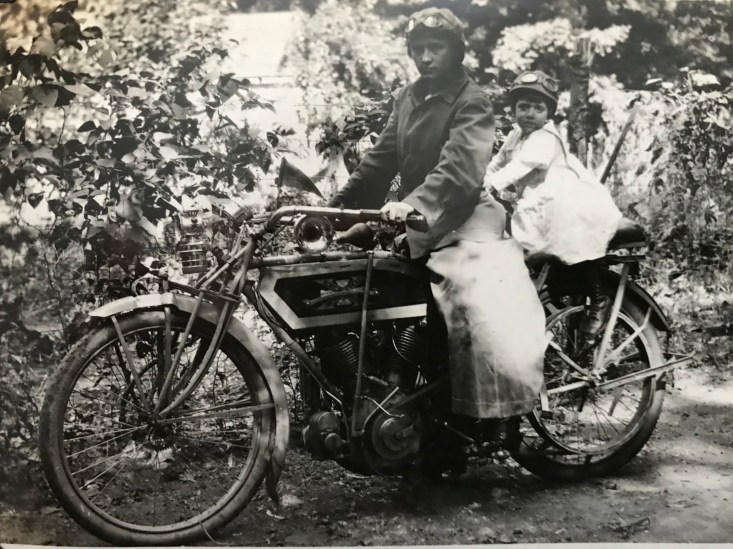
Unknown lady and toddler posing on an Excelsior motorcycle. Photo by Lewis Reed
Back in the early part of the last century when the motorcycle was still new and a novelty, it was often used for Kodak moments.
Lewis Reed has a number of photographs showing relatives and other unknown people on their motorcycles in the period of the early 1900s through the early 1920s. This photo taken by Lewis Reed is an unknown lady and a toddler (mother/daughter?) posing on an Excelsior motorcycle. The motorcycle was easy to identify because of the logo, but I could not pinpoint the exact year it was made. I tend to think it might be a circa 1913-1914 model Excelsior.
This is, without question, one of the best posed photos on a motorcycle that I have come across in my grandfather’s albums. The toddler’s sporty little cap and goggles make the image. Just imagine how excited she must have been to sit on that big machine.
The motorcycle seems to be well equipped with extras including: a headlamp, a handlebar-mounted Klaxon horn, and a well padded passenger seat on the back.
Ice Harvesting in Darnestown, ca.1910

Men harvesting ice with pitchforks and hand saws in Darnestown, Maryland. Photo taken by Lewis Reed, ca.1910. Note the blocks of ice stacked up along the shoreline.
Got ice? Usually, we don’t think about ice very often, unless there’s none in the freezer. At the start of the 19th century, keeping food fresh and edible was one of the biggest challenges of everyday life. So what was life like before we had that incredible device that we now take for granted, the refrigerator?
Before the first successful ice-making machines were built, ice for refrigeration was obtained through a process called “ice harvesting.” Men would venture out onto frozen ponds with saws, tongs, and pitchforks and methodically cut and dragged blocks of ice.
Refrigeration is a modern convenience that we just can’t live without and certainly one that I take for granted … or took for granted until I wrote this!
Books

Related Resources


Copyright Notice

Reed Brothers Dodge History (1915-2012) by Jeanne Gartner is licensed under a Creative Commons Attribution-NonCommercial 3.0 Unported License.
 Reed Brothers Dodge History 1915 – 2012
Recent Comments