
On the Self-Publishing Horizon … Again!
I’m excited to announce that for the last year or so, I’ve been thinking about self-publishing a photo book specific to my grandfather, Lewis Reed, with a working title of, “Lewis Reed Photograph Collection (1898-1960).” Looking back at photography from the past is a fascinating experience for me, and with a newfound interest in history, the curious part of me wants to learn more: When was the picture taken? Where? What is it? Who’s in it? The majority of his photos are more than 100 years old and many are lacking labels and/or dates, which requires quite a bit of research and a little photo detective work on my part.
With that in mind, I will be frequently spotlighting photographs that may not directly pertain to the history of Reed Brothers Dodge, but will have a lot to do with it’s founder, Lewis Reed. I will not try to be an historian; I will post photos and supply a few paragraphs of context. Many photographic images in this collection have never before been seen publicly in print and will be available in this book for the first time.
I’ve been sitting on this post for a few weeks, timid to hit the ‘publish’ button. Likely because the size of the project is overwhelming and committing to it is a bit daunting (although exciting at the same time). It doesn’t help that as the ambition of my projects and goals increase, so too, can self-doubt. Below is the Draft Table of Contents for the book, which I’m sure will see some revisions as I progress.
Having said that, I will be switching my focus and time to mostly photo identification and researching/writing for the book.
Time to get to work!
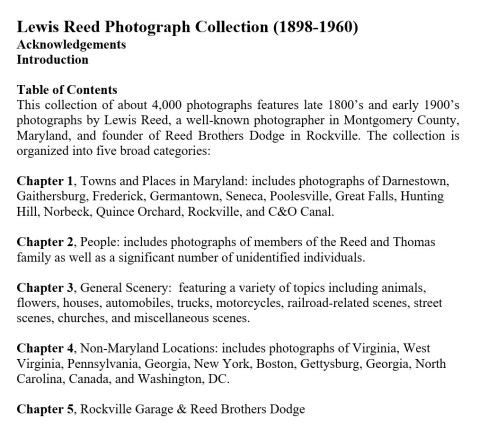
Draft Table of Contents
Rockville B&O Railroad Station, Early 1900s

Rockville B&O Train Station early 1900s. On the left, a horse-drawn carriage has just left the station. Photo by Lewis Reed
Built in 1873, the station was one of several stops along the route between Washington’s Union Station and Point of Rocks where the Metropolitan Branch joined the B&O Main Line of the railroad. Along the route of the railroad were twenty-six stations. In the early days people came to the stations on foot, on horseback, in buggies. Some wives took their commuting husbands to the station in the buggy in the morning and then met the train as it came through in the evening.

Lewis Reed using a tripod and five-by-four box camera to shoot photos of an arriving B&O train.
While the station helped to spur Rockville’s early growth, development pressures would later threaten its existence. In the mid-1970s Metro’s original plans for the Rockville Metro Station and the final phase of construction on the Red Line called for the demolition of the B&O Station which by then was disused and in disrepair. However, Peerless Rockville, then only one year old, brought the station’s plight to the attention of the City and Metro, ultimately negotiating a compromise—the station and its freight house would not be demolished, but instead would be relocated so that a new tenant could be found to occupy the historic buildings, while allowing the Metro construction to continue as planned.
In 1981, the 400-ton station carefully was lifted off of its foundation, moved approximately 30 feet to the south, and reoriented 180 degrees so that the train platform which originally faced the tracks now faced Church Street and the Wire Hardware Store.
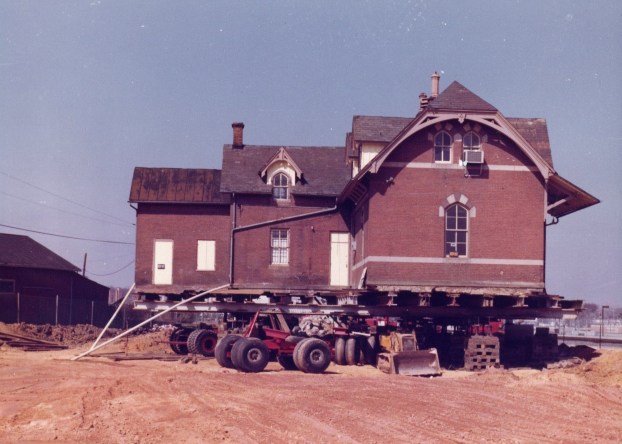
Relocating the 400-ton Passenger Station, 1981. Photograph by John Spano via Peerless Rockville
Reed Photo Collection (1898-1960)
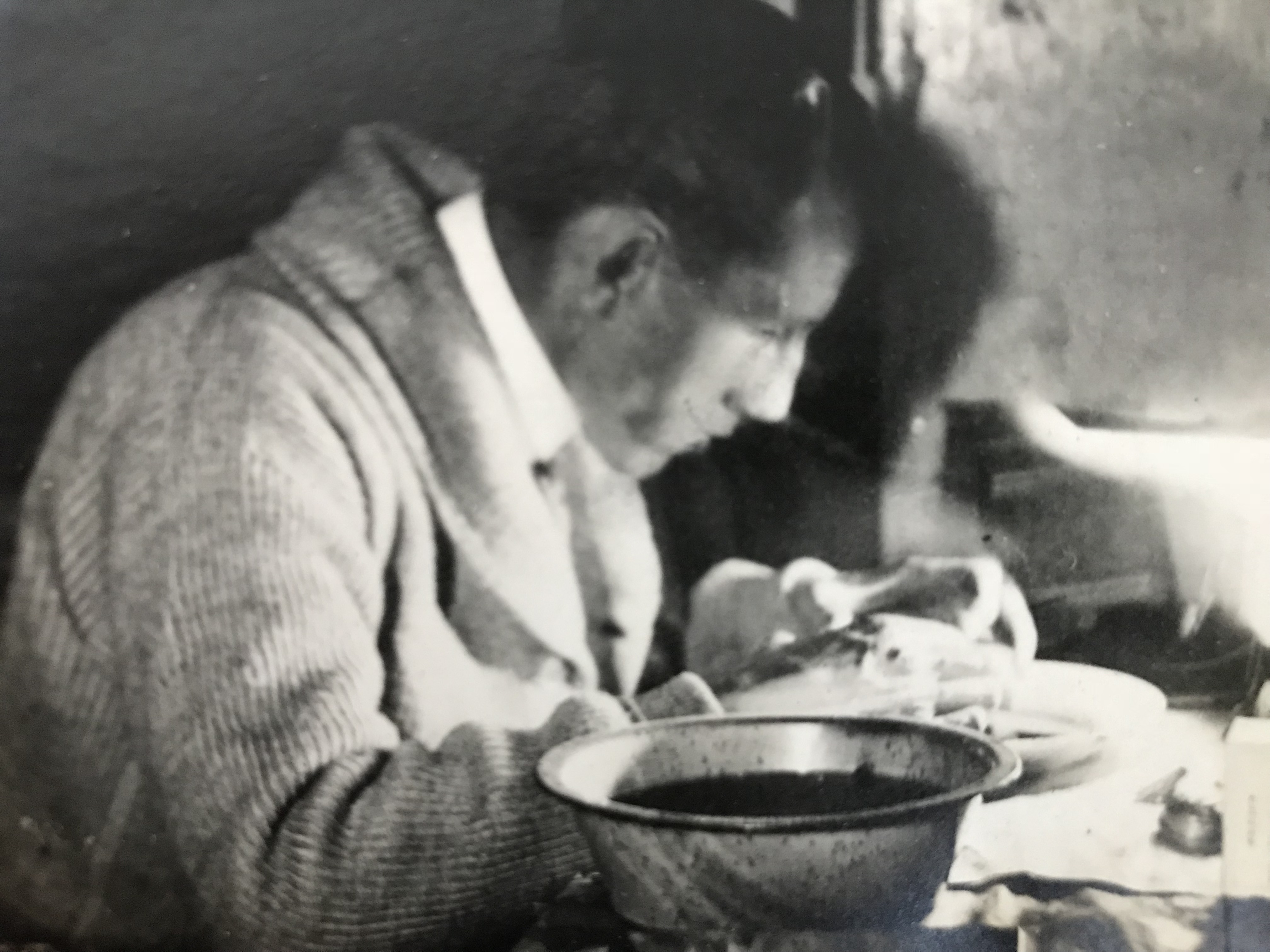
Lewis Reed, founder of Reed Brothers Dodge, was one of the most prolific photographers in Montgomery County at the turn of the 20th century. A self-taught photographer, he used a darkroom set up in his kitchen, sometimes working late at night to develop the negatives.
About This Collection:
Since launching this blog, it has been possible to explore an extraordinary archive: Lewis Reed’s photographs, taken across Maryland, Washington, DC, Virginia, and well beyond. The Reed Photo Collection (1898-1960) highlights the images that have been researched and identified, gathered into 200+ blog posts that offer vivid glimpses of everyday life more than a century ago.
Featured subjects range from the Black Rock Grist Mill, Rockville Water Tower, and C&O Canal to the 1939-1940 New York World’s Fair, Rockville Fair dirt track races, trolley cars, the Wright Brothers’ airplane, and the Quebec Bridge, once called the “Eighth Wonder of the World.” Particularly striking are the images documenting the devastation of the 1936 Gainesville, Georgia tornado, one of the deadliest in U.S. history; many photographs in this collection have never before appeared in print.
Lewis Reed’s legacy
Lewis Reed’s photographs have become an essential visual resource for local historians and have appeared in respected publications as well as historical television programs, including American Pickers, Science Channel’s Impossible Engineering, Maryland Public Television, and the PBS American Experience series.
In Montgomery County, his work is woven into the landscape: if you see a historical marker by the roadside, there is a good chance it features one of his images. His photographs appear on markers such as the Andrew Small Academy and Origins of Darnestown markers, the Baltimore & Ohio Railroad Station marker in Gaithersburg, From Trolley to Trail in Bethesda, the African American Heritage Walking Tour in Rockville, and the 19th Century Crossroads marker in Darnestown, as well as on an interpretive sign along the trail at Watters Smith Memorial State Park in West Virginia.
Early photographic “special effects”
One especially intriguing part of the collection is Lewis Reed’s experimentation with manipulated images. Long before digital cameras and Photoshop, he was creating imaginative “special effects,” a full century ahead of his time. His techniques included hand-tinting, double exposures, applied handwork, and playful compositions that introduce ghostly figures into the frame, all achieved with the limited tools of the early twentieth century. These experiments reveal not only technical skill but also a remarkable sense of creativity and humor.
Preserving historical authenticity
All images presented here are scanned from prints made from Lewis Reed’s original glass plate negatives, which were commonly used from the 1880s through the late 1920s. No digital retouching or alteration has been applied, preserving the photographs as faithfully as possible and maintaining their historical character.
Click here to step back in time and explore the lives, places, and stories captured through Lewis Reed’s camera.
And They’re Off! Rockville Fair Dirt Track Racing
This special post is a collection of early dirt track race photos that were taken by Lewis Reed at the Rockville Fair in the early 20th century. Held by the Montgomery County Agricultural Society (1846-1932) in Rockville, Maryland, the fair was known simply as the “Rockville Fair.” The fair’s oval dirt track was used for bicycles, harness races and later, cars.
Since the mid-19th century, an annual county fair was held in Montgomery County for four days in the month of August. Families came in wagons and carriages to the Rockville Fairgrounds and stayed for the duration. Like many fairgrounds, the Rockville Fairgrounds included an oval track. Fairground race tracks, typically one-mile or half-mile dirt racing ovals with wide, sweeping curves and grandstands for spectators, were easily adapted for bicycles, harness racing, and the sport of car racing.
Early action shots like these were difficult to take and are fairly rare, however, all of the photographs below were taken by Lewis Reed at the Rockville Fairgrounds in the early 1910-1920s. The fairgrounds were just outside Rockville, about where Richard Montgomery High School is today. The Fair lasted four days, from August 21st to the 24th, and drew visitors from local counties, Washington, and Baltimore. As always, click the photos to get a better look.
Bicycle Racing
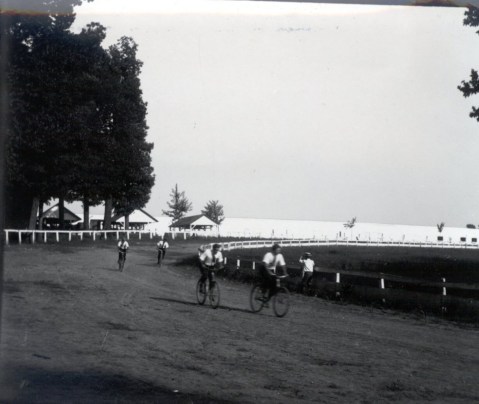
This circa 1915 photo of an early bicycle race at the Rockville Fairgrounds gives a sense of just how popular the sport was at the time. Photo by Lewis Reed
Harness Racing
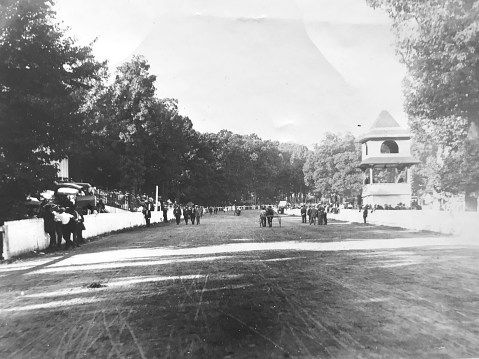
Harness race at the Rockville Fair, circa 1910. All those throngs of people had plenty to see. Photo by Lewis Reed
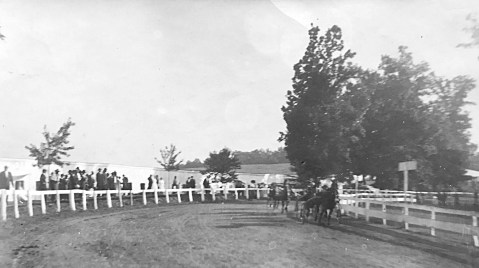
Harness racers rounding the bend on the racetrack, Rockville Fairground circa 1910. Photo by Lewis Reed
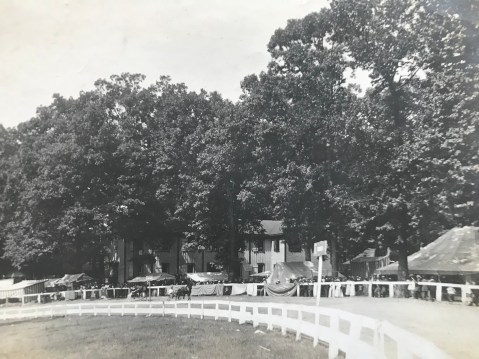
Bend on the harness racetrack, Rockville Fairground circa 1910. Photo by Lewis Reed
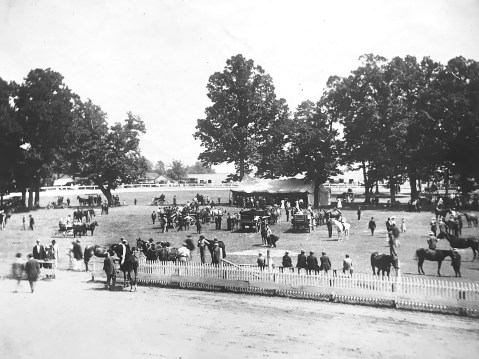
Crowds at the racetrack, Rockville Fair. Photo by Lewis Reed

Harness race at the Rockville Fair, circa 1910. Same vantage point as auto race photo below. Photo by Lewis Reed
Harness racing was one of the main attractions, but after the introduction of the automobile in the early 20th century, auto races took over…
Auto Racing
The photos below depict auto races at the Rockville fairgrounds. The photo of a harness race above was taken from approximately the same vantage point as the auto race below, which you don’t see very often in pictures from that era.
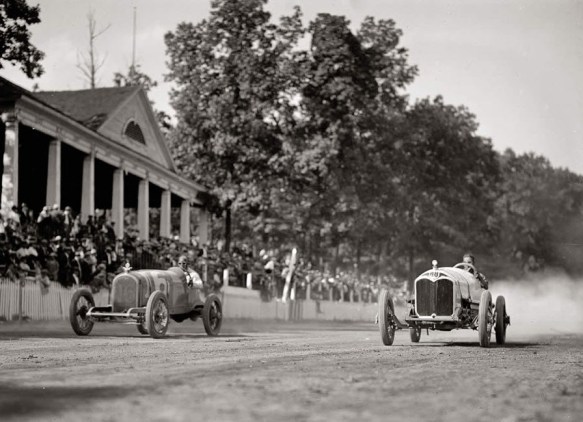
Rockville drew huge crowds for auto races. Rockville Fair, August 1923. Photo by Lewis Reed

Dusty Action – 1923 photo of the exciting auto races at Rockville Fair. Five racers are just coming around the bend on this dirt track with their tires spinning up dust in their wake. Photo by Lewis Reed

This race car is a total mystery…what on earth is it? It appears to be a two-man race car. Photo by Lewis Reed

More dirt track action. Photo by Lewis Reed
Below is a 1923 Washington Post ad for an auto race at the Rockville Fair.

Rockville Fair Race Ad
A football field was designed within the oval of the old Fair racetrack in 1946.
Reed Brothers Dodge Yearbook Ads from 1930-1957
Reed Brothers Dodge was always a supporter of local high school yearbooks. The advertising section at the back of high school yearbooks offer a glimpse at the businesses of the town the school is in, which can be particularly useful for small towns that may not have had their own city directories. The listings usually always included addresses for the businesses, and sometimes, photographs of the businesses themselves.
A blurb preceding the 1939 Richard Montgomery High School Rocket Yearbook reads:
The folks who have advertised here have a civic interest in Rockville. They manifest this interest by their advertisement in the ROCKET. Now you ROCKET owners do your part by patronizing those who have an interest in bettering your school and your community!
The following yearbook ads from Richard Montgomery, Gaithersburg, Sherwood, Damascus and Poolesville High Schools are dated from 1930-1957. Not many high school yearbooks are online, but most of the ads below were found on E-Yearbook.com, an online resource for the largest online collection of old and new high school yearbooks on the Internet.
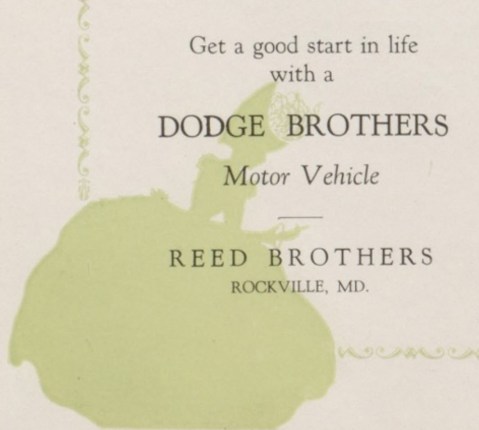
1930 Richard Montgomery High School “Rocket” Yearbook Ad (Rockville, MD)

1934 Richard Montgomery High School “Rocket” Yearbook Ad (Rockville, MD)
In 1930, Reed Brothers added the Plymouth line. The first Plymouth was built in 1928 and Plymouths were sold at Reed Brothers until 1969, when the brand was given to the Chrysler dealers. The fact that the phone number was just ’67′ in the ad above gives a real feeling of how different life was back then.

1935 Richard Montgomery High School “Rocket” Yearbook Ad (Rockville, MD)

1951 Sherwood High School “Leaves” Yearbook Ad (Sandy Spring, MD)
Reed Brothers Dodge had a separately maintained glass shop in their service department which was equipped to replace all types of automobile glass. In addition to auto replacements, glass was also cut for mirrors and table tops. Another innovation of the repair department was a separate paint and body shop which was located next to the glass shop. Reed Brothers was capable of repairing all makes and models from all manufacturers with factory-prepared paints available to match any color of car.

1951 Poolesville High School “Sugar Loaf Echo” Yearbook Ad (Poolesville, MD)
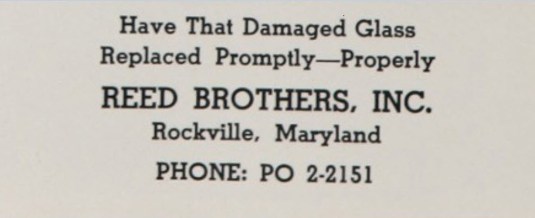
1954 Damascus High School “Scimitar” Yearbook Ad (Damascus, MD)
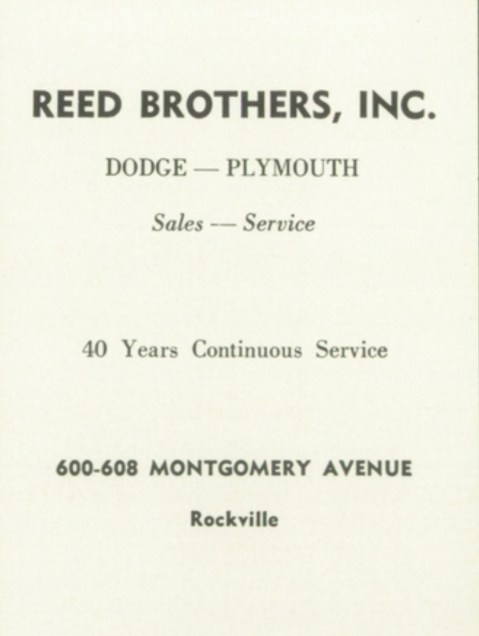
1955 Richard Montgomery High School “Rocket” Yearbook Ad (Rockville, MD)
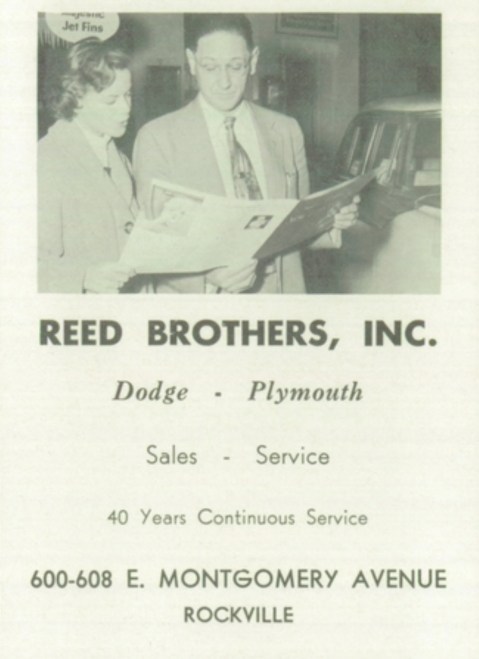
1956 Richard Montgomery High School “Rocket” Yearbook Ad (Rockville, MD)
The photo in the ad above was taken inside the new car showroom at Reed Brothers original location at the triangle at Veirs Mill Road and Rockville Pike. The people posing in the ad are two Reed Brothers employees: W. Lester Wilson, and Evelyn Beane Norris. Lester Wilson started at Reed Brothers in 1918 as a Mechanic (and first Service Manager) and stayed for 28 years. Evelyn B. Norris joined the business in 1945 and worked as Administrative Secretary.

1956 Gaithersburg High School “Sail On” Yearbook Ad (Gaithersburg, MD)

1957 Gaithersburg High School “Sail On” Yearbook (Gaithersburg, MD)
Source: E-Yearbook.com, the largest online collection of digitized high school yearbooks
Books

Related Resources


Copyright Notice

Reed Brothers Dodge History (1915-2012) by Jeanne Gartner is licensed under a Creative Commons Attribution-NonCommercial 3.0 Unported License.
 Reed Brothers Dodge History 1915 – 2012
Recent Comments