
Cherry Blossoms on the Tidal Basin, Then & Now
Time passes, but the cherry blossoms always come back. Seeing the cherry blossoms is a time-honored D.C. tradition that dates back to 1912, when Tokyo gifted 3,020 cherry trees to the U.S. in an act of friendship. While many of the original trees have been replaced, the Tidal Basin’s beauty has persisted for more than a century. Each spring, more than 1.5 million visitors descend upon Washington, D.C. each year to admire the 3,000-plus trees.
Here’s a great “then and now” comparison shot of the Cherry Blossoms on the Tidal Basin in Washington, D.C. from the 1930s and 2023.
Cherry Blossoms on the Tidal Basin (THEN): From Lewis Reed’s collection of photographs. Cherry blossoms in bloom along the Tidal Basin, circa 1930s with my mother, Mary Jane (Reed) Gartner.

Cherry blossoms in bloom along the Tidal Basin with my mother, Mary Jane (Reed) Gartner. Photo by Lewis Reed, ca. 1930s
Cherry Blossoms on the Tidal Basin (NOW): The “now” photo is a google image of approximately the same location… some 90 years later. On average, DC’s cherry blossoms bloom around the last week of March into the first week of April. But it varies from year to year based on weather conditions, so it can also be a little before or after that period. The best viewing of the cherry blossom trees typically lasts four to seven days after peak bloom begins, but the blossoms can last for up to two weeks under ideal conditions.
The 2023 National Cherry Blossom Festival is scheduled to run from March 18 to April 16. (It was originally scheduled to begin March 20, but they moved that forward by a couple of days in light of the early bloom.)

Cherry blossoms in bloom along the Tidal Basin today.
Fun facts about Washington, DC’s cherry blossoms
- The first donation of 2,000 trees, received in 1910, was burned on orders from President William Howard Taft. Insects and disease had infested the gift, but after hearing about the plight of the first batch, the Japanese mayor sent another 3,020 trees to DC two years later.
- The first two trees were planted on the north bank of Tidal Basin in March 1912, and they still stand today. You can see them at the end of 17th Street Southwest, marked by a large plaque.
- It’s against the law to pick the cherry blossoms in Washington DC. While there aren’t any subtle wire fences or stern security guards like in a museum, any attempts to create your own corsage may very well land you a fine.
- The majority of the cherry blossom trees around the Tidal Basin are of the Yoshino variety. But another species, the Kwanzan, usually blooms two weeks after the Yoshino trees, giving visitors a second chance to catch the blossoms.
- The average lifespan of a cherry blossom tree is only 20 to 30 years, but nearly 100 of the original trees from 1912 still thrive at the Tidal Basin due to the maintenance of the National Park Service.
- No, they’re not all from 1912, reinforcements are sometimes necessary. New trees have been regularly planted, including in 1965, the late 1980s, 1999 and from 2002 to 2006, according to the NPS.
Reed Family “Real Photo Postcard” (1910)
Nostalgic photo postcards, known as “real photo postcards”, were popular in the early 1900’s. Kodak even produced a special camera (the model #3A) and added a special postcard developing and printing service that made it easy for anyone to make their own photo postcard. Mailing a postcard was only a penny and the photo postcard itself cost between one and two cents. The postcard below is a “real photo postcard” mailed by Geneva (Eva) Reed, sister of Lewis Reed in 1910. It was mailed to her half-brother Rufus who lived in Point of Rocks, Maryland.
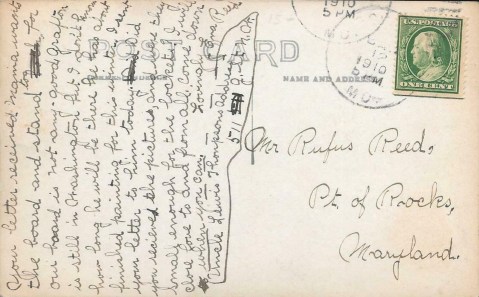
Postcard addressed to Rufus Reed from Eva Reed. Note the cost of the postage stamp is just one penny.
The photo of Woodlawn Hotel on the front of the postcard was taken by Phillip Reed (Lewis Reed’s brother). Lewis Reed’s photograph collection contains several hundred of these photo postcards dating from approximately 1907-1915. Many of these postcards are rare, one of a kind items and historical documents.
A bit of history about the Woodlawn Hotel: Opened as a luxury hotel in 1889 for Washingtonians seeking to escape the city’s summer heat, the Woodlawn Hotel thrived until the economy and more accessible transportation made Rockville a suburb of Washington rather than a summer vacation destination. The hotel was then purchased by Dr. Ernest L. Bullard who reopened the building, naming it Chestnut Lodge, as “a sanitarium for the care of nervous and mental diseases”. The Bullard family operated nationally famous Chestnut Lodge for 75 years. The building was conveyed to a developer in 2003 with the intention to convert it to condominiums as part of the development of the Chestnut Lodge property. The facade and the chestnut grove from which it got its name were to be preserved. The downturn in the real estate market derailed those plans.
Sadly, a fire on June 7, 2009 destroyed the landmark building that began as Woodlawn Hotel and came to symbolize the psychiatric institution of Chestnut Lodge. Today, the Chestnut Lodge campus is preserved for the community and consists of Little Lodge, Frieda’s Cottage, a Stable and an Ice House, and eight acres of forested lawn.
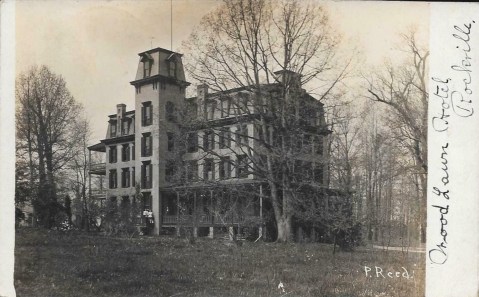
Postcard image was taken by Phillip Reed (Lewis Reed’s brother) of Woodlawn Hotel before it became Chestnut Lodge in 1910.
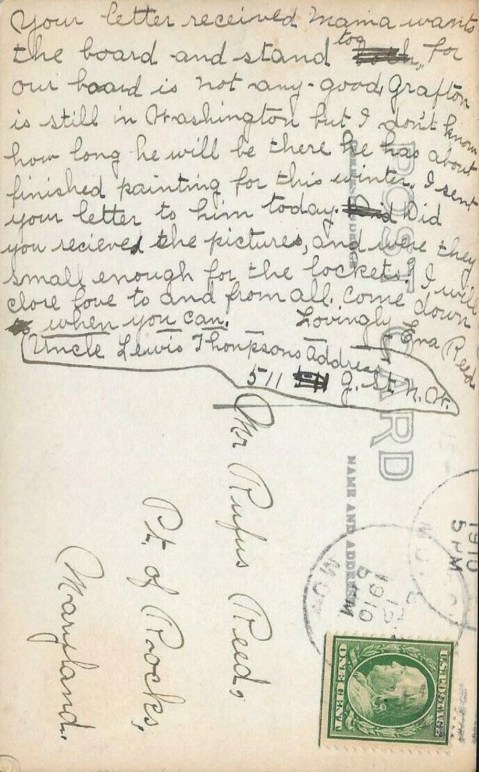
The postcard below reads:
Your letter received. Mama wants the board and stand too, for our board is not any good. Grafton is still in Washington but I don’t know how long he will be there he has about finished painting for this winter. I sent your letter to him today. Did you receive the pictures, and were they small enough for the lockets? I will close love to and from all. Come down when you can. Lovingly, Eva Reed
Uncle Lewis Thompson’s address is 511 G St N.W.
Strong as an Ox

A pair of oxen pull a wagon in Point of Rocks, Maryland. Edgar Reed, second from left is seated on the railing. Photo by Lewis Reed, 1911.
Everyone’s heard the phrase, “as strong as an ox”. Oxen often were used as draft animals in the early 20th century. They supplied much of the power associated with agriculture and were used to haul heavy loads, plow fields, and for carrying goods. A two-animal team usually can manage several tons. Interesting fact: Oxen cost half as much as horses, required half the feed and could be eaten in an emergency.
Point of Rocks has been an important crossroads of travel since American Indians established routes through the region. Though quieter these days, the area was bustling with commerce between the 1830s and 1930s. During the Civil War, troops from both sides frequently crossed the River and the Towpath. Troops traded volleys across the water, skirmished in and near Point of Rocks, and Confederates attacked canal boats and trains, destroyed locks, and raided supply stores. Both the C&O Canal Company and the B&O Railroad reached Point of Rocks by 1832.
Christmas Trees and Snow Villages from a Hundred Years Ago
With only a few days left until Christmas, I thought it might be fun to take a look at some photos from Lewis Reed’s collection that show us what Christmas trees used to look like 100 years ago. In those days, there was not wide-spread agreement on exactly what a tree should look like, which made for a lot of creativity. Not surprisingly, they were very different than the perfectly shaped tress we have on display today.
The trees were big back then and always fresh. They went right to the ceiling and were very wide. Early Christmas trees were generally fastened onto a flat board surrounded with fence-rails, snow villages and carpeted with cotton blankets of snow. The tree in the photo below has an abundance of tinsel, which grew in popularity to the point that, by the 1920s, it was common to nearly cover the tree in the decorative material.
So, what is tinsel (aka icicles) exactly? Originally made from strands of silver alloy, tinsel was in fact first used to decorate sculptures. It was only later that it became a Christmas tree decoration, employed to enhance the flickering of the candle flames. In the 1950s, tinsel became so popular that it was often used as a substitute for Christmas lights.
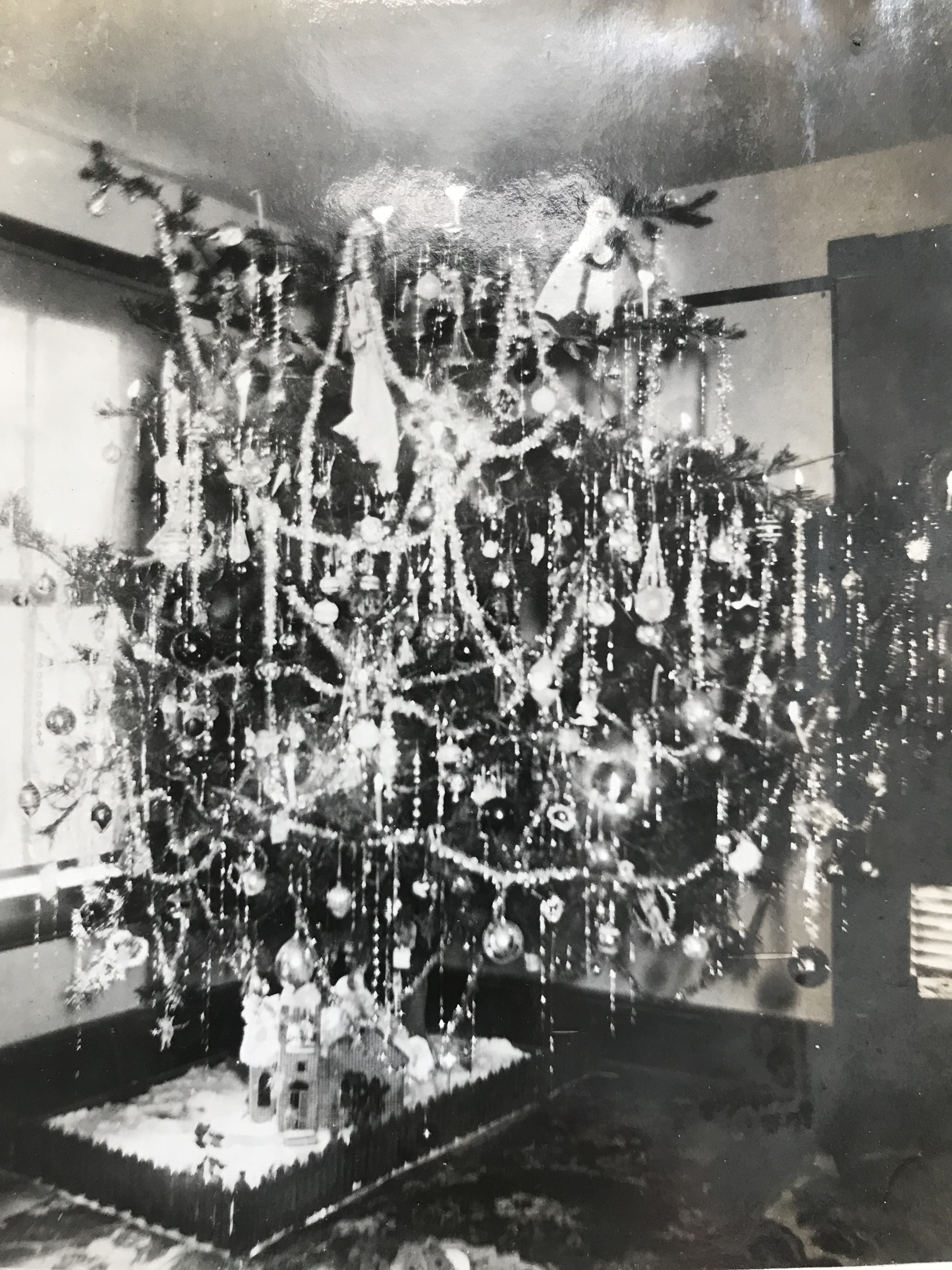
A small snow scene with what appears to be a miniature church is arranged at the foot of the Christmas tree. A popcorn garland adorns the tree. Photo by Lewis Reed
So, where did Washingtonians get their trees?
From The Evening Star, Washington, DC 23 December 1923:
Conduit Road on the long stretch between Glen Echo and Great Falls for many years has been a favorite hunting ground where hundreds and hundreds of families have customarily obtained scrub pine trees for Christmas week. Usually there is plenty of holly and some mistletoe to be found in the rugged and rolling hill lands which are the gateway to Great Falls.

No room for a star on the top of this tree! And just look at those big Santa and Angel dolls. Other fun little details are notable, including a miniature church with picket fence is arranged at the base of the tree. Photo by Lewis Reed
There’s a fine art to decorating Christmas trees that’s been developing since over 100 years ago. People consider lights, garland, ornaments, skirt, and more. But one thing that’s hard to resist sometimes is just filling every available space with decorations. Clearly, that was the case years ago too. What I like about these trees is that they are so randomly shaped and even misshapen. Folks back then didn’t trim them down to a more aesthetically pleasing symmetry like we do today.
The tradition of building miniature Christmas village landscapes, including houses, animals, and other hand-crafted wooden figures, began with the Pennsylvania Dutch in the late 1800s. Mass-produced cardboard houses, sold in dimestores, became popular in the mid-20th century. Today, these villages in good condition can be highly collectible.
Below are photos of Lewis Reed’s snow village set up under the Christmas tree decorated with vintage ornaments, tinsel, and lights. I don’t remember the odd-shaped Christmas trees, but I do remember having a lot of fun helping my grandfather set up the miniature landscapes with the varied figures, little houses, and trees at Christmastime each year. It seemed like a holiday village right out of a storybook.
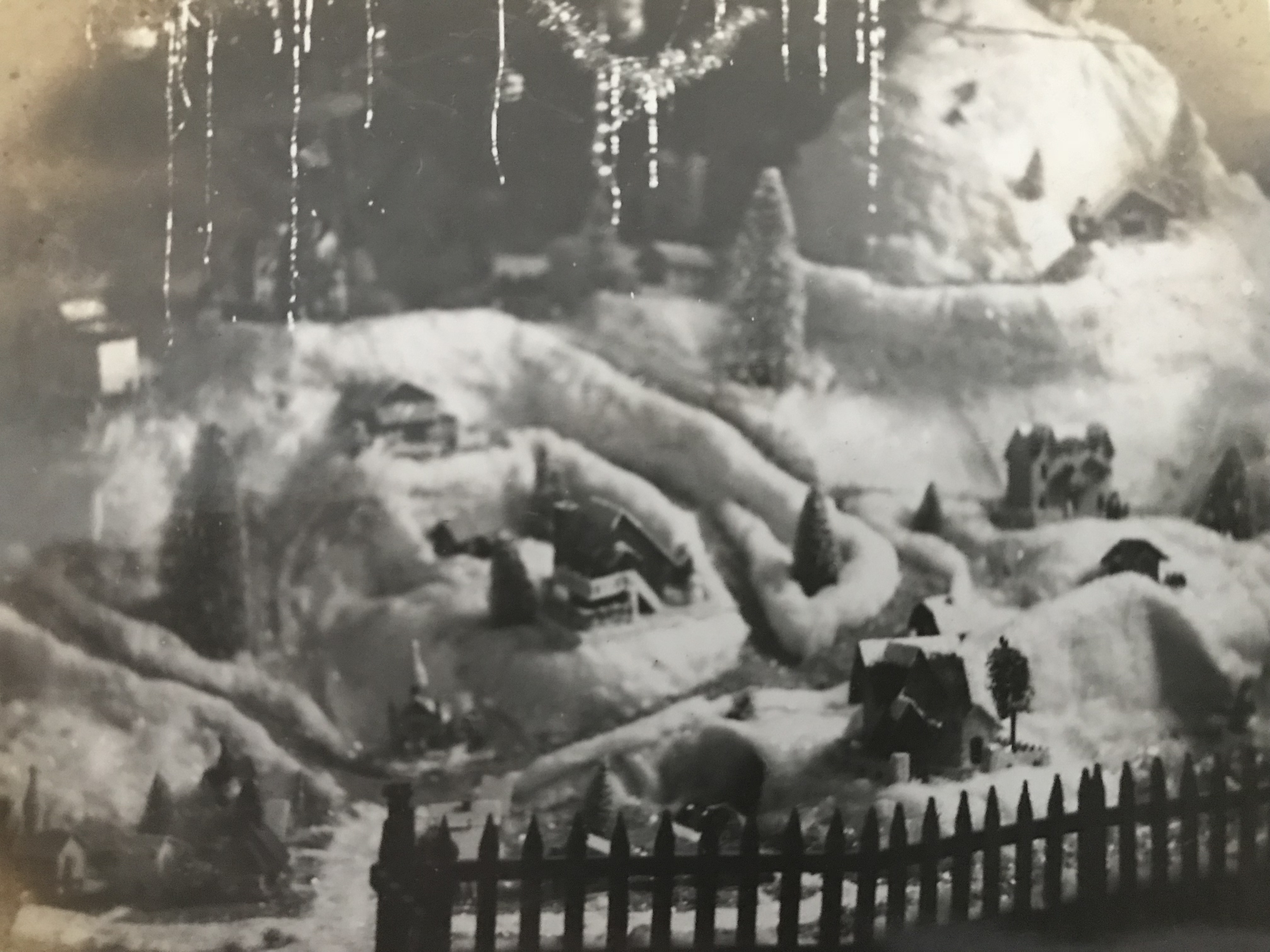
A rustic picket fence is used to set off the village display. Dangling strands of tinsel hang below the tree. Photo by Lewis Reed
The snow villages were set up in Lewis Reed’s basement on top of a big table beneath a small Christmas tree. He made the snow scenes entirely by hand using wire-covered cardboard and balled up paper to make hills and pathways. The little houses and figurines would fit into the landscape with cotton ‘snow’ all around; and lights would be wired underneath.

Little houses, churches, fences, trees, and pathways were added to the scene. Some of the houses have charming light effects in the windows. The roofs of the houses were decorated with fake snow. Photo by Lewis Reed
These Christmas villages were precursors of the Holiday Villages that were made popular by Department 56 that you see today.
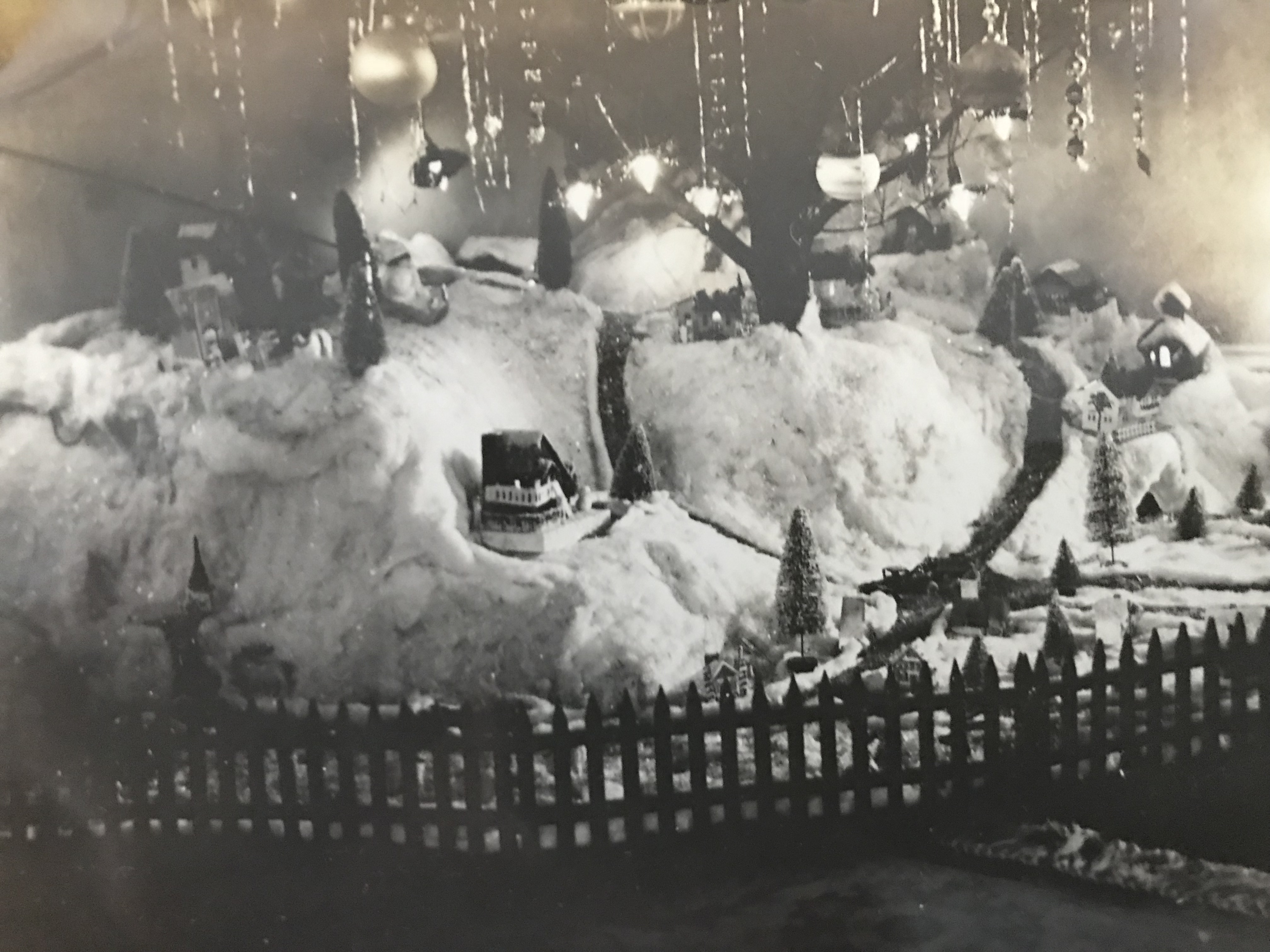
Old-fashioned lights can be seen on the tree, along with lit windows in the houses. The miniature houses usually had holes in the back or the bottom through which tiny lights were placed to provide illumination. Photo by Lewis Reed
Wishing all of you who have stopped in to visit a very Merry Christmas and Happy New Year! Stay safe and enjoy the holiday season with friends and family!

Then & Now: Smithsonian Institution Castle
This post is a continuation of a series of “Then & Now” images from Lewis Reed’s Photo Collection alongside photographs of how they appear today. Lewis Reed worked hard to preserve a visual history of Montgomery County, Maryland and surrounding area long before automobiles were even around. As early as 1905, he toured on his motorcycle across the states of Maryland, Virginia, and Washington, D.C. and took photographs of many historic locations. Taken approximately 115 years apart, you can see how the Smithsonian Institution Castle looks both the same and completely different from over a century ago.
Smithsonian Institution Castle (THEN): The Smithsonian Institution Building, popularly known as the “Castle,” was designed by architect James Renwick, Jr. Initially, the Castle was intended to be built in white marble and then in yellow sandstone. The architect and the building committee finally agreed on using Seneca red sandstone from the Seneca Quarry, located in Montgomery County, Maryland. When it was completed in 1855, it sat on an isolated piece of land cut off from downtown Washington, DC, by a canal. In the ensuing decades, the Castle became the anchor for the National Mall, as additional museums and government buildings were constructed around it.

Smithsonian Institution Castle. Photo taken by Lewis Reed in 1907
Smithsonian Institution Castle (NOW): The same view over a century later. The Smithsonian Institution Castle, located near the National Mall in Washington, D.C. behind the National Museum of African Art and the Sackler Gallery, houses the Smithsonian Institution’s administrative offices and information center.
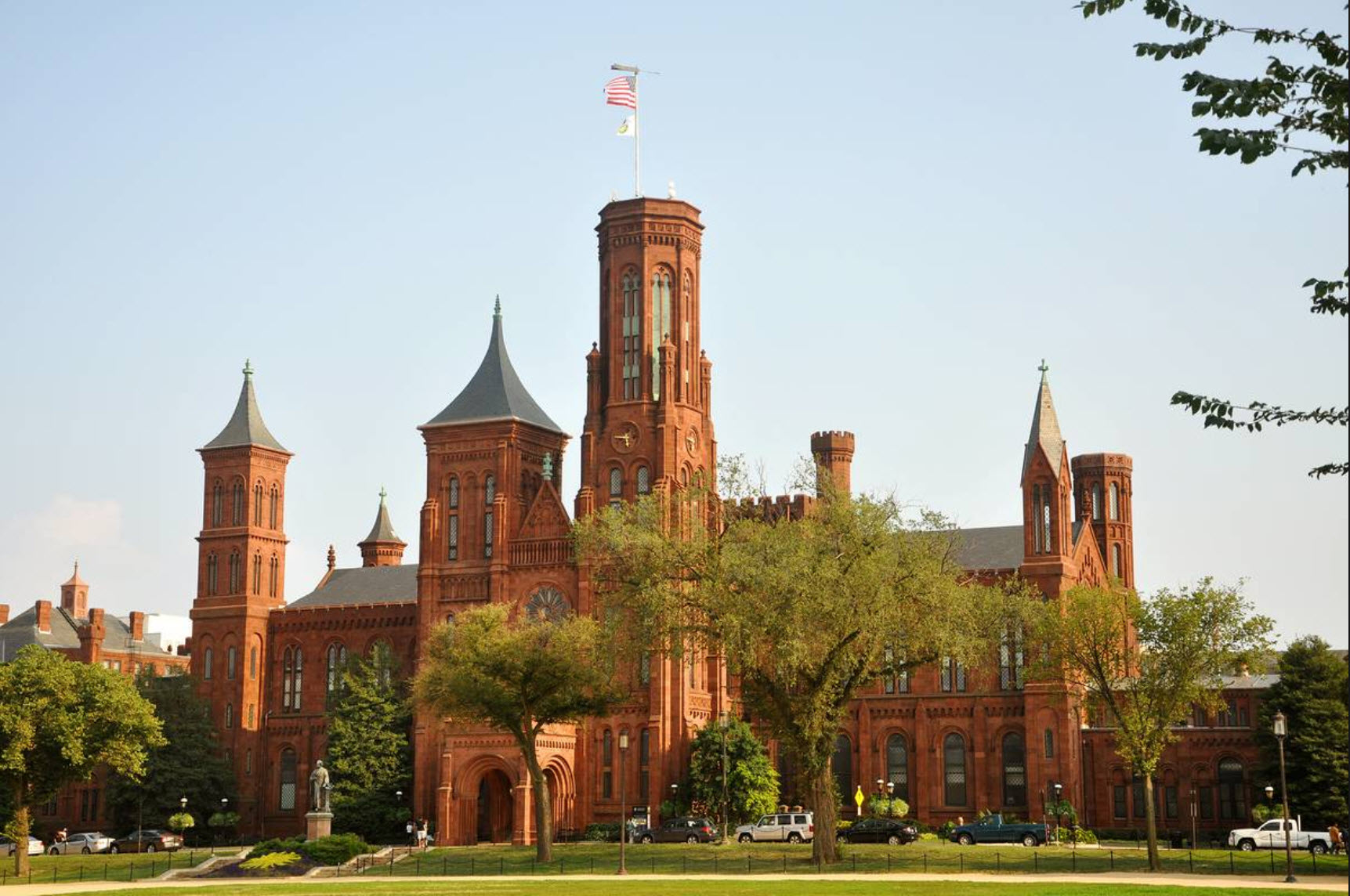
Smithsonian Institution Castle today
Books

Related Resources


Copyright Notice

Reed Brothers Dodge History (1915-2012) by Jeanne Gartner is licensed under a Creative Commons Attribution-NonCommercial 3.0 Unported License.
 Reed Brothers Dodge History 1915 – 2012
Recent Comments