
Blog Milestone: 300K Page Views
 If you ever glance at the blog view counter on the right side of this page, you might have noticed that this blog just went over 300,000 views. After reaching this milestone, I would like to take the time to thank all of you who have visited, followed, shared, or commented on this blog. Visitors to this site on a daily basis continue to grow — we have been visited by folks from all fifty of the United States and 187 different countries world wide.
I have often been asked why I started this blog. For me, it’s because history is important. Sometimes we don’t know we need to do something until it’s handed to us, and once we have it, we suddenly see and feel its value. As we were getting ready to close the doors to the dealership for the last time in May 2012, I was standing in the empty showroom thinking about all the history, past achievements, and hardships the dealership had endured over the years. Few businesses can say they’ve lasted almost a century. It seemed a particularly pertinent time to start thinking about such a project, as it was a time of reminiscence, but also looking forward.
When I stop to think about what Reed Brothers Dodge has experienced over the last century, from World War I, The Great Depression, World War II, to three economic recessions, two energy crises, and numerous Chrysler setbacks — including the first Chrysler Bailout, the sale of Chrysler to Daimler, and the sale to the private equity firm Cerberus — I could not be more proud to be a part of such an amazing story. It takes resilience to weather 97 years in business. The dealership adapted itself multiple times in order to survive. Through the good times and the bad, Reed Brothers Dodge held on and prospered.
I felt it was important to take the time to ensure our history remained accessible for those who read it years from now, or decades from now, when I or other family members who know the story firsthand are no longer around to tell it. How Reed Brothers Dodge came into being, and how the company overcame the inevitable changes and challenges throughout almost a century of being in business — all adds up to a great story.
Creating this blog and sharing our business history has been the most rewarding endeavor of my life. I appreciate all of you for your continued support and making Reed Brothers Dodge History one of the places you visit during the course of your day.
Thanks for reading!
Jeanne Gartner, Blog Author
Sept 17, 1908: Testing the Wright Military Flyer at Fort Myer, VA
On this day in September 17,1908, the first military airplane in the world, built by the Wright brothers for the Army Signal Corps, made its first flight at Fort Myer, Virginia. Less than a thousand people witnessed the first flight at Fort Myer, because the general public was still doubtful that powered flight had been achieved. But Lewis Reed was there… and to commemorate that milestone, I have posted six original snippets of history that Lewis Reed captured through the lens of his camera that day.

Soldiers at Fort Myer prepare to pull the Wright Military Flyer out of its temporary hangar. Photo by Lewis Reed
Five years after the first successful flight at Kitty Hawk, Orville Wright and Thomas E. Selfridge test flew the Wright Flyer in a demonstration for the U.S. Army at Fort Myer, VA. The Army was considering contracting Wright’s aircraft to use as a military airplane, but, in order to win the contract, he needed to demonstrate the plane’s ability to carry a passenger. Twenty-six-year-old Lt Thomas E. Selfridge volunteered to be a passenger that day. Orville Wright succeeded in keeping the Wright Flyer aloft for one minute and 11 seconds. After more than four minutes in the air, the airplane crashed to the ground from a height of about seventy-five feet after a propeller blade broke and the machine went out of control. Orville Wright was severely cut and bruised and his passenger, Lt. Thomas Selfridge, became the first powered-aviation fatality.

Curtiss Model D with tricycle undercarriage. Photo by Lewis Reed

Curtiss Model D. Photo by Lewis Reed

Wright Model B with skids. Photo by Lewis Reed

Another early aircraft from 1909 was the Bleriot XI monoplane. In the background a Rex Smith Aeroplane Company School is advertised on the side of a building. Photo by Lewis Reed
A Rex Smith Aeroplane Company School can be seen on the side of the building in the background. The founder, Rex Smith, was an inventor and a patent attorney. The Rex Smith Biplane was used in the successful April 3, 1911 U.S. Army Signal Corps experiments in wireless communications. The Signal Corps did not buy any Smith Biplanes, they did however use them from time to time to train pilots to fly the Curtiss aircraft at the same field.

Airplane Hangars at Fort Myers, Virginia. Photo by Lewis Reed
The Wrights would prove their machine’s qualifications at Fort Myer. They met or exceeded all of the Army’s specifications, including flying at 40 miles per hour, carrying a combined passenger weight of 350 pounds, maneuvering in any direction in the air, landing without damage, and flying for at least an hour non-stop, which was a world record at the time.
Today, the Wright brothers are legends, with their accomplishments being the storybook example of American perseverance and ingenuity.
September 7, 1979: The First Chrysler “Bailout”
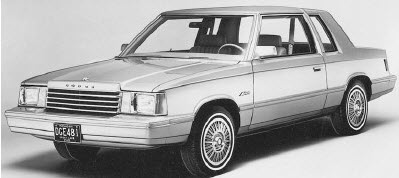
In the early 1980s, the Dodges Aries-K inspired Chrysler’s renaissance.
In 1979, Chrysler was at death’s door and petitioned the U.S. government for $1.5 billion in loan guarantees to avoid bankruptcy. It made gas guzzlers that nobody wanted to buy and it asked for $1.5 billion to keep itself going until a fleet of more fuel efficient cars could take up the sales slack. It was by far the largest government bailout in US history. On September 7, 1979 Chrysler formally petitioned the U.S. government for the loans, and on December 20, 1979 Congress ratified the appropriation in the “Chrysler Corporation Loan Guarantee Act,” which President Carter subsequently signed into law. It was an extremely painful period for Chrysler, but Reed Brothers survived the first Chrysler Bailout and resurgence under Lee Iacocca.
The K-Cars, the Dodge Aries and Plymouth Reliant, were, quite literally, the cars that saved Chrysler from the abyss in 1980. Their only real savior other than the K-Car was a government bailout. Though it came after bankruptcy, they managed to save the company with it by 1983. The K-Cars were inexpensive, reliable, and they delivered economical transportation for 6 people at an affordable price. Sales from the K-Car enabled Chrysler to emerge from bankruptcy and evolve into a profitable company.
Reeling from the combined effects of a recession and a global energy crisis, in 1979 Chrysler was forced to seek government loan guarantees. Meanwhile, Chrysler chairman Lee Iacocca took the company’s case straight to the people in a series of television commercials. Looking straight into the camera, the legendary auto executive pitched the company’s new K-cars with total conviction, asserting, “America, if you can find a better car, buy it.”
Buyers took up Iacocca’s challenge, flocking to the showrooms to buy their own K-cars. Nearly one million Aries were sold (and another million Reliants), allowing Chrysler to pay off its loans a full seven years early. Soon Iacocca was back on the airwaves with another ad campaign. This one was called “The Pride Is Back.”
These models were soon followed by what would become a home run product for Chrysler: minivans.
Nearly thirty years later, in 2008, Chrysler would receive billions in a new bailout from the U.S. government in the aftermath of the financial crisis that decimated automotive sales over the following few years. In 2009, Chrysler files for Chapter 11 bankruptcy protection. On May 14, 2009, Chrysler left 789 dealerships, about a quarter of its dealer base, out in the cold by rejecting their franchise agreements and giving them about a month to sell all their remaining new cars, factory parts and service equipment.
Whether a franchise is run by a second- or third-generation dealer, or is older than even Chrysler itself, didn’t seem to matter when Chrysler decided to cut dealerships ranks during their 2009 bankruptcy process. After almost 95 years selling Dodges, Reed Brothers was one of the 15 dealerships in Maryland and 789 dealerships nationwide notified by Chrysler that their franchise agreement would not be renewed. Chrysler was acquired in total by Fiat in 2014.
Source: Chrysler
Reed Brothers Third Annual Goodyear Dealers Zeppelin Race Winner July-August 1931
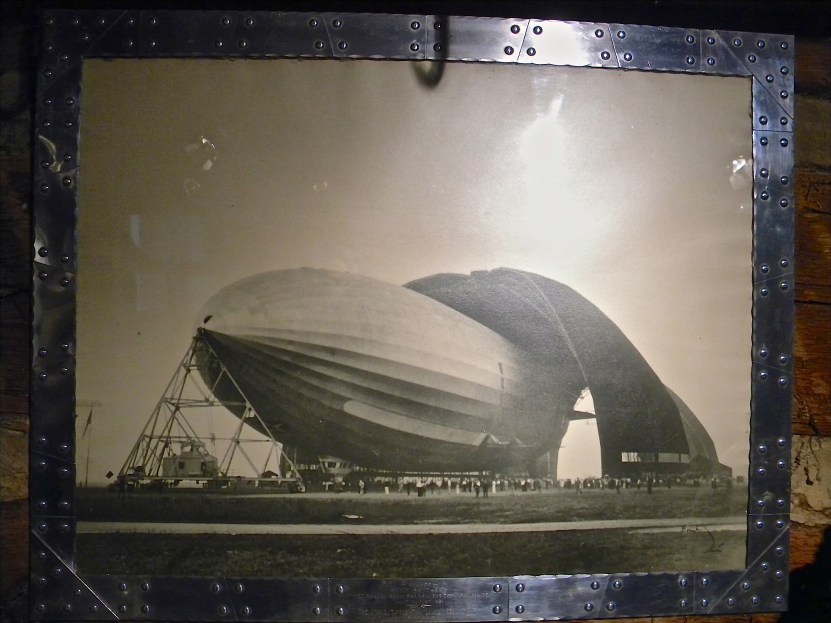
MARGARET BOURKE-WHITE, 1931 REED BROTHERS THIRD ANNUAL GOODYEAR DEALERS ZEPPELIN RACE WINNER
In 1931, the Goodyear Zeppelin Company produced a series of framed prints as rewards for Goodyear dealers as prizes for high sales. Sales was based on a two months quota, and participated in by thousands of dealers all over the country. The print shows the maiden launch of the USS Akron leaving the Goodyear Zeppelin air dock at Akron, Ohio. The engraved plaque at the bottom center of the frame reads, “Winner – Reed Brothers, Third Annual Goodyear Dealers Zeppelin Race. July – August 1931.” This frame is made of duralumin used in the girder construction of the United States Airship “AKRON” built by the Goodyear Zeppelin Corporation”. The print is signed in the lower right-hand corner by the famed 20th century photographer, Margaret Bourke-White. During the early years of the Depression, Goodyear was one of Bourke-White’s most important clients. She made this image of the airship Akron when it was removed from its hangar for the first time.
Built in 1929, the almost unbelievably huge Goodyear air dock in Akron, Ohio, was created as a space where blimps, airships, and dirigibles could be constructed. Evidently building such a massive space created problems, such as indoor rain, and putting the whole thing on rollers so that it could expand and contract with the seasons.
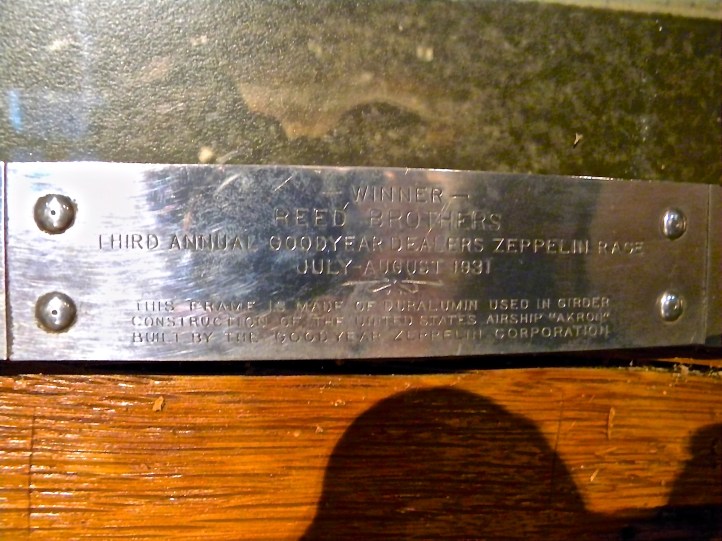
Inscription Plaque
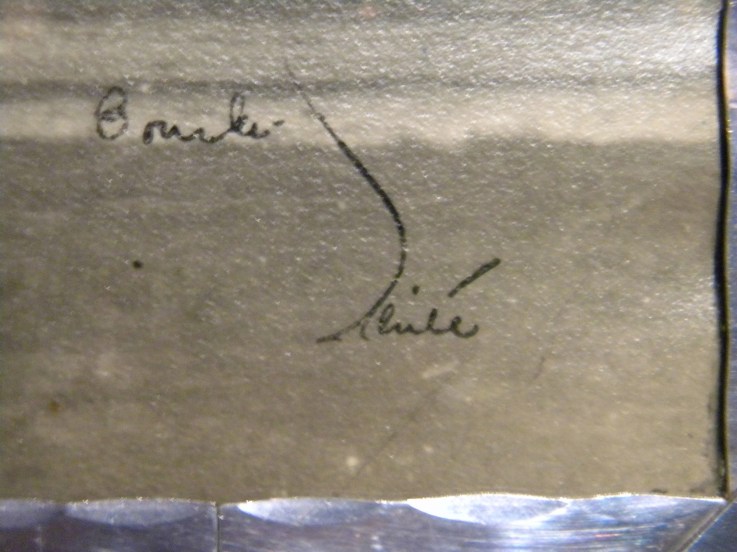
Photo is signed in the lower right corner by famed 20th century photographer, Margaret Bourke White
The USS Akron, first of a class of two 6,500,000 cubic foot rigid airships, was built at Akron, Ohio. Commissioned in late October 1931, she spent virtually all of her short career on technical and operational development tasks, exploring the potential of the rigid airship as an Naval weapons system. During the remainder of 1931 and the early part of 1932, the Akron made flights around the eastern United States and over the western Atlantic, including one trial of her capabilities as a scouting unit of the fleet. While beginning a trip to the New England area, Akron encountered a violent storm over the New Jersey coast and, shortly after midnight on 4 April 1933, crashed tail-first into the sea. Only three of the seventy-six men on board survived this tragic accident. During the search for other possible survivors, the Navy non-rigid airship J-3 also crashed, killing two more men.
Note: Margaret Bourke-White (1904 1971) is best known as the first foreign correspondent to be permitted to take photographs of Soviet industry, the first female war correspondent, and the first female correspondent permitted to work in war zones.
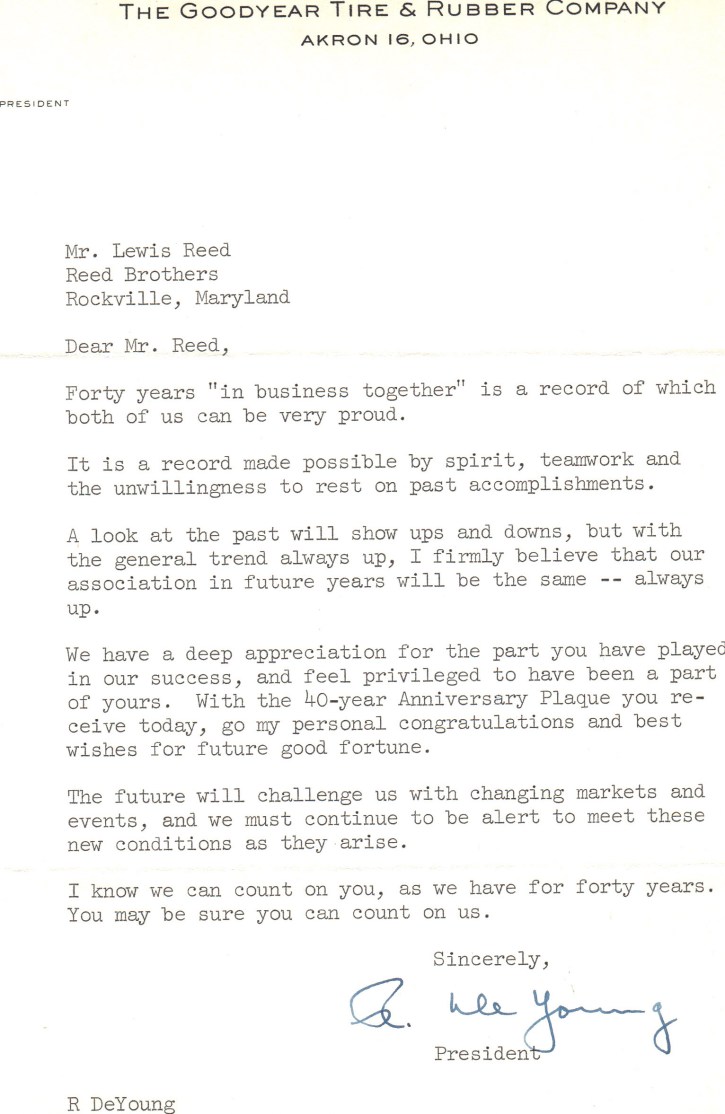
40th Anniversary with Goodyear
Lewis Reed was recognized by Goodyear Tire & Rubber Co. for reaching his 40th year as a Goodyear dealer. Reed Brothers Dodge began selling Goodyear tires in the 1920s. Below is a letter from Russell DeYoung thanking Lewis Reed for his 40 years “in business together”.
8 Years, 353 Posts & Thank You

This month marks the 8-year anniversary of this blog. It’s been an honor to share the history of Reed Brothers Dodge – whether you’ve read our blog, followed us on Twitter, or “liked” us on Facebook. I would like to thank all of you who have visited, followed, shared, or commented on this blog, and many others, for their kind words and the visibility they have provided.
Here’s a look back at the last year.
What People are Saying Around Facebook:
“Amazing blog and postings. I spent sometime reviewing your site and found it both fascinating and interesting.”
“I am thankful for the documentation this site provides with images of a beloved hometown that can no longer be seen.”
“Love seeing the old photos.”
“This is soooo cool! Someone needs to do one of those historical books of Historical Rockville photos!”
“These photos are absolutely awesome!!!”
“Thank you so much for sharing! This is classic Montgomery County info.”
“That was so cool reading all your memory posts. Best thing I’ve read on FB in a while.”
“I love seeing these old photos and reading the history. Thank you.”
“Thank you for this history. There is so much we take for granted.”
Past Lectures:
2019 Montgomery County History Conference: Each year in January, the Montgomery County Historical Society holds a day-long conference on various aspects of local history. Upwards of 200 people attend this annual event, which has been held since 2007. Last year, I was very honored for the invitation to speak about the history of Reed Brothers Dodge at the Montgomery County History Conference on Saturday, January 26, 2019.
The PowerPoint presentation followed the dealerships 97-year historic timeline and included more than 100 photographs, 70 of them rare, historic images taken by the dealership’s founder, Lewis Reed. The conference was held at the Bioscience Education Center on Montgomery College’s Germantown Campus.
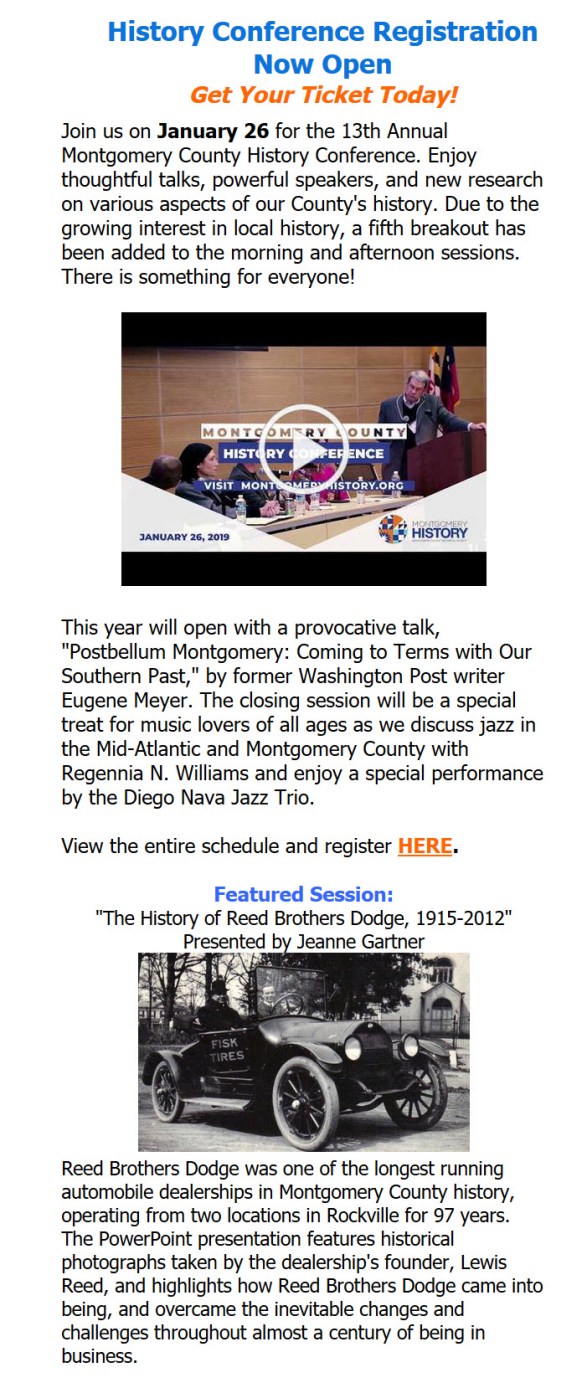
Montgomery History Speakers Bureau: Officially added to the Montgomery History Speakers Bureau. My topic is, of course, “The History of Reed Brothers Dodge“. It is my great honor to join the talented league of speakers at Montgomery History, and I sincerely look forward to sharing our 97-year family business history throughout Montgomery County and the greater Washington D.C. metro area.
 Kensington Park Retirement Community Talk: Gave a presentation as part of Montgomery History’s Speakers Bureau at Kensington Park Retirement Community. Approximately 25 residents from the Woodlands Assisted Living facility attended. Such a joy me sharing, their listening, and appreciating the time spent together. Thanks to Activities Director Kate Moeller who invited me to speak.

Kensington Park Woodlands Assisted Living
Montgomery History Tuesday Talks: Montgomery History’s lunchtime lecture series, Tuesday Talks, takes place at noon on the first Tuesday of every month at the historic Beall-Dawson House in Rockville, Maryland. Enjoy presentations covering various aspects of history including local history of Montgomery County and the history of those who once lived here.

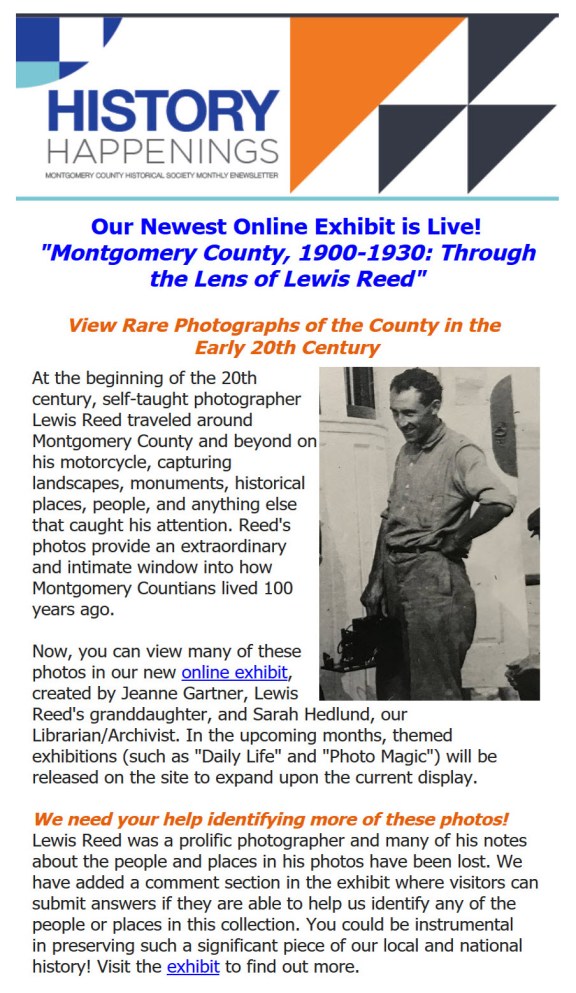
Online Exhibit: Montgomery County, 1900-1930: Through the Lens of Lewis Reed Lewis Reed’s photographs are now a part of a series of online exhibitions featured on the Montgomery History website. Montgomery County, 1900-1930: Through the Lens of Lewis Reed displays extraordinary photographs in several themed categories (Transportation, Photo-magic, Recreation, & Daily Life) taken at the beginning of the 20th century by county native and founder of Reed Brothers Dodge, Lewis Reed. It is an absolutely unique window into how the people of Montgomery County lived over a century ago. Working in collaboration with Montgomery History Librarian and Archivist, Sarah Hedlund, I am proud to play a part in the preservation of local history, making these photographs available to all.
 I appreciate all of you for your continued support and making Reed Brothers Dodge History one of the places you visit during the course of your day.

Books

Related Resources


Copyright Notice

Reed Brothers Dodge History (1915-2012) by Jeanne Gartner is licensed under a Creative Commons Attribution-NonCommercial 3.0 Unported License.
 Reed Brothers Dodge History 1915 – 2012
Recent Comments