
Trees of Christmas Past
With only a few days left until Christmas, I thought it might be fun to take a look at a couple of photos from Lewis Reed’s collection that show us what Christmas trees used to look like a century ago. In those days, there was not wide-spread agreement on exactly what a tree should look like, which made for a lot of creativity. Not surprisingly, they were very different than the perfectly shaped tress we have on display today.
The trees were big back then and always fresh. They went right to the ceiling and were very wide. Early Christmas trees were generally fastened onto a flat board surrounded with fence-rails, snow villages and carpeted with cotton blankets of snow. The tree in the photo below has an abundance of tinsel, which grew in popularity to the point that, by the 1920s, it was common to nearly cover the tree in the decorative material.
And what is tinsel exactly? Tinsel was designed to mimic the way ice looks, and the earliest tinsel was made from strips of real silver. It was only later that it became a Christmas tree decoration, employed to enhance the flickering of the candle flames. In the 1950s, tinsel became so popular that it was often used as a substitute for Christmas lights.
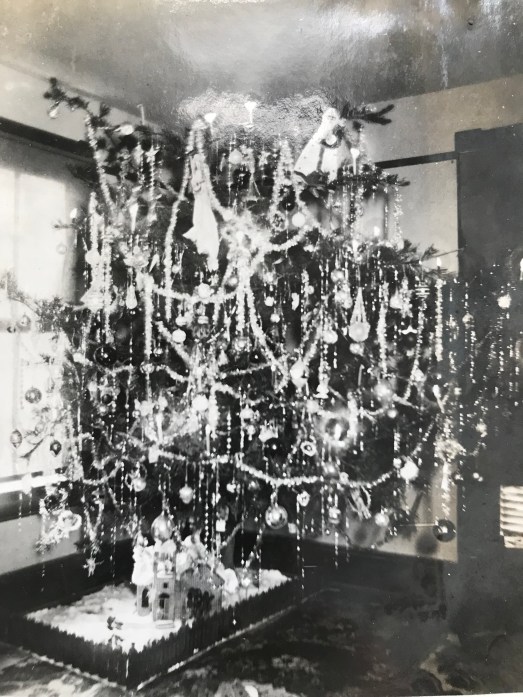
A small snow scene with what appears to be a miniature church is arranged at the foot of the Christmas tree. A popcorn garland adorns the tree. Photo by Lewis Reed
So, where did Washingtonians get their trees?
From The Evening Star, Washington, DC 23 December 1923:
Conduit Road on the long stretch between Glen Echo and Great Falls for many years has been a favorite hunting ground where hundreds and hundreds of families have customarily obtained scrub pine trees for Christmas week. Usually there is plenty of holly and some mistletoe to be found in the rugged and rolling hill lands which are the gateway to Great Falls.

No room for a star on the top of this tree! And just look at those big Santa and Angel dolls. Other fun little details are notable, including a miniature church with picket fence is arranged at the base of the tree. Photo by Lewis Reed
There’s a fine art to decorating Christmas trees that’s been developing since over 100 years ago. People consider lights, garland, ornaments, skirt, and more. But one thing that’s hard to resist sometimes is just filling every available space with decorations. Clearly, that was the case years ago too. What I like about these trees is that they are so randomly shaped and even misshapen. Folks back then didn’t trim them down to a more aesthetically pleasing symmetry like we do today.
Today, most Christmas trees are artificial and very symmetrical. Stringing lights and hanging ornaments are used mostly for decorating, since large bare spots are a thing of the past. Branches are clicked into place and limbs can be fanned out to accommodate whatever decorations you choose to add. Tinsel is long gone and lights now come in all types of sizes and styles. Tree lights can be set to not blink or programmed to flash in whatever sequence fits your mood. You have the control of exactly how you want your tree to look. It is a far cry from the trees of Christmas past.
Happy Birthday to Our Founder, Lewis Reed

This ca. 1965 photo of Lewis Reed was taken in the new car showroom at Reed Brothers Dodge original location at the triangle at Veirs Mill Road and Rockville Pike.
Lewis Reed was born in Darnestown, Maryland on November 25, 1887 and was the founder of Reed Brothers Dodge. When Lewis Reed opened his car dealership in October 1915, he never knew he was starting a family tradition that would be carried out for 97 years and three generations. He founded what would become the oldest Dodge dealership under the same family ownership in the state of Maryland, and one of the oldest in the entire United States.
Lewis Reed was just 27 years old when he started selling cars built by brothers Horace and John Dodge in Detroit. Few people jumped onto the Dodge Brothers bandwagon earlier than Lewis Reed, and not many have lasted longer. Reed Brothers was franchised as a Dodge dealership and service facility less than one year after the first Dodge automobile rolled off the assembly line. Lewis Reed was the first to sell Dodge cars in Montgomery County, Maryland and his company was the first Gulf gas dealer in the Washington, D.C. area. During the early years, Reed Brothers represented several franchise nameplates along with Dodge, including Oldsmobile, Hudson and Essex. The Hudson and Oldsmobile were sold at Reed Brothers from roughly 1917 through 1923.
Lewis Reed was a member of the Gaithersburg Grace Methodist Church where he served as a member and Chairman of the Board of Stewards, a Lay Leader, and President of the Men’s Bible Class. He was one of nine original incorporators of the Gaithersburg-Washington Grove Volunteer Fire Department when it was created by charter in 1928. He was a Charter Member and Past President of the Gaithersburg-Washington Grove Fire Department and a member of the advisory board of the Rockville Branch of the First National Bank of Maryland. He belonged to the Masonic Lodge of Rockville, the Pentalpha Chapter of the Eastern Star and the Rockville Rotary Club. Before opening his Dodge dealership in 1915, Lewis Reed was one of the earliest and most prolific photographers in Montgomery County. Many of his photographs are now part of Montgomery History’s photo archives. Unsurprisingly, his love of both cars and cameras resulted in his taking numerous pictures of car culture all over the State of Maryland as it developed from infancy to supremacy.
Prior to World War I, Lewis Reed’s love of automobiles led him to becoming a chauffeur. Chauffeurs were not only trained to be proficient with their driving skills, but they also had to keep the luxury automobiles in tip top shape which is where his mechanic training would have come into play. He received his training as an automobile mechanic at the Pierce Arrow factory at Buffalo, New York, the Dodge and Hudson factories at Detroit and the Washington Auto College.
Active in the dealership daily until the day of his death, Lewis Reed passed on January 28, 1967 at the age of 79. Shortly after his death, the Senate of Maryland passed Senate Resolution No. 10, expressing “the deepest regret and sympathy of every member of this body,” describing Reed as “a kindly and loyal person completely devoted to his duties” which he carried out “with fairness and human understanding.” The resolution was sponsored by Senator Thomas M. Anderson, Jr. and Senator Louise Gore.
When you look back and consider what has taken place in the world in the past 100 years or so, you gain a perspective of what Lewis Reed faced. He overcame a lot of obstacles throughout his life. He steered his dealership through World War I, The Great Depression and World War II. When Reed Brothers had no new cars to sell for three and a half years and many dealers went bankrupt, he converted his car showroom into a display room and sold GE Washing Machines, Westinghouse Radios, and other large appliances. Reed Brothers Dodge occupied two locations, the original at the Veirs Mill Road and Rockville Pike intersection and the second at 15955 Frederick Road in front of the Shady Grove Metro.
Lewis Reed set an outstanding example through his success, but more importantly through his sacrifices and commitment to the community he served. Today, Bainbridge Shady Grove Metro Apartments pays tribute to the oldest Dodge dealership in Maryland with commemorative art on the former site of the iconic Reed Brothers dealership.

Bainbridge Shady Grove Metro Apartments now stands on the former site of the Reed Brothers Dodge dealership at 15955 Frederick Road. A sculpture now installed on the property pays tribute to the oldest Dodge dealership in Maryland history. More than 20 feet high, and over 6 feet wide, the public art is inspired by 1939 Dodge headlamps, and the fender of a 1957 Dodge pickup truck.
The First Dodge Automobile Debuted in 1914

Horace Dodge (left, rear) and John Dodge (right, rear) take delivery of the first Dodge automobile on Nov. 14, 1914.
One hundred and seven years ago on this date –November 14, 1914 — the very first Dodge car, “Old Betsy”, rolled off the assembly line. On that day, the Dodge Brothers (Horace and John) were photographed riding in the rear seat of the first car to bear their last name. It cost $785, had a 110-inch wheelbase, and was powered by an L-head 4-cylinder engine that proved so reliable it was continued until 1920 with very little modification. Total production for 1914 was a mere 249 touring cars. The following year Dodge offered a two-passenger roadster which also sold for $785 and the plant went into full production.
According to “The Dodge Brothers: The Men, the Motor Cars, and the Legacy” by Charles K. Hyde, here’s the full story:
The widely accepted history of the initial production of early Dodge Brothers automobiles in November 1914 is at odds with much of the evidence about the earliest Dodge Brothers cars. Automotive historians have thought that the first production car, later named “Old Betsy,” came off the assembly line at the Hamtramck factory on 14 November 1914. Guy Ameel, superintendent of final assembly for Dodge Brothers since the start of automobile production, served as John and Horace’s chauffeur that day. With the brothers in the back seat, Ameel stopped the first Dodge Brothers car in front of John Dodge’s mansion on Boston Boulevard in Detroit and a photographer recorded this important moment.
“Old Betsy” was more likely an experimental prototype car assembled several months before 14 November 1914 and not a production car at all…

The Dodge Brothers
The Dodge Brothers began an aggressive advertising campaign to promote their new automobiles and to attract potential dealers to sell their cars. Few people jumped onto the Dodge Brothers bandwagon earlier than Lewis Reed, and not many have lasted longer.

A Dodge Brothers Coupe ad from by Reed Brothers. Montgomery County Sentinel. December 24, 1920
Lewis Reed received his franchise to sell Dodge Brothers Motor Cars from John and Horace Dodge in October 1915; less than one year after the first Dodge Model-30 rolled off the assembly line for $785. He was just 27 years old. Since then, the business grew and transformed into the oldest Dodge dealership in Maryland history and one of the oldest in the entire United States.
1935 Auto Body Repair & Fender Repair Addition
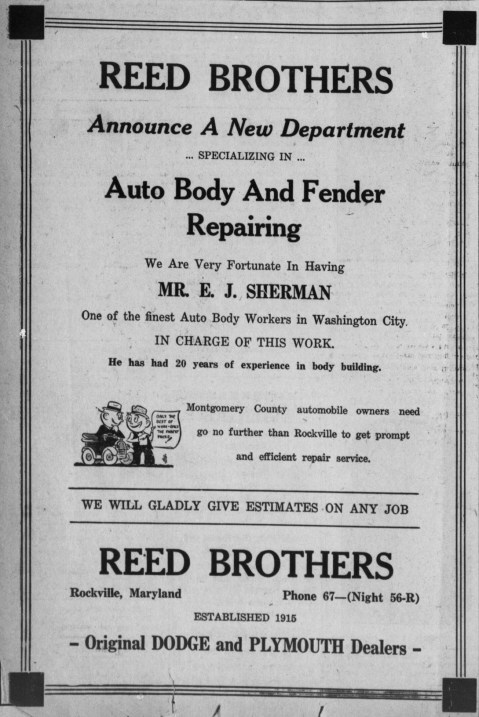
Montgomery County Sentinel, February 14, 1935
Reed Brothers Announce New Department of Auto Body and Fender Work
Reed Brothers Dodge and Plymouth dealers of Rockville, have inaugurated a new department of auto body and fender repairing under the direction of E.J. Sherman, who has had 20 years of experience along this line. Edgar Reed pointed out that this new department will enable automobile owners to get a satisfactory and economical service in Rockville, whereas, they have in the past been obliged to go to Washington or Baltimore for such work.
With a surge in automobile purchases in the early 1900’s, and an equal amount of car accidents and breakdowns, Reed Brothers began offering collision repair services. Just as the automobile has gone through numerous transformations over the last century, so has the auto body repair industry. When Henry Ford first mass produced the car in 1908, it was so new and unlike any other means of transportation at the time, that no one, outside of the few people who designed and built the old Model T Fords, was really qualified to do repairs. In the early years, many people turned to a machinist or even a bicycle repair shop for car repairs. As the popularity of the automobile grew, so did the demand for experienced and reliable mechanics and auto body specialists.
By the 1920s, there were a great deal of cars on the roads, which meant that manufacturers and dealerships needed to provide drivers with the means of repairing their vehicles in the event of a collision or breakdown. To meet this demand, manufacturers started making standardized parts that could easily replace damaged components of a vehicle. Dealerships were now able to employ mechanics that were able to easily repair vehicles using the prefabricated parts provided by the manufacturers. This method of auto repair lasted into the 1930s and 40s, though production and demand for repairs did hit a major decline at this time due to the Great Depression and World War II.
By the 1970s, Reed Brothers Auto Body Shop used state of the art equipment in the repair and refinishing process on all vehicles. Reed Brothers had computer downloaded specifications for practically every vehicle made and they color matched all paints in-house, with world renowned Spies Hecker paint and mixing system. The skilled “plastic surgeons” of the automobile world, their technicians were all formally trained professional with ASE and I-CAR, which kept them up to the minute with the latest technology.
Honoring a Legacy
When Lewis Reed opened his Dodge dealership 106 years ago in October 1915, he never knew he was starting a family tradition that would be carried out for 97 years and three generations. Since then, the business grew and transformed from a small-scale garage and dealership into one of the largest and most recognized commercial enterprises on Rockville Pike.
Lewis and Edgar Reed’s business philosophy was simple:
Treat your customer as your friend and always do what you promise.
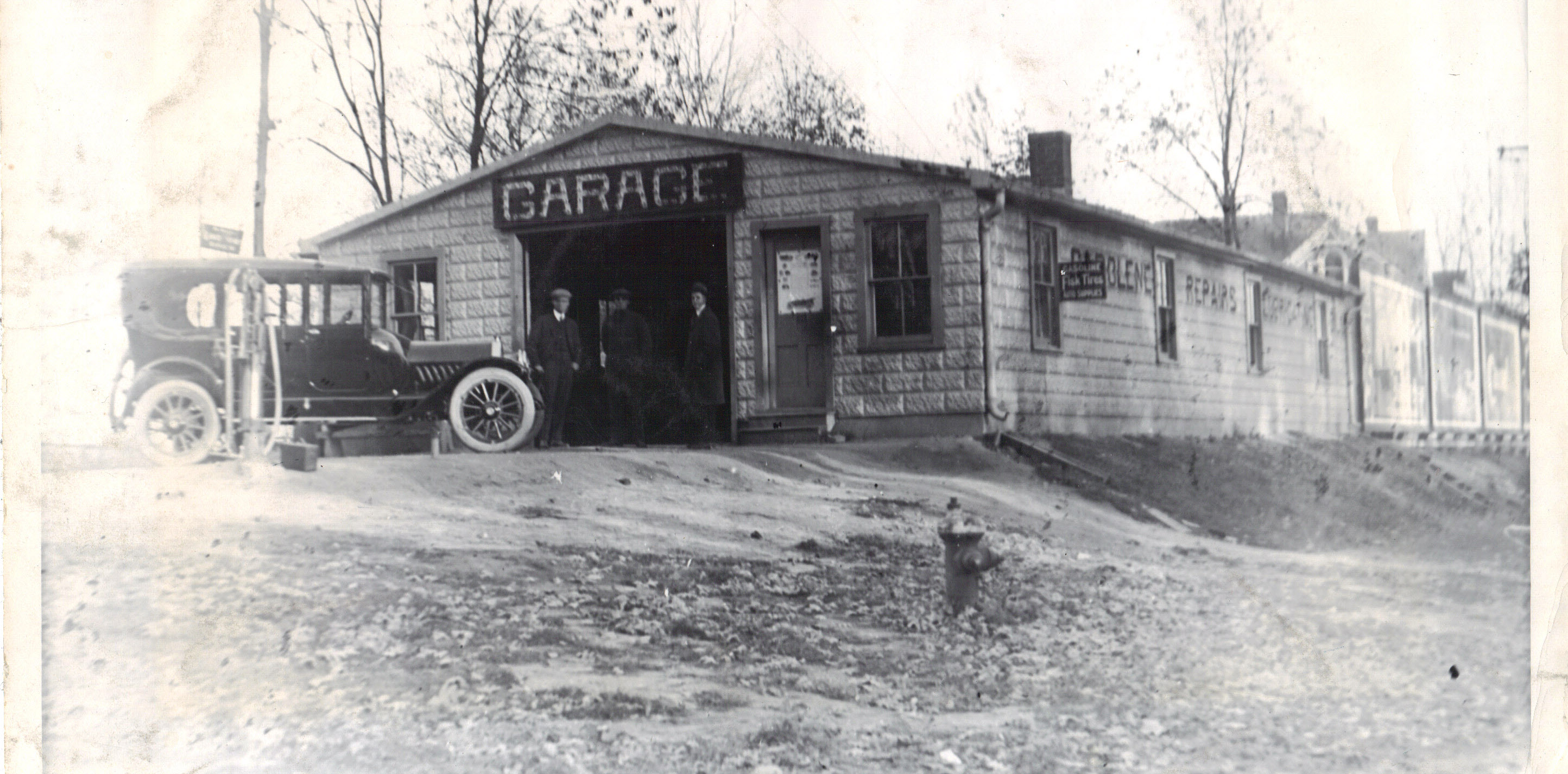
1915 Rockville Garage located at the intersection of Veirs Mill Road and Rockville Pike The original owners of Rockville Garage are standing in front. From left: Lewis Reed – Roy Warfield – Griffith Warfield.
The photo above shows the Rockville Garage where Lewis Reed got his start by becoming a partner with Robert L. and Griffith Warfield in 1914. The Warfield brothers had purchased this building in July 1915, from Lee Ricketts and Sons who had the Overland Agency. In 1917, Lewis Reed bought out the Warfield brothers’ interest and continued the business until 1919 when he was joined by his brother, Edgar. The firm’s name was changed to Reed Brothers upon a suggestion of the late Judge Edward C. Peter.
Reed Brothers handled the first Dodge cars placed on the market in Montgomery County, Maryland. The company continued for two generations later under the Gartner family and sold tens of thousands of cars to generations of local drivers. The late George M. Hunter, President of the Montgomery County National Bank, purchased the first automobile sold by the Rockville Garage.
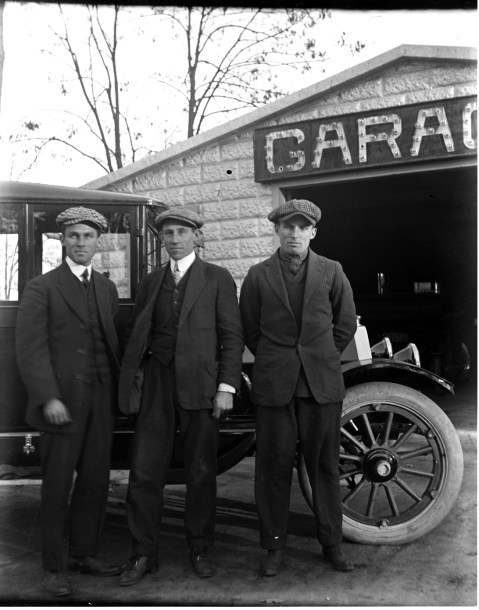
1916 – The original owners of Rockville Garage. From left: Roy Warfield – Lewis Reed – Griffith Warfield
Initially, Reed Brothers sold Oldsmobile and Hudson along with Dodge. The first Plymouth was built in 1928 and Plymouths were sold at Reed Brothers from 1930 until 1969, when the Plymouth car was given to the Chrysler dealers. In 1928, when Walter P. Chrysler took over after Horace and John Dodge died, Lewis Reed became an original member of the Chrysler family. By 1929, when the stock market crashed and Great Depression began, nobody could afford to buy cars. Like most other businesses, the Great Depression hit hard and Reed Brothers had to rely on its Service Department to make ends meet. But, the dealership survived through these lean times.
During World War II, Reed Brothers Dodge had virtually no new cars to sell for three and a half years. Tires and parts were rationed. Strict price ceilings governed used-car sales. Used cars were really hard to find, because people couldn’t afford to give them up. So, most dealerships had to rely on their service and parts departments to fix the cars people couldn’t replace. Empty showrooms were a problem. When manufacturers halted car production and many dealers went bankrupt, Lewis Reed converted his car showroom into a display room and sold GE washing machines, Westinghouse Radios, and other large appliances to fill the gap.
The dealership survived The Great Depression, World War II, the first Chrysler Bailout and resurgence under Lee Iacocca, the sale of Chrysler to Daimler and the sale to the private equity firm Cerberus. Reed Brothers has, in fact, survived everything but Chrysler itself. Whether a franchise is run by a second- or third-generation dealer or is older than even Chrysler itself didn’t seem to matter when Chrysler decided to cut dealership ranks during their 2009 bankruptcy process. After almost 95 years selling Dodges, Reed Brothers was one of the 15 dealerships in Maryland and 789 dealerships nationwide notified by Chrysler that their franchise agreement would not be renewed.
The dealership’s historical legacy continues to this day on the site of its former location at 15955 Frederick Road in Rockville, which is now the Bainbridge Shady Grove Metro Apartments. Bainbridge Shady Grove Metro Apartments pays homage to this history with commemorative art on the former site of the iconic Reed Brothers Dodge dealership.
Tom Keady, President of the Bainbridge Companies said:
Honoring the rich historical legacy of this site was extremely important to us. With the sculpture and the floor plan names, our residents and visitors feel a real connection to the site’s past, and we pay tribute to Reed Brothers Dodge’s role in creating a vibrant Rockville.
A sculpture now installed on the property pays tribute to the oldest Dodge dealership in Maryland history. More than 20 feet high, and over 6 feet wide, the public art is inspired by 1939 Dodge headlamps and the fender of a 1957 Dodge pickup truck. Along with the sculpture, a set of Hemi Piston street lamps line the walkway towards the metro station. Historical elements have been incorporated into the interior design of the development which carries out a common theme of dealership history and automobiles.
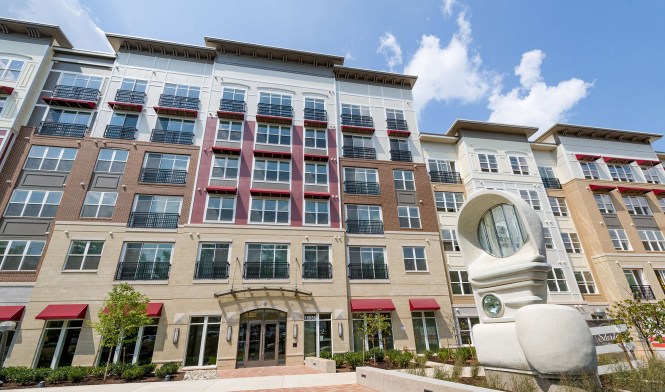
Bainbridge Shady Grove Metro Apartments now stands on the former site of the Reed Brothers Dodge dealership at 15955 Frederick Road. A sculpture now installed on the property pays tribute to the oldest Dodge dealership in Maryland history.
Books

Related Resources


Copyright Notice

Reed Brothers Dodge History (1915-2012) by Jeanne Gartner is licensed under a Creative Commons Attribution-NonCommercial 3.0 Unported License.
 Reed Brothers Dodge History 1915 – 2012
Recent Comments