
Then & Now: Saylorsburg Lake House & Hotel of Horror
With Halloween just around the corner, I thought it would be fun to feature a photograph that Lewis Reed took of the Saylorsburg Lake House Hotel, now the site of Hotel of Horror. The aging Lake House Hotel in Saylorsburg, Pennsylvania, once a vibrant Poconos retreat, was a popular hotel for the region’s tourists who were looking for fun on nearby Saylors Lake. During the hotel’s heyday, its staff was booking rooms a year in advance. Today, the former hotel’s fame is generated from its annual Halloween haunted-house attraction.
Lake House Hotel (THEN): The legend of the Lake House Hotel spans more than two-hundred years. According to local folklore, during World War II, many of the employees at the Lake House were called to assist in the Pennsylvania National Guard, leaving the local asylum with one lone security guard to watch over the entire building. The inmates escaped, made their way to the hotel and took it over. The insane patients performed experiments on the guests. What was once a renowned resort for the rich and famous, became a torture chamber.

Saylorsburg Lake House Hotel. Photo taken by Lewis Reed, 1915.
Hotel of Horror (NOW): This 2018 season will celebrate the 26th year that the Hotel of Horror has been fascinating and horrifying legions of fans from the far reaches of the United States and even internationally. To all the readers of this blog: Have a spooky, enjoyable and very safe Halloween!

Welcome to The Hotel of Horror, The Pocono Mountains Premier Haunted House Attraction

Lewis Reed’s ‘Ghost’ Photograph

Surrealistic, ghost-like effect of Lewis Reed (right) standing next to a tree in the middle of train track. From Lewis Reed’s Photograph Collection
Lewis Reed had a passion for photography and had the know-how to try out a few of the trick shots that were popular at the time — including creating double exposures that made it look as if there were ghosts in the picture.
When I saw this photograph — which is slick enough to fool anyone not paying attention to detail — I became curious. How on earth did he do that? So I did some research to get some information on what went into this type of photography. This technique often left a telltale vertical line along the center of the image — a fuzzy stripe separating the two exposures.
Supernatural effects were mainly accomplished using double exposure. When developing the photos, a pre-prepared glass plate would be used which already had the image of a person on it. This would be the ‘ghost’. It would then be inserted into the camera in front of an unused plate which was used to shoot the photo. The developed negative comes out with both images on it — an incompletely exposed ghostly image as well as a sitter, looking perfectly unaware.
I think it’s really amazing how Lewis Reed’s early photography shows such versatility and creativity.
Photo Manipulation Without a Computer
If you take a look at the state of photography today, such as the advances of digital cameras and the artful image manipulation by Photoshop, it is easy to forget that back in the 1900s photographers couldn’t just go into a computer program and change their images any way they wanted. Instead of retouching an image on a computer, as it’s done now, it originally took place on the negative.
Photo manipulation was one tool Lewis Reed had in his photography tool belt. He was 100 years ahead of his time by creating special effects to images long before the convenience and efficiency of digital photography and Photoshop were ever imaginable.
I was hugely interested in how this was undertaken, and by the fact that the modification looked so seamless in the printed image. Spotting these manipulated photos in his extensive collection has been both easy and difficult. Some were simple double exposure images or hand colored images. The addition of these hand-drawn backgrounds was a little more difficult. It wasn’t until I viewed the high resolution scan that this modification jumped out at me.
Reading up on the subject I have become aware that retouching is in fact an art that evolved right alongside the birth of photography. The photographs below were retouched by hand (also known as “handwork”) on the glass negative using a hard graphite pencil and pieced together in the darkroom from separate photographs. The two photographs, one of the people standing on the edge of a cliff, and the other of the hand-drawn mountains, appear to be joined at the edge of the cliff where the mountains begin. All of this required a degree of artistic skill and access to a darkroom. Lewis Reed developed his own photographs in a darkroom in his house — in the kitchen, to be exact — and worked at night to develop the negatives.
The photographs below show two unknown people posing on a cliff in front of a hand-drawn background of mountains.

An original photograph retouched with hand-drawn mountains by Lewis Reed

Same photo as above, different angle, retouched by Lewis Reed.
Today, we can look back and appreciate the time and creativity it took to edit these photos without Photoshop.
Then & Now: Reed Brothers Dodge 80 Years Ago
Reed Brothers Dodge and the surrounding area sure has changed a lot in its almost century-long history. You might not realize how much things have changed until you look back and see what it looked like in the past. For this post, I have used one of Lewis Reed’s original photographs for “then” and a Google Maps street view image from today for “now”.
THEN: Aerial view showing Reed Brothers Dodge at its original location at the triangle close to 80 years ago. The connector street behind the dealership was later named “Dodge Street” commemorating Reed Brothers’ presence from 1914-1970. Photo taken by Lewis Reed from a Goodyear Blimp that came to the dealership in 1938 to promote tires.
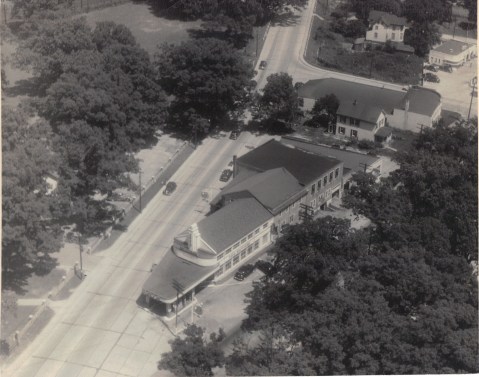
Aerial view of entire original Reed Brothers dealership at the intersection of Veirs Mill Road and Rockville Pike, ca. 1940. A two-story house stands behind the dealership. Photo by Lewis Reed.
NOW: The color photograph below, is the dealership’s location today, now known as Veterans Park. In the 1970s the site was known as the Francis Scott Key Memorial Park, and later in 1988, it was permanently rededicated as Veterans Park. In the late 1960s, the state of Maryland acquired the land to widen 355 and donated the remaining sliver to the City. The state named the connector street behind the dealership’s location “Dodge Street” because Reed Brothers Dodge dealership was located there for more than 50 years.

Reed Brothers Dodge original location at the triangle today. Google Image Capture, 2018
New Blog Feature: Then & Now
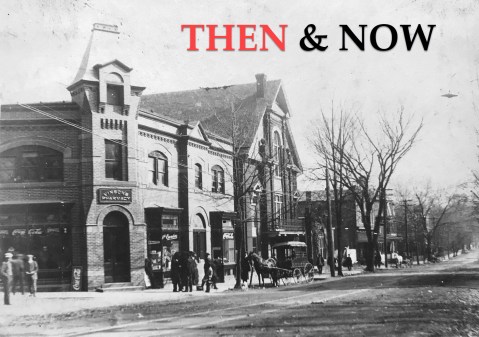
Looking back at photography from the past is a fascinating experience for me, and with a newfound interest in history, it occurred to me that with the vast number of historical photographs in Lewis Reed’s Collection, that this blog would be a great place to feature a series of Then & Now photography. I started doing this about a year ago as a research tool, now I mostly do it because of my passion for history and fascination with the subject. With that in mind, I will occasionally be spotlighting some “Then & Now” images from his collection that will show photographs of buildings, street scenes, and other historical locales alongside photographs of how they appear today.
Some of the historic locations in this series includes the Smithsonian, Capitol, Union Station, Old Post Office, Library of Congress, Raleigh Hotel, Key Bridge and other important sites in and around the Maryland, Virginia, and Washington, D.C. area. There are also photographs of many non-Maryland locations including the historic landmark “Lucy the Elephant”, Gettysburg Battlefield, Mount Vernon, Pennsylvania Monument and United States Regulars Monuments under construction, and Quebec Bridge (the 8th Wonder of the World).
I have no formal history training, just a general interest in local history where I grew up. I will post one of Lewis Reed’s photographs matched with a corresponding contemporary shot of the same area, and supply a few sentences of context. All of them will in some way will offer a visual history of how things have changed over the years. I look forward to sharing them with you.
Books

Related Resources


Copyright Notice

Reed Brothers Dodge History (1915-2012) by Jeanne Gartner is licensed under a Creative Commons Attribution-NonCommercial 3.0 Unported License.
 Reed Brothers Dodge History 1915 – 2012
Recent Comments