
November 14, 1914: First Dodge Automobile Built

Horace Dodge (left, rear) and John Dodge (right, rear) take delivery of the first Dodge automobile on Nov. 14, 1914.
One hundred and four years ago on this date –November 14, 1914 — the very first Dodge car, “Old Betsy”, rolled off the assembly line. On that day, the Dodge Brothers (Horace and John) were photographed riding in the rear seat of the first car to bear their last name. It cost $785, had a 110-inch wheelbase, and was powered by an L-head 4-cylinder engine that proved so reliable it was continued until 1920 with very little modification. Total production for 1914 was a mere 249 touring cars. The following year. Dodge offered a two-passenger roadster which also sold for $785 and the plant went into full production.
According to “The Dodge Brothers: The Men, the Motor Cars, and the Legacy” by Charles K. Hyde, here’s the full story:
The widely accepted history of the initial production of early Dodge Brothers automobiles in November 1914 is at odds with much of the evidence about the earliest Dodge Brothers cars. Automotive historians have thought that the first production car, later named “Old Betsy,” came off the assembly line at the Hamtramck factory on 14 November 1914. Guy Ameel, superintendent of final assembly for Dodge Brothers since the start of automobile production, served as John and Horace’s chauffeur that day. With the brothers in the back seat, Ameel stopped the first Dodge Brothers car in front of John Dodge’s mansion on Boston Boulevard in Detroit and a photographer recorded this important moment.
“Old Betsy” was more likely an experimental prototype car assembled several months before 14 November 1914 and not a production car at all…

The Dodge Brothers
The Dodge Brothers began an aggressive advertising campaign to promote their new automobiles and to attract potential dealers to sell their cars. Few people jumped onto the Dodge Brothers bandwagon earlier than Lewis Reed, and not many have lasted longer.
Lewis Reed received his franchise to sell Dodge Brothers Motor Cars from John and Horace Dodge; less than one year after “Old Betsy” rolled off the assembly line. He was just 27 years old. Since then, the business grew and transformed into the oldest Dodge dealership in Maryland history and one of the oldest in the entire nation.
How Reed Brothers Started & Survived Almost a Century
It was 103 years ago, in October 1915, that Lewis Reed signed a franchise agreement with brothers Horace and John Dodge in Detroit. He was just 27 years old. Since then, the business grew and transformed into the oldest Dodge dealership in Maryland history and one of the oldest in the entire nation. In 1914, Lewis Reed became a partner in Rockville Garage, a business he purchased in 1918. His brother Edgar joined the business in 1919 upon his return from World War I, and the name became Reed Brothers Dodge.

This photograph of the original 1915 Rockville Garage shows a 1916 Model 44 Oldsmobile parked in front. The original owners of Rockville Garage are standing in front. From left: Roy Warfield – Lewis Reed – Griffith Warfield.
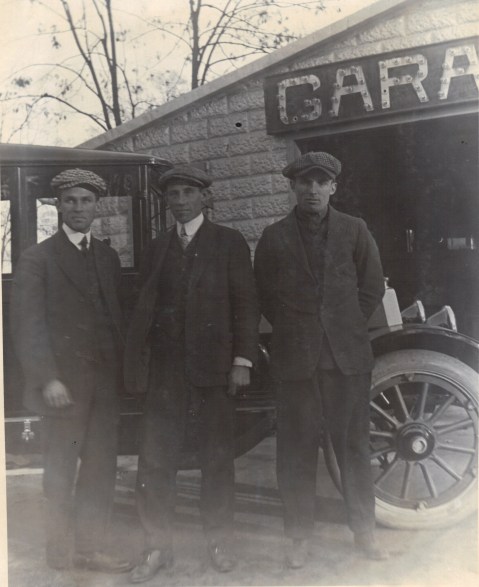
1916 – Original owners of Rockville Garage. From left: Roy Warfield – Lewis Reed – Griffith Warfield.
A mechanical aptitude was necessary to be a dealer in the early 1900’s. When cars were shipped to the dealer from the manufacturer, they arrived partially assembled in railroad boxcars. It was the dealer’s responsibility to unpack and assemble the cars at the rail yard and drive them back to the dealership. Mechanics were often needed to repair the new cars if they broke down along the way. Lewis Reed was an expert auto mechanic. He received his automotive training at the Pierce-Arrow factory in Buffalo, New York, the Dodge Hamtramck and Hudson Motor Car factories in Detroit, Michigan and the Washington Auto College.

1916 – The first shop force of Rockville Garage (from left: Lewis Reed, (first name unknown) Long and Phillip Reed.
The Great Depression
In 1928, when Walter P. Chrysler took over after Horace and John Dodge died, Lewis Reed became an original member of the Chrysler family. By 1929, when the stock market crashed and Great Depression began, no one could afford to buy cars. Like most other businesses, the Great Depression hit hard and Reed Brothers had to rely on its Service Department to make ends meet. But, the dealership survived through these lean times.
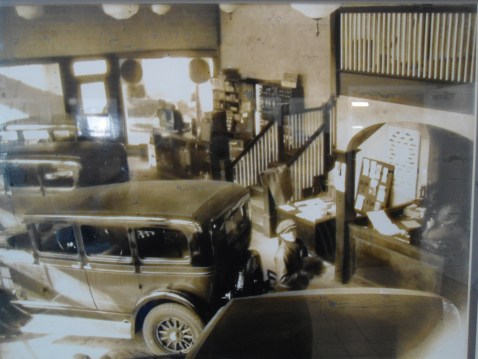
Late 1920s New Car Showroom
This new car showroom above is filled with late 1920s Dodge Brothers new car models. The showroom faced the triangle at Veirs Mill Road and Rockville Pike (now known as Veterans Park) which gave the dealership maximum visibility to the largest volume of cross traffic. Behind the large plate glass windows and an awning above was the product — the new car.
There were no salesman’s desks in the showroom until after World War II. Lewis Reed allotted specific sales territory to his salesmen in four different directions from the dealership. The salesmen spent all day in the outlying areas of Poolesville, Rockville, Barnesville and Spencerville demonstrating cars to potential customers. At that time, Reed Brothers was selling about eight new cars a month and most sales resulted from knocking on people’s doors. It was direct person to person sales contact, relationship building and trust – all built and sealed on a handshake. Three of the four salesmen at the time were Francis O. Day, Raleigh S. Chinn and Benjamin J. Thompson.
United States Enters World War II
Reed Brothers faced another setback during World War II. All U.S. car manufacturers stopped production in order to concentrate on military equipment. Reed Brothers had no new cars to sell for three plus years. Many car dealers went bankrupt at this time. Lewis Reed converted his car showroom into a display room and sold GE washing machines and other large appliances to fill the gap. At this time, Reed Brothers had in their employ eight Veterans of World War II.
The Customers
Ask anyone who has been in the car business for a while how they create lasting customer relationships. They’ll tell you it’s through conversation. In Lewis Reed’s day, a customer would come into the showroom and sit for hours and talk about local sports teams, the weather or family. But they’d never mention an automobile. Then, the customer would come back, maybe talk a second day. And on the third day, they’d get down to talking about a car. But it was all cautious, deliberate and very polite.

Lewis Reed (right) in new car showroom talking with a customer
The Cars
New car introduction was always one of the most exciting times at Reed Brothers. It was a once-a-year celebration that everyone looked forward to attending. For the salesman, it meant additional car sales. To the dealership, it was another method to reach out to hundreds of current and potential customers, not only for new car sales, but also to advertise the dealership’s other services. Many sales were made during new car introduction by those customers who had to be the first on their block to own one of the new models.
To attract drive-by motorists, large signs were placed in the showroom windows hyping the new year models: Dart, Lancer and Polara. Back in the day, there was tremendous brand loyalty. Customers who bought Dodges, usually bought them for life. In fact, many former customers traded every year and would buy a car on the spot. In the 1960s, new car introduction was a much more important part of the American automotive buying habit.

1961 – Lewis Reed (left) and James Gartner, Salesman, stand in front of the new car showroom
Setbacks
Reed Brothers Dodge successfully navigated through numerous Chrysler setbacks during the 1970’s and 80’s, including the first Chrysler Bailout, the sale of Chrysler to Daimler, and the sale to the private equity firm Cerberus. Reed Brothers met the challenges of gasoline shortages, high interest rates, severe inflation, and weakening consumer confidence which drove Chrysler into financial crisis. This survival is testimony that the dealership not only conquered setbacks, but often rebounded to reach new levels of success.
When you look back and consider what has taken place in the world in the past 100 years or so, you gain a perspective of what Lewis Reed faced. He overcame a lot of obstacles throughout his life. He steered his dealership through World War I, The Great Depression and World War II. When Reed Brothers had no new cars to sell for three and a half years and many dealers went bankrupt, he converted his car showroom into a display room and sold GE washing machines and other appliances.
Transformation
Chrysler filed for Chapter 11 bankruptcy protection. Chrysler terminated 789, or about 25% of its dealerships by June 9. The cuts resulted in an estimated 38,000 job losses. Whether a franchise was run by a second- or third-generation dealer, or is older than even Chrysler itself, didn’t seem to matter when Chrysler decided to cut dealerships ranks during their 2009 bankruptcy process. After almost 95 years selling Dodges, Reed Brothers was one of the 15 dealerships in Maryland and 789 dealerships nationwide notified by Chrysler that their franchise agreement would not be renewed.
During this time when many car dealers had to close their doors, Reed Brothers made behind-the-scenes tweaks to withstand the economic downturn and the loss of their franchise. The signs standing outside on Rockville Pike still said Reed Brothers Dodge, but inside, a new business was forming: Reed Brothers Automotive.
A business landmark in the Rockville area since 1915, Reed Brothers underwent a change in its structure – and its name – but still catered to the local community as it had for decades. Reed Brothers changed its name from Reed Brothers Dodge to Reed Brothers Automotive, and continued on as a used car dealer and repair shop until 2012.
Legacy
Over 100 years later, the only name that remains familiar to Rockville car buyers is Lewis Reed. Reed Brothers Dodge was one of the longest running automobile dealers in Montgomery County Maryland, serving Rockville and the area for over 97 years. Along with St. Mary’s Church (1813), King Farm (1925), Red Brick Courthouse (1891), and the B&O Railroad Station (1873) — Reed Brothers Dodge (1915) — became a “Peerless Place” in 2015, the year marking its 100th Anniversary. Today, Bainbridge Shady Grove Metro Apartments pays homage to the oldest Dodge dealership in Maryland history with commemorative art on the former site of the iconic Reed Brothers dealership.
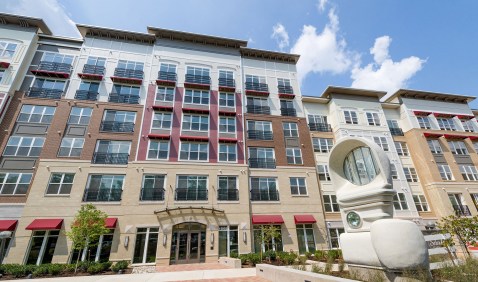
Bainbridge Shady Grove Metro Apartments now stands on the former site of the Reed Brothers Dodge dealership at 15955 Frederick Road. But a sculpture now installed on the property pays tribute to the oldest Dodge dealership in Maryland history. More than 20 feet high, and over 6 feet wide, the public art is inspired by 1939 Dodge headlamps, and the fender of a 1957 Dodge pickup truck.
Bainbridge Shady Grove Metro lives up to its motto: “Great Stories Start Here.”
Rockville Garage Hudson Motor Car Ads (1919-1920)
The advertisements in this post do more than just simply pitch a product, they capture a moment in history. A moment in history when Lewis Reed’s Rockville Garage represented several franchise nameplates along with Dodge, including Oldsmobile, Hudson, and Essex. The Hudson and Oldsmobile were sold at Reed Brothers from roughly 1917 through 1923.
Hudson introduced the Essex brand in 1919. The Essex was intended to compete with Ford and Chevrolet for budget-minded buyers. The Essex offered one of the first affordable sedans and by 1925 the combined Hudson and Essex sales made Hudson the third largest automobile manufacturer in the United States.
Prior to the advent of television and radio advertising, print media was the most popular form of advertising and most car ads were black and white. The following ads distributed by the Lambert Automobile Company in The Baltimore Sun newspaper advertises the Hudson and Essex automobiles.
In addition to franchise car dealers, there were also factory stores. In the early days, the factory stores did the national advertising. A factory store, also known as a branch store or branch dealer, was a dealership owned and run by the manufacturer. A list of area Dealers was placed in fine print at the bottom of the ads. Rockville Garage, Rockville, Md, is highlighted in yellow on each of these ads.

The Baltimore Sun 2 March 1919
By the 1920s, Hudson and Essex Motor Car advertisements featured elegant architectural borders with static drawings of their cars; some ads never pictured people during this period.

The Baltimore Sun 30 May 1920

The Baltimore Sun 29 Aug 1920
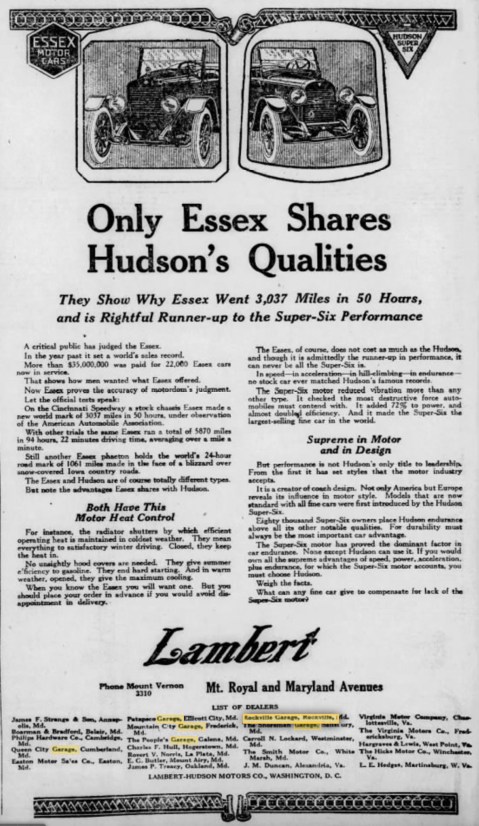
The Baltimore Sun 25 Jan 1920
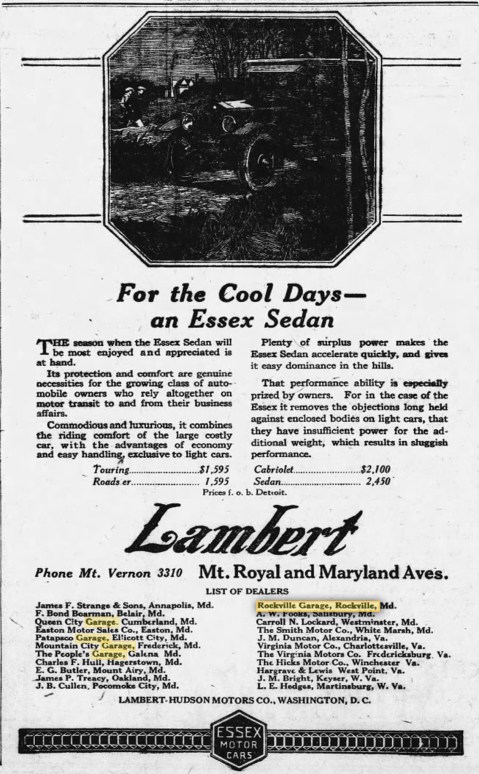
The Baltimore Sun 24 Oct 1920

The Baltimore Sun 21 Nov 1920

The Baltimore Sun 17 Oct 1920

The Baltimore Sun 13 Jun 1920

The Baltimore Sun 10 Oct 1920

The Baltimore Sun 1 Feb 1920

The Baltimore Sun 3 Oct 1920
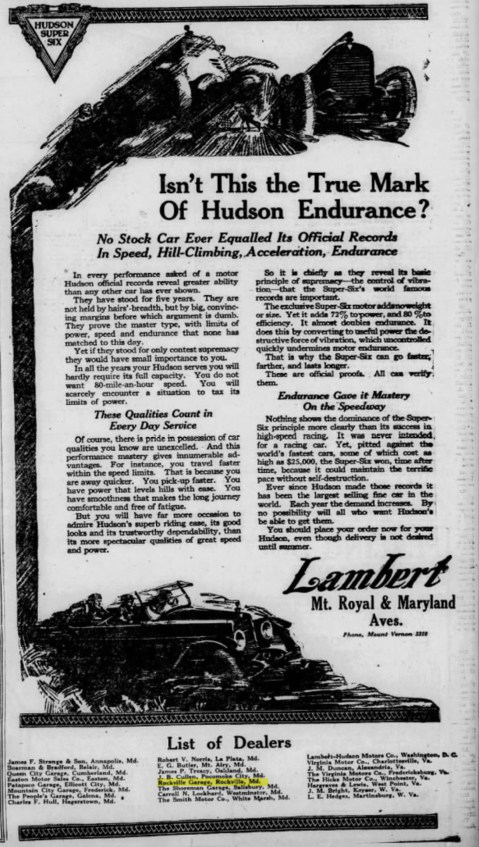
The Baltimore Sun 28 Mar 1920
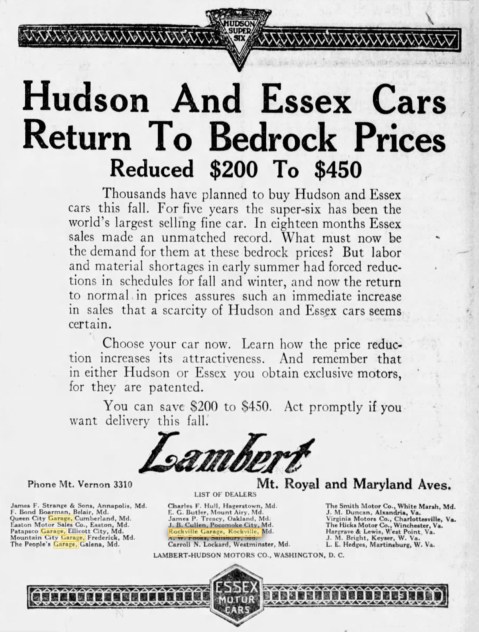
The Baltimore Sun 30 Sep 1920

The Baltimore Sun 5 Mar 1922
A lot of old newspapers have found their way online and with digital archival, it’s easier to take a trip back through old newspapers than ever before. These ads were found on NewspaperARCHIVE.com, the largest historical newspaper database online.
Reed Brothers Memorabilia
Dealers have always produced a wide array of promotional giveaways. These items are rare finds, because most get thrown away when the doors are closed. Some of the more difficult collectibles to obtain are awards given to the salespeople for outstanding sales performance, including neckties, cuff links, pen and pencil sets, and award plaques. Unique items were often given to salesmen to promote a new model being released that year. Each year at new car introduction, dealers created an entirely new set of collectibles. A few items were provided by the factory to promote a theme for the new models, but most of the others were created uniquely by the dealer.
Most of the memorabilia in this special post belonged to Marvin Shultz, Reed Brothers longest tenured employee. Marvin worked for 43 of the company’s 97 years of existence before retiring in 1984 as a new car salesman. A few others are from my own personal collection.
I would like to express my thanks to the Shultz family for sending me these mementos!

1970s Dodge emblem neckties. Courtesy the Shultz family

Sales Meeting left to right: Dorsey Howes (Sales Manager), Dale Reed (Salesman), Marvin Shultz (Salesman), Lee Gartner (President). In the 1970s, the sales staff wore red blazers with the Dodge emblem on the pocket. Note the neckties.

1970s Reed Brothers Dodge Service Department Pen – Quaker State Motor Oil. Courtesy the Shultz family.


Reed Brothers Dodge license plate. J. Gartner collection
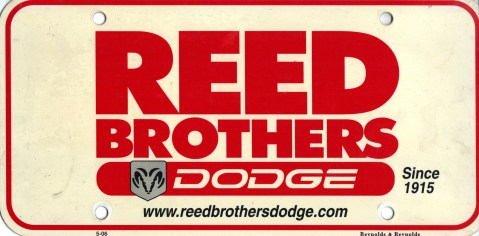
Reed Brothers Dodge license plate. J. Gartner collection
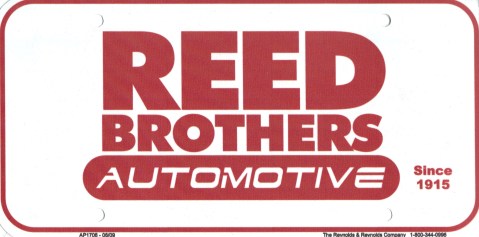
Reed Brothers Automotive license plate. J. Gartner collection
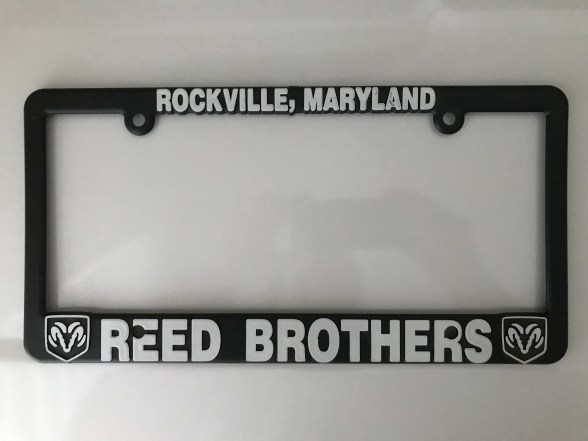
Reed Brothers license plate frame. J. Gartner collection

Reed Brothers Dodge Polo Shirt with original logo. J. Gartner collection

Reed Brothers Dodge Hat. J. Gartner collection

Reed Brothers Dodge T-Shirt. J. Gartner collection
Lewis Reed Photo: Lady & Toddler on a 1913 Excelsior
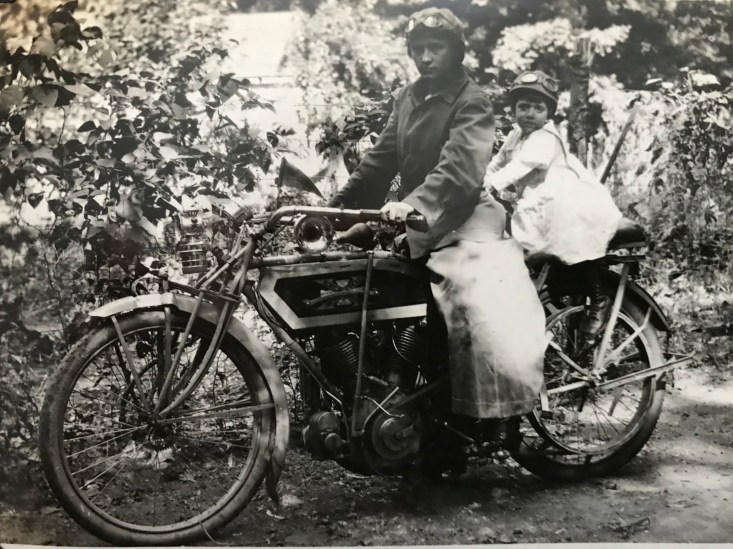
Unknown lady and toddler posing on an Excelsior motorcycle. Photo by Lewis Reed
Back in the early part of the last century when the motorcycle was still new and a novelty, it was often used for Kodak moments.
Lewis Reed has a number of photographs showing relatives and other unknown people on their motorcycles in the period of the early 1900s through the early 1920s. This photo taken by Lewis Reed is an unknown lady and a toddler (mother/daughter?) posing on an Excelsior motorcycle. The motorcycle was easy to identify because of the logo, but I could not pinpoint the exact year it was made. I tend to think it might be a circa 1913-1914 model Excelsior.
This is, without question, one of the best posed photos on a motorcycle that I have come across in my grandfather’s albums. The toddler’s sporty little cap and goggles make the image. Just imagine how excited she must have been to sit on that big machine.
The motorcycle seems to be well equipped with extras including: a headlamp, a handlebar-mounted Klaxon horn, and a well padded passenger seat on the back.
Books

Related Resources


Copyright Notice

Reed Brothers Dodge History (1915-2012) by Jeanne Gartner is licensed under a Creative Commons Attribution-NonCommercial 3.0 Unported License.
 Reed Brothers Dodge History 1915 – 2012
Recent Comments