
Roots of a 97 Year Old Auto Business
Lewis Reed, founder of Reed Brothers Dodge, grew up on a farm in rural Darnestown and for much of his young life had no running water or electricity. He was the son of a Blacksmith, raised in a family that survived on knowledge and hard work. Philip (1845-1918), father of Lewis Reed was an early settler in Darnestown who came from the Medley’s District of Poolesville in 1880. The Reed family farmhouse was located west of the James Windsor Store and Post Office as indicated on the map. In 1880, Philip Reed bought this lot from Windsor on which he built his house. The house was later owned by Kelley Rice who ran the farm at “Pleasant Hills.”  In 1870, at age 25, Philip Reed’s occupation is listed as a Blacksmith and Cabinet Maker. Darnestown residents of that time included a doctor, a merchant, a blacksmith and a wheelwright. It seems Philip may not have considered his primary occupation as a wheelwright, but I do know he worked with both cabinetmaker and blacksmith skills. Blacksmiths were once important members of this thriving crossroads community. They provided a vital trade that continued up to the mid-20th century. It wasn’t until I traced the Reed family tree, that I found that the Blacksmithing trade goes back about four generations. Back then, it was commonplace for sons to follow their father’s professions.
“T. H. S. Boyd, The History of Montgomery County, Maryland, from Its Earliest Settlement in 1650 to 1879” gives a population of 200 in the Darnestown area in 1879. The inhabitants of the town at that time are recorded in G.M. Hopkins’ Atlas from which the map reproduced above is taken.
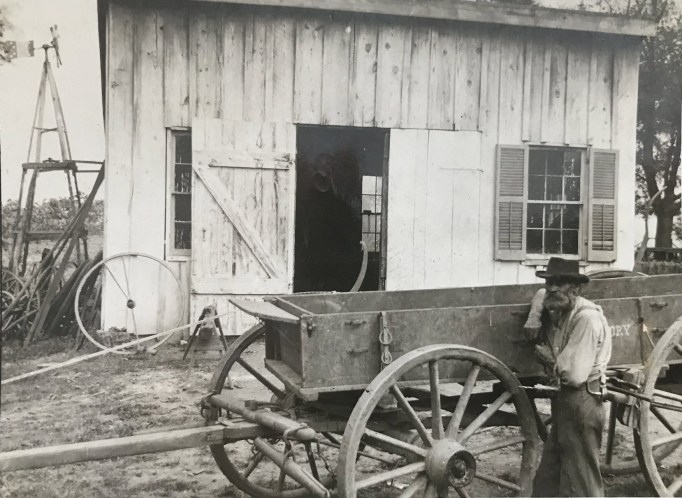
Formerly located on Darnestown Road near the intersection of Seneca Road, Lewis Reed’s father, Philip (1845-1918), operated a blacksmith, wheelwright, and cabinet making business next to his home. Photo by Lewis Reed.
Lewis Reed’s passion for cars began at a very early age. He was a young man full of curiosity, with an insatiable desire to know details, how things worked, and why. Early vehicles were terrifyingly loud and could be heard coming from at least a mile away on rural country roads. As a child, he would watch cars go past the family farm and then take off running across the fields to catch up with them until they would go out of sight. The “normal” speed during this time was so slow that drivers had difficulty keeping their cars from stalling out. It was my mother, Mary Jane Gartner (Lewis Reed’s daughter) who told me this story.

Philip Reed family farmhouse and blacksmith shop. Photo by Lewis Reed
At the beginning of the 20th century, farming was done with the power of horses and the skills of a blacksmith were important to the local economy. The shop was a popular destination, to wait for repairs of equipment, have horses shod and hear the latest news.
According to the 1910 U.S. Federal Census, Philip Reed worked as a Blacksmith in Darnestown until about age 65, after which time he moved his family to the Park Avenue community in Rockville. In July 1910, Philip purchased lot #3 of the east side of Park Avenue. In 1916, Lewis purchased lots 4-9 and started a garage and automobile dealership which became Reed Brothers Dodge. In 1923, he sold lots 4-7 to Edgar at which time Edgar then constructed a bungalow home and resided there until sold in 1947.

The Park Subdivision in Rockville, Lot #3 purchased by Philip Reed in 1910
From Miscellaneous For Sale Section: The Washington Post, (Washington, D.C.) April 21, 1910
 The classic anvil and hammer, in addition to tongs, forms, wedges, and chisels were all key tools of the Blacksmith; many of which were hand-made by each individual blacksmith. If they did not possess the tools required for a specific job, blacksmiths would make their own. Over the span of a blacksmith’s career, he could accumulate hundreds of different tools that existed solely for the completion of one particular item.

A young Lewis is shown inside his father’s Blacksmith Shop, ca. early 1900. The identity of the man on the right is unknown. Photo by Lewis Reed.
Special note: Lewis Reed’s love of photography began at a very young age, at a time when most families did not own a camera. The oldest photo in his collection is dated 1898, which would have made him around 11-12 years old when he started using a camera. I am relatively certain that Lewis took the photograph above himself by stabilizing the camera on a nearby tripod or some other object, and because of the long exposure times in early photography, he was able to run into the shot himself for a minute or more.
When the car was first invented there was no such thing as an automotive mechanic. When a car broke down, people turned to blacksmiths and bicycle mechanics for repair work. When using horses for farming and transportation came to an end, it forever changed the blacksmith’s role in the community. The traditional, small town blacksmith’s shop gradually went out of business, or evolved into the first automobile repair shops, as the horsepower of mechanical engines replaced the power of horses. Having grown up in a blacksmith family, Lewis Reed was well positioned to move to the new technology.

1916 – Rockville Garage first shop force. Lewis Reed, (first name unknown) Long and Phillip Reed. Photo by Lewis Reed.
One hundred years ago, the direction of the auto industry was uncharted territory to be explored by many people. Lewis Reed was an enterprising young man who put his future in the fledgling automobile industry. Although the specific motivation for Lewis to go into the automobile business is not clear, the 1910s was a period of exponential growth in the American automobile industry, and with a location on the major east-west route through Rockville, a town that was on its way to becoming a satellite community of Washington, D.C., he was well positioned for success. The 1910 census indicates that 23-year old Lewis Reed was working as a machinist.
In 1914, Lewis Reed became a partner in Rockville Garage with Robert L. and Griffith Warfield, a business he purchased in 1918. His brother Edgar joined the business in 1919 upon his return from World War I, and the name became Reed Brothers Dodge. In October 1915, Lewis Reed signed a franchise agreement with brothers Horace and John Dodge in Detroit. He was just 27 years old. Since then, the business grew and transformed into the oldest Dodge dealership in Maryland history and one of the oldest in the entire nation.
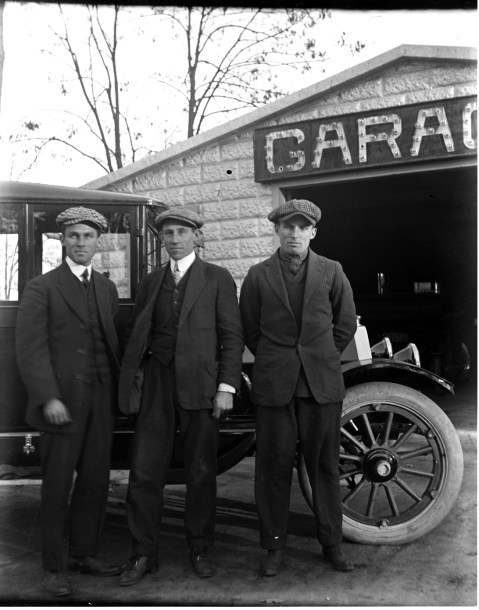
1916 – The original owners of Rockville Garage. From left: Roy Warfield – Lewis Reed – Griffith Warfield. Photo by Lewis Reed.
Over 100 years later, the only name that remains familiar to Rockville car buyers is Lewis Reed. Reed Brothers Dodge was one of the longest running automobile dealers in Montgomery County Maryland, serving Rockville and the area for over 97 years. Along with St. Mary’s Church (1813), King Farm (1925), Red Brick Courthouse (1891), and the B&O Railroad Station (1873) — Reed Brothers Dodge (1915) — became a “Peerless Place” in 2015, the year marking its 100th Anniversary. Today, Bainbridge Shady Grove Metro Apartments pays homage to the oldest Dodge dealership in Maryland history with commemorative art on the former site of the iconic Reed Brothers dealership.
Credit to: Jane C. Sween, The Montgomery County Story, “Darnestown, As It Was” (Feb 1982)
Other sources of information: Newspapers.com, Montgomery History, and Montgomery County Land Records
Looking Back 50 Years Ago Today: 55th Anniversary and Grand Opening
 Today marks 50 years since the Grand Opening of Reed Brothers Dodge new showroom and service facility. When the state widened the roads in 1970, Lee Gartner purchased 4.37 acres of land from Eugene Casey and relocated Reed Brothers Dodge to a new state-of-the-art showroom and Dodge/Chrysler/Jeep service complex on Route 355 at 15955 Frederick Road in Rockville Maryland.

Turning out to honor the company were several hundred dignitaries, officials, businessmen and friends. The new building, a complete automotive sales and service facility marked Reed Brothers 55th year of selling Dodge’s. The state-of-the-art dealership contained the newest customer-focused features throughout which combined technology and comfort. (click on any photo to scroll through gallery)


The new dealership provided a modern new vehicle showroom, 30 service bays, a comprehensive detail and car wash area, Parts Department, Body Shop, the newest technologies to service customer’s vehicles and provided customers with a convenient location to purchase and service their vehicle needs.

Design and construction of the new dealership was managed by the Glen Construction Company.
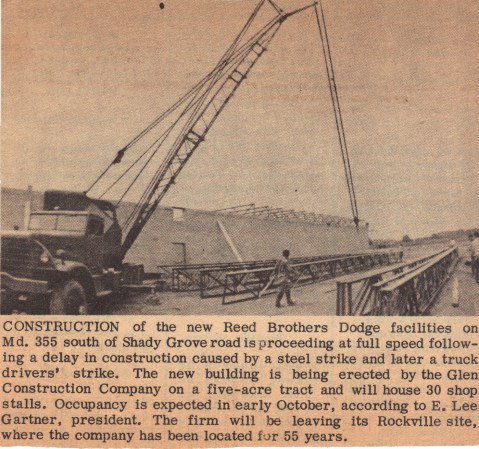 After 42 years of serving Rockville at this location, the dealership property went to settlement on August 30, 2012. Reston, Virginia-based Silverwood Companies put the former Reed Brothers Dodge dealership under contract, then won annexation into the City of Rockville, and ultimately conveyed the property to apartment builder, The Bainbridge Companies. Today, Bainbridge Shady Grove Metro pays homage to almost a Century of history by celebrating the golden age of the automobile with commemorative art on the former site of the iconic Reed Brothers Dodge dealership.
Peerless Rockville/Glenview Mansion Speaker Series
The Peerless Rockville/Glenview Mansion Speaker Series continues on-line. Join me Thursday, October 8 at 7:00pm on WebEx for my presentation on The History of Reed Brothers Dodge. My PowerPoint presentation will follow the dealerships historic timeline which showcases how Reed Brothers Dodge came into being, and how the company overcame the inevitable changes and challenges throughout almost a century of being in business. More than 150 photos will be featured, 90 of them historic images taken by the dealership’s founder, Lewis Reed. Click the link for free registration >> https://www.eventbrite.com/e/the-history-of-reed-brothers-dodge-1915-to-2012-tickets-122409759887

No New Cars During WWII, But That Didn’t Stop Lewis Reed
During World War II, Reed Brothers Dodge had virtually no new cars to sell for three and a half years. Tires and parts were rationed. Strict price ceilings governed used-car sales. Used cars were really hard to find, because people couldn’t afford to give them up. So, most dealerships had to rely on their service and parts departments to fix the cars people couldn’t replace. Empty showrooms were a problem. When manufacturers halted car production and many dealers went bankrupt, Lewis Reed converted his car showroom into a display room and sold GE washing machines, Westinghouse Radios, and other large appliances to fill the gap.
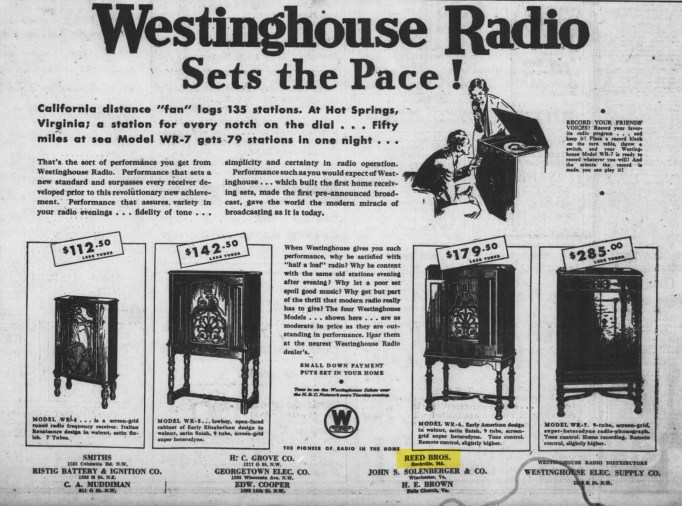
Newspaper ad for Westinghouse Radios with Reed Bros, Rockville, MD listed in fine print at the bottom
Reed Brothers Dodge lost eight employees to the draft. One former employee, Philip Frank, a member of the Air Corps in World War II was in killed in combat in the South Pacific. Raleigh S. Chinn of Rockville, Salesman, who started with Reed Brothers in 1920, resigned in 1942 due to lack of automobiles to sell. Edward R. Brosius of Barnesville, Salesman, started with the company in 1938. He, too, resigned in 1942 when cars were unavailable. Guy Merry of Rockville started in 1937 as a mechanic. He entered the armed forces in World War II and served for three years. When he was released, he returned to his old job. John Burdette of Gaithersburg, Gas Station attendant, started in 1940 and worked for about one year and then entered the armed services. He served four years in World War II and returned to his old job when he was released. Richard C. Burdette, Rockville, mechanic, started in 1941 and also worked at Reed Brothers until he entered the service. He served two years and then returned to work.
Car salesmen back in the 1940s would drive as far as 35 miles to deliver cars to their spread-out farmer customers. Lewis Reed allotted specific sales territory to his salesmen in four different directions from the dealership. The salesmen spent all day in the outlying areas, because the farmers in Poolesville, Rockville, Barnesville and Spencerville had no time to go to a showroom. Lee Gartner (Lewis Reed’s son-in-law) spent his summers on his grandfather’s farm and it was Mr. Lewis Reed who brought his grandfather’s car to him. Three of the four salesmen at the time were Francis O. Day, Raleigh S. Chinn and Benjamin Thompson.
At that time, Reed Brothers was selling about eight new cars a month and most sales resulted from knocking on people’s doors. After the end of World War II, the car boom came and the automobile assembly lines were back in action. The first car after the war was the1946 Dodge, which sold for about $800.
Sept 17, 1908: Testing the Wright Military Flyer at Fort Myer, VA
On this day in September 17,1908, the first military airplane in the world, built by the Wright brothers for the Army Signal Corps, made its first flight at Fort Myer, Virginia. Less than a thousand people witnessed the first flight at Fort Myer, because the general public was still doubtful that powered flight had been achieved. But Lewis Reed was there… and to commemorate that milestone, I have posted six original snippets of history that Lewis Reed captured through the lens of his camera that day.

Soldiers at Fort Myer prepare to pull the Wright Military Flyer out of its temporary hangar. Photo by Lewis Reed
Five years after the first successful flight at Kitty Hawk, Orville Wright and Thomas E. Selfridge test flew the Wright Flyer in a demonstration for the U.S. Army at Fort Myer, VA. The Army was considering contracting Wright’s aircraft to use as a military airplane, but, in order to win the contract, he needed to demonstrate the plane’s ability to carry a passenger. Twenty-six-year-old Lt Thomas E. Selfridge volunteered to be a passenger that day. Orville Wright succeeded in keeping the Wright Flyer aloft for one minute and 11 seconds. After more than four minutes in the air, the airplane crashed to the ground from a height of about seventy-five feet after a propeller blade broke and the machine went out of control. Orville Wright was severely cut and bruised and his passenger, Lt. Thomas Selfridge, became the first powered-aviation fatality.

Curtiss Model D with tricycle undercarriage. Photo by Lewis Reed

Curtiss Model D. Photo by Lewis Reed

Wright Model B with skids. Photo by Lewis Reed

Another early aircraft from 1909 was the Bleriot XI monoplane. In the background a Rex Smith Aeroplane Company School is advertised on the side of a building. Photo by Lewis Reed
A Rex Smith Aeroplane Company School can be seen on the side of the building in the background. The founder, Rex Smith, was an inventor and a patent attorney. The Rex Smith Biplane was used in the successful April 3, 1911 U.S. Army Signal Corps experiments in wireless communications. The Signal Corps did not buy any Smith Biplanes, they did however use them from time to time to train pilots to fly the Curtiss aircraft at the same field.

Airplane Hangars at Fort Myers, Virginia. Photo by Lewis Reed
The Wrights would prove their machine’s qualifications at Fort Myer. They met or exceeded all of the Army’s specifications, including flying at 40 miles per hour, carrying a combined passenger weight of 350 pounds, maneuvering in any direction in the air, landing without damage, and flying for at least an hour non-stop, which was a world record at the time.
Today, the Wright brothers are legends, with their accomplishments being the storybook example of American perseverance and ingenuity.
Books

Related Resources


Copyright Notice

Reed Brothers Dodge History (1915-2012) by Jeanne Gartner is licensed under a Creative Commons Attribution-NonCommercial 3.0 Unported License.


Recent Comments