
Early Days of Automobile Repair
The first car was created and it was good. A few days later, it broke down. That was bad. This led, of course, to the creation of the auto mechanic.
With a surge in automobile purchases in the early 1900’s, and an equal amount of car accidents and breakdowns, Rockville Garage/Reed Brothers Dodge began offering auto repair services as early as 1914. By the early 1900s, there were a great deal of cars on the roads, which meant that manufacturers and dealerships needed to provide drivers with the means of repairing their vehicles in the event of a collision or breakdown. To meet this demand, manufacturers started making standardized parts that could easily replace damaged components of a vehicle. Dealerships were now able to employ mechanics that were able to easily repair vehicles using the prefabricated parts provided by the manufacturers.
The First Auto Mechanics of Rockville Garage
First auto mechanics of the Rockville Garage: Lewis Reed, (first name unknown) Long and Phillip Reed.
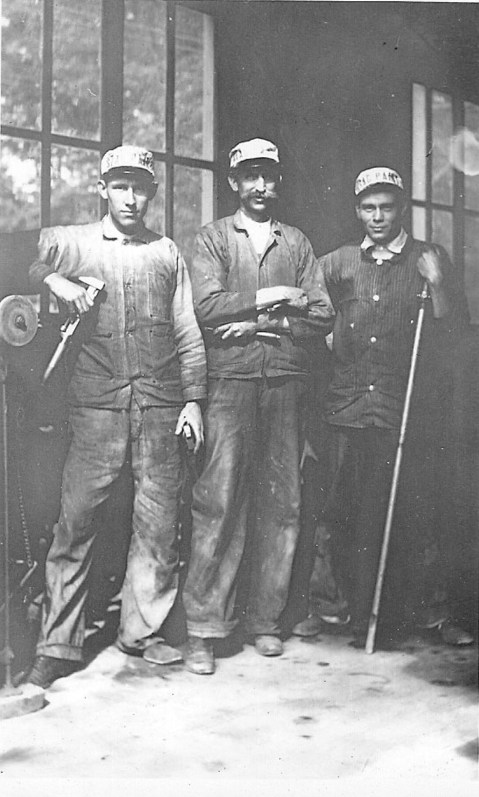
A mechanical aptitude was necessary to be a dealer in the early 1900’s. When cars were shipped to the dealer from the manufacturer, they arrived partially assembled in railroad boxcars. It was the dealer’s responsibility to unpack and assemble the cars at the rail yard and drive them back to the dealership. Mechanics were often needed to repair the new cars if they broke down along the way. Lewis Reed was an expert auto mechanic. He received his automotive training at the Pierce-Arrow factory in Buffalo, New York, the Dodge Hamtramck and Hudson Motor Car factories in Detroit, Michigan and The Automobile College of Washington.
The Automobile College of Washington
The Automobile College of Washington was organized in 1909 for the purpose of training young men to become chauffeurs and repair cars. The school was the pioneer institution of its kind in Washington, DC. The school had a repair department, machine shop, and a chassis construction classroom for the very latest automobiles. Some of the cars used in the school: the Washington A-1 Touring Car, Pope Tribune, Ricketts Model G 6-cylinder, Peerless 35hp; and the Mitchell 25hp.
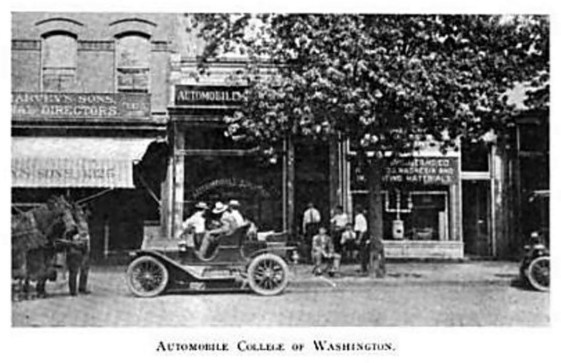
The Automobile College of Washington from the August 11, 1909 issue of The Horseless Age magazine (Google Books)
During the early days when automobiles had left the factory, routine maintenance and repair was largely left up to the owner as the auto repair industry was still in its formative stages. For the early generations of cars and car drivers, how long an automobile remained in good operating condition was left up to the owner and their routine service visits.
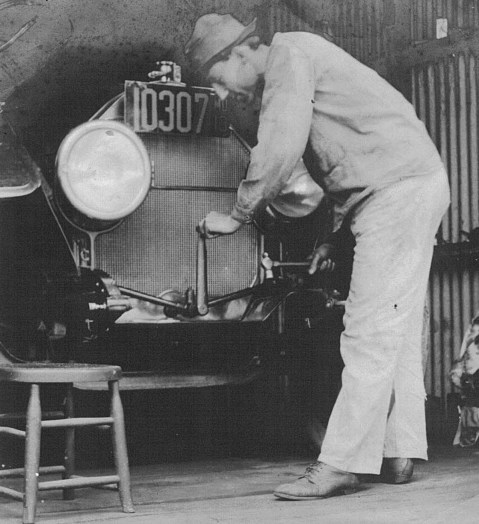
Lewis Reed hand cranking an old car. The hammer in Lewis Reed’s right hand is for straightening the hand crank. Apparently they can bend when starting big engines. The license plate is MD 10307 dated 1913.
Many early auto dealers started out of existing garages. Business owners of the early dealership soon discovered they could create a market not just for sales but for repair as well. Between 1900 and 1930 the American automobile business was built by tinkerers and visionaries and the repair and maintenance industry was no different. In 1932, automobile manufacturing reached its lowest point since 1918 and the advent of the used car rose to great prominence in the automotive community.
Lewis Reed, Chauffeur-Mechanic
The year is 1910 and you’ve just purchased a brand new automobile. To show it off for the first time, you’ve hired a knowledgeable chauffeur. You sit on a padded seat while the chauffeur tends to the engine. Though it takes a while to start up, your new ride can reach around 37 mph. The ride is a bumpy one, and you could probably walk faster than the car travels. Ooops!!! One of the wheels has popped off as you go around a bend. Chauffeurs were not only trained to be proficient with their driving skills, but they also had to keep the luxury automobiles in tip-top shape, which is where Lewis Reed’s mechanic training – a vital skill in the early days of motoring – would have come into play.
Prior to World War I, Lewis Reed’s love of automobiles led him to becoming a chauffeur. At the dawn of the early 20th century, society was transitioning from horse-drawn carriages to automobiles. Having grown up in a blacksmith family, he was well positioned to move to the new technology.
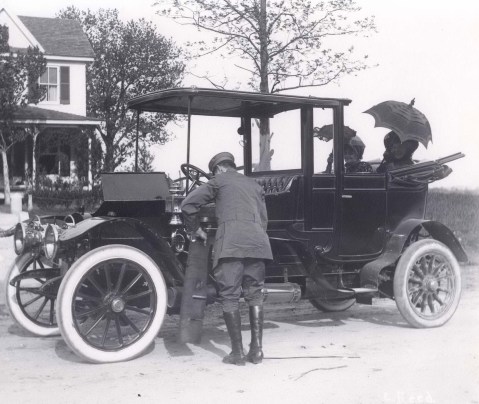
Chauffeur Lewis Reed is tending to the motor. Photo taken circa 1910.
Chauffeur-mechanics of the early 1900s were the first group to earn a living working on automobiles. Wealthy people employed private chauffeur-mechanics to not only drive, but also maintain and repair their large, expensive automobiles — rather than learn to do it themselves. The vehicles of the time came with mobile toolboxes often resembling a small hardware store tucked away in the trunk. The early 1900s Pierce-Arrow toolkit included extra intake and exhaust valves, not exactly your typical roadside service. During the height of travel season, Spring through Fall, oil changes were required almost weekly. As you can easily surmise, there had to be someone to keep track of all of the maintenance and upkeep of the vehicle as well as the daily driving. The 1910 census indicated that 23-year-old Lewis Reed was working as a machinist. Lewis worked as a chauffeur from roughly 1910-1914, before he became involved in the business of selling and repairing automobiles.
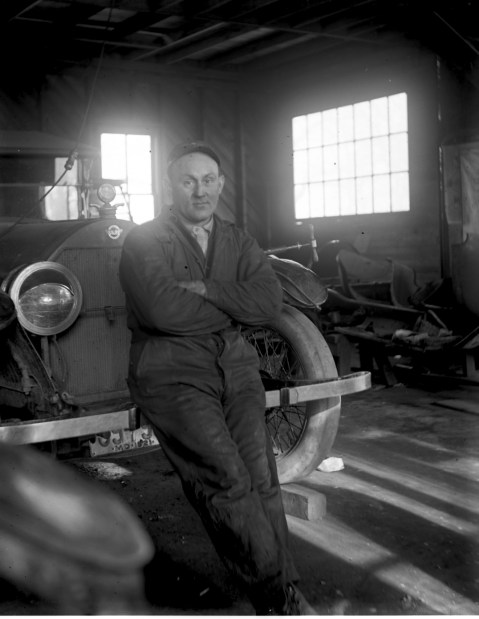
Grafton Reed, Mechanic & Garage Manager, Rockville Garage, ca. 1921
Grafton Reed was a brother of Lewis Reed and a part of the dealership’s first shop force. Grafton started working as a mechanic at the dealership in ca. 1918. According to his U.S. World War I Draft Registration Card, 1917-1918, his occupation at the time was listed as Garage Manager, Rockville Garage. Phillip Reed, another brother of Lewis Reed, was also a part of the dealership’s first work force. Phillip came to work for the dealership in 1916 and worked as a mechanic until 1944.
During the Great Depression, many consumers held onto their vehicles for longer periods of time and the lubrication of the vehicle became a matter of great importance to extend its running life. Author and Automotive Historian Robert Genat wrote, “The Depression of the early 1930s proved devastating for the marginally financed automakers. Dealerships for the top-selling cars survived the drought by virtue of their parts and service departments for maintenance and repair of consumer automobiles.” Like most other businesses, the Great Depression hit hard and Reed Brothers had to rely on its Service Department to make ends meet. But, the dealership survived through those hard times.
1953 Reconstruction of Gulf Gasoline Station
Due to changes in the highway, Reed Brothers Dodge began an extensive remodeling and rebuilding program. The program consisted of a sizable addition to their Service Department which enlarged the Showroom area and housed the Parts Department. Two-thirds of the original location at the junction of then Route 240 and Veirs Mill Road was razed and a modern Gulf Service Station was erected. The following photos were taken before demolition and after reconstruction of the Gulf Gasoline station.
Before Demolition

1936 Reed Brothers Dodge canopied Gulf Gas Station prior to 1953 reconstruction of Gulf Gasoline Station. View Rockville Pike side
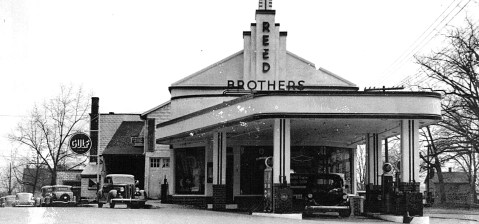
1936 Reed Brothers Dodge canopied Gulf Gas Station prior to 1953 reconstruction of Gulf Gasoline Station. View Veirs Mill Road side.
After Reconstruction

After reconstruction of new Gulf Gas Station, view from Rockville Pike
Like many building types of commercial and roadside industries, gas stations often underwent alterations or changes over time. Reed Brothers Gulf Gas Station underwent five alterations over the course of 55 years that were built to follow corporate design. The famous Gulf “ice box” design dates back to late 1930’s, and there were probably more of these built than any single one of the later Gulf designs.
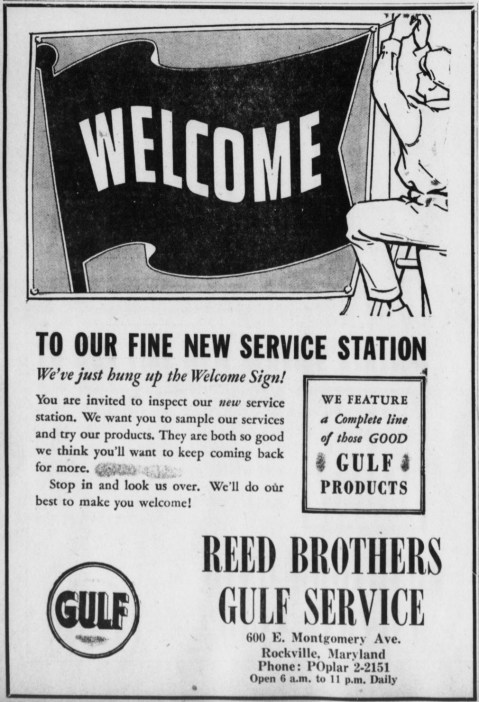
The Montgomery County Sentinel. November 12, 1953
From The Montgomery County Sentinel. June 04, 1953
Reed Brothers Will Move June 13 to New Building
Reed Brothers, second oldest Dodge dealer, which has been serving the county for 38 years, is moving from its present location at the point of the Veirs Mill Road, Route 240 triangle in Rockville to a modernized location nearby at 608 East Montgomery Avenue. Open House will be held June 13 from 6p.m. to enable residents to view the new structure.
The automobile firm will have greatly enlarged quarters in the new location, with increased floor space for the new car department and the repair department. A completely new parts department and a modern service department where the tradition of service that has been built up by this firm through the years will be carried on, and if possible, improved.
The service department will be completely equipped with parts for all Chrysler made cars and will have facilities for repair of all makes of cars. The paint and body shop will be one of the best equipped in the area and the glass department will be prepared to install any or all automobile glass and also to prepare custom cut glass for any other use.
The shop and sales offices will be open from 8 a.m. to 9 p.m. weekdays and will remain open until 6 p.m. Saturdays.
The familiar triangle gasoline station will be razed and an ultra-modern Gulf gasoline service station constructed. The new service station will be operated independently of the Reed Brothers plant. Every effort will be made to serve the customers while the transition is taking place, company officials said.

The Montgomery County Sentinel. June 11, 1953
Batter Up! 1950s Service Reminder
 Remember in the 1950’s and 1960’s when gas stations were called service stations? They pumped gas and gave out road maps and promotional giveaways like pens, calendars, thermometers, etc. These items are rare finds, because most get thrown away when the doors are closed.
This item is a promotional 1950s Reed Brothers Dodge-Plymouth 3-1/4 inch cardboard BATTER UP! service reminder. The dealership still used a 4 digit phone number: Rockville 2151 and had the old blue and orange Gulf logo. Some of the more difficult collectibles to obtain were awards given to the salespeople for outstanding sales performance, including neckties, cuff links, pen and pencil sets, and award plaques. Unique items were often given to salesmen to promote a new model being released that year.

 This item is currently being offered for sale on ebay: 1950s GULF GAS-Reed Bros. Dodge/Plymouth 3-1/4″ inch BATTER UP! Cardboard Baseball service reminder.

Montgomery Magazine Wheels and Deals Feature
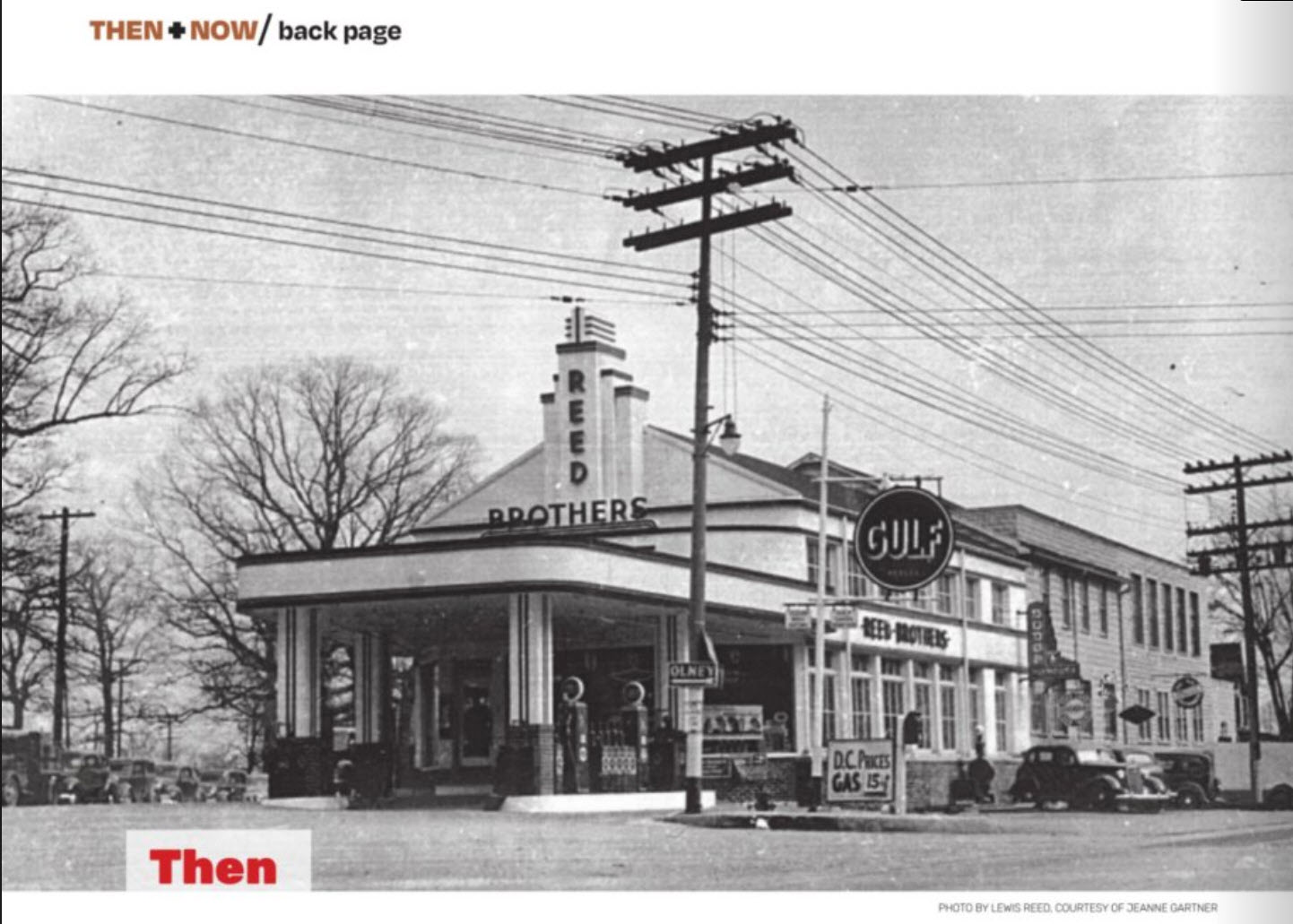 Reed Brothers is very proud and honored to be featured in the month of August/September 2022 Montgomery Magazine, “Then & Now” section. The black and white photograph above shows the expansion of Reed Brothers Dogde showroom and Gulf Gasoline Station that took place in 1941. At about the same time as the gas station was remodeled, Lewis Reed split up the Sales and Parts and Service operations by constructing a complete new building that was located at the intersection of at Montgomery Avenue and Dodge Street.
A closer look at the photo reveals the price of gasoline as 15 cents. On the right attached to a telephone pole is a sign pointing the way to Olney. In addition to the Gulf signage there is a small, barely visible sign below that promotes, “Clean Rest Rooms”.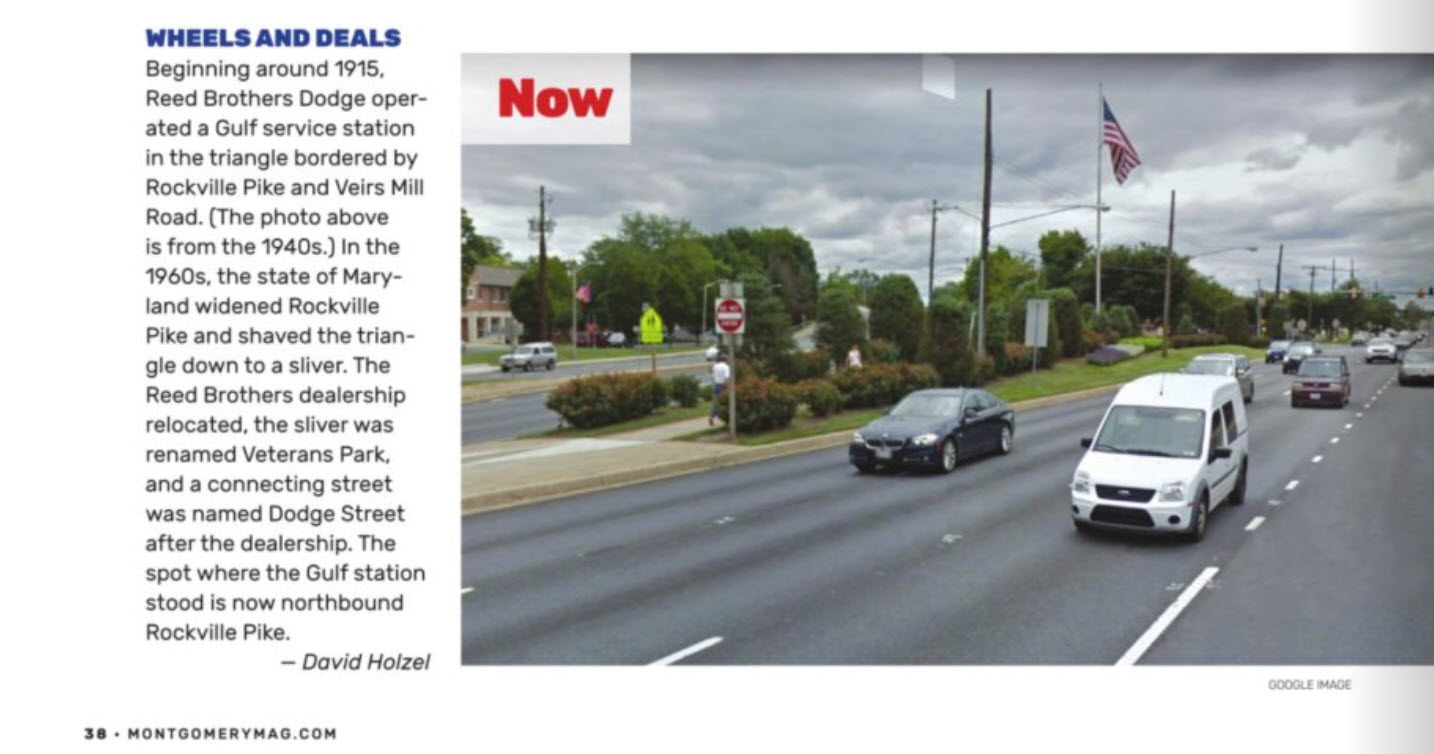
The color photograph above, is the dealership’s location today, now known as Veterans Park. In the 1970s, the site was known as the Francis Scott Key Memorial Park, and later in 1988, it was permanently rededicated as Veterans Park. In the late 1960s, the state of Maryland acquired the land to widen Rt 355 and donated the remaining sliver to the City. The State of Maryland named the connector street behind the dealership’s original location “Dodge Street” following the dealership’s 1941 expansion.
Montgomery Magazine is a lifestyle magazine, with timely articles on county leaders, entertainment, sports, neighborhood and restaurant profiles, entrepreneurs, historic landmarks then and now, plus seasonal special sections of local interest.
Find the issue online at: http://digital.montgomerymag.com/issues/August-2022/index.html
The First Plymouth Automobile Debuted on This Date 94 Years Ago
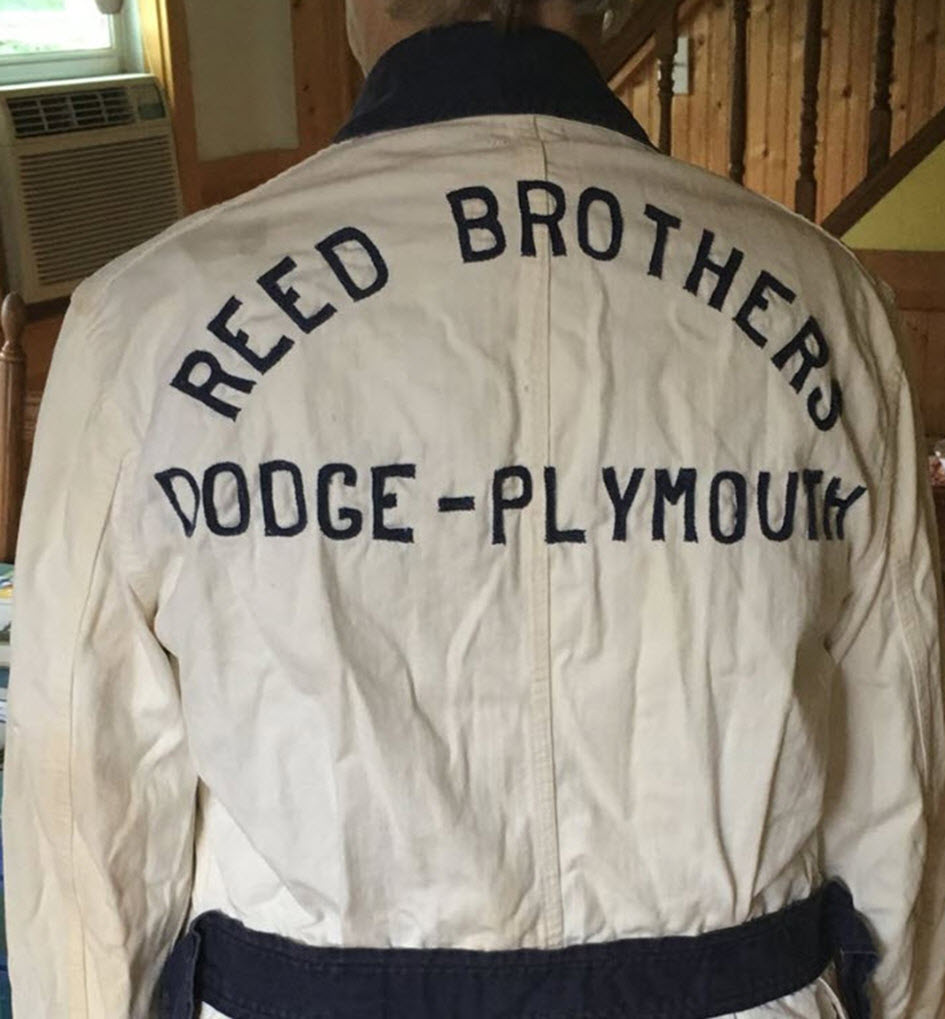
Plymouths were sold at Reed Brothers from 1930-1969. Pictured is an original 1940s Reed Brothers Dodge-Plymouth three-pocket shop coat made by Anderson Bros. of Danville, VA.
The first Plymouth automobile was introduced on July 7, 1928. Plymouth was Chrysler Corporation’s first entry in the low-priced field, which at the time was already dominated by Chevrolet and Ford. Plymouths were actually priced slightly higher than their competition, but offered all standard features such as internal expanding hydraulic brakes that the competition did not provide. While the original purpose of the Plymouth was to serve a lower-end marketing niche, during the Great Depression of the 1930s, the marque helped significantly in ensuring the survival of the Chrysler Corporation in a decade when many other car companies failed. Beginning in 1930, Plymouths were sold by all three Chrysler divisions (Chrysler, DeSoto, and Dodge).
Plymouth sales were a bright spot during this dismal automotive period, and by 1931 Plymouth rose to the number three spot among all cars. Plymouth almost surpassed Ford in 1940 and 1941 as the second most popular make of automobiles in the U.S.
In 1957, Virgil Exner’s new Forward Look design theme, produced cars with much more advanced styling than Chevrolet or Ford. 1957 total production soared to 726,009, about 200,000 more than 1956, and the largest output yet for Plymouth. However, the 1957–1958 Forward Look models suffered from poor materials, spotty build quality and inadequate corrosion protection; they were rust-prone and greatly damaged Chrysler’s reputation.
Most Plymouth models offered from the late 1970s onward, such as the Volaré, Acclaim, Laser, Neon, and Breeze, were badge-engineered versions of Chrysler, Dodge, or Mitsubishi models. By the 1990s, Plymouth had lost much of its identity, as its models continued to overlap in features and prices with Dodges. Plymouth’s product offerings and buyer appeal, and sales continued to fall.
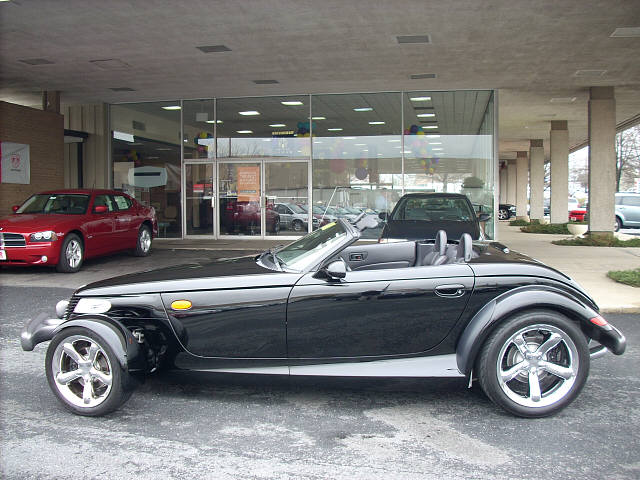
This Limited Edition 1999 Plymouth Prowler convertible was a vehicle from the dealership owners’ private collection. Photo by blog author.
By the late 1990s, only four vehicles were sold under the Plymouth name: the Voyager/Grand Voyager minivans, the Breeze mid-size sedan, the Neon compact car, and the Prowler sports car, which was to be the last model unique to Plymouth. The Prowler came about as part of Chrysler’s efforts (the last as it turned out) to differentiate Plymouth from the rest of its lineup in hopes of keeping the brand alive. It was hoped that it would be received well enough to garner some attention, some of which might spill over into some of their other models.
Plymouth rarely exceeded 200,000 cars per year after 1990. Consequently, DaimlerChrysler decided to drop the make after a limited run of 2001 models. This was announced on November 3, 1999.
Books

Related Resources


Copyright Notice

Reed Brothers Dodge History (1915-2012) by Jeanne Gartner is licensed under a Creative Commons Attribution-NonCommercial 3.0 Unported License.
 Reed Brothers Dodge History 1915 – 2012
Recent Comments