
Derailed Trolley: Montrose Rd & Rt 355
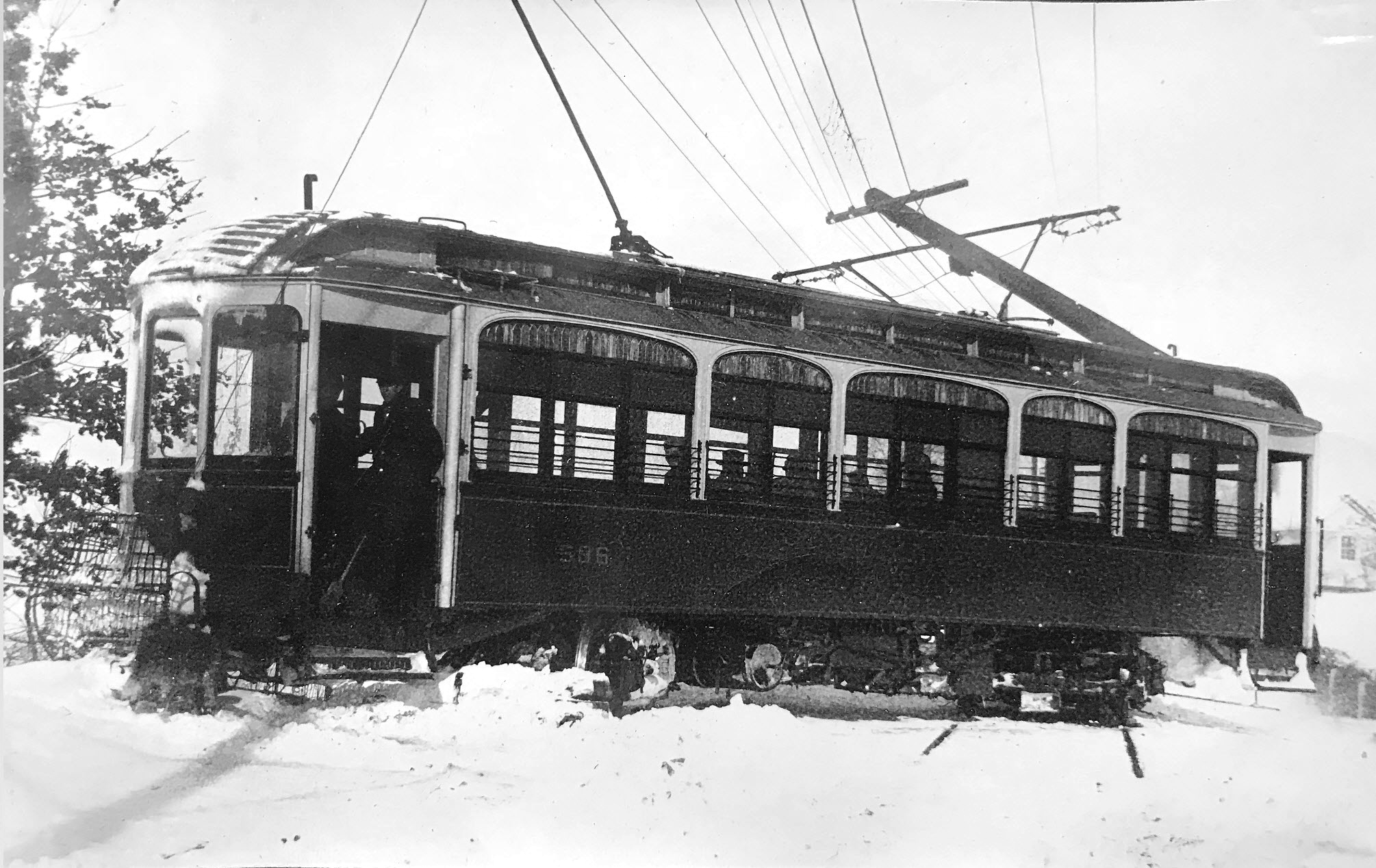
Derailed trolley at Montrose Road and Rockville Pike. Photo by Lewis Reed
In the early years of the 20th century, when electric trolleys were a lifeline for Montgomery County, a derailment near Montrose Road (today’s Rt 355) brought travel to a sudden halt.
In populated urban areas, trolley cars kept speeds to 12 mph (6 mph at intersections), but in open country they could get up to 40 mph. Traveling in snow was additionally hazardous, as evidenced by the trolley pictured in these photos, which derailed and plowed into a telephone pole at Montrose Road and Rockville Pike.
Lewis Reed was there to capture the accident from two different perspectives using a five-by-four box camera which produced images on a glass plate.
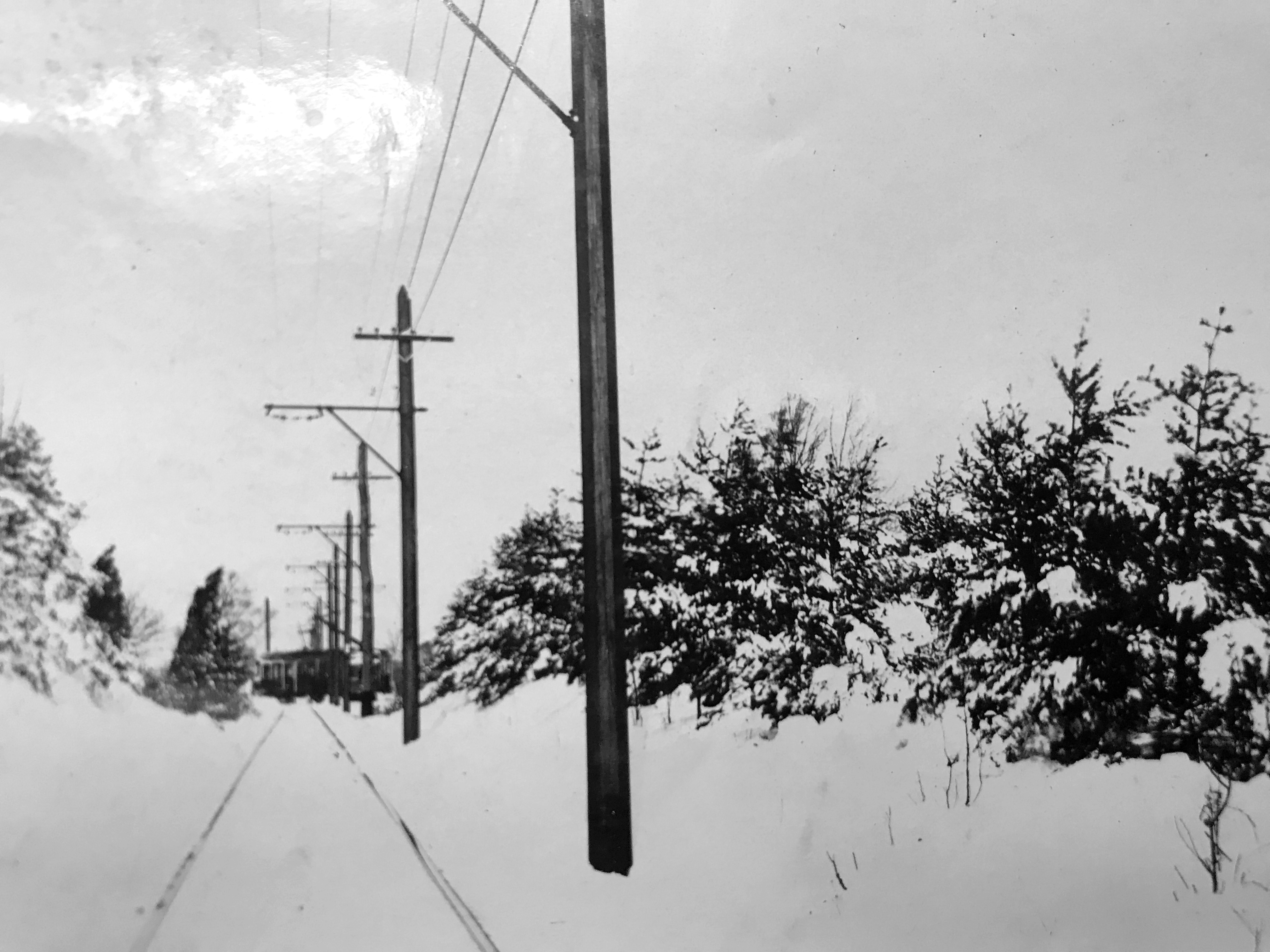
Viewed from a distance, the derailed trolley lies off the tracks as Lewis Reed records the scene.
Early 1900s Frederick Fair Parking Lot

Frederick Fair Parking Lot, circa 1914. Photo by Lewis Reed
This fascinating scene of hundreds of vintage cars parked in the Frederick Fair parking lot was taken by Lewis Reed. What is fascinating to me is, with all of these early cars painted in black, how on earth would you find your car in the parking lot?
The Frederick County Fair is one of the oldest agricultural fairs in the state of Maryland dating back to 1822 when it was known as the Cattle Show and Fair. Over the years the fair has changed names several times. Today, the Frederick County Fair is officially named the Great Frederick Fair. The GREAT Frederick Fair is celebrating 154 years in 2016 (Sept. 16-24).
Lewis Reed Photos: Steam-Powered Engines
Looking back at photography from the past is a fascinating experience for me. Since I started this blog, I have had the opportunity to look through my grandfather’s extensive collection of photographs from locations all across the country. The majority of his photos are more than 100 years old and, unfortunately, are lacking labels and/or dates, which requires quite a bit of research and a little photo detective work on my part. Adding up the clues can help solve the mystery, date, and help identify the images. Google sometimes surprises me with its capabilities.
The below previously unpublished photos (dated 1909) from Lewis Reed’s album are what appears to be some of the early machines that helped build America. Steam traction engines, or steam rollers and road locomotives as they were sometimes called, were the predecessor to today’s modern farm tractor. They could plow, they could haul, and you could put a big belt on the fly wheel and drive a saw mill; whatever you wanted to do. They were also used as a transportable power source. The engines would normally run on coal, wood, or even straw, or whatever would build a fire. The photos shown here were dated 1909.

1909: SAWMILL POWERED BY STEAM TRACTION ENGINE – photograph by Lewis Reed
As a Michigan farm boy, Henry Ford recorded his first sight of a traction engine: “I remember that engine as though I had seen it only yesterday, for it was the first vehicle other than horse drawn that I had ever seen. It was intended to drive threshing machines and power sawmills and was simply a portable engine and a boiler mounted on wheels.” It was the steam traction engine that inspired Ford to design and manufacture automobiles.
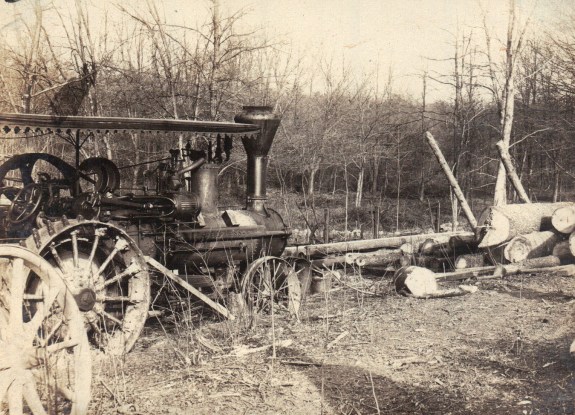
1909: SAWMILL POWERED BY STEAM TRACTION ENGINE – photograph by Lewis Reed
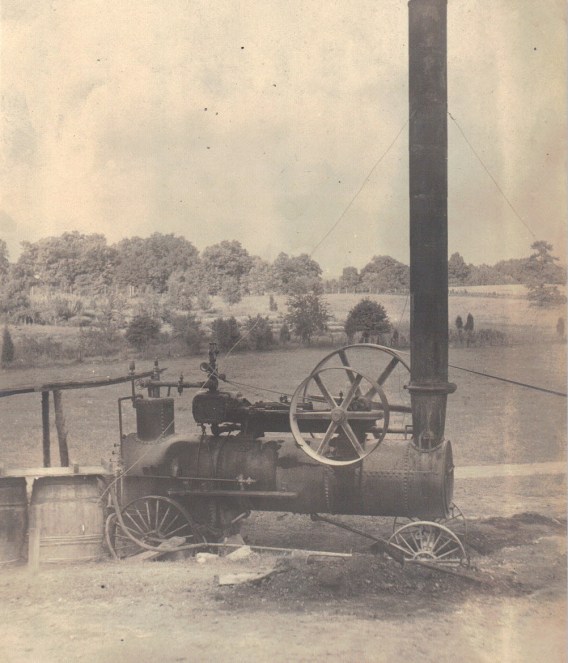
PORTABLE ENGINE WITH CHIMNEY SHOWING THE LACK OF SELF-DRIVEN WHEELS – photograph by Lewis Reed
A portable engine is a type of self-contained steam engine and boiler combination that may be moved from site to site. Although bearing a strong family resemblance, in both appearance and (stationary) operation, the portable engine is not classed as a traction engine as it is not self-propelled.

STEAM ROAD ROLLER – photograph by Lewis Reed
Steam Road Roller: This take-off of the steam traction engine was designed specifically for road building and flattening ground mimicking today’s modern rollers used for compacting road surfaces. A single, heavy roller replaced the front wheels and axle and a smoother rear wheels replaced larger wheels without strakes. (strake – name for the diagonal strips cast into or riveted onto the wheel rims to provide traction on unmade ground).
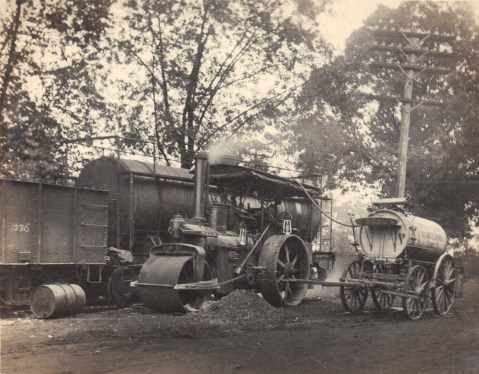
STEAM ROAD ROLLER – photograph by Lewis Reed
Photos cannot convey the raw power of a steam tractor: the way its pistons, valves, gears, and wheels are locked in constant motion. You really have to see this machinery in action.
Watch video of a 1916 Case steam engine tractor power a sawmill.
Road Tripping in a 1935 Dodge Touring Sedan

Lewis Reed’s 1935 Dodge Touring Sedan. Photo by Lewis Reed
This photograph was taken by Lewis Reed on one of his many cross country road trips. The car is a 1935 Dodge Touring Sedan with Maryland Dealer license plates. Note the rear-hinged “Suicide Door” in the photo below. Cars of this era did not have seat belts, so there was nothing to hold a passenger in the car. The term “suicide doors” was therefore placed on vehicles with the rear-hinged door configuration, the theory being that the forward motion of the car could cause the door to fly open, possibly causing the unlucky person sitting next to the door to be pulled out of the car, or the door itself could be ripped from its hinges.

I have no idea what prompted my grandfather to take a photo at this location, but perhaps it was the amazing view in the background. Photo by Lewis Reed
April 6, 1936 Gainesville GA Tornado: Through the Lens of Lewis Reed
One of the deadliest tornadoes in American history hit Gainesville, Georgia on April 6, 1936. And Lewis Reed was there to capture the aftermath. On the 80th anniversary of this epic tornado, I have posted seven original snippets of history that Lewis Reed captured through the lens of his camera that day.
In 1936, two F4 tornadoes tore through the heart of town destroying much of the business district and the county courthouse, trapping hundreds in debris, before moving on to surrounding neighborhoods. The funnel fueled fires all over the area, including the Cooper Pants manufacturing company, where 60 employees were killed. The storm left more than 200 dead, 1,600 injured, 2,000 homeless and millions of dollars in damage. President Franklin Roosevelt toured the city three days later, and returned in 1938 to rededicate the courthouse and city hall after a massive citywide rebuilding effort.
Take a look at some of the sobering aftermath photos of the deadliest tornado to ever hit Georgia … through the lens of Lewis Reed. (click on images for slide show)


Source: Wikipedia – 1936 Tupelo–Gainesville tornado outbreak
Books

Related Resources


Copyright Notice

Reed Brothers Dodge History (1915-2012) by Jeanne Gartner is licensed under a Creative Commons Attribution-NonCommercial 3.0 Unported License.
 Reed Brothers Dodge History 1915 – 2012
Recent Comments