
Here’s How Rockville’s Trolley Era Looked Over 115 Years Ago
This special post is a collection of early trolley car photos that were taken by Lewis Reed in the early 20th century. Trolleys existed in American cities before the Civil War, but a line did not connect Washington, DC to Rockville, Maryland, until 1900.
The agreement between the town of Rockville and the W&R Railway Co. ran for 35 years. From 1900 to 1935, street cars plied the track from the Washington terminus at Wisconsin and M Streets, N.W., up Wisconsin and then Old Georgetown Road, over a steel trestle just before the cars approached Georgetown Prep, through dense woods at Montrose and onto the Rockville Pike, through Rockville on Montgomery Avenue, to Laird Street, and back again. The cars could be driven from either end. In 1929, W&R ran 24 trips a day between 6:30 a.m. and 12:30 a.m. to connect Rockville and Washington. Major stops along the line included Georgetown, Alta Vista, Bethesda, Montrose, Halpine, the Fairgrounds, Courthouse Square, and Chestnut Lodge. Six switching stations and side tracks enabled street cars to pass as they went in different directions.
Below are a collection of photographs taken by Lewis Reed that shows what the old trolley cars looked like, highlighting what riding the trolley car was like in the early 1900s. From wood-paneled exteriors with ceiling fans to advertisements, here’s a nostalgic look back at Rockville’s Trolley car era through the lens of Lewis Reed. (click on photos to enlarge)

Western Avenue car barn for the streetcars that served the Georgetown-Tenelytown-Bethesda-Rockville line. Photo by Lewis Reed
A car barn is the streetcar equivalent of a garage for buses. It’s a covered facility in which streetcars were stored overnight, cleaned and given light repairs before the next day’s run. The car barn for the trolleys at the time was the second Western Avenue car barn for the streetcars that served the Georgetown-Tenelytown-Bethesda-Rockville line. It was located at on west side of Wisconsin at between Harrison and Jennifer. It was demolished and later replaced by a purpose-built bus garage which is still in use by WMATA. The National Capital Trolley Museum was instrumental in helping to identify the car barn in the photo above.
Leroy King described the street car below as one of Washington Railway’s majestic “Rockville” cars, at 4 switch in 1908. Note multiple unit jumper box under center front window.

Passengers board car #596 heading to Rockville in 1908. These distinctively styled cars, popularly know as ‘Rockville’ cars, were also used on Washington Railway’s Maryland line. Note the ‘people catcher’ or ‘lifeguard’ in the front. Photo by Lewis Reed, 1908
Traveling in snow was sometimes hazardous to trolley cars, as evidenced by the trolley pictured below which derailed the train tracks and plowed into a telephone pole at Montrose Road and Rockville Pike. Lewis Reed was there to capture the accident from two different perspectives using a five-by-four box camera which produced images on a glass plate.
In populated areas, street cars kept speeds to 12 mph (6 mph at intersections), but in open country they could get up to 40 mph.

Derailed trolley at Montrose Road and Rockville Pike. Photo by Lewis Reed
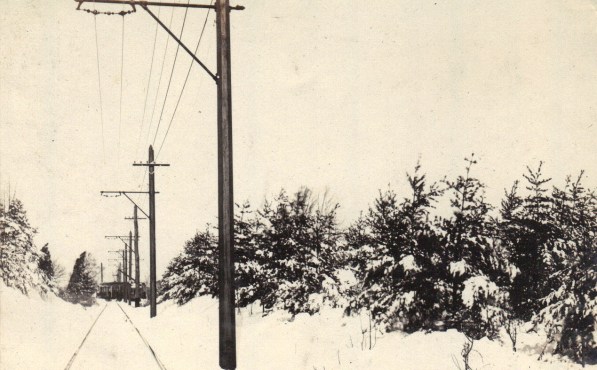
Derailed trolley through dense woods at Montrose Road and Rockville Pike. Photo by Lewis Reed
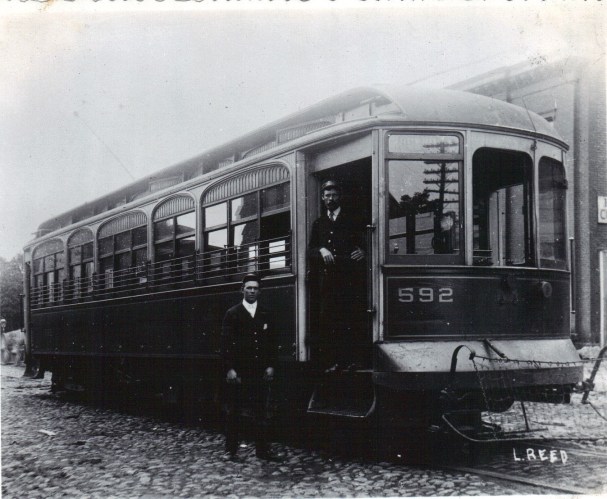
Rockville Trolley Car 592. Photo by Lewis Reed
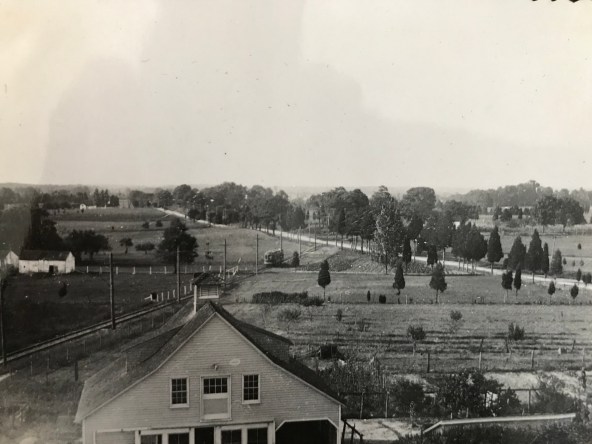
A trolley heads south from Rockville toward Tenallytown through open farmland. This view appears to be looking north and shows the area south of where Montrose Road intersects with Rockville Pike. The Pike is in the background. Photo by Lewis Reed, 1910

Trolley tracks on Rockville Pike south of Sherrer Farm. Note that one of the young men is holding a bicycle. Photo by Lewis Reed, ca. 1911
The Archival Producer for television’s most-watched history series, AMERICAN EXPERIENCE on PBS, found the photograph of the 1920’s trolley interior on this blog and asked permission to use it in the documentary, “The Great War,” a six-hour, three-night event, that premiered April 10-12, 2017 in conjunction with the 100th anniversary of America’s entry into WWI.
All of these prints were originally made from a glass plate negative, an early photographic technique which was in common use between the 1880s and the late 1920s. The early 1900s were considered by many to be the golden era of early photography, because of its new availability to the public and somewhat simplified production methods. Many of Lewis Reed’s early photographs are now part of the Montgomery County Historical Society photo archives.
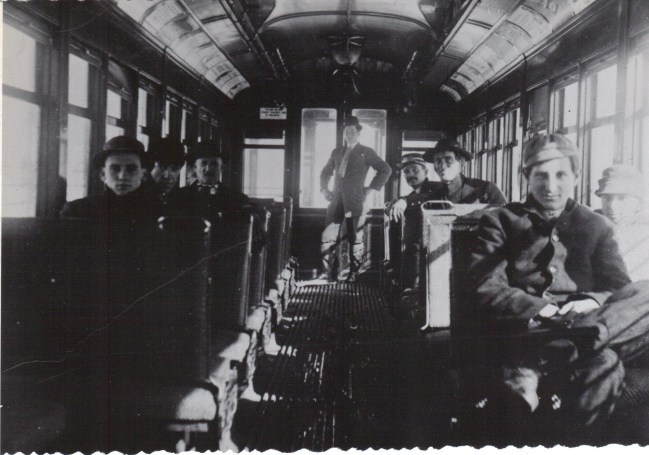
Interior of 1920’s Rockville trolley car. Photo taken by Lewis Reed
Panels for advertising line the edge of the ceiling on both sides of the trolley. Instead of AC, the interiors were cooled with wooden ceiling fans.
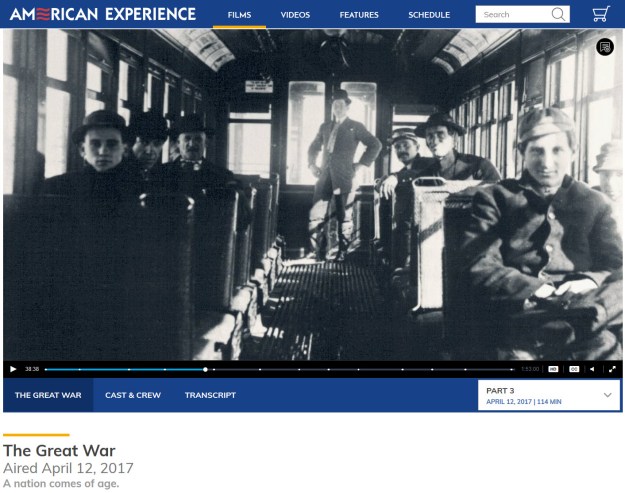
Rare peak of the inside of a 1920’s trolley car and passengers featured in PBS documentary “The Great War”. Photo taken by Lewis Reed
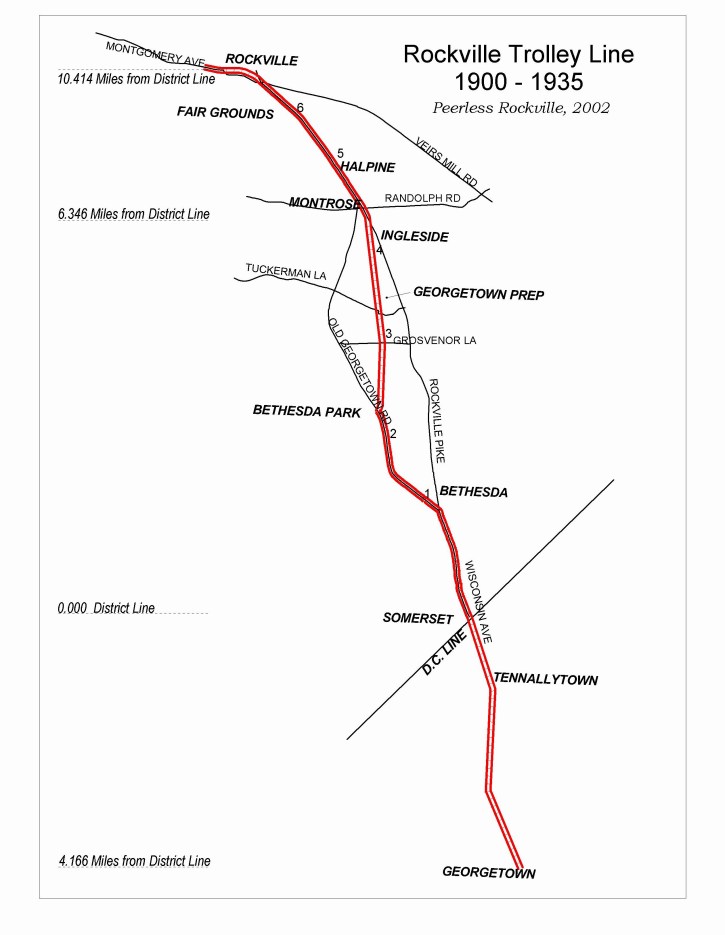
Rockville Trolley Line 1900-1935 – Peerless Rockville 2002
Sources: Rockville Pike History – City of Rockville
History of the Street Car Lines of Montgomery County
Halpine / Lenovitz Store at 1600 Rockville Pike, 1910

Halpine / Lenovitz General Store at Rockville Pike and Halpine Road, 1910. Photo taken by Lewis Reed.
The Halpine Store, also known as the Lenovitz General Store, was built on Rockville Pike in 1898, taking advantage of the prime location on the trolley and railroad lines and the Pike. The store sold food, gasoline and other items to locals and Pike travelers. There is a young African American man standing in front of the store. Note the telephone or telegraph poles, and the trolley tracks paralleling the road. The nearby Halpine railroad station also brought customers to the area, and the store became the social/community gathering place for the Halpine area.
The proprietors, Benjamin and Anna Lenovitz, lived on the second floor. The building burned in 1923 and a new fire-resistant brick building was rebuilt in its place. This building, at 1600 Rockville Pike, became a Radio Shack, selling computers and electronics.
Source: Maryland Historical Trust
Huckleberry Finn?
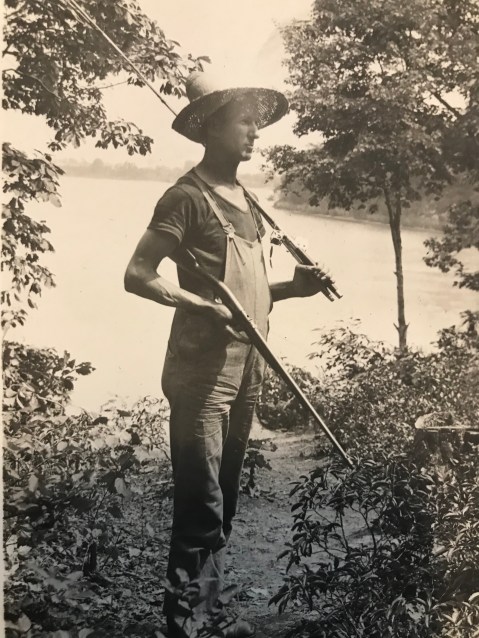
An adult Huckleberry Finn look-alike poses at Pope’s Creek, Maryland on the Potomac River. Photo by Lewis Reed, ca. early 1900s.
Pope’s Creek is located on the shore of a north-south section of the Potomac River north of and in sight of the Harry Nice Memorial Bridge. Lewis Reed was an avid fisherman and frequently fished and camped at Pope’s Creek with friends and family.
Near here, John Wilkes Booth was rowed across the river, a week after he assassinated President Abraham Lincoln.
On the Self-Publishing Horizon … Again!
I’m excited to announce that for the last year or so, I’ve been thinking about self-publishing a photo book specific to my grandfather, Lewis Reed, with a working title of, “Lewis Reed Photograph Collection (1898-1960).” Looking back at photography from the past is a fascinating experience for me, and with a newfound interest in history, the curious part of me wants to learn more: When was the picture taken? Where? What is it? Who’s in it? The majority of his photos are more than 100 years old and many are lacking labels and/or dates, which requires quite a bit of research and a little photo detective work on my part.
With that in mind, I will be frequently spotlighting photographs that may not directly pertain to the history of Reed Brothers Dodge, but will have a lot to do with it’s founder, Lewis Reed. I will not try to be an historian; I will post photos and supply a few paragraphs of context. Many photographic images in this collection have never before been seen publicly in print and will be available in this book for the first time.
I’ve been sitting on this post for a few weeks, timid to hit the ‘publish’ button. Likely because the size of the project is overwhelming and committing to it is a bit daunting (although exciting at the same time). It doesn’t help that as the ambition of my projects and goals increase, so too, can self-doubt. Below is the Draft Table of Contents for the book, which I’m sure will see some revisions as I progress.
Having said that, I will be switching my focus and time to mostly photo identification and researching/writing for the book.
Time to get to work!
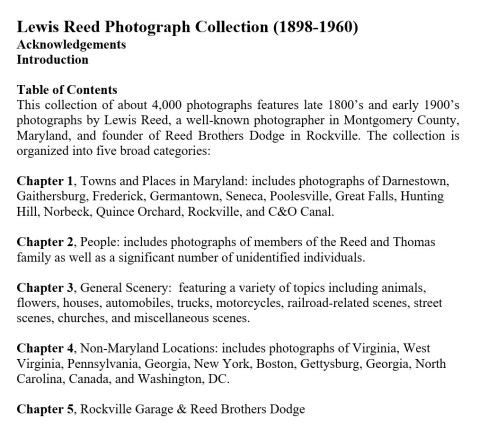
Draft Table of Contents
Lewis Reed Shows Off His “Photoshopping” Skills… 100 Years Ago
If you take a look at the state of photography today, such as the advances of digital cameras and the artful image manipulation by Photoshop, it is easy to forget that back in the 1900s photographers couldn’t just go into a computer program and change their images any way they wanted. They did what they could with the tools they had. Double image exposure was one tool Lewis Reed had in his photography tool belt. He was doing crazy things to images and creating humorous effects over 100 years ago. With double exposure technique, you could create certain effects like placing the same person on both sides of a picture simultaneously. Photographs were pieced together in the darkroom from separate photographs.
Below are eight (circa 1920s) photographs from Lewis Reed’s collection that will make you do a double take. No digital manipulation here. (click on photos to enlarge)

A double exposure image of Lewis Reed’s brother, Edgar, seated on both sides of a table.
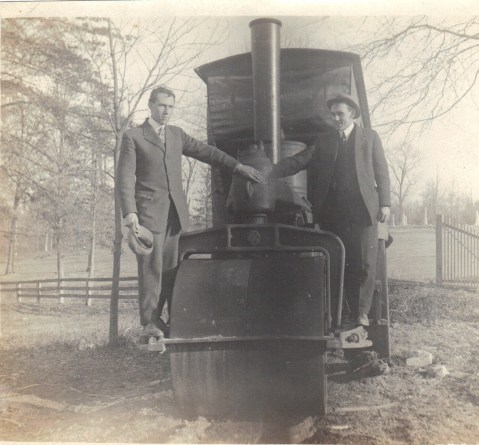
Lewis Reed standing on both sides of a steamroller

Another double exposure wonderment. Wanna Fight?

Oh No! What on earth are they doing? I don’t know, but this one is epic.
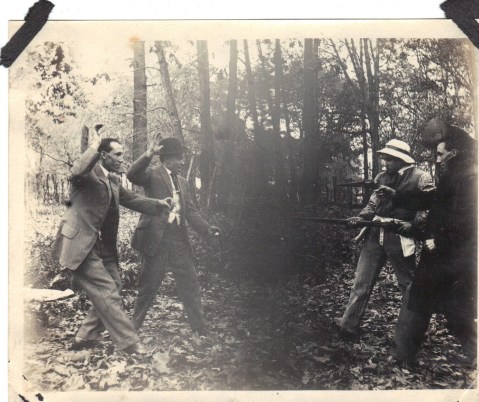
Don’t Shoot! Lewis Reed is standing both front left and front right in this photo
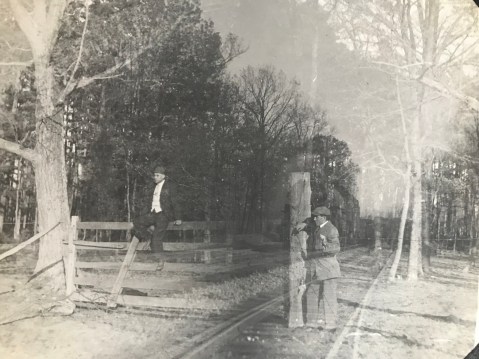
Surrealistic, ghost-like effect of Lewis Reed standing next to a tree in the middle of train track.

More “photoshop” fun. Lewis Reed pushing the same man in baby carriage on both sides of the photo.
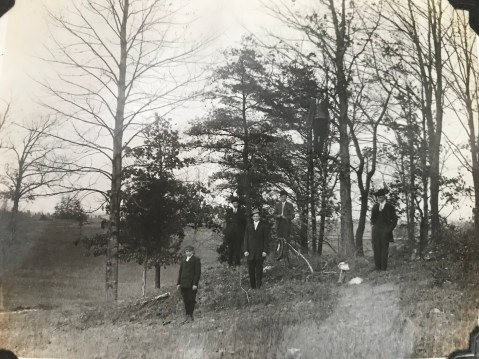
It’s a bird, it’s a plane .. no, it’s a man up in a tree!
Books

Related Resources


Copyright Notice

Reed Brothers Dodge History (1915-2012) by Jeanne Gartner is licensed under a Creative Commons Attribution-NonCommercial 3.0 Unported License.


Recent Comments