
Gallery of Early 20th Century General Stores in Montgomery County
Some of the earliest general merchandise stores in Montgomery County were located in Rockville, and on the roads leading to it. They were community-oriented businesses: the owners were friendly and knew all the locals. Day books kept by merchants at this time indicate they kept open accounts for their customers, allowing them to buy items on credit, and occasionally accepted payment of items in trade rather than currency. Toward the end of the century, some general stores found it more profitable to stop being “general” and specialized stores (selling only drugs, hardware, or farming equipment) became more common.
Rockville Business District, 1914
The heart of Rockville’s business district ran east-west on East Montgomery Avenue and Commerce Lane, spanning approximately eight blocks. Proximity to the courthouse influenced many hotels, professionals, and businesses to locate along East Montgomery Avenue, Commerce Lane (now West Montgomery Avenue), and Washington Street. Craftspeople and merchants often lived on the second story of their building or in a dwelling house next door.
The shops sold groceries, baked goods, sewing machines, hats, lumber, and hardware. Families lived above their stores, renting rooms to others. From right to left is the H. Reisinger Bakery, Confectionery, Ice Cream and Lunch Room, 5 and 10-cent Bargain Store, W. Hicks General Store, Suburban Electrical Company (SECO), and a two-story dwelling.

A view of the North side of Commerce Lane near the courthouse. Right to left: H. Reisinger Bakery, W. Hicks General Store, Suburban Electrical Company (SECO), and a two-story dwelling. Note the trolley car approaching from the left. Photo by Lewis Reed
W. Hicks General Store, 1914
Washington Hicks operated the general or dry goods store in Rockville from the late 19th century until 1940. His son W. Guy Hicks continued to run the store until his retirement in the late 1950s. The upper story of the building was the living quarters of Mr and Mrs B. F. Hicks. The building was later acquired by W. Valentine Wilson, who tore it down and replaced it with the “SECO” for Mr Wilson’s Suburban Electric Company. The ground floor was made into a moving picture theater in 1915. Sidney Lust took over the operation of this theater between 1931 and 1935 and renamed it the Arcade. He closed it down on April 21, 1935 and opened the new Milo later that year.
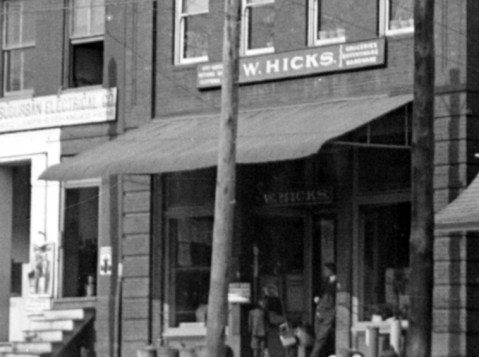
Washington Hicks operated this dry goods store in Rockville from the late 19th century until 1940. His son W. Guy Hicks continued to run the store until his retirement in the late 1950s. The photo shows the storefront in 1914. Photo by Lewis Reed
H. Reisinger Bakery & Confectionary, 1914
Below: H. Reisinger Bakery, Confectionery, Ice Cream and Lunch Room, 5 and 10-cent Bargain Store on Montgomery Avenue, Rockville. Prices were very low– in 1899 and 1900 Reisinger’s regularly advertised bread for 4 cents a loaf– yet wages were low also.
From The Baltimore Sun, 22 Sep 1912, Help Wanted Section:
WANTED – A sober, reliable all-around CAKE BAKER and ICE CREAM MAKER for retail trade; $14 per week, board and lodging. H. REISINGER Rockville, Md.

H. Reisinger Lunch Room Montgomery Ave, 1914. Photo by Lewis Reed
General Store at Quince Orchard, 1906
A small school for white children was established on the northeast corner of Darnestown and Quince Orchard Roads around 1850. It was damaged during the Civil War and eventually burned down in 1873. The school was rebuilt on the same site in 1875 but was moved across the road next to Pleasant View Methodist Church in 1902 after the fire destroyed the school for black children. The General Store at Quince Orchard was built on the same site shortly after the school building was moved.

General Store at Quince Orchard, 1906. Photo by Lewis Reed
Windsor Store in Darnestown, Early 1900s
Mr James Windsor, grandfather of Curry England, opened the Windsor Store at the corner of Seneca and Darnestown Roads in approximately 1878. He operated the store for many years, and also served as Darnestown’s Postmaster for some 20 years. During the 1800s mail arrived three times a week by stagecoach from Rockville and local people gathered for the arrival, creating a regular social event. The Darnestown Post Office was discontinued in 1911. The Windsor building survived until 1969, when it caught fire and burned to the ground.

James S. Windsor Store Darnestown, early 1900s. Photo by Lewis Reed
Downtown Germantown, ca. 1906
The original downtown Germantown was located at the intersection of Route 118 and Clopper Road. At the turn of the 20th century, most of the activity shifted to the railroad station and mill. General stores, a post office, a bank, and houses were constructed in this new downtown area. Everything from lengths of cloth to a medium rare steak could be purchased at the general store and post office on the right. Opposite the store were the mill and various small industries.

Downtown Germantown, 1906. Photo by Lewis Reed
Halpine-Lenovitz General Store, 1906
The Halpine Store, also known as the Lenovitz General Store, was built on Rockville Pike in 1898, taking advantage of the prime location on the trolley and railroad lines and the Pike. The store sold food, gasoline and other items to locals and Pike travelers. There is a young African American man standing in front of the store. Note the telephone or telegraph poles, and the trolley tracks paralleling the road. The nearby Halpine railroad station also brought customers to the area, and the store became the social/community gathering place for the Halpine area.
The proprietors, Benjamin and Anna Lenovitz, lived on the second floor. The building burned in 1923 and a new fire-resistant brick building was rebuilt in its place. This building, at 1600 Rockville Pike, became a Radio Shack, selling computers and electronics.
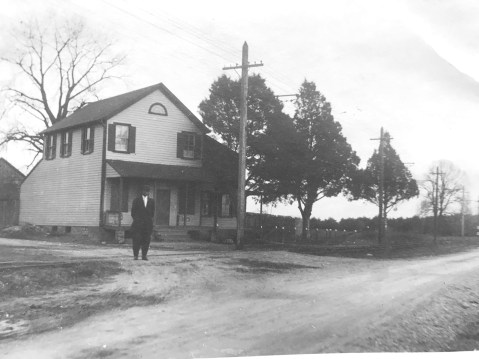
Halpine-Lenovitz General Store at Rockville Pike and Halpine Road, 1906. In this photo, there is a young African American man (unidentified) standing in front of the store. Note the telephone or telegraph poles running the length of the street. Photo by Lewis Reed
Clarksburg Main Street, 1913
In the early 20th century, Clarksburg was the third largest town in Montgomery County, after Rockville and Poolesville. Clarksburg had four general stores, two hotels, and an academy of learning. It also had a blacksmith, a doctor’s office, tanneries, shoemakers, winemakers, tailors, wheelwrights, fertilizer businesses, skilled farmers, master carpenters and two town bands.

Main street (Frederick Road Rt 355) Clarksburg, 1913. Photo by Lewis Reed
Unknown General Store, Early 1900s
While every store was different, there were similarities among them, including a front door that was often decorated by tin signs advertising for tobacco, cigars, shoes, hardware, and more. The sign in front of this unidentified mercantile advertises Battle Axe Shoes, Stephen Putney Shoe Company. Usually, general stores featured double doors that opened inward and lots of barrels that might contain any number of items — from pickles, to crackers, potatoes, flour and candies. The store was usually an unpainted, two- story frame building fronted by a raised porch for convenient loading and unloading.
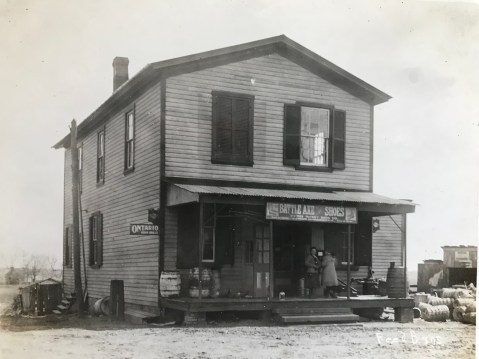
Circa 1900s country store on a dirt road. Note the sign advertising Battle Axe Shoes. Two ladies standing on the porch. Location Unknown. Photo by Lewis Reed
J.F. Collins General Store, 1914
On a bleak night in February 1921, a pistol shot was fired while others yelled, “Fire!”. From John Collin’s store on East Montgomery Avenue — beloved by local children for Cracker Jacks and penny candy — flames reached toward the sky. Volunteers arrived with buckets while others operated the hose reels and hook and ladder truck. The main street was saved with help from men and equipment of Washington, D.C., but Collins’s store was a smouldering ruin. A few weeks later, fifty concerned townspeople elected officers of the newly formed Rockville Volunteer Fire Department.
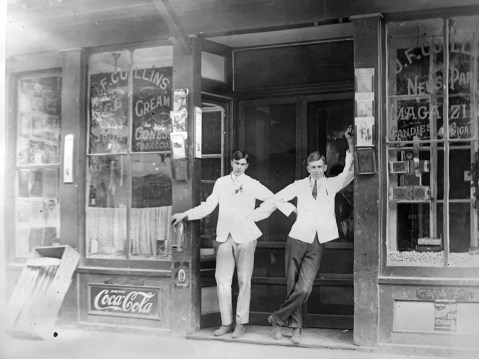
Clerks at J. F. Collins General Store on East Montgomery Avenue in Rockville, 1914. At left is A. F. “Seen” Beane, who bought this store from Collins in the 1920s and continued doing business in downtown Rockville until his retirement in the 1960s.
Find photos like these and much more on Montgomery History’s online exhibit, “Montgomery County 1900-1930: Through the Lens of Lewis Reed“.
Then & Now: Washington’s Cherry Blossoms
Time passes, but the cherry blossoms always come back. Seeing the cherry blossoms is a time-honored D.C. tradition that dates back to 1912, when Tokyo gifted 3,020 cherry trees to the U.S. in an act of friendship. While many of the original trees have been replaced, the Tidal Basin’s beauty has persisted for more than a century. Each spring, more than 1.5 million visitors descend upon Washington, D.C. each year to admire the 3,000-plus trees.
Here are “then and now” comparison shots of the Cherry Blossoms on the Tidal Basin in Washington, D.C. from 1930 and 2022.
Cherry Blossoms on the Tidal Basin (THEN): From Lewis Reed’s collection of photographs. Cherry blossoms in bloom along the Tidal Basin, circa 1930s with my mother, Mary Jane (Reed) Gartner.

Cherry blossoms in bloom along the Tidal Basin with my mother, Mary Jane (Reed) Gartner. Photo by Lewis Reed, ca. 1930
Cherry Blossoms on the Tidal Basin (NOW): The “now” photo is a google image of approximately the same location… some 90 years later. According to the National Park Service, DC’s 2022 cherry blossoms will reach peak bloom sometime between March 22-25. The best viewing of the cherry blossom trees typically lasts four to seven days after peak bloom begins, but the blossoms can last for up to two weeks under ideal conditions.

Cherry blossoms in bloom along the Tidal Basin today.
Fun facts about Washington, DC’s cherry blossoms
- The first donation of 2,000 trees, received in 1910, was burned on orders from President William Howard Taft. Insects and disease had infested the gift, but after hearing about the plight of the first batch, the Japanese mayor sent another 3,020 trees to DC two years later.
- The first two trees were planted on the north bank of Tidal Basin in March 1912, and they still stand today. You can see them at the end of 17th Street Southwest, marked by a large plaque.
- It’s against the law to pick the cherry blossoms in Washington DC. While there aren’t any subtle wire fences or stern security guards like in a museum, any attempts to create your own corsage may very well land you a fine.
- The majority of the cherry blossom trees around the Tidal Basin are of the Yoshino variety. But another species, the Kwanzan, usually blooms two weeks after the Yoshino trees, giving visitors a second chance to catch the blossoms.
- The average lifespan of a cherry blossom tree is only 20 to 30 years, but nearly 100 of the original trees from 1912 still thrive at the Tidal Basin due to the maintenance of the National Park Service.
- No, they’re not all from 1912, reinforcements are sometimes necessary. New trees have been regularly planted, including in 1965, the late 1980s, 1999 and from 2002 to 2006, according to the NPS.
Life Before Ice in Montgomery County (1910)
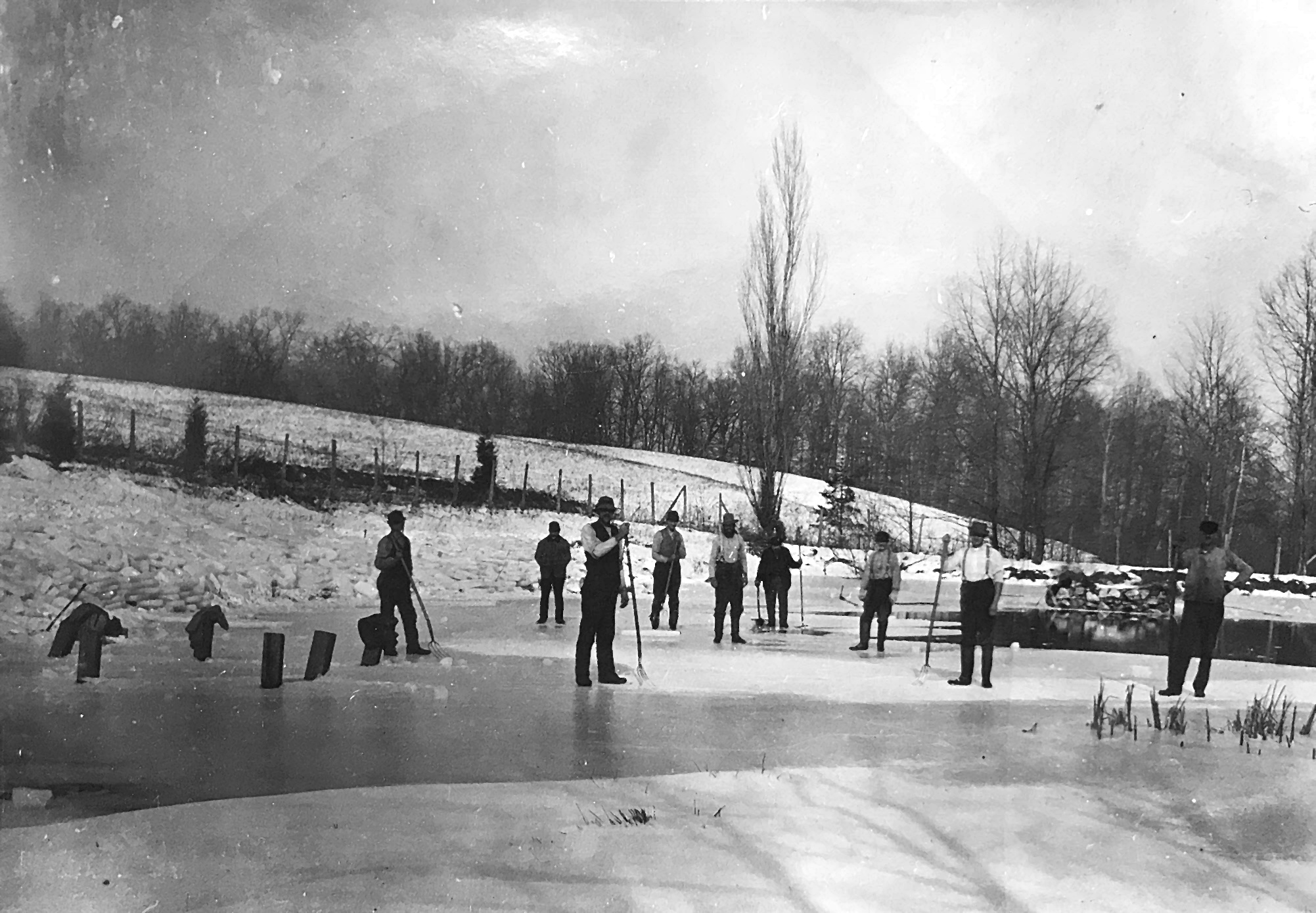
Men harvesting ice with pitchforks and hand saws in Darnestown, Maryland. Photo taken by Lewis Reed in 1910. Note the blocks of ice stacked up along the shoreline. The exact location of the pond is unknown.
Got ice? Usually, we don’t think about ice very often, unless there’s none in the freezer. Before the first successful ice-making machines were built, ice for refrigeration was obtained through a process called “ice harvesting.” Ice cutters used to risk their lives by going out onto frozen ponds with saws, tongs, and pitchforks and methodically cut and dragged blocks of ice which would be stored in hay-packed ice houses. But people did not put ice in drinks as we do now. The possibility of debris having been in the water as it froze – even a bug now and then – discouraged the idea.
Ice houses were dug into the ground to keep the temperature low; double-thick walls were often filled with sawdust for further insulation, and the blocks themselves were packed in sawdust or straw. When you wanted some ice for drinks or to make ice cream, you wouldn’t pull out a whole block; ice picks, chisels, hatchets and shavers were used to get just what you needed.
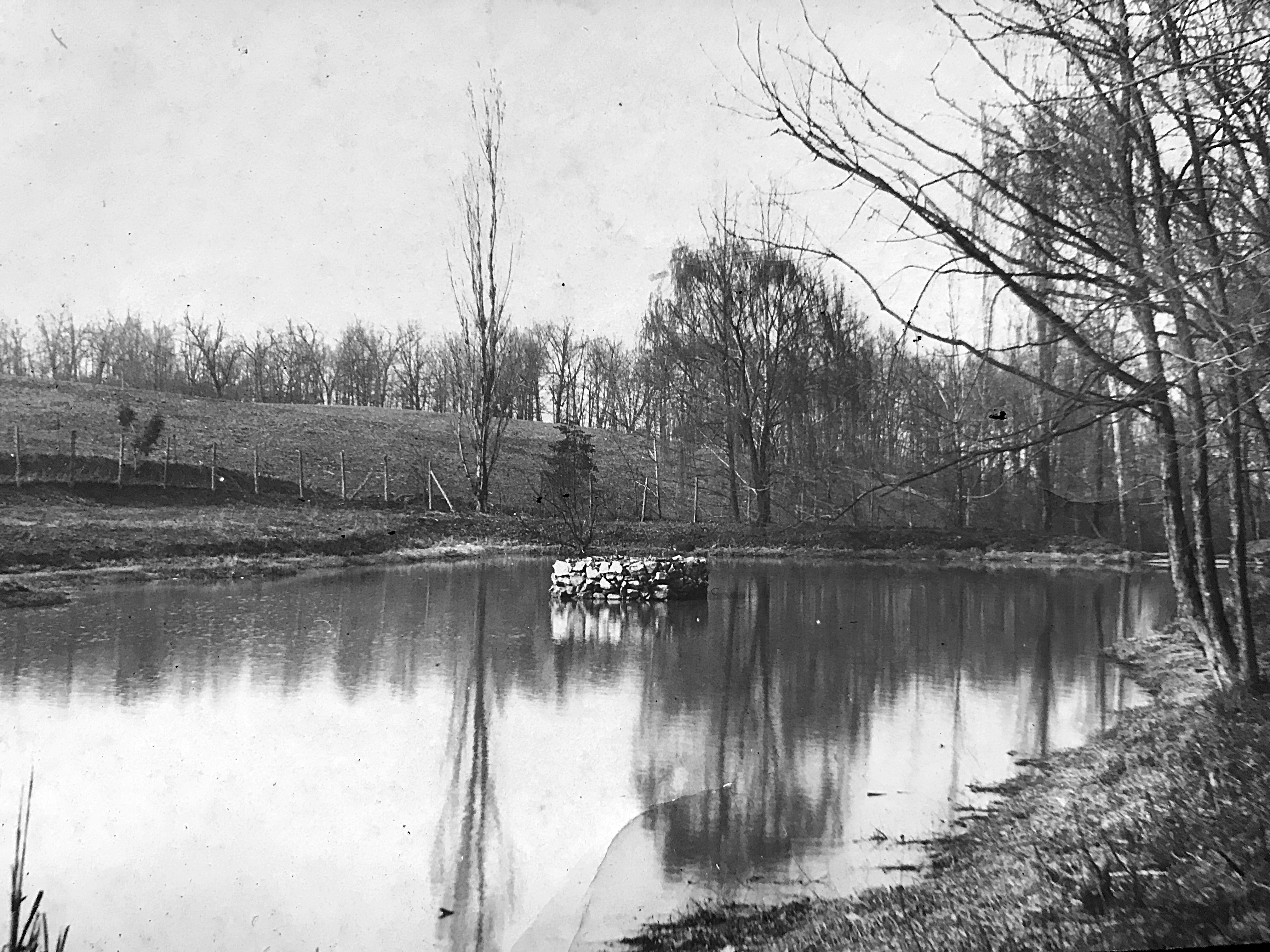
Same pond in summertime without ice. Photo by Lewis Reed, 1910.
I’m not exactly sure what the structure is in the middle of the pond, but “google” said it could be an outlet structure to keep the water surface in the pond at its optimum level, which usually coincides with the maximum water level designed for the pond. If anyone knows exactly what it is, please leave a comment.
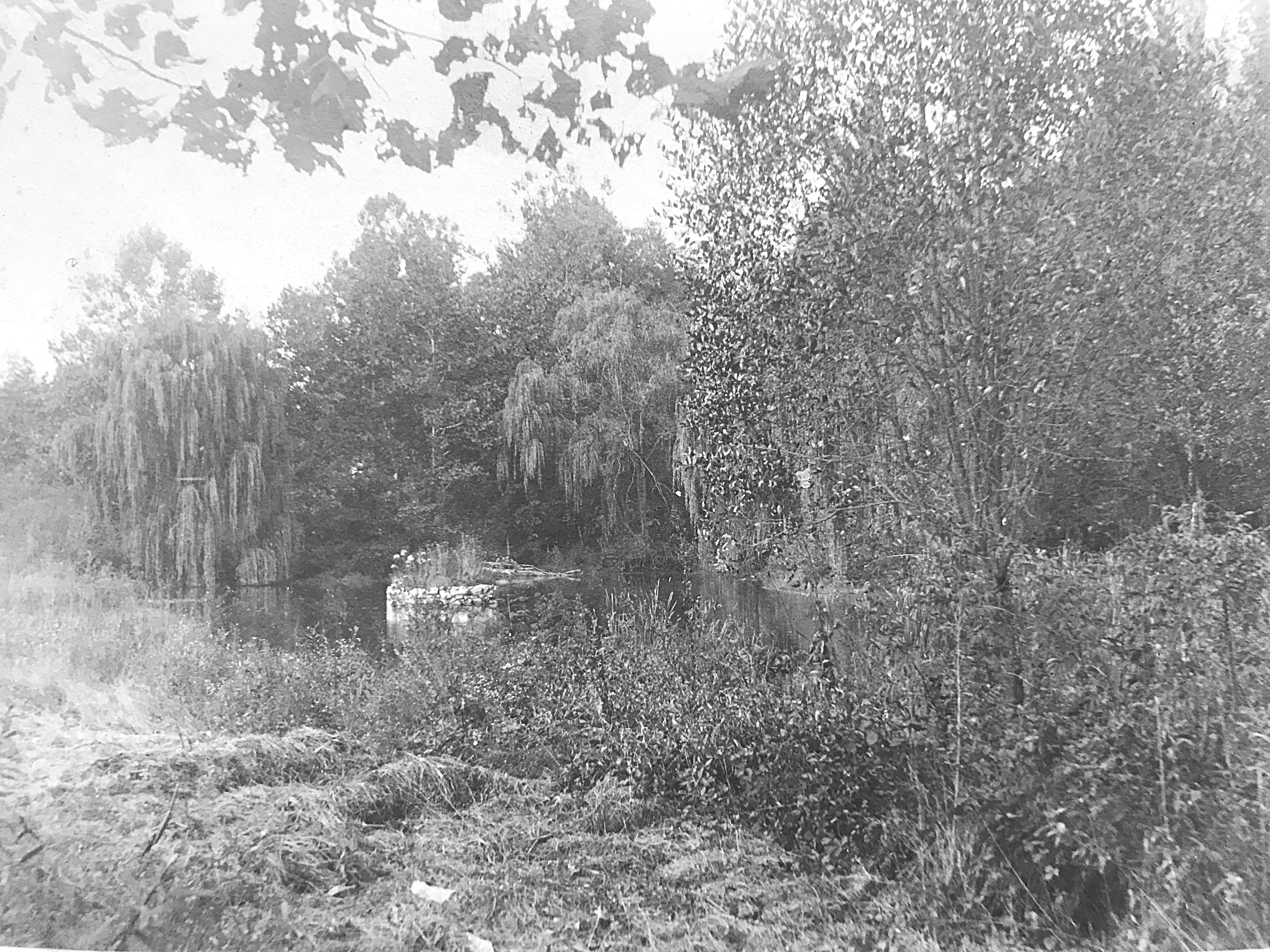
Same pond in summertime from a different perspective. Photo by Lewis Reed, 1910.
From The Evening Star, Washington, D.C. December 22, 1904
ROCKVILLE AND VICINITY GENERAL NEWS
The cold weather of the past ten days has frozen the ponds and creeks throughout this county to a thickness of six or seven inches, and the ice harvesting is now the order of the day. The quality of the ice is not regarded as first-class, however, and for this reason many persons will defer filling their houses until later in the winter.
Next time you drop a few ice cubes into a glass or take out a frozen piece of meat from the freezer, perhaps give a momentary thought to how much we take for granted the ability to have ice cold drinks, preserved foods that can be stored for months, ice cream, cold frothy beer, and so many perishable food products. Refrigeration is a modern convenience that we just can’t live without and certainly one that I take for granted … or took for granted until I wrote this!
Ice Harvesting in Darnestown, ca.1910
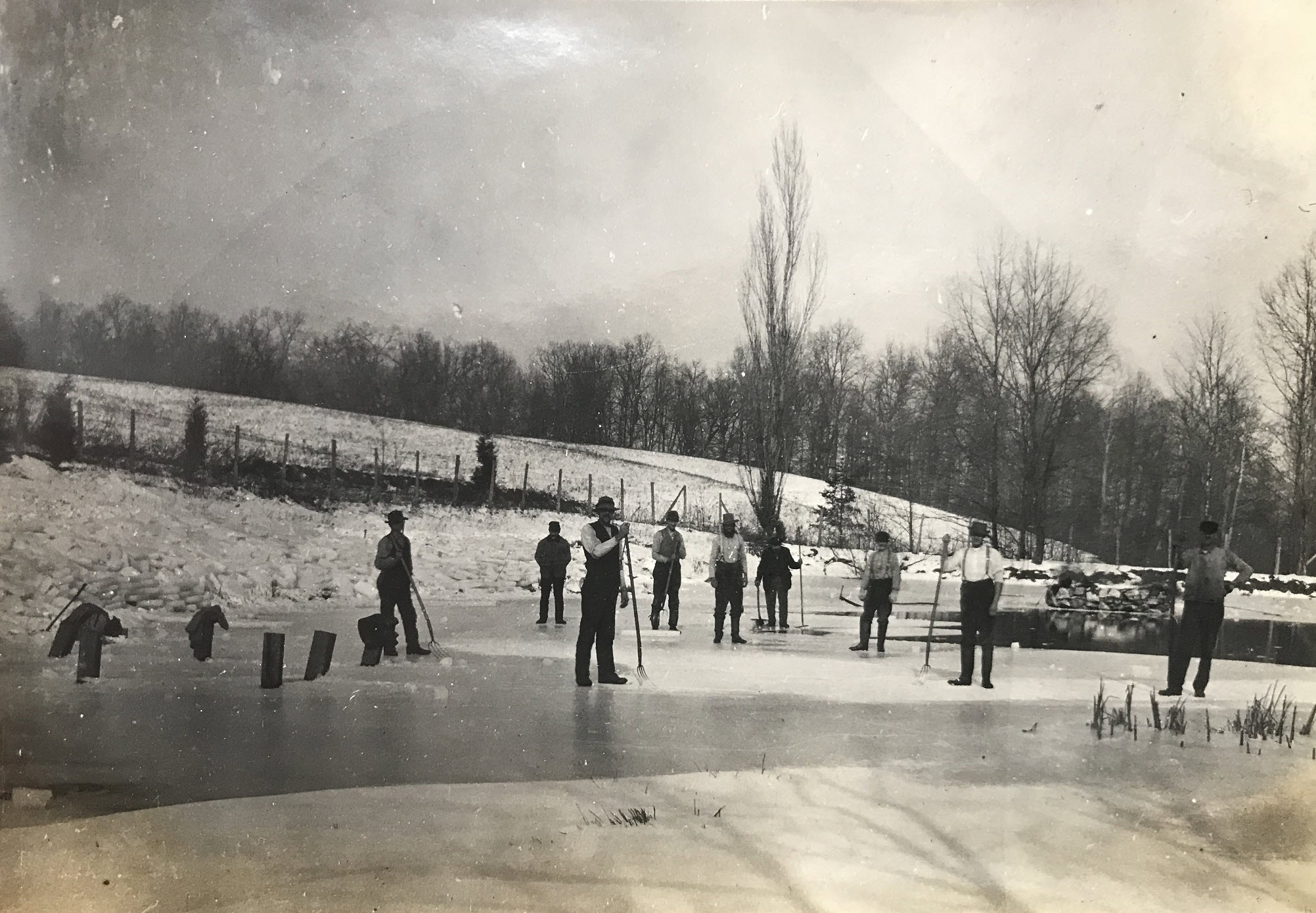
Men harvesting ice with pitchforks and hand saws in Darnestown, Maryland. Photo taken by Lewis Reed, ca.1910. Note the blocks of ice stacked up along the shoreline.
Got ice? Usually, we don’t think about ice very often, unless there’s none in the freezer. At the start of the 19th century, keeping food fresh and edible was one of the biggest challenges of everyday life. So what was life like before we had that incredible device that we now take for granted, the refrigerator?
Before the first successful ice-making machines were built, ice for refrigeration was obtained through a process called “ice harvesting.” Men would venture out onto frozen ponds with saws, tongs, and pitchforks and methodically cut and dragged blocks of ice.
Refrigeration is a modern convenience that we just can’t live without and certainly one that I take for granted … or took for granted until I wrote this!
On the Self-Publishing Horizon … Again!
I’m excited to announce that for the last year or so, I’ve been thinking about self-publishing a photo book specific to my grandfather, Lewis Reed, with a working title of, “Lewis Reed Photograph Collection (1898-1960).” Looking back at photography from the past is a fascinating experience for me, and with a newfound interest in history, the curious part of me wants to learn more: When was the picture taken? Where? What is it? Who’s in it? The majority of his photos are more than 100 years old and many are lacking labels and/or dates, which requires quite a bit of research and a little photo detective work on my part.
With that in mind, I will be frequently spotlighting photographs that may not directly pertain to the history of Reed Brothers Dodge, but will have a lot to do with it’s founder, Lewis Reed. I will not try to be an historian; I will post photos and supply a few paragraphs of context. Many photographic images in this collection have never before been seen publicly in print and will be available in this book for the first time.
I’ve been sitting on this post for a few weeks, timid to hit the ‘publish’ button. Likely because the size of the project is overwhelming and committing to it is a bit daunting (although exciting at the same time). It doesn’t help that as the ambition of my projects and goals increase, so too, can self-doubt. Below is the Draft Table of Contents for the book, which I’m sure will see some revisions as I progress.
Having said that, I will be switching my focus and time to mostly photo identification and researching/writing for the book.
Time to get to work!
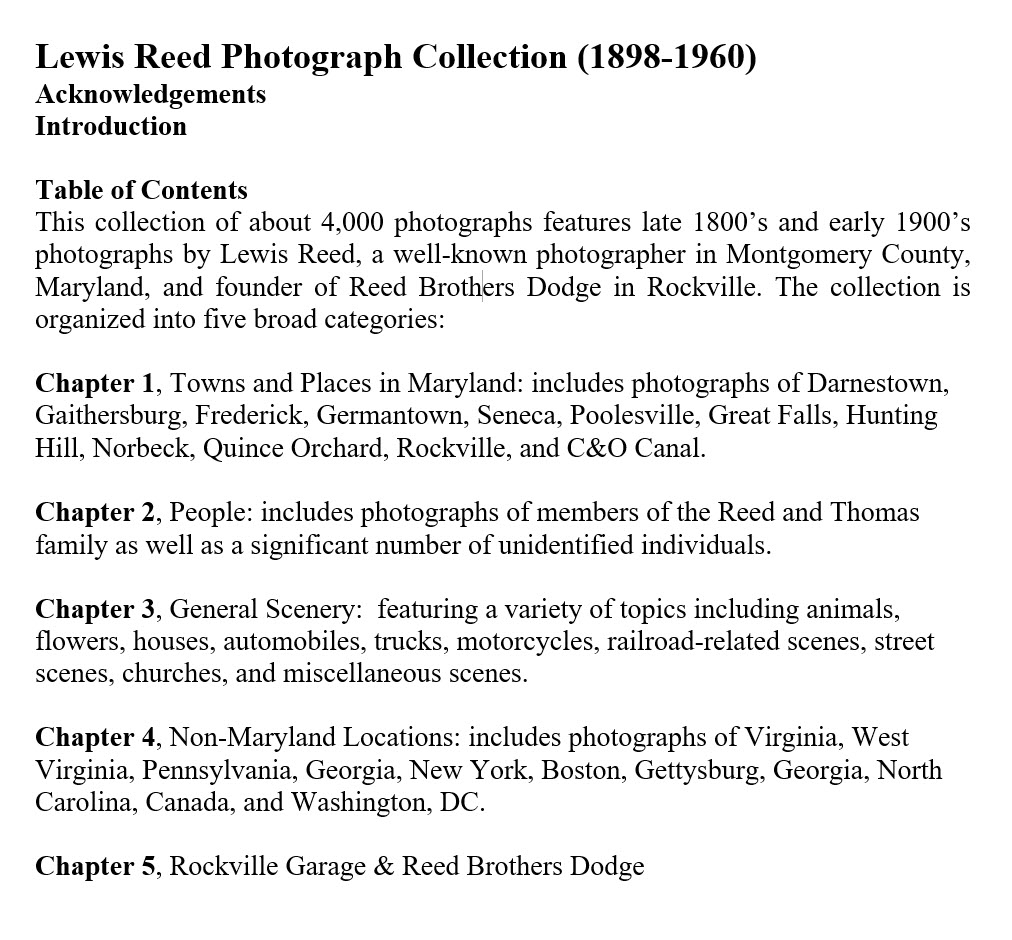
Draft Table of Contents
Books

Related Resources


Copyright Notice

Reed Brothers Dodge History (1915-2012) by Jeanne Gartner is licensed under a Creative Commons Attribution-NonCommercial 3.0 Unported License.
 Reed Brothers Dodge History 1915 – 2012
Recent Comments