
Lewis Reed Photo: Lady & Toddler on a 1913 Excelsior
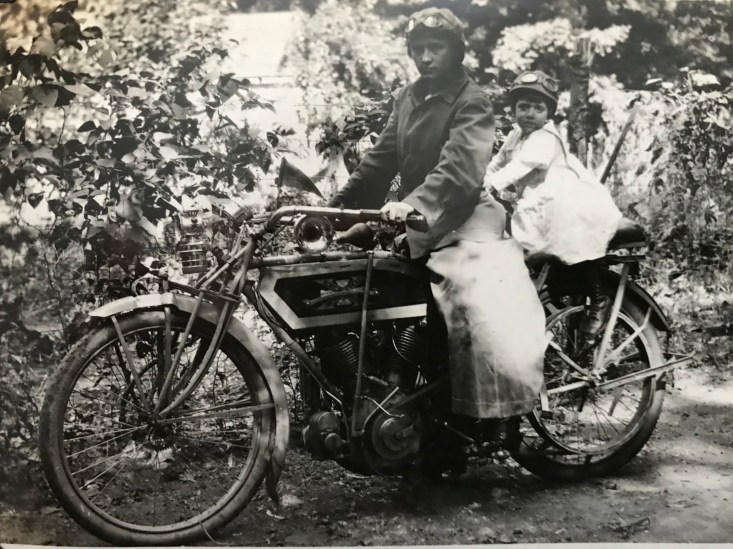
Unknown lady and toddler posing on an Excelsior motorcycle. Photo by Lewis Reed
Back in the early part of the last century when the motorcycle was still new and a novelty, it was often used for Kodak moments.
Lewis Reed has a number of photographs showing relatives and other unknown people on their motorcycles in the period of the early 1900s through the early 1920s. This photo taken by Lewis Reed is an unknown lady and a toddler (mother/daughter?) posing on an Excelsior motorcycle. The motorcycle was easy to identify because of the logo, but I could not pinpoint the exact year it was made. I tend to think it might be a circa 1913-1914 model Excelsior.
This is, without question, one of the best posed photos on a motorcycle that I have come across in my grandfather’s albums. The toddler’s sporty little cap and goggles make the image. Just imagine how excited she must have been to sit on that big machine.
The motorcycle seems to be well equipped with extras including: a headlamp, a handlebar-mounted Klaxon horn, and a well padded passenger seat on the back.
Then & Now: Thomas Hardware Store, Gaithersburg
Looking at old photographs is like peering through an open window back into history. Not only do they give you a sense of wonder from traveling back in time, but also a staggering feeling of awe from seeing just how much things have changed. For this post, I have used one of Lewis Reed’s original photographs for “then” and a Google Maps street view image from today for “now”.
Thomas Hardware Store (THEN): This photo was taken by Lewis Reed when the first system of water mains and sewers were installed by the WSSC in Gaithersburg, circa 1926-1928. The store in the background is the Thomas Hardware Store, originally built and operated by Thomas Iraneous Fulks. The water pipes to be laid are resting by the side of the road. The child on the right in the photograph is Lewis Reed’s daughter, Mary Jane (Reed) Gartner.
T. I. Fulks was a businessman and farmer. He worked as a bookkeeper for the Gaithersburg Milling and Manufacturing Company and then opened a hardware store at 219 East Diamond Avenue.

Thomas Hardware Store, originally built and operated by Thomas I. Fulks. Photo by Lewis Reed, ca. 1928
Thomas Hardware Store Location (NOW): The same view 90 years later. The old hardware store is enclosed in the present brick building (Gaithersburg Rental Center) at 219 East Diamond Avenue.
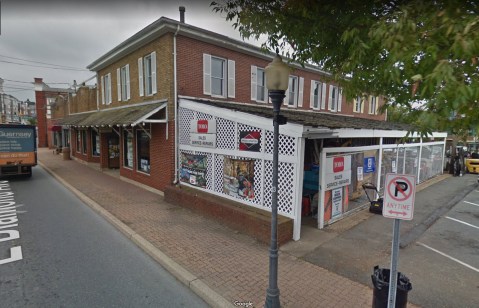
219 East Diamond Avenue today
Source: Gaithersburg: History of a City
Then & Now: Gaithersburg B&O Railroad Station
This post is a continuation of a series of “Then & Now” images that will show photographs of buildings, street scenes, and other historical locales from Lewis Reed’s Photo Collection alongside photographs of how they appear today.
Gaithersburg B&O Train Station (THEN): The station was originally built as the Gaithersburg B&O Railroad Station and Freight Shed in 1884, for the Metropolitan Branch of the Baltimore and Ohio Railroad (B&O). A freight house, which currently houses the Gaithersburg Community Museum, allowed farmers to easily ship their products. Over the years, the station buildings gradually fell into disrepair and by the 1960’s were slated for demolition. According to the Gaithersburg city website, they were purchased by the city from the Chessie Systems in 1984 and restored. The Station and Freight House have been listed in the National Register of Historical Places since 1978.

Gaithersburg B&O Railroad Station (looking north up the tracks), 1911. Photo by Lewis Reed
Gaithersburg B&O Train Station (NOW): The same view 107 years later. The station has limited hours but still serves as a ticket office for MARC train daily commuters going to and from Washington, DC. Amtrak trains rumble through Gaithersburg but this is no longer a scheduled stop on their routes. As many as 50 freight trains travel through Gaithersburg each day.
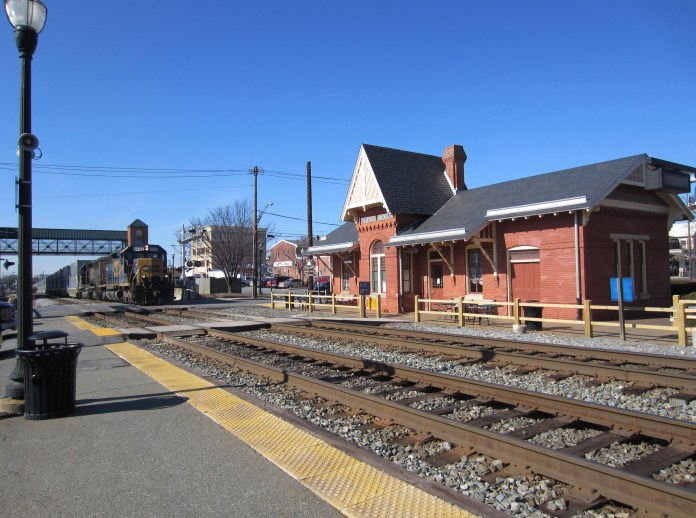
Gaithersburg B&O Railroad Station today
Source: Maryland Historical Trust
Then & Now: Howard House Hotel, Ellicott City
This post is a continuation of a series of “Then & Now” images that will show photographs of buildings, street scenes, and other historical locales from Lewis Reed’s Photo Collection alongside photographs of how they appear today.
Howard House Hotel (THEN): The Howard House Hotel, built in 1840, contained a bar and dining room in addition to 14 bedrooms. The hotel featured fine German cooking and was the first place in town to offer ice cream — which was made on Wednesdays only and was a real draw. The hotel and restaurant was a popular stop for mid-19th-century travelers headed west on the National Road, and a day-trip destination for urban dwellers. In the 1940s, the decorative wrought iron on its second-floor porch was sold for scrap metal for the war effort.
The trolley tracks on main street were originally part of the Catonsville and Ellicott City Electric Railway Company trolley line that shuttled passengers between Ellicott City and Baltimore from the late 1890s to the mid-1950s.

Howard House Hotel Ellicott City, Maryland, circa 1914. Note the signs over the entrance read, “ICE CREAM” below it “OYSTERS” Photo by Lewis Reed
Howard House Hotel (NOW): The same view 105 years later, restored to its original grandeur as 10 “luxury” rental apartments which includes panel doors, moldings and much of the original woodwork.

Howard House Apartments today
Ice Harvesting in Darnestown, ca.1910

Men harvesting ice with pitchforks and hand saws in Darnestown, Maryland. Photo taken by Lewis Reed, ca.1910. Note the blocks of ice stacked up along the shoreline.
Got ice? Usually, we don’t think about ice very often, unless there’s none in the freezer. At the start of the 19th century, keeping food fresh and edible was one of the biggest challenges of everyday life. So what was life like before we had that incredible device that we now take for granted, the refrigerator?
Before the first successful ice-making machines were built, ice for refrigeration was obtained through a process called “ice harvesting.” Men would venture out onto frozen ponds with saws, tongs, and pitchforks and methodically cut and dragged blocks of ice.
Refrigeration is a modern convenience that we just can’t live without and certainly one that I take for granted … or took for granted until I wrote this!
Books

Related Resources


Copyright Notice

Reed Brothers Dodge History (1915-2012) by Jeanne Gartner is licensed under a Creative Commons Attribution-NonCommercial 3.0 Unported License.
 Reed Brothers Dodge History 1915 – 2012
Recent Comments