
A Look Back at the Forgotten Art of Hand-Tinted Photography
The hand-tinted photos of Lewis Reed and his daughter, Mary Jane, are examples of the photographic process that most of the people reading this will have never experienced: hand-tinting.
The golden age of hand-colored photography occurred between 1900 and 1940. Before the days of true color photography, these views were immensely popular. While hand coloring doesn’t help you identify or date an image, it does enhance a photograph’s appearance and add to its history.
Before the advent of color photography, photographers painstakingly applied color to black and white photos in order to show a truer visual depiction of a photo image. All of the photographs featured here were taken by Lewis Reed in the early 1900s and were hand-tinted by his daughter, Mary Jane, likely in the late 1930s to 1940. She colored the photos with special photographic watercolor and a paintbrush. Rather than coloring the entire image—a time-consuming task—she carefully selected details that would make the image lively and attractive. The fact that these photos, all of which are over 100 years old, are still in relatively good condition is a strong testament to the lasting power of hand-tinted photographs.
Do you recognize the road pictured below? Few modern residents of Montgomery County would guess, but this is a shot down Veirs Mill Road in the early 1900s. Mary Jane Reed added some depth to the image with subtle earth tones, in the colorized version.

Veirs Mill Road looking east before it was paved. Original photograph by Lewis Reed, 1911.
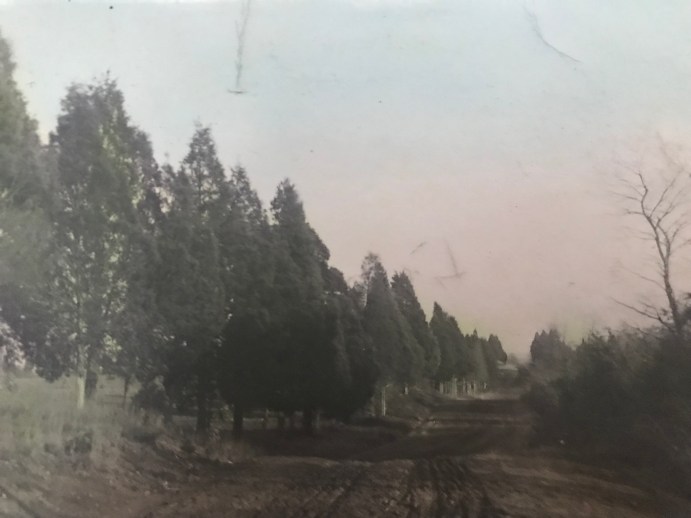
Colorized version of the photograph above by Lewis Reed. The photo was hand-tinted by Mary Jane (Reed) Gartner, making it look like a color photo.
Below, Lewis Reed’s c. 1909 photograph of his little cousin, Amanda Reed, sitting amongst the hydrangeas — the original before, and the colorized version after.

Amanda Reed before hand-tinting. Original photograph by Lewis Reed.

Amanda Reed after hand-tinting by Mary Jane (Reed) Gartner. Pastel was apparently a good choice for coloration.
To a visual artist like a dedicated photographer, the inability of the black-and-white camera to capture the richness of colorful blooms or the vibrancy of a summer scene must have been endlessly frustrating.
Lewis Reed’s daughter Mary Jane seemed particularly fond of hand-tinting photographs of flowers — it must have given her a lot of pleasure to “restore” color to her father’s beautifully composed shots. View some more of her work below.

Roses before hand-coloring. Original photograph by Lewis Reed.

Roses after hand-coloring
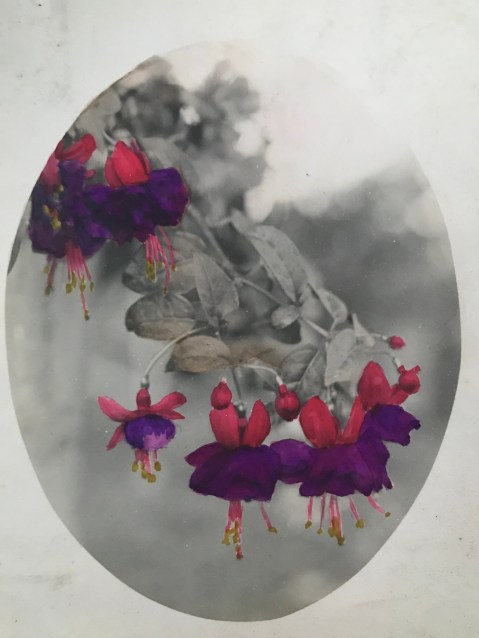
Hand-colored flowers
Below are two different versions of tinting a similar image. In Version 2, some of the flowers at the top were removed from the vase (by Lewis Reed, before taking a second shot) for a different aesthetic effect. The color artist used bolder colors to enhance that effect.

Original arrangement before hand-tinting. Original photograph by Lewis Reed.

Version 1: Arrangement after hand-tinting by Mary Jane (Reed) Gartner
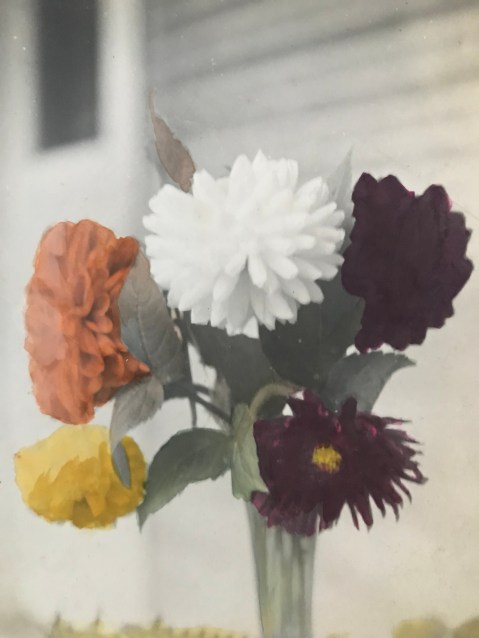
Version 2: Arrangement after hand-tinting by Mary Jane (Reed) Gartner

This is a hand-tinted version of Rock Creek taken by Lewis Reed in the early 1920s.
Other examples of hand-tinting are included in the following collection of Lewis Reed’s Black Rock Mill photographs. Black Rock Mill was built by Thomas Hillary and has stood along the banks of Great Seneca Creek as a landmark since its construction in 1815-1816. The mill was in working operation for over a hundred years until a flood in 1920 destroyed a dam on Seneca Creek and damaged the mill. Today, it a unique survivor of the many mills in Montgomery County harnessing the water-power of the creeks to grind wheat and corn into flour. It is one of only two mills standing in Montgomery County Maryland.

Black Rock Mill bridge hand-tinted by Lewis Reed’s daughter, Mary Jane.
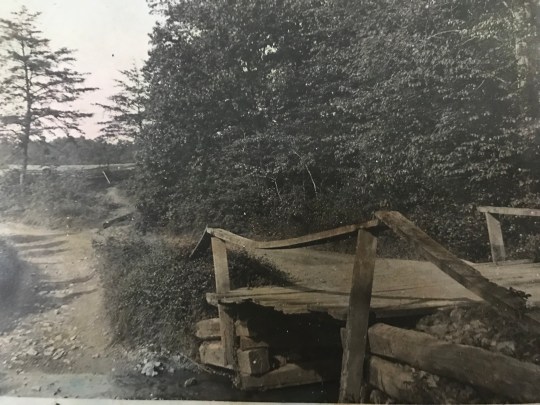
Bridge over Seneca Creek. Photo by Lewis Reed and hand-tinted by his daughter, Mary Jane

Strolling down a lane on a beautiful summer’s day. Black Rock Mill hand-tinted photo
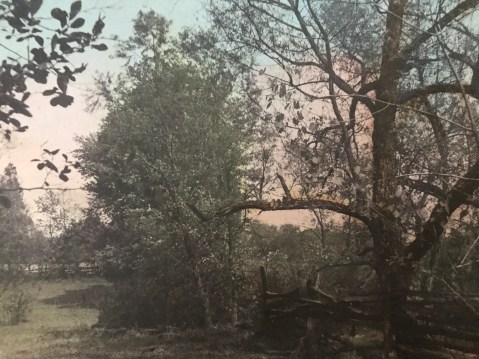
Black Rock Mill hand-tinted photo
The art of hand-tinted photos was introduced along side the daguerreotype in 1839. In the 19th century it was most common for the professional photographer to tint the photograph or tintype just after printing. Later photo artists introduced new techniques using oil, watercolor and other types of paint to achieve the desired result. With the Great Depression, the sale of professional hand-tinted photographs declined, but the home artist continued to have access to hand-tinting kits. Today, we can look back and appreciate the time and creativity it took to edit these photos without Photoshop.
Find photos like these and much more on Montgomery History’s online exhibit, “Montgomery County 1900-1930: Through the Lens of Lewis Reed“.
Celebrating Lewis Reed’s 135th Birthday

Lewis Reed (1887-1967)
Lewis Reed was born in Darnestown, Maryland on November 25, 1887 and was the founder of Reed Brothers Dodge. When Lewis Reed opened his car dealership in October 1915, he never knew he was starting a family tradition that would be carried out for 97 years and three generations. He founded what would become the oldest Dodge dealership under the same family ownership in the State of Maryland, and one of the oldest in the United States.
Success demands courage, dedication, perseverance and relentless hard work. As a young man, Lewis Reed apparently believed in the similar thought. He was the son of a blacksmith, raised in a large family that survived on knowledge and hard work. Tinkering with things and an interest in machines at an early age was probably encouraged by his father. The blacksmithing trade goes back about four generations in the Reed family. In those days, it was commonplace for sons to follow their father’s professions. The 1910 census indicated that 23-year old Lewis Reed was working as a machinist.
On the occasion of my grandfather’s 135th birthday, I thought I would revisit some interesting facts about him.
1. Lewis Reed’s passion for cars began at a very early age. He was full of curiosity, with an insatiable desire to know details, how things worked, and why. As a child, he would watch cars go past the family farm and then take off running across the fields to catch up with them until they would go out of sight. The “normal” speed during this time was so slow that drivers had difficulty keeping their cars from stalling out.
2. Lewis attended Darnestown School, a one-room schoolhouse which was located on Thomas Kelley’s Farm at Pleasant Hill. First through sixth grades were taught by one teacher to about thirty or more students. Few students went beyond sixth or seventh grade; in fact, Lewis Reed’s education stopped after the sixth grade. He would later be home-schooled by his wife, who was a teacher in the Maryland public school system.
3. Lewis Reed’s love of photography began at a very young age, at a time when most families did not own a camera. The oldest photo in his collection is dated 1898, which would have made him around 11-12 years old when he started using a camera. At the turn of the century, before automobiles were even around, he toured up and down the East Coast on his motorcycle, taking photographs of landscapes, monuments, historic places, and people. His entire collection spans more than six decades and showcases his love for people, automobiles, events, landmarks, and travel throughout the first half of the 20th century. Unsurprisingly, his love of both cars and cameras resulted in his taking numerous pictures of car culture all over the State of Maryland as it developed from infancy to supremacy.
4. Lewis Reed understood automobiles. He knew how they worked and how to fix them. He loved cars and anything associated with them. Prior to World War I, his love of automobiles led him to becoming a chauffeur. Lewis Reed worked as a chauffeur from roughly 1910-1914, before he became involved in the business of selling and repairing automobiles.
5. In October 1915, Lewis Reed received his franchise to sell Dodge Brothers Motor Cars with brothers Horace and John Dodge in Detroit; less than one year after the very first Dodge automobile was invented.
6. In 1941, the State of Maryland named the connector street behind the original dealership at the triangle, “Dodge Street,” commemorating Reed Brothers’ presence from 1915-1970. The connector street was so short that Lewis Reed always liked to joke, “if the state wanted to name a street after him, the street needed to be longer”. Hence the street was named, “Dodge Street”.
7. When the United States entered World War I, Lewis Reed worked at the Navy Yard in Washington DC as a torpedo tester.
Note: Interestingly, there’s nothing online that explains how torpedoes were tested during WWI. I was, however, able to find how they were tested during WWII. “Torpedoes produced by the Alexandria Torpedo Factory were transported to Piney Point on the shore of the Potomac River where they were fixed with dummy heads, fired from boats and then retrieved by men or tenders. The purpose of the facility was to see whether the torpedo could hold a straight course. Some of them are said to have sunk to the bottom of the Potomac where they now rest in mud.”
8. In the early 1930s, Lewis Reed inaugurated a new department of auto body and fender repair. He did this primarily because no other repair agencies were locally available to motorists. The new department enabled motorists to obtain this critical repair service locally in Rockville, whereas, in the past they had to travel to Washington, D.C. or Baltimore for such work.
9. During World War II, Reed Brothers Dodge had virtually no new cars to sell for three and a half years. But that didn’t stop Lewis Reed. When manufacturers halted car production and many dealers went bankrupt, Lewis Reed converted his car showroom into a display room and sold GE washing machines, Zuillen home freezers, Westinghouse radios, and other large appliances to fill the gap.
10. Active in the dealership daily until the day of his death, Lewis Reed passed on January 28, 1967 at the age of 79. Shortly after his death, the Senate of Maryland passed Senate Resolution No. 10, honoring the life and achievements of Lewis Reed. The resolution was sponsored by Senator Thomas M. Anderson, Jr and Senator Louise Gore.
Lewis Reed’s business philosophy was simple: “Treat your customer as your friend and always do what you promise.” These words aptly showcase his life and his passion for what would become his life’s work.
Lewis Reed as a Chauffeur-Mechanic
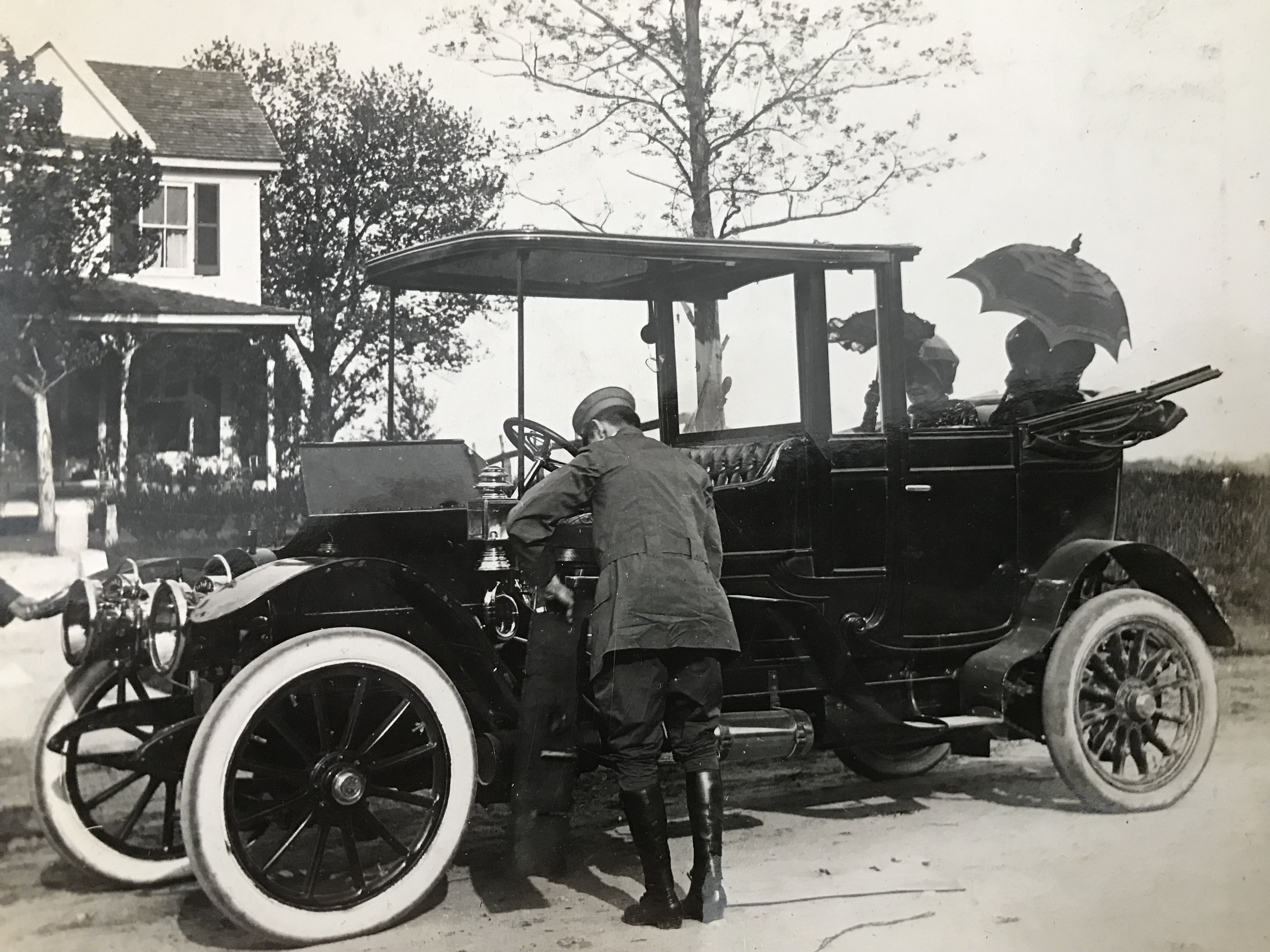
Two ladies with parasols are sitting in the landaulet section of an early Pierce-Arrow limousine, while chauffeur Lewis Reed tends to the motor. The rear portion of the limousine is partitioned from the driver with a glass shield, and covered by a convertible top, which you can see is currently in the lowered position behind the ladies. Photo taken circa 1910.
The year is 1910 and you’ve just purchased a brand new automobile. To show it off for the first time, you’ve hired a knowledgeable chauffeur. You sit on a padded seat while the chauffeur tends to the engine. Though it takes a while to start up, your new ride can reach around 37 mph. The ride is a bumpy one, and you could probably walk faster than the car travels. Ooops! One of the wheels has popped off as you go around a bend. Chauffeurs were not only trained to be proficient with their driving skills, but they also had to keep the luxury automobiles in tip top shape, which is where Lewis Reed’s mechanic training – a vital skill in the early days of motoring – would have come into play.
Lewis Reed understood automobiles. He knew how they worked and how to fix them. He loved cars and anything associated with them. Prior to World War I, Lewis Reed’s love of automobiles led him to becoming a chauffeur. At the dawn of the early 20th century, society was transitioning from horse-drawn carriages to automobiles. Having grown up in a blacksmith family, he was well positioned to move to the new technology. The 1910 census indicates that 23-year-old Lewis Reed was working as a machinist. Lewis worked as a chauffeur from roughly 1910-1914, before he became involved in the business of selling and repairing automobiles.
Chauffeur-mechanics of the early 1900s were the first group to earn a living working on automobiles. Wealthy people employed private chauffeur-mechanics to not only drive, but also maintain and repair their large, expensive automobiles — rather than learn to do it themselves. The vehicles of the time came with mobile toolboxes often resembling a small hardware store tucked away in the trunk. The early 1900s Pierce-Arrow toolkit included extra intake and exhaust valves, not exactly your typical roadside service. During the height of travel season, Spring through Fall, oil changes were required almost weekly. As you can easily surmise, there had to be someone to keep track of all of the maintenance and upkeep of the vehicle as well as the daily driving.
The novelty of the motor car led many manufacturers to create clothes that were specifically marketed for the automobile driver and his or her passengers. Lewis Reed wore a typical chauffeur’s uniform of the time. His motoring outfit was taken from the military uniform, combining a single or double breasted hip length coat and a pair of knicker pants with tall boots and a traditional driver’s cap. Gauntlet gloves were worn while driving and goggles were worn in open air cars. Goggles obviously protected ones’ eyes from flying pebbles and dirt, but heavy-weight boots ensured that the driver could, when necessary, get out to push a stalled car or fix a punctured tire.
Savvy marketers were especially quick to recognize that automobile owners had “more money to spend” than non-car owners. As these marketers gleefully noted, car owners “spend…more freely than non-[car] owners.” Convincing these customers of the need for special clothes was not too difficult. In fact, some car owners spent nearly as much on their motoring clothes as they did on their cars. The ladies in the photograph with parasols could have used them as an attractive way of shielding themselves from the sun’s rays, or to keep the dust from the dirt roads off their faces.
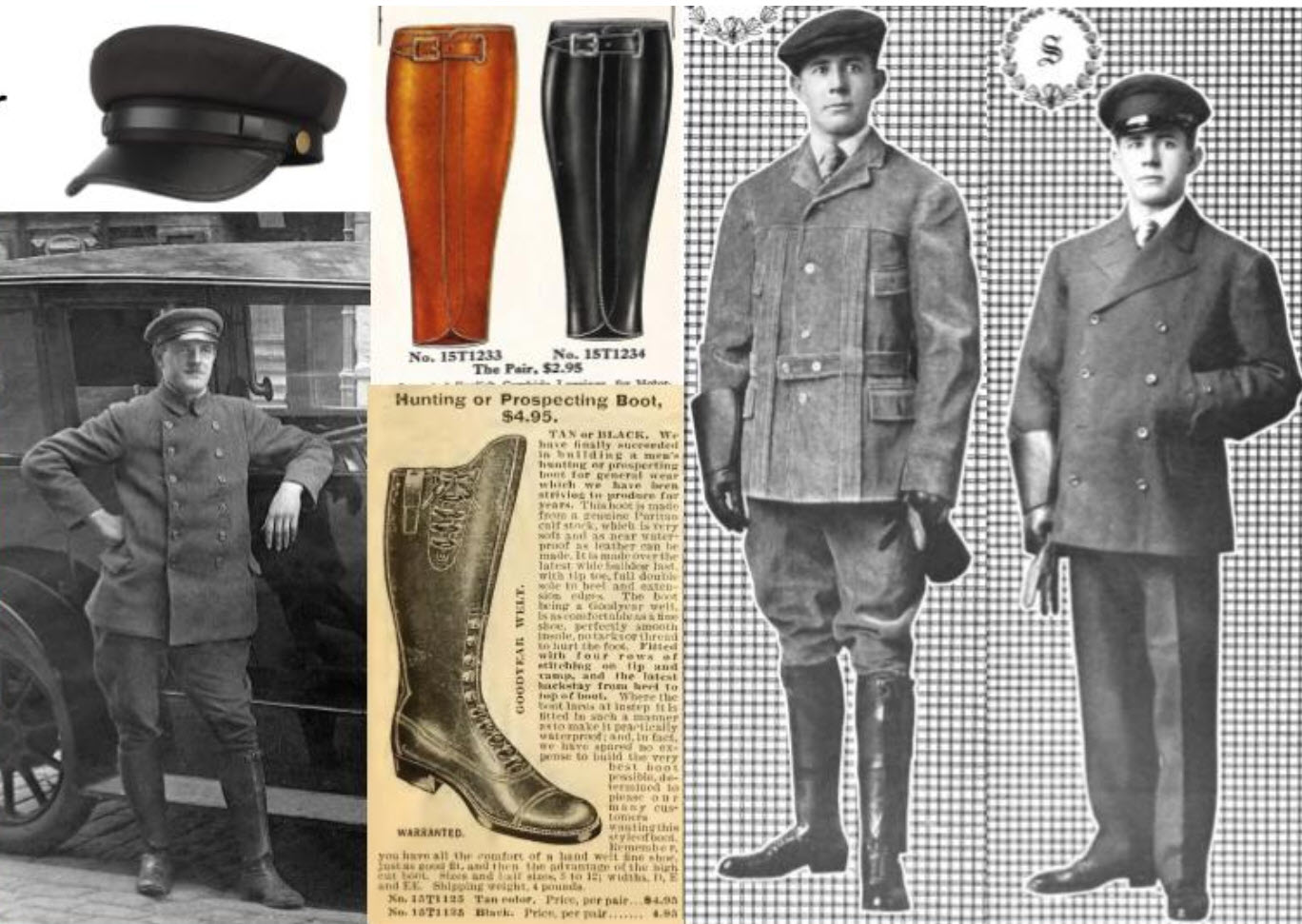
Early 1900s Chauffeur’s uniform
In October of 1915, Lewis Reed opened his Dodge dealership on Rockville Pike, less than one year after the first-ever Dodge automobile rolled off the assembly line. Reed Brothers Dodge provided “wheels” to many families for most of the 20th century during a period when the number of motorcars was rising rapidly throughout Maryland. Few businesses survived the Great Depression and two world wars, but Reed Brothers Dodge eventually emerged from the gauntlet of the 20th century as the oldest Dodge dealership in Maryland history and one of the oldest in the United States.
Happy Birthday to Our Founder, Lewis Reed
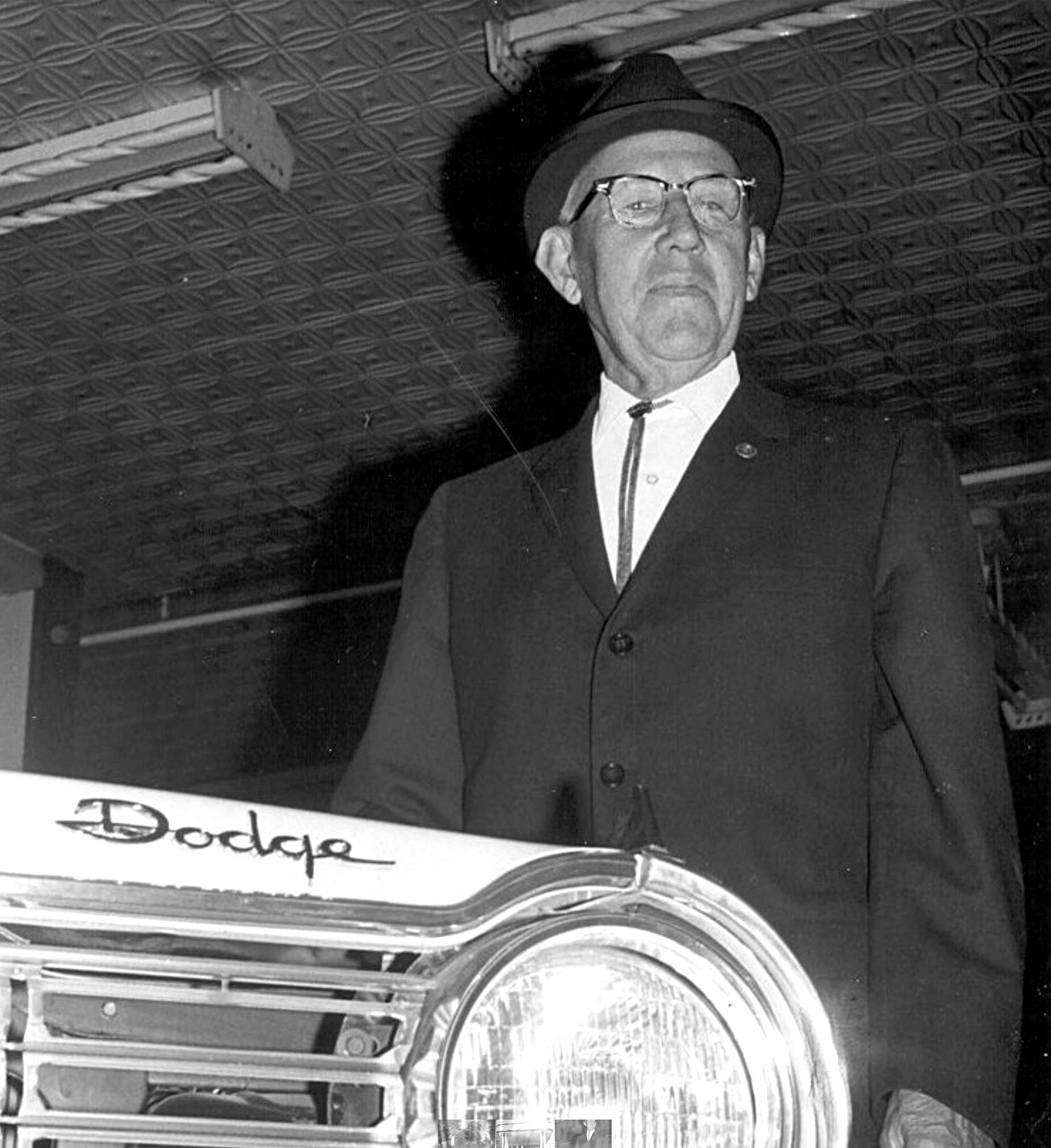
This ca. 1965 photo of Lewis Reed was taken in the new car showroom at Reed Brothers Dodge original location at the triangle at Veirs Mill Road and Rockville Pike.
Lewis Reed was born in Darnestown, Maryland on November 25, 1887 and was the founder of Reed Brothers Dodge. When Lewis Reed opened his car dealership in October 1915, he never knew he was starting a family tradition that would be carried out for 97 years and three generations. He founded what would become the oldest Dodge dealership under the same family ownership in the state of Maryland, and one of the oldest in the entire United States.
Lewis Reed was just 27 years old when he started selling cars built by brothers Horace and John Dodge in Detroit. Few people jumped onto the Dodge Brothers bandwagon earlier than Lewis Reed, and not many have lasted longer. Reed Brothers was franchised as a Dodge dealership and service facility less than one year after the first Dodge automobile rolled off the assembly line. Lewis Reed was the first to sell Dodge cars in Montgomery County, Maryland and his company was the first Gulf gas dealer in the Washington, D.C. area. During the early years, Reed Brothers represented several franchise nameplates along with Dodge, including Oldsmobile, Hudson and Essex. The Hudson and Oldsmobile were sold at Reed Brothers from roughly 1917 through 1923.
Lewis Reed was a member of the Gaithersburg Grace Methodist Church where he served as a member and Chairman of the Board of Stewards, a Lay Leader, and President of the Men’s Bible Class. He was one of nine original incorporators of the Gaithersburg-Washington Grove Volunteer Fire Department when it was created by charter in 1928. He was a Charter Member and Past President of the Gaithersburg-Washington Grove Fire Department and a member of the advisory board of the Rockville Branch of the First National Bank of Maryland. He belonged to the Masonic Lodge of Rockville, the Pentalpha Chapter of the Eastern Star and the Rockville Rotary Club. Before opening his Dodge dealership in 1915, Lewis Reed was one of the earliest and most prolific photographers in Montgomery County. Many of his photographs are now part of Montgomery History’s photo archives. Unsurprisingly, his love of both cars and cameras resulted in his taking numerous pictures of car culture all over the State of Maryland as it developed from infancy to supremacy.
Prior to World War I, Lewis Reed’s love of automobiles led him to becoming a chauffeur. Chauffeurs were not only trained to be proficient with their driving skills, but they also had to keep the luxury automobiles in tip top shape which is where his mechanic training would have come into play. He received his training as an automobile mechanic at the Pierce Arrow factory at Buffalo, New York, the Dodge and Hudson factories at Detroit and the Washington Auto College.
Active in the dealership daily until the day of his death, Lewis Reed passed on January 28, 1967 at the age of 79. Shortly after his death, the Senate of Maryland passed Senate Resolution No. 10, expressing “the deepest regret and sympathy of every member of this body,” describing Reed as “a kindly and loyal person completely devoted to his duties” which he carried out “with fairness and human understanding.” The resolution was sponsored by Senator Thomas M. Anderson, Jr. and Senator Louise Gore.
When you look back and consider what has taken place in the world in the past 100 years or so, you gain a perspective of what Lewis Reed faced. He overcame a lot of obstacles throughout his life. He steered his dealership through World War I, The Great Depression and World War II. When Reed Brothers had no new cars to sell for three and a half years and many dealers went bankrupt, he converted his car showroom into a display room and sold GE Washing Machines, Westinghouse Radios, and other large appliances. Reed Brothers Dodge occupied two locations, the original at the Veirs Mill Road and Rockville Pike intersection and the second at 15955 Frederick Road in front of the Shady Grove Metro.
Lewis Reed set an outstanding example through his success, but more importantly through his sacrifices and commitment to the community he served. Today, Bainbridge Shady Grove Metro Apartments pays tribute to the oldest Dodge dealership in Maryland with commemorative art on the former site of the iconic Reed Brothers dealership.
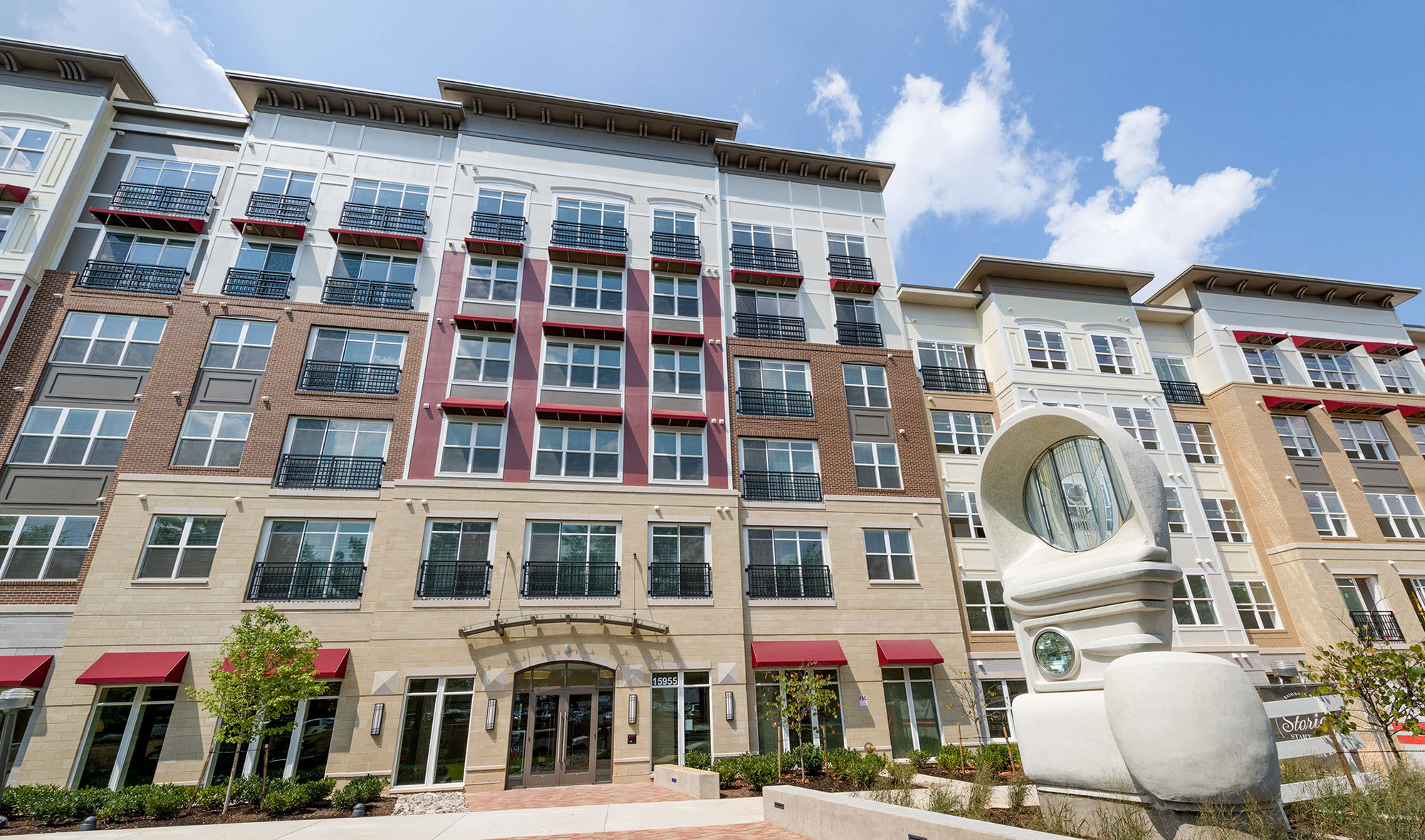
Bainbridge Shady Grove Metro Apartments now stands on the former site of the Reed Brothers Dodge dealership at 15955 Frederick Road. A sculpture now installed on the property pays tribute to the oldest Dodge dealership in Maryland history. More than 20 feet high, and over 6 feet wide, the public art is inspired by 1939 Dodge headlamps, and the fender of a 1957 Dodge pickup truck.
Honoring a Legacy
When Lewis Reed opened his Dodge dealership 106 years ago in October 1915, he never knew he was starting a family tradition that would be carried out for 97 years and three generations. Since then, the business grew and transformed from a small-scale garage and dealership into one of the largest and most recognized commercial enterprises on Rockville Pike.
Lewis and Edgar Reed’s business philosophy was simple:
Treat your customer as your friend and always do what you promise.
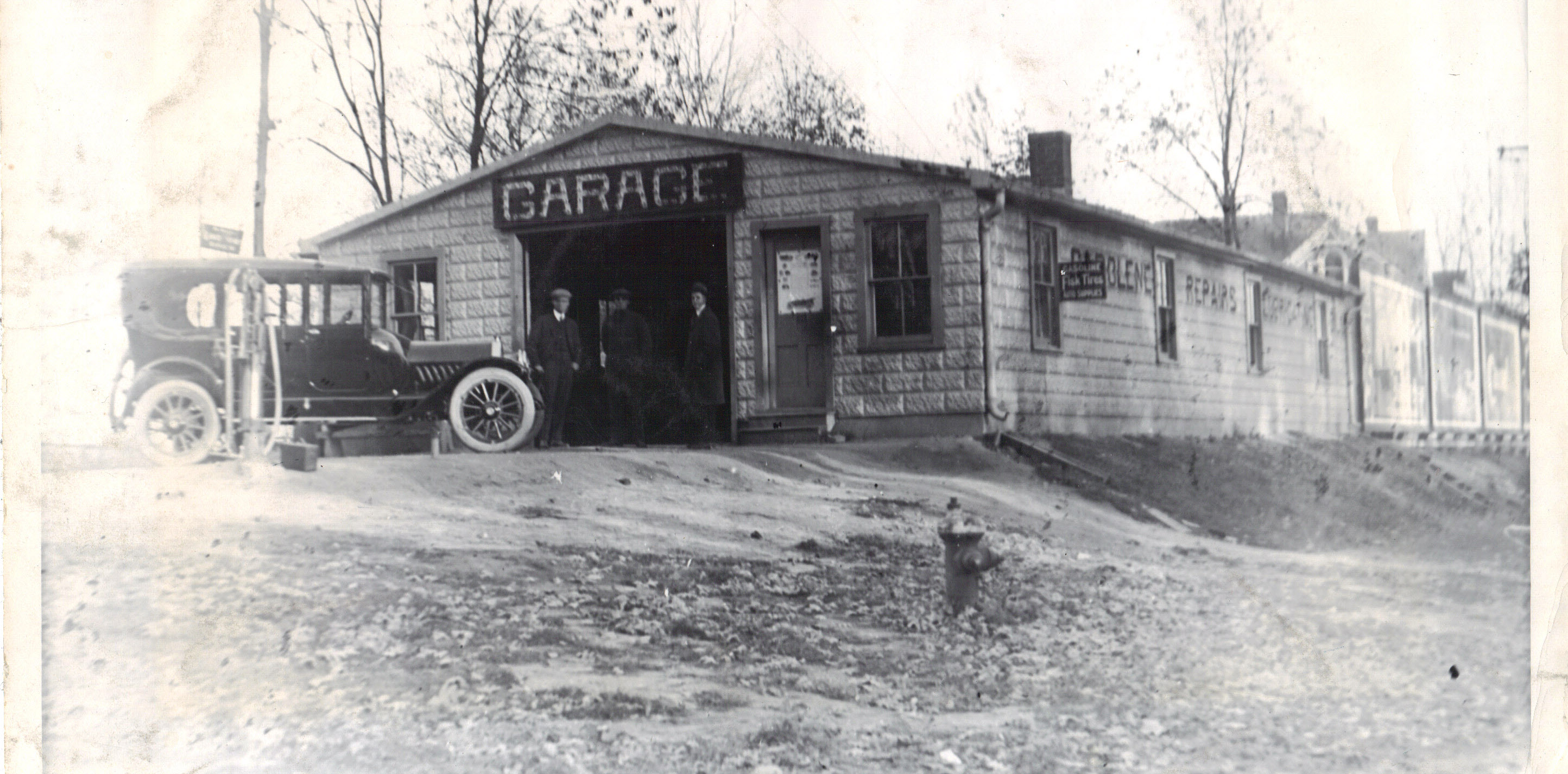
1915 Rockville Garage located at the intersection of Veirs Mill Road and Rockville Pike The original owners of Rockville Garage are standing in front. From left: Lewis Reed – Roy Warfield – Griffith Warfield.
The photo above shows the Rockville Garage where Lewis Reed got his start by becoming a partner with Robert L. and Griffith Warfield in 1914. The Warfield brothers had purchased this building in July 1915, from Lee Ricketts and Sons who had the Overland Agency. In 1917, Lewis Reed bought out the Warfield brothers’ interest and continued the business until 1919 when he was joined by his brother, Edgar. The firm’s name was changed to Reed Brothers upon a suggestion of the late Judge Edward C. Peter.
Reed Brothers handled the first Dodge cars placed on the market in Montgomery County, Maryland. The company continued for two generations later under the Gartner family and sold tens of thousands of cars to generations of local drivers. The late George M. Hunter, President of the Montgomery County National Bank, purchased the first automobile sold by the Rockville Garage.
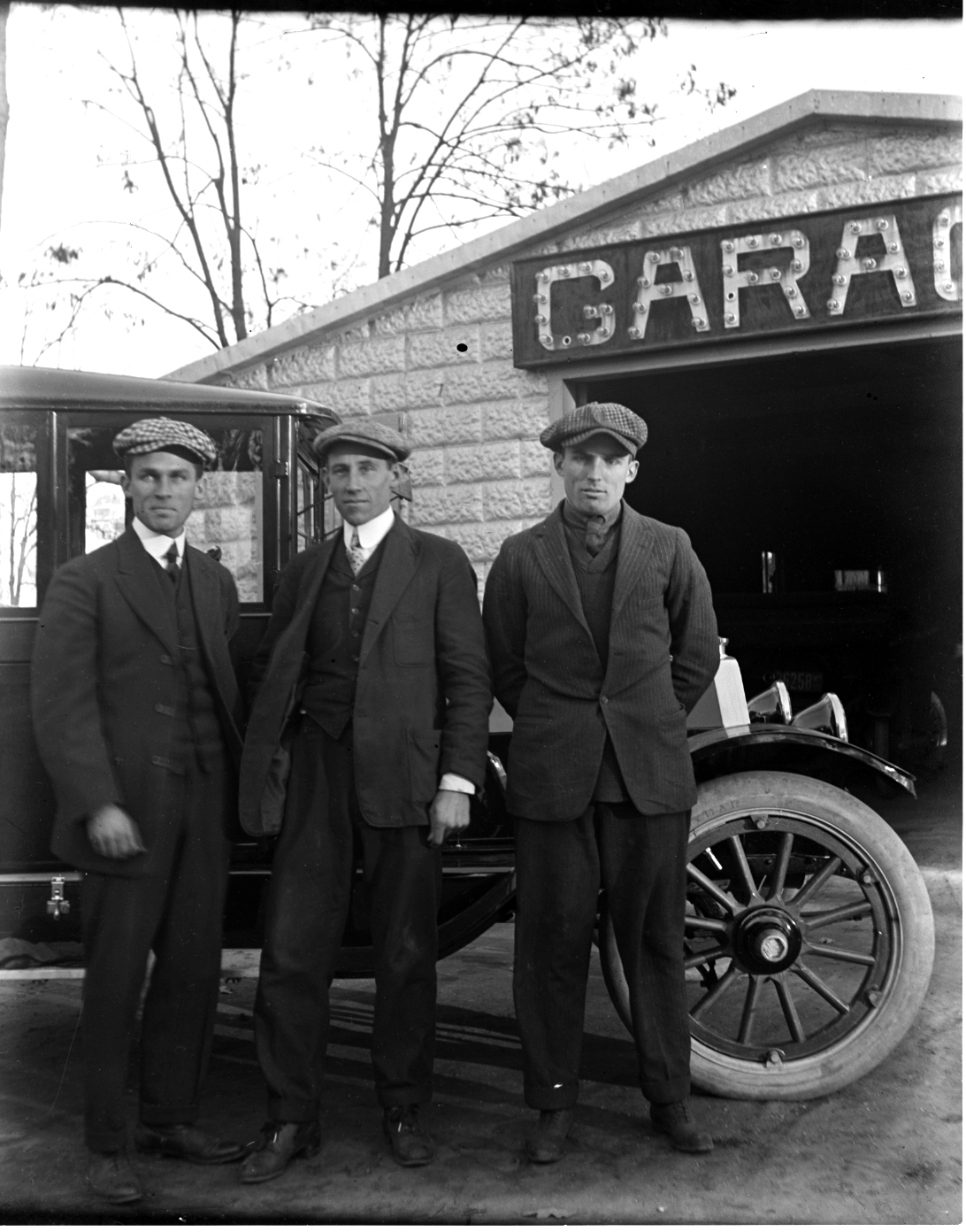
1916 – The original owners of Rockville Garage. From left: Roy Warfield – Lewis Reed – Griffith Warfield
Initially, Reed Brothers sold Oldsmobile and Hudson along with Dodge. The first Plymouth was built in 1928 and Plymouths were sold at Reed Brothers from 1930 until 1969, when the Plymouth car was given to the Chrysler dealers. In 1928, when Walter P. Chrysler took over after Horace and John Dodge died, Lewis Reed became an original member of the Chrysler family. By 1929, when the stock market crashed and Great Depression began, nobody could afford to buy cars. Like most other businesses, the Great Depression hit hard and Reed Brothers had to rely on its Service Department to make ends meet. But, the dealership survived through these lean times.
During World War II, Reed Brothers Dodge had virtually no new cars to sell for three and a half years. Tires and parts were rationed. Strict price ceilings governed used-car sales. Used cars were really hard to find, because people couldn’t afford to give them up. So, most dealerships had to rely on their service and parts departments to fix the cars people couldn’t replace. Empty showrooms were a problem. When manufacturers halted car production and many dealers went bankrupt, Lewis Reed converted his car showroom into a display room and sold GE washing machines, Westinghouse Radios, and other large appliances to fill the gap.
The dealership survived The Great Depression, World War II, the first Chrysler Bailout and resurgence under Lee Iacocca, the sale of Chrysler to Daimler and the sale to the private equity firm Cerberus. Reed Brothers has, in fact, survived everything but Chrysler itself. Whether a franchise is run by a second- or third-generation dealer or is older than even Chrysler itself didn’t seem to matter when Chrysler decided to cut dealership ranks during their 2009 bankruptcy process. After almost 95 years selling Dodges, Reed Brothers was one of the 15 dealerships in Maryland and 789 dealerships nationwide notified by Chrysler that their franchise agreement would not be renewed.
The dealership’s historical legacy continues to this day on the site of its former location at 15955 Frederick Road in Rockville, which is now the Bainbridge Shady Grove Metro Apartments. Bainbridge Shady Grove Metro Apartments pays homage to this history with commemorative art on the former site of the iconic Reed Brothers Dodge dealership.
Tom Keady, President of the Bainbridge Companies said:
Honoring the rich historical legacy of this site was extremely important to us. With the sculpture and the floor plan names, our residents and visitors feel a real connection to the site’s past, and we pay tribute to Reed Brothers Dodge’s role in creating a vibrant Rockville.
A sculpture now installed on the property pays tribute to the oldest Dodge dealership in Maryland history. More than 20 feet high, and over 6 feet wide, the public art is inspired by 1939 Dodge headlamps and the fender of a 1957 Dodge pickup truck. Along with the sculpture, a set of Hemi Piston street lamps line the walkway towards the metro station. Historical elements have been incorporated into the interior design of the development which carries out a common theme of dealership history and automobiles.
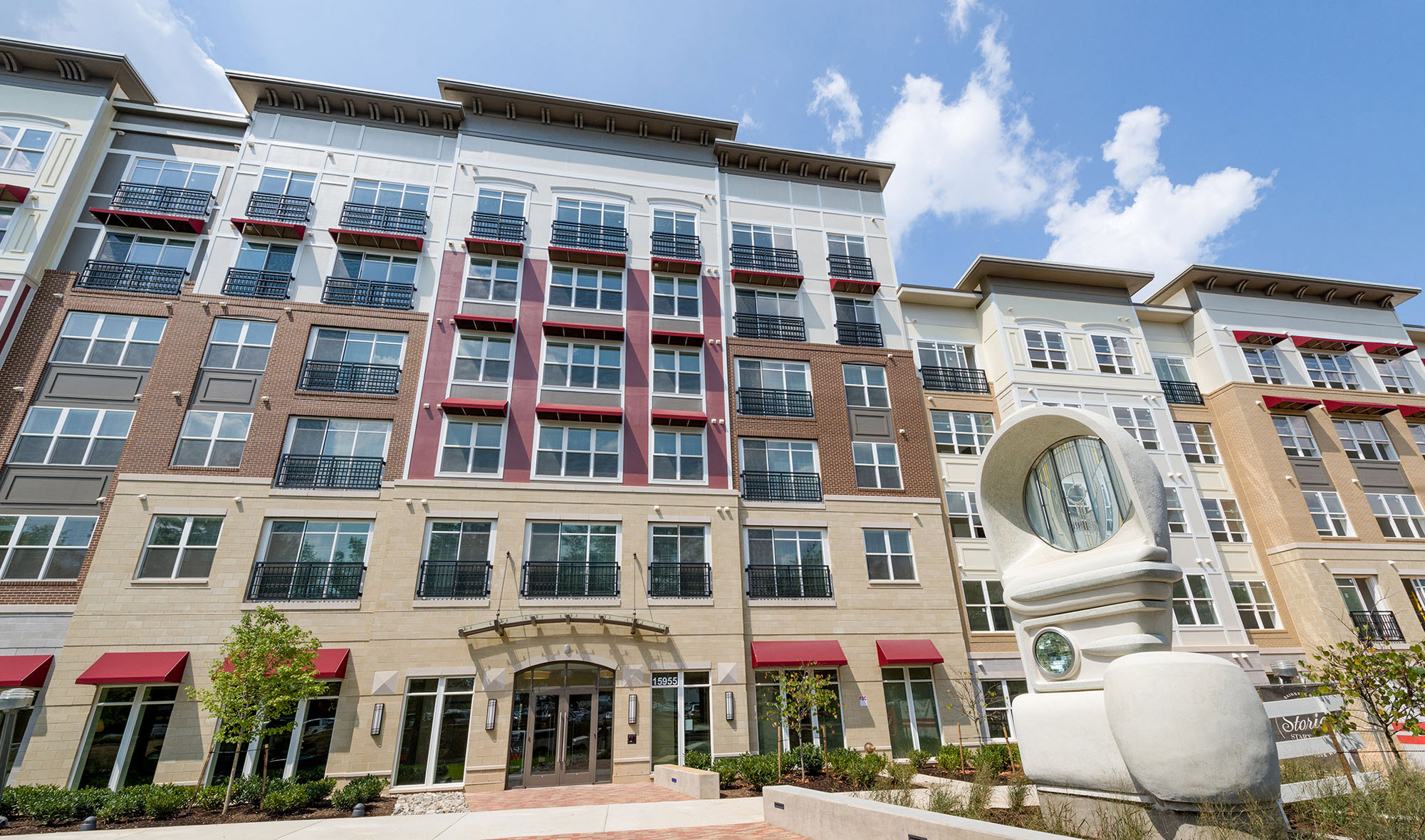
Bainbridge Shady Grove Metro Apartments now stands on the former site of the Reed Brothers Dodge dealership at 15955 Frederick Road. A sculpture now installed on the property pays tribute to the oldest Dodge dealership in Maryland history.
Books

Related Resources


Copyright Notice

Reed Brothers Dodge History (1915-2012) by Jeanne Gartner is licensed under a Creative Commons Attribution-NonCommercial 3.0 Unported License.


Recent Comments