
U.S. Capitol Then & Now… 108 Years of Change
You might not realize how much Washington DC has changed until you look back and see what it looked like in the past. I thought it would be fun to revisit an historic location using one of Lewis Reed’s original photographs for “then” and a stock image from today for “now” to see what differences are visible. In the following photographs, you can see how the United States Capitol looks both the same and completely different from a century ago.
U.S. Capitol (THEN): Seen in the black & white photograph taken by Lewis Reed in 1910, is the United States Capitol in Washington, DC. Visible in both photos is the white marble Peace Monument that stands in the circle to the west of the U.S. Capitol at Pennsylvania Avenue and First Street, NW. A streetcar can also be seen in the black & white photo. The Pennsylvania Ave streetcar line ran from Georgetown, across Pennsylvania Avenue, past the White House, up to Capitol Hill, and then down to the Navy Yard. With no stop signs, speed limits, or lane lines, the streets of the early 1900s were completely different.
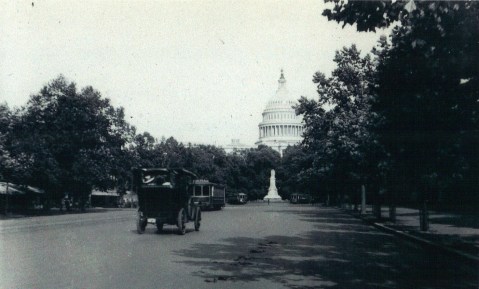
U.S. Capitol as seen from Pennsylvania Ave in 1910. Photo by Lewis Reed
U.S. Capitol (NOW): The same view over a century later hasn’t changed much… except for the traffic and Segway riders with fanny packs.
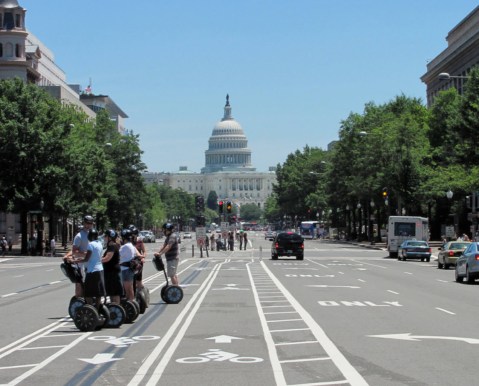
On Pennsylvania Ave and U.S. Capitol building today. A Segway tour is stopped along the bike lanes.
The First Dodge Car
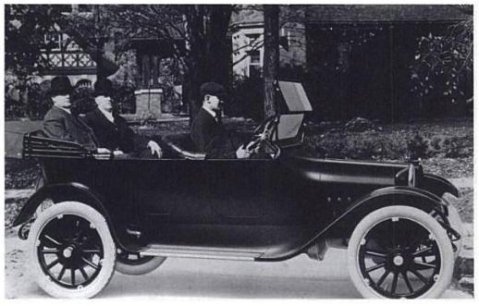
Horace Dodge (left rear) and John Dodge (right rear) in “Old Betsy” in front of John Dodge’s Boston Boulevard home, 14 November 1914.
One hundred and three years ago on this date – November 14, 1914 — the very first Dodge car, “Old Betsy”, rolled off the assembly line. On that day, the Dodge Brothers (Horace and John) were photographed riding in the rear seat of the first car to bear their last name. It cost $785, had a 110-inch wheelbase, and was powered by an L-head 4-cylinder engine that proved so reliable it was continued until 1920 with very little modification. Total production for 1914 was a mere 249 touring cars. The following year, Dodge offered a two-passenger roadster which also sold for $785 and the plant went into full production.
According to “The Dodge Brothers: The Men, the Motor Cars, and the Legacy” by Charles K. Hyde, here’s the full story:
The widely accepted history of the initial production of early Dodge Brothers automobiles in November 1914 is at odds with much of the evidence about the earliest Dodge Brothers cars. Automotive historians have thought that the first production car, later named “Old Betsy,” came off the assembly line at the Hamtramck factory on 14 November 1914. Guy Ameel, superintendent of final assembly for Dodge Brothers since the start of automobile production, served as John and Horace’s chauffeur that day. With the brothers in the back seat, Ameel stopped the first Dodge Brothers car in front of John Dodge’s mansion on Boston Boulevard in Detroit and a photographer recorded this important moment.
“Old Betsy” was more likely an experimental prototype car assembled several months before 14 November 1914 and not a production car at all…
The Dodge Brothers began an aggressive advertising campaign to promote their new automobiles and to attract potential dealers to sell their cars. Lewis Reed was an enterprising young man who put his future in the fledgling automobile industry. In 1915 he received his franchise to sell Dodge Brothers Motor Cars from John and Horace Dodge; less than one year after “Old Betsy” rolled off the assembly line. Lewis Reed and his brother Edgar, were the first to sell Dodge cars in Montgomery County, Maryland. That made Reed Brothers the oldest Dodge dealership under the same family ownership in Maryland, and one of the oldest in the entire nation.
11/14/1914: First Dodge Off Assembly Line
John & Horace Dodge in one of their 1914 Tourers
One hundred and two years ago on this date –November 14, 1914 — the very first Dodge car, “Old Betsy”, rolled off the assembly line. On that day, the Dodge Brothers (Horace and John) were photographed riding in the rear seat of the first car to bear their last name. It cost $785, had a 110-inch wheelbase, and was powered by an L-head 4-cylinder engine that proved so reliable it was continued until 1920 with very little modification. Total production for 1914 was a mere 249 touring cars. The following year. Dodge offered a two-passenger roadster which also sold for $785 and the plant went into full production.
According to “The Dodge Brothers: The Men, the Motor Cars, and the Legacy” by Charles K. Hyde, here’s the full story:
The widely accepted history of the initial production of early Dodge Brothers automobiles in November 1914 is at odds with much of the evidence about the earliest Dodge Brothers cars. Automotive historians have thought that the first production car, later named “Old Betsy,” came off the assembly line at the Hamtramck factory on 14 November 1914. Guy Ameel, superintendent of final assembly for Dodge Brothers since the start of automobile production, served as John and Horace’s chauffeur that day. With the brothers in the back seat, Ameel stopped the first Dodge Brothers car in front of John Dodge’s mansion on Boston Boulevard in Detroit and a photographer recorded this important moment.
“Old Betsy” was more likely an experimental prototype car assembled several months before 14 November 1914 and not a production car at all…
The Dodge Brothers began an aggressive advertising campaign to promote their new automobiles and to attract potential dealers to sell their cars. Lewis Reed was an enterprising young man who put his future in the fledgling automobile industry. In 1915 he received his franchise to sell Dodge Brothers Motor Cars from John and Horace Dodge; less than one year after “Old Betsy” rolled off the assembly line. Lewis Reed and his brother Edgar, were the first to sell Dodge cars in Montgomery County, Maryland. That made Reed Brothers the oldest Dodge dealership under the same family ownership in Maryland, and one of the oldest in the entire nation.
Lewis Reed Photo: 1911 Speedwell Touring

Two ladies posing in a 1911 Speedwell Touring car. Photo by Lewis Reed
One of the things I enjoy doing is looking through all of the old photographs in my grandfather’s albums and trying to figure out who and what they are. Unfortunately, the majority of the photos are more than 100 years old and do not come neatly labeled on the back with names, dates, people or places. Anyway, I came across this cool looking car and thought it would be fun to try and identify it, so I went on a quest. The only real clue I had to go on was the “S” on the front of the car.
After some digging, my research has identified the car as a circa 1910 or 1911 Speedwell Touring car — pictured just below is a fully restored 1911 Speedwell Series 11 50HP. Looks the same to me. What do you think?

Fully restored 1911 Speedwell Series 11 50HP. In 2011, this car was offered for sale at auction. It was estimated to sell for $195,000-$225,000 but bidding fell short of the estimate and left the auction unsold.
The Speedwell Motor Car Company was an early United States automobile manufacturing company that produced cars from 1907 to 1914. In 1910, the Speedwell cars and the Wright aircraft were produced in the same factory building. Powering the cars was a Speedwell four-cylinder motor that offered 50 horsepower, making it more than capable of sustaining high speeds. The exterior designs of the Speedwell automobiles were inspired from multiple parts of the automotive industry. Speedwell declared bankruptcy in 1915.
Source: Wikipedia – Speedwell Motor Car Company
November 14, 1914: The First Dodge Car

Horace Dodge (left rear) and John Dodge (right rear) in “Old Betsy” in front of John Dodge’s Boston Boulevard home, 14 November 1914.
One hundred and one years ago on this date –November 14, 1914 — the very first Dodge car, “Old Betsy”, rolled off the assembly line. On that day, the Dodge Brothers (Horace and John) were photographed riding in the rear seat of the first car to bear their last name. It cost $785, had a 110-inch wheelbase, and was powered by an L-head 4-cylinder engine that proved so reliable it was continued until 1920 with very little modification. Total production for 1914 was a mere 249 touring cars. The following year. Dodge offered a two-passenger roadster which also sold for $785 and the plant went into full production.
According to “The Dodge Brothers: The Men, the Motor Cars, and the Legacy” by Charles K. Hyde, here’s the full story:
The widely accepted history of the initial production of early Dodge Brothers automobiles in November 1914 is at odds with much of the evidence about the earliest Dodge Brothers cars. Automotive historians have thought that the first production car, later named “Old Betsy,” came off the assembly line at the Hamtramck factory on 14 November 1914. Guy Ameel, superintendent of final assembly for Dodge Brothers since the start of automobile production, served as John and Horace’s chauffeur that day. With the brothers in the back seat, Ameel stopped the first Dodge Brothers car in front of John Dodge’s mansion on Boston Boulevard in Detroit and a photographer recorded this important moment.
“Old Betsy” was more likely an experimental prototype car assembled several months before 14 November 1914 and not a production car at all…
The Dodge Brothers began an aggressive advertising campaign to promote their new automobiles and to attract potential dealers to sell their cars. Few people jumped onto the Dodge Brothers bandwagon earlier than Lewis Reed, and not many have lasted longer. Lewis Reed was an enterprising young man who put his future in the fledgling automobile industry. In 1915 he received his franchise to sell Dodge Brothers Motor Cars from John and Horace Dodge; less than one year after “Old Betsy” rolled off the assembly line. Lewis Reed and his brother Edgar, were the first to sell Dodge cars in Montgomery County, Maryland. That made Reed Brothers the oldest Dodge dealership under the same family ownership in Maryland, and one of the oldest in the entire nation.
The Beginning of Dodge | Chrysler Historical Video
Source: “The Dodge Brothers: The Men, the Motor Cars, and the Legacy“
Books

Related Resources


Copyright Notice

Reed Brothers Dodge History (1915-2012) by Jeanne Gartner is licensed under a Creative Commons Attribution-NonCommercial 3.0 Unported License.
 Reed Brothers Dodge History 1915 – 2012
Recent Comments