
UPDATE: Lewis Reed Photos to Appear on Science Channel ‘Impossible Engineering’

I just got word from the Production Assistant at Discovery that the new season of Impossible Engineering Series 4 is about to start airing in the US. Lewis Reed’s race car photographs will be a part of the “London Array Wind Farm” episode which is the second episode of the series. The show is scheduled to be broadcast on Thursday, January 10, 2019 on Discovery’s Science Channel.
The following 1923 dirt track race shots taken by Lewis Reed at the Rockville Fair will be used on the program that will feature a segment on the development of the race car.
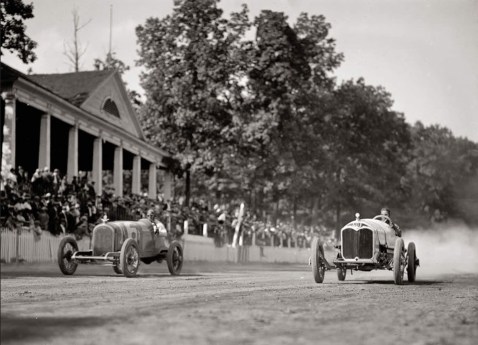
Photo by Lewis Reed
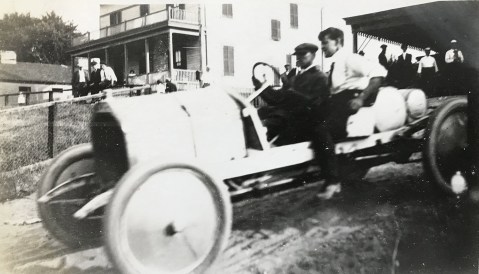
Photo by Lewis Reed
About Impossible Engineering
Behind every seemingly impossible marvel of modern engineering is a cast of historic trailblazers who designed new building techniques, took risks on untested materials and revolutionized their field. Brand new series, ‘Impossible Engineering’, is a tribute to their achievements. Each episode details how giant structures, record-beating buildings, war ships and space crafts are built and work. As the show revels in these modern day creations, it also leaps back in time to recount the stories of the exceptional engineers whose technological advances made it all possible. How would they have ever existed without the historical work of their ancestors? Interviews with their great advocates bring engineering history to life and retell how these incredible accomplishments shaped the modern world.
“Impossible Engineering” is produced for Science Channel by Twofour Broadcast.
Then & Now: Saylorsburg Lake House & Hotel of Horror
With Halloween just around the corner, I thought it would be fun to feature a photograph that Lewis Reed took of the Saylorsburg Lake House Hotel, now the site of Hotel of Horror. The aging Lake House Hotel in Saylorsburg, Pennsylvania, once a vibrant Poconos retreat, was a popular hotel for the region’s tourists who were looking for fun on nearby Saylors Lake. During the hotel’s heyday, its staff was booking rooms a year in advance. Today, the former hotel’s fame is generated from its annual Halloween haunted-house attraction.
Lake House Hotel (THEN): The legend of the Lake House Hotel spans more than two-hundred years. According to local folklore, during World War II, many of the employees at the Lake House were called to assist in the Pennsylvania National Guard, leaving the local asylum with one lone security guard to watch over the entire building. The inmates escaped, made their way to the hotel and took it over. The insane patients performed experiments on the guests. What was once a renowned resort for the rich and famous, became a torture chamber.

Saylorsburg Lake House Hotel. Photo taken by Lewis Reed, 1915.
Hotel of Horror (NOW): This 2018 season will celebrate the 26th year that the Hotel of Horror has been fascinating and horrifying legions of fans from the far reaches of the United States and even internationally. To all the readers of this blog: Have a spooky, enjoyable and very safe Halloween!

Welcome to The Hotel of Horror, The Pocono Mountains Premier Haunted House Attraction

Lewis Reed Photo: Old Country Store

Circa 1900s country store on a dirt road. Note the sign advertising Battle Axe Shoes. Two ladies standing on the porch. Location Unknown. Photo by Lewis Reed
This early 1900s photo taken by Lewis Reed is a flashback to a time when the clip-clop of horses could be heard going down the street, kids would walk to school, and people took the time to care about and create things that would last. This old store would have been considered not very clean from modern standards and the roads outside were unpaved.
While every store was different, there were similarities among many, including a front that was decorated by tin sign advertising, tobacco, cigars, shoes, hardware, and more. The sign in front advertises Battle Axe Shoes, Stephen Putney Shoe Company. I did a little research and found out Samuel and Stephen Putney were father and son shoe manufacturers of Battle Axe Shoes in Richmond, Virginia.
Usually, country stores featured double doors that opened inward and lots of barrels that might contain any number of items — from pickles, to crackers, potatoes, flour and candies. The store was usually an unpainted, two-story frame building fronted by a raised porch for convenient loading and unloading.
One thing in this photo I can’t explain are the steps seemingly leading to nowhere on side of the building. And I wonder what the tall pole is for? It seems to be bracketed on the side of the building. Ideas, folks?
The Putney’s owned and ran Battle Axe Shoes, and had this factory on 2200 West Broad Street as touted by the 1909 Postcard below.
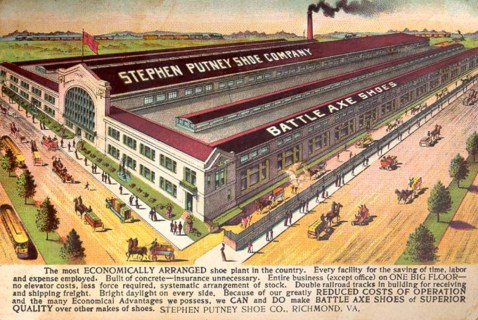
By the way, it appears as if the writer of this postcard was a big fan of CAPS-lock to get his point across.
Impressive….
And environmentally friendly to boot! (Pun intended)
The postcard reads:
“The most ECONOMICALLY ARRANGED shoe plant in the country. Every facility for the saving of time, labor and expense employed. Built of concrete – insurance unnecessary. Entire business (except office) on ONE BIG FLOOR – no elevator costs, less force required, systematic arrangement of stock. Double railroad tracks in building for receiving and shipping freight. Bridge daylight on every side. Because of our greatly REDUCED COSTS OF OPERATION and the many Economical Advantages we posses, we CAN and DO make BATTLE AXE SHOES of SUPERIOR QUALITY over other makes of shoes. STEPHEN PUTNEY SHOE CO., RICHMOND, VA.”
Lewis Reed: Enters 1936 Amateur Photo Contest
The Star published a series of pictures reproduced from photographs taken by local amateurs. The pictures were selected and judged each week and the best one chosen on its merits and published the following Sunday. Lewis Reed submitted his photo, “Sunset Over the River”, in the Washington Star Best Snapshots of the Week in The Star’s Amateur Contest. There was no indication where the photo was taken, but I’m guessing it was probably on the Potomac River, Maryland. At the time, Lewis Reed would have been 49 years old. There was no mention of whether or not he won a prize for his photograph, but I’m not surprised he entered this contest. He was a passionate photographer and always had his camera with him.
The full page image below is from the Sunday Gravure Section of The Washington Star newspaper. When looking at the top of the page, I wondered what the term “Gravure” meant, so I “googled” it. Turns out gravure refers to the special newspaper sections of photographs which were printed with this process starting around the late 1800s. In the 1930s, newspapers published relatively few photographs and instead published separate gravure sections in their Sunday editions. These sections were devoted to photographs and identifying captions, not news stories.

Full page image from The Sunday Star, Washington, D.C. – Gravure Section – June 28, 1936.

“Sunset Over the River” taken by Lewis Reed in 1936
Lewis Reed was a well-known photographer in Montgomery County and many of his photographs are now part of the Montgomery County (Maryland) Historical Society photo archives. His photography has appeared in highly regarded history books such as, “Montgomery County: Two Centuries of Change” by Jane C. Sween, “Montgomery County (Then & Now)” by Mark Walston, “Montgomery County (MD) Images of America”, by Michael Dwyer, “Rockville: Portrait of a City” by Eileen S. McGuckian, and “Gaithersburg: History of a City”. His photographs have been featured in the Norris-Banonis Automotive Wall Calendar, on the national television show, American Pickers, and on television’s most watched history series, American Experience on PBS.
Lewis Reed’s ‘Ghost’ Photograph

Surrealistic, ghost-like effect of Lewis Reed (right) standing next to a tree in the middle of train track. From Lewis Reed’s Photograph Collection
Lewis Reed had a passion for photography and had the know-how to try out a few of the trick shots that were popular at the time — including creating double exposures that made it look as if there were ghosts in the picture.
When I saw this photograph — which is slick enough to fool anyone not paying attention to detail — I became curious. How on earth did he do that? So I did some research to get some information on what went into this type of photography. This technique often left a telltale vertical line along the center of the image — a fuzzy stripe separating the two exposures.
Supernatural effects were mainly accomplished using double exposure. When developing the photos, a pre-prepared glass plate would be used which already had the image of a person on it. This would be the ‘ghost’. It would then be inserted into the camera in front of an unused plate which was used to shoot the photo. The developed negative comes out with both images on it — an incompletely exposed ghostly image as well as a sitter, looking perfectly unaware.
I think it’s really amazing how Lewis Reed’s early photography shows such versatility and creativity.
Books

Related Resources


Copyright Notice

Reed Brothers Dodge History (1915-2012) by Jeanne Gartner is licensed under a Creative Commons Attribution-NonCommercial 3.0 Unported License.
 Reed Brothers Dodge History 1915 – 2012
Recent Comments