
A Family Photo Postcard Jackpot

Postcard front was taken by Lewis Reed at Pope’s Creek Maryland on the Potomac River ca. 1915

Postcard addressed to Ethlene Thomas from L. Reed. Note the cost of the postage stamp is just one penny.
Lewis Reed’s albums contain several hundred of these photo postcards dating from approximately 1907-1915. What makes this particular photo postcard so special is, it was sent from Lewis Reed to Ethlene Thomas. Lewis Reed married the former Ethlene Thomas of Frederick County on June 15, 1920. This is a real photo postcard — one in which the photographic paper on which the photo was developed was itself then sent as the postcard. The stamp is a one penny stamp with the image of Benjamin Franklin. The Benjamin Franklin series stamp was issued by the U.S. Post Office between 1908 and 1922.
What I love about the address is how it’s addressed merely to “Miss Ethlene Thomas, New Market, Frederick Co, MD. I have a feeling, however, that the postcard would have found it’s way even had “New Market” been left off the card.
The card reads:
Dear Friend,
You can look for me Friday afternoon between 6 and 7 o’clock or sooner, if it is not raining. I will be there sooner if I can.
As ever, L. Reed
Kodak made photo paper in standard 3 1/2 by 5 1/2 postcard size with “Post Card” printed on the back. Lewis Reed developed all of his own photographs. He had a darkroom in his house — in the kitchen, to be exact — and worked at night to develop the negatives. This gave him the ability to take the paper into his dark room and produce a real photo postcard. This one is definitely a treasure.
Meet Lewis Reed, Photographer


Before opening his Dodge dealership in 1915, Lewis Reed was a well-known photographer in Montgomery County Maryland. At the turn of the century, before automobiles were even around, Lewis Reed toured up and down the East Coast on his motorcycle, taking photographs of landscapes, monuments, historic places, and people.
Some of the historic locations in his photograph collection includes the Black Rock Grist Mill, Smithsonian Institution, Montgomery County Maryland Almshouse, United States Capitol, Key Bridge, Union Station and other important sites in and around the Maryland, Virginia, and Washington, D.C. area. There are also photographs of many non-Maryland locations including Virginia, West Virginia, Pennsylvania, Georgia, New York, Boston, Georgia, North Carolina, and Canada. Especially stunning are images of the aftermath of the 1936 Gainesville Georgia tornado, one of the deadliest tornadoes in American history. As his photograph collection reveals, Lewis Reed was on the scene for some of the most important events in the history of the twentieth-century, and he always had his camera with him.
Lewis Reed developed all of his own photographs. He had a darkroom in his house — in the kitchen, to be exact — and worked at night to develop the negatives.
His photography has appeared in highly regarded history books such as, Montgomery County: Two Centuries of Change by Jane C. Sween, Rockville: Portrait of a City by Eileen S. McGuckian, and Gaithersburg: History of a City. His photographs have been featured in the Norris-Banonis Automotive Wall Calendar, on the national television show, American Pickers, and on television’s most watched history series, American Experience on PBS.
In a way, his photographs — more than 2500 in all — serve as an unwritten diary of his early adventures as an amateur photographer. My greatest pleasure now — more than 100 years later — is being able to share them.
Then & Now: Georgetown University and Potomac Aqueduct Bridge 100 Years Apart
Washington DC has a lot of history. The Smithsonian museums, the monuments, etc., but it is interesting to see just how much the city has changed over the years. I thought it would be fun to revisit an historic location using one of Lewis Reed’s original photographs for “then” and a stock image from today for “now” to see what differences are visible. In the following photographs, you can see how Washington, DC looks both the same and completely different from a century ago.
Georgetown University and Aqueduct Bridge (THEN): The Key Bridge was not the original connector between Georgetown and Virginia. Prior to that construction in the 1920s, there were two iterations of the Aqueduct Bridge. The second iteration of the bridge looked visibly different, but even that one suffered from deterioration and was only used between 1889 and 1918. The Aqueduct Bridge continued as a bridge for traffic until the Key Bridge opened in 1923.
Seen in the black & white photograph taken by Lewis Reed in 1913, is the Aqueduct Bridge over the Potomac River in Washington, DC. The spires of buildings at Georgetown University can be seen in the background.
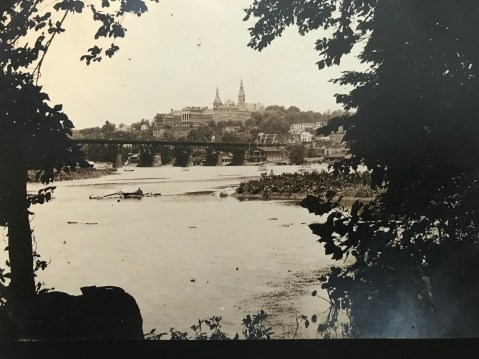
Potomac Aqueduct Bridge Washington DC 1913. Photo by Lewis Reed
Georgetown University and Key Bridge (NOW): The same view over a century later hasn’t changed much.

Georgetown University and Key Bridge Washington DC today
Frederick, Maryland, 1912: Jug Bridge Over the Monocacy River

Motorcyclist waving as he crosses Jug Bridge. Photo by Lewis Reed, ca. 1912
The Jug Bridge was built over the Monacacy River in 1808 at a location a few miles east of Frederick, Maryland. The bridge consisted of two 65-foot spans. The bridge’s name derived from a stone bottle that was situated at the northeastern end of the bridge. There was a legend that an Irish mason accidentally sealed a jug of whiskey inside the stone bottle. Today, the stone bottle sits in a roadside park west of the river.
The bridge collapsed suddenly on March 3, 1942, creating a nightmarish detour for through traffic. A replacement bridge was opened just south of the jug bridge. Click the photos to get a better look at the huge demijohn that guards the entrance.
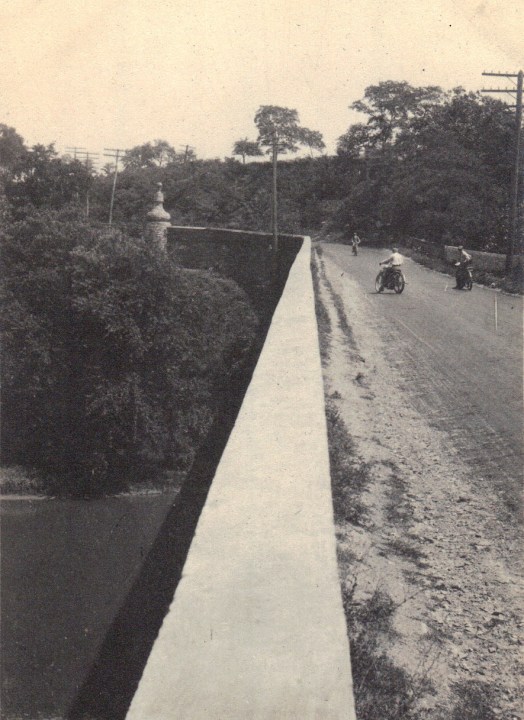
Motorcyclists crossing Jug Bridge. Photo by Lewis Reed, ca. 1912
With the new alignment across the Monacacy River, the stone bottle was dismantled and moved to an interpretive park high on the western bank of river valley. By the way, the bottle was empty – there was no jug of whiskey.
Montgomery County Fairgrounds in the Snow, ca. 1910

Montgomery County Fairgrounds. Photo by Lewis Reed, ca. 1910
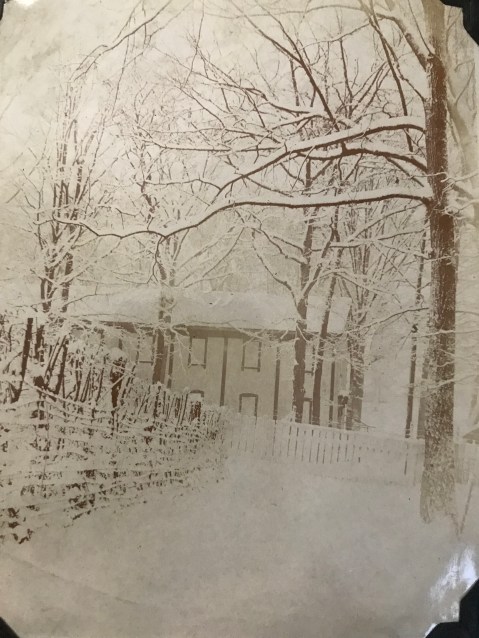
Montgomery County Fairgrounds Chicken House. Photo by Lewis Reed, ca. 1910
These snowy images of the Montgomery County Fair were taken by Lewis Reed, ca. 1910. From 1846-1932, the Montgomery County Fair took place in Rockville with competitions, entertainment, and food that attracted people from Montgomery County and Washington, DC.
Books

Related Resources


Copyright Notice

Reed Brothers Dodge History (1915-2012) by Jeanne Gartner is licensed under a Creative Commons Attribution-NonCommercial 3.0 Unported License.
 Reed Brothers Dodge History 1915 – 2012
Recent Comments