
Remember Full Service Gas Stations?

1940s Reed Brothers Dodge full service Gulf gasoline station with two attendants posing in front. Professional service was very important in the first half of the 20th century, so it was common for gas station attendants to wear the company uniform. Photo by Lewis Reed
Do you remember full service gas stations? I sure do. As a baby boomer growing up in the 60s, I remember Reed Brothers Dodge when it was a full service gasoline station. Reed Brothers was the first to sell Gulf gasoline to the motoring public in the Washington, D.C. area. In 1915, they began selling gas at their original location in Old Rockville at the triangle at Veirs Mill Road and Rockville Pike. Their first “gas station” consisted of a single pump. Reed Brothers Dodge offered full service gasoline for 55 years until they relocated to their new facility in 1970.

Circa 1957, Marvin Shultz pumps gas into a truck at Reed Brothers Gulf Gas Station. Marvin began as Manager of Reed Brothers full service Gulf Gasoline and Service Station when it was located at its original location at the intersection of Veirs Mill Road and Rockville Pike. Photo courtesy of the Shultz family.
The uniformed attendant would greet the customer by name, fill the car up with gas, wipe the windshield, check the tire pressures and check under the hood. Back then, getting a tank of gas could take up to 10-15 minutes per person. I used to love to hear the bell ding after every gallon pumped. Gulf had orange foam balls you could place on your car’s antenna and they also gave away things like pens, key chains, calendars and road maps. But for the most part, gas stations today resemble convenience stores more than a one-stop haven for all things automotive. Some changes are for the better, but there are some amenities that are missed.
The first uniformed gas station attendants appeared at Reed Brothers Dodge around 1920. The Gulf station included a manager and four attendants. Attendants worked long hours in all weather, possessed a thorough knowledge of service requirements for various automobile makes and models, improvised quick repairs on the spot, provided directions to lost travelers, and did it all with a smile. The men dressed in uniforms and caps in the photo below were Gulf Gasoline Station attendants. Three of the original gas station attendants were Walter (Bud) Beall, Otis Beall and John Burdette.

Reed Brothers Dodge Sales & Service staff and Gulf Gasoline Attendants, circa 1920s. Photo by Lewis Reed
Gas station attendants used to be as well-dressed as police officers and firefighters, right down to the snappy hat and bow tie. The uniform shirt usually had the company logo stitched on one breast pocket and the employee’s embroidered nameplate on the other. The attendant also had a roll of fives and singles in his shirt pocket so that he could make change.
Black rubber hoses used to snake across the pavement. They were hooked up to a bell inside the building and the “ding” signaled for an attendant to dash over to the driver’s window and ask, “Fill ‘er up? Every attendant had a huge rag hanging out of his back pocket that he used to wipe the oil dipstick. Then, much like a sommelier proffering a sample of a vintage wine, he’d present the dipstick to the driver for his inspection. He would then use his squeegee to carefully clean those panoramic windshields of the era with just a few expert swipes. All this whether the customer had purchased 50 cents worth or a tank full of gas.
In earlier times, lost motorists could pull into any service station and get detailed, accurate directions. The attendant would often mark on a road map as a visual aid and then let the driver take it with him, free of charge. In fact, it was expected that gas stations in any given area had a rack full of complimentary road maps. Gulf was the first oil company to use maps to promote its pump attendants as courteous, helpful, and reliable sources of local tourist information, as seen in this 1933 ad. However, you won’t find many road maps available today thanks to navigation provided by smartphones, Garmin and other built-in-car GPS systems.

Reed Brothers Service Station provided restrooms for the traveling public. Patrons wanted clean and safe facilities. In addition to the Gulf signage there is a small, barely visible sign below that promotes, “Clean Rest Rooms” which assured the traveler that the restrooms were well maintained. Gulf was the first oil company to promote clean restrooms as a customer benefit.
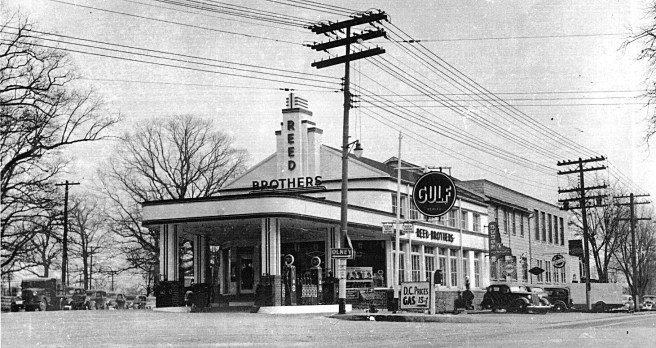
1936 — Reed Brothers Dodge canopied Gulf Gas Station. A closer look reveals the price of gasoline as 15 cents. On the right attached to a telephone pole is a sign pointing the way to Olney. In addition to the Gulf signage there is a small, barely visible sign below that promotes, “Clean Rest Rooms”. Photo by Lewis Reed
We’ve come a long way since these times. We pull up, pump our own gas, stick a plastic card in a machine and go. No human contact required. That’s progress, one supposes.
Look Out! Early 20th Century Reckless Driving
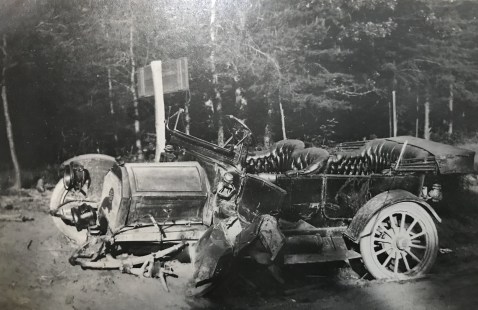
Car Wreck. Photo by Lewis Reed, ca. 1920
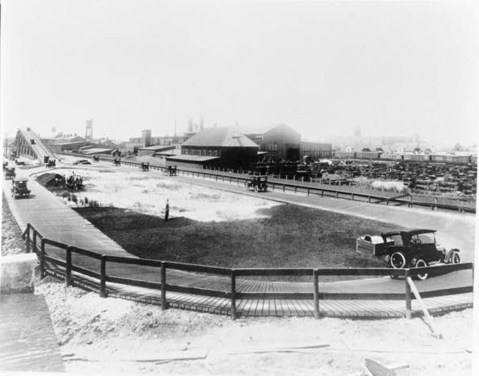
Dodge Test Track 1915
The clipping is from the Bismarck Daily Tribune, April 21, 1915 newspaper.
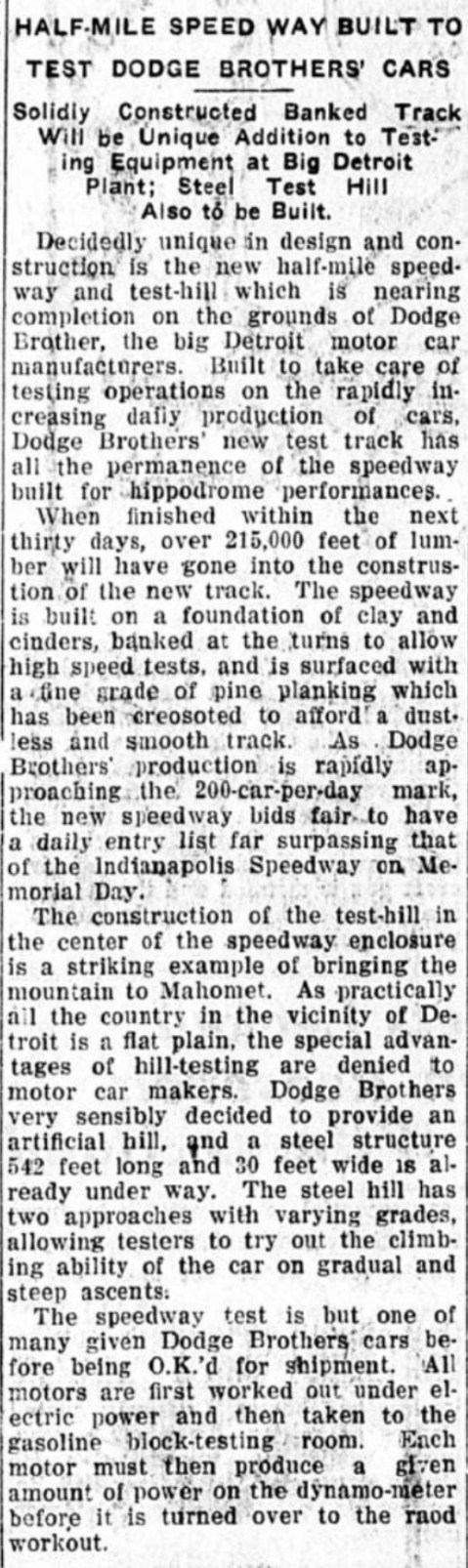
Bismarck Daily Tribune April 21, 1915
November 14, 1914: First Dodge Automobile Built

Horace Dodge (left, rear) and John Dodge (right, rear) take delivery of the first Dodge automobile on Nov. 14, 1914.
One hundred and four years ago on this date –November 14, 1914 — the very first Dodge car, “Old Betsy”, rolled off the assembly line. On that day, the Dodge Brothers (Horace and John) were photographed riding in the rear seat of the first car to bear their last name. It cost $785, had a 110-inch wheelbase, and was powered by an L-head 4-cylinder engine that proved so reliable it was continued until 1920 with very little modification. Total production for 1914 was a mere 249 touring cars. The following year. Dodge offered a two-passenger roadster which also sold for $785 and the plant went into full production.
According to “The Dodge Brothers: The Men, the Motor Cars, and the Legacy” by Charles K. Hyde, here’s the full story:
The widely accepted history of the initial production of early Dodge Brothers automobiles in November 1914 is at odds with much of the evidence about the earliest Dodge Brothers cars. Automotive historians have thought that the first production car, later named “Old Betsy,” came off the assembly line at the Hamtramck factory on 14 November 1914. Guy Ameel, superintendent of final assembly for Dodge Brothers since the start of automobile production, served as John and Horace’s chauffeur that day. With the brothers in the back seat, Ameel stopped the first Dodge Brothers car in front of John Dodge’s mansion on Boston Boulevard in Detroit and a photographer recorded this important moment.
“Old Betsy” was more likely an experimental prototype car assembled several months before 14 November 1914 and not a production car at all…

The Dodge Brothers
The Dodge Brothers began an aggressive advertising campaign to promote their new automobiles and to attract potential dealers to sell their cars. Few people jumped onto the Dodge Brothers bandwagon earlier than Lewis Reed, and not many have lasted longer.
Lewis Reed received his franchise to sell Dodge Brothers Motor Cars from John and Horace Dodge; less than one year after “Old Betsy” rolled off the assembly line. He was just 27 years old. Since then, the business grew and transformed into the oldest Dodge dealership in Maryland history and one of the oldest in the entire nation.
35 Years Ago Today, Chrysler Invented the Minivan, And Changed History
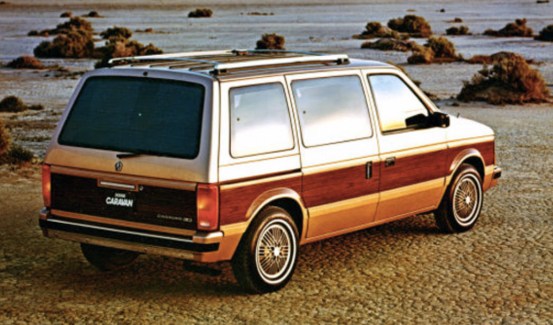
1984 Dodge Caravan
On November 2nd, 1983, the world’s first minivan rolled off of Chrysler’s assembly line. It was the vehicle that saved Chrysler from financial doom. When Ronald Reagan was president — the economy was far from robust and Chrysler was on death’s doorstep. Chrysler needed a home run, and Lee Iacocca, who was running the company at the time, gambled that the first wave of baby boomers who were starting families would likely want something roomier and far more practical than the traditional family hauler, the station wagon. Iacocca practically bet the company on the fact that a new automotive segment dubbed “the minivan” would catch on with the boomers. It was a $660-million gamble, only made possible by money acquired earlier from Washington’s $1.5-billion bailout of Chrysler.
Sales improved dramatically with the debut of the well-received K-car platform and the introduction of the Dodge Caravan and Plymouth Voyager. Chrysler paid off government loans seven years early. Reed Brothers successfully navigated through numerous Chrysler setbacks during the 1970’s and 80’s, including the first Chrysler Bailout and resurgence under Lee Iacocca.
The 1984 Dodge Caravan was designed specifically with families in mind. The early design looked like station wagons at the time, featuring a wood panel along the sides. The Caravan was essentially a big, roomy box on wheels, utilizing maximum form efficiency — small on the outside, huge on the inside.
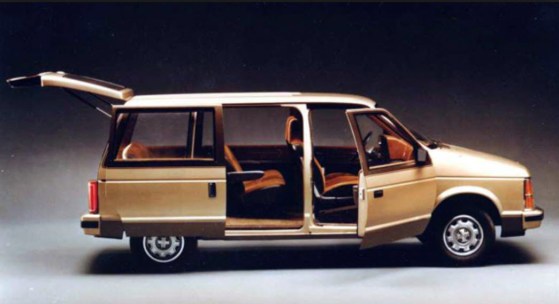
1984 Dodge Caravan
The other distinguishing features of the new minivan were its car-like features – notably including power windows, comfortable interiors, a nice dashboard, and front-wheel drive. These also explain the appeal of the vehicle. Not only did it fit in a garage like a car, but it actually drove like a car, while also providing plenty of room for the kids and luggage and giving mom a nice, high view of the road. The sliding door made it easy to for people to quickly enter or exit the vehicle and, with its lack of hinges, the sliding door was seen as a safer option for children.
After The 1984 Dodge Caravan was released, it became an immediate success. The minivan helped bring the company back from the brink of bankruptcy, and it reinvigorated the automotive market. Many buyers had to wait weeks to have their orders filled because there was so much demand. Dodge created an entirely new market with the minivan, and other models soon followed suit.
Lee Iacocca, the mastermind of the minivan era, presented this 12,000-mile Voyager at the assembly line in Windsor, Canada on November 2, 1983. A truly game-changing vehicle…
Chrysler Buys Dodge

1928 Chrysler logo
May 28, 1928 marks an important milestone in the history of Chrysler. It was on this day in 1928 that Dodge Brothers, Horace and John Dodge, became a part of Chrysler. It was on this same date that Lewis Reed, founder of Reed Brothers Dodge in Rockville, Maryland also became an original member of the Chrysler family.
During 1920, the Dodge Brothers company lost its founding fathers. John Dodge died in January, and his younger brother Horace succumbed the following December. A New York investment banking firm paid the brothers’ widows, in a single cash payment, $146 million for the Dodge Brothers firm. Within three years, the bankers initiated negotiations, and on May 28, 1928, Walter P. Chrysler purchased Dodge Brothers, Inc. for $170 million, making it, at the time, the largest business transaction in history. When the transaction was complete, the Chrysler Corporation had grown five-fold overnight to become the third of Detroit’s “Big Three” automakers.
The first Plymouth was built in 1928 and Plymouths were sold at Reed Brothers until 1969, when the Plymouth brand was given to the Chrysler dealers.
Books

Related Resources


Copyright Notice

Reed Brothers Dodge History (1915-2012) by Jeanne Gartner is licensed under a Creative Commons Attribution-NonCommercial 3.0 Unported License.
 Reed Brothers Dodge History 1915 – 2012
Recent Comments