
A Glimpse of Christmas Past in the Reed Family Home

Lewis Reed’s craftsman-style home, looking rather solitary on a snowy day. Photo by Lewis Reed.
I am flooded today with memories of my grandparents’ house. As a kid, it was a magical place. It was not a huge house, a modest Sears and Roebuck craftsman-style home built in 1926. Some of my earliest memories are visits to this home as I spent a lot of time there during my childhood. While looking through my grandfathers Christmas photographs, I started making some notes about some of the arbitrary things I could remember about them. And eventually some of that turned into this blog post.

Snow on the ground means it’s time for building a (presidential) snowman. This photo is Lewis Reed and the snowman he built of George Washington.
The following photos from Lewis Reed’s collection are a fabulous glimpse into Christmas inside the Reed family home at 301 North Frederick Avenue in Gaithersburg, Maryland. A lot of people assume that the traditions we follow have looked pretty much the same since their inception but, in most cases, like everything else in life, Christmas has definitely changed over the years.
The trees were big back then and always fresh. They went right to the ceiling and were very wide. Early Christmas trees were generally fastened onto a flat board surrounded with fence-rails, snow villages and carpeted with cotton blankets of snow. Lots of tinsel and strings of popcorn garnish the trees.
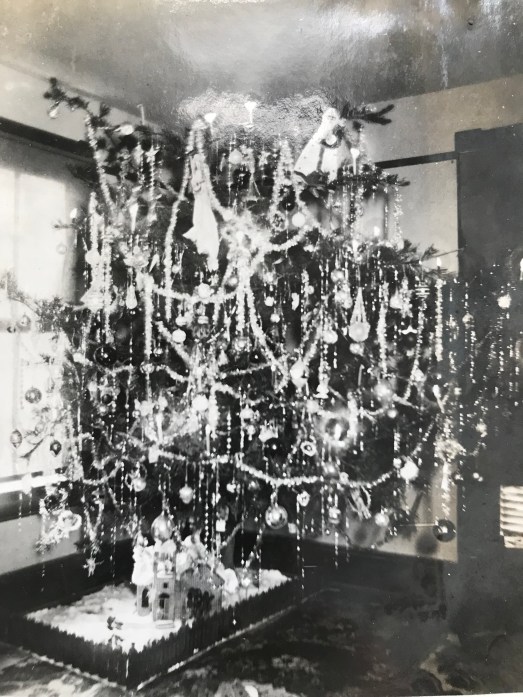
A small snow scene with what appears to be a miniature church is arranged at the foot of the Christmas tree. A popcorn garland adorns the tree. Photo by Lewis Reed
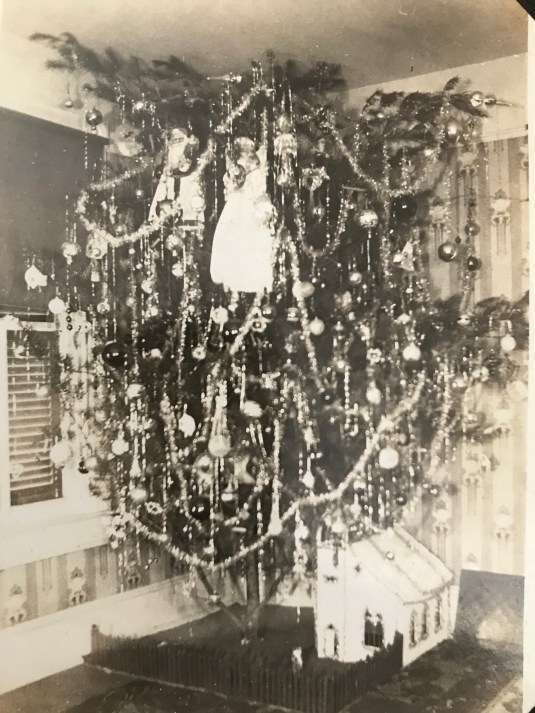
No room for a star on the top of this tree! And just look at those big Santa and Angel dolls. A miniature church with picket fence is arranged at the base of the tree. Photo by Lewis Reed
Below are photos of Lewis Reed’s snow village set up under the Christmas tree decorated with vintage ornaments, tinsel, and lights. I used to have a ton of fun helping my grandfather set up the miniature landscapes with the varied figures, little houses, and trees at Christmastime each year. It seemed like a holiday village right out of a storybook.

A rustic picket fence is used to set off the village display. Photo by Lewis Reed
The snow villages were set up in Lewis Reed’s basement on top of a big table beneath a small Christmas tree. He made the snow scenes entirely by hand using wire-covered cardboard and balled up paper to make hills and pathways. The little houses and figurines would fit into the landscape with cotton ‘snow’ all around; and lights would be wired underneath. It was just amazing to me.
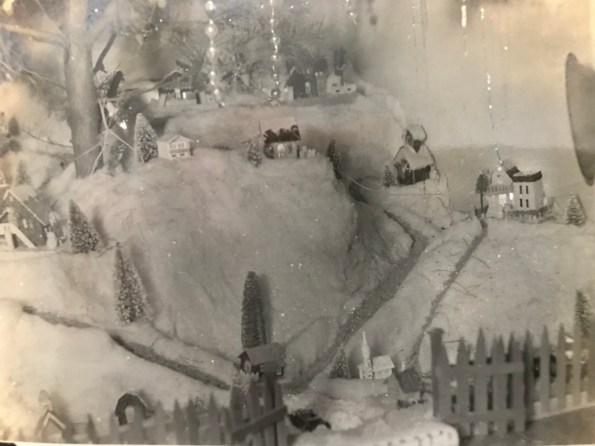
Little houses, churches, fences, trees, and pathways were added to the scene. Some of the houses have charming light effects in the windows. Photo by Lewis Reed
These Christmas villages were precursors of the Holiday Villages that were made popular by Dept. 56 that you see today.

Old-fashioned lights can be seen on the tree, along with lit windows in the houses. Photo by Lewis Reed
Looking back on these memories now in my adult mind is like watching my favorite Christmas movie. They are memories of my grandparents house at Christmastime, and are ones I will always treasure.
48 Years Ago Today: 55th Anniversary and Grand Opening

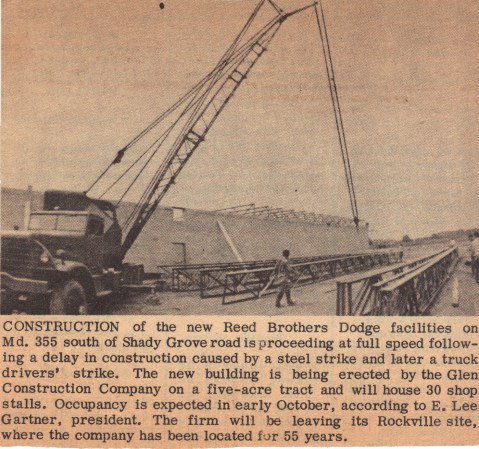
Today marks 48 years since the Grand Opening of Reed Brothers Dodge new showroom and service facility. When the state widened the roads in 1970, Lee Gartner purchased 4.37 acres of land from Eugene Casey and relocated Reed Brothers Dodge to a new state-of-the-art showroom and Dodge/Chrysler/Jeep service complex on Route 355 at 15955 Frederick Road in Rockville Maryland.
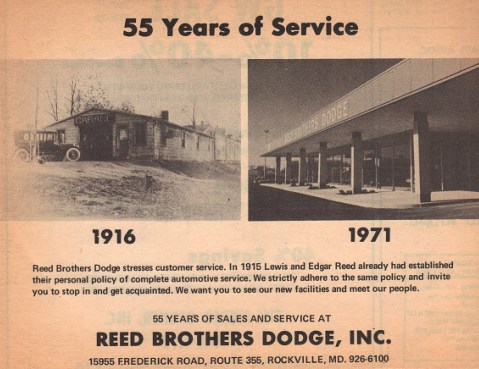
Turning out to honor the company were several hundred dignitaries, officials, businessmen and friends. The new building, a complete automotive sales and service facility marked Reed Brothers 55th year of selling Dodge’s. The state-of-the-art dealership contained the newest customer-focused features throughout which combined technology and comfort.


The new dealership provided a modern new vehicle showroom, 30 service bays, a comprehensive detail and car wash area, Parts Department, Body Shop, the newest technologies to service customer’s vehicles and provided customers with a convenient location to purchase and service their vehicle needs.

Design and construction of the new dealership was managed by the Glen Construction Company.
The 2019 Montgomery County History Conference

Each year in January, the Montgomery County Historical Society holds a day-long conference on various aspects of local history. Upwards of 200 people attend this annual event, which has been held since 2007. This year, I am very honored for the invitation to speak about the history of Reed Brothers Dodge at the History Conference on Saturday, January 26 at 12:45pm.
 The PowerPoint presentation will follow the dealerships historic timeline which showcases how Reed Brothers Dodge came into being, and how the company overcame the inevitable changes and challenges throughout almost a decade of being in business. More than 100 photographs will be featured, 60 of them rare, historic images taken by the dealership’s founder, Lewis Reed.
This one-day conference is a place for all people to explore and celebrate the many aspects of our past that shape our community to this day. The conference will be held at the Bioscience Education Center located at 20200 Observation Drive on Montgomery College’s Germantown Campus.
Registration is now open: REGISTER HERE
Then & Now: Walker Avenue Gaithersburg
This post is a continuation of a series of “Then & Now” images that will show photographs of buildings, street scenes, and other historical locales from Lewis Reed’s Photo Collection alongside photographs of how they appear today. These photos show the same view of Walker Avenue in Gaithersburg about 98 years apart.
Walker Avenue (THEN): This photo of Walker Avenue in Gaithersburg was taken by Lewis Reed from the steeple of Grace United Methodist Church in the late 1920s. The street is named after John Walker, whose farm became Walker Avenue when he decided to subdivide the front end in 1904. Walker was mayor of Gaithersburg from 1906 to 1908 and again from 1918 to 1924. In June 1913, Walker Avenue was the first street in Gaithersburg to have electric streetlights installed along its full length. This period saw major advances in technology, communication, and transportation.
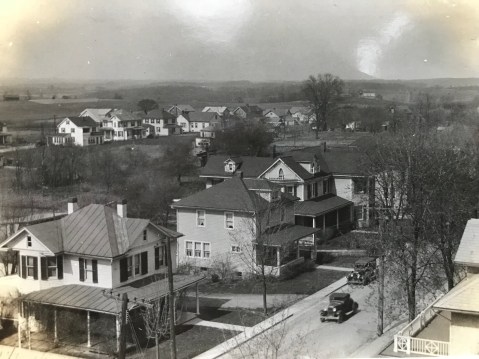
Walker Avenue in Gaithersburg taken from the steeple of Grace United Methodist Church, late 1920s. Photo by Lewis Reed
Walker Avenue (NOW): Walker Avenue is the most cohesive street in Gaithersburg’s historic district. Most of its houses were built between 1904 and 1930.
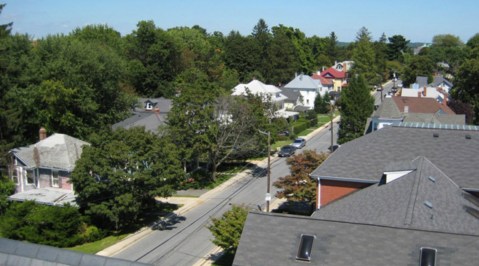
Walker Avenue in Gaithersburg today
Source: Maryland Historical Trust
Historic Gem: Drunk Falls Through Plate Glass Window of Reed Brothers Dodge
I encountered this fun and interesting news story among the millions of pages in the Library of Congress’s massive digitized database of historic American newspapers. The database is a superb resource, but it’s also the best kind of Internet rabbit hole: You go in looking for one thing, and encounter a dozen fascinating oddities along the way. This article is one of them:
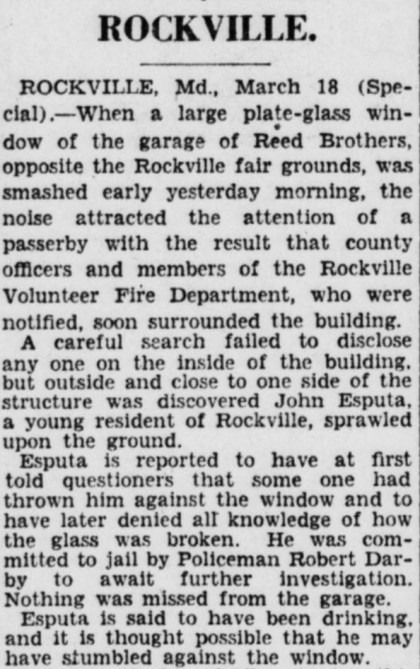
The Evening Star Washington, D.C., Monday, March 18, 1929
One of the dealership’s large plate glass windows in the photograph below would have been where the young resident may have stumbled through.
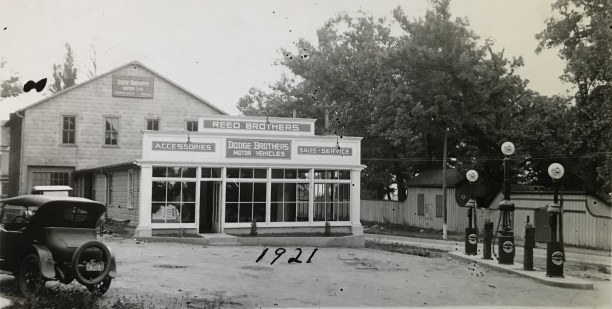
Reed Brothers Dodge, 1921
Books

Related Resources


Copyright Notice

Reed Brothers Dodge History (1915-2012) by Jeanne Gartner is licensed under a Creative Commons Attribution-NonCommercial 3.0 Unported License.
 Reed Brothers Dodge History 1915 – 2012
Recent Comments