
Remembering Rockville Volunteer Fire Department Carnival
On this date 87 years ago the Rockville Volunteer Fire Department held its first annual carnival.
From The Daily News, Frederick Maryland, August 10, 1932:
At a special meeting of the department August 5 it was unanimously voted that a carnival should be held on the Fairgrounds from September 3 to 10, inclusive. The first event will be a fireman’s parade and hook-up contests with three cups being offered as prizes. Other items of interest will be the baby show, the old-fashioned square dance, and the public wedding. An automobile and fifteen cash prizes are to be given away during the carnival.

The News [Frederick, Maryland] 08 Aug 1964
The June 1960 Rockville Sanborn map below shows the location of the Rockville Fire Department Carnival Grounds. From what I have been able to piece together from newspaper archives, the carnival began in 1932 and closed sometime in the early 1970s. The carnival office and administrative building used to be the one-room doctor’s office built for and used by Dr. Edward E. Stonestreet from 1852 to 1903. It was donated to the Montgomery County Historical Society and moved to the complex in 1972.
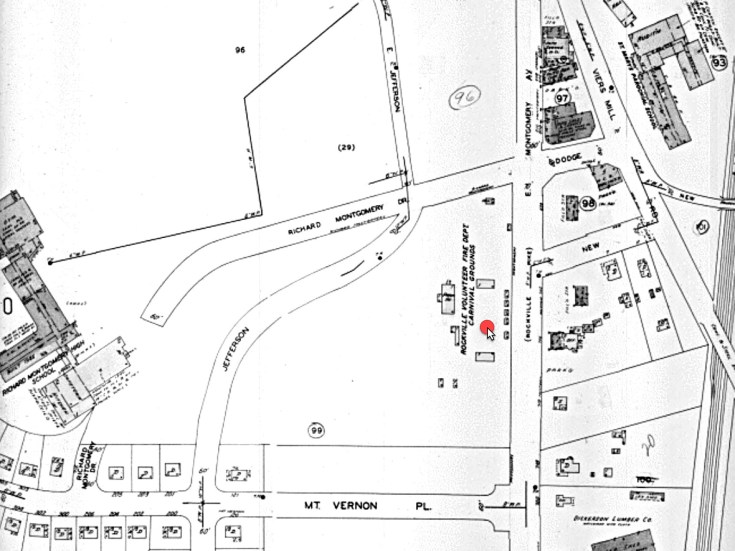
Rockville Fire Department Carnival Grounds location, circa 1960. Courtesy of the Library of Congress digital collection of Sanborn maps.
All of the buildings, including flood lights, fencing and metal frames for carnival stands, on the 10-acre site on the Rockville Pike were permanent fixtures all year long and remained unused until the carnival. In 1947, a 70-foot dance pavilion with detachable side walls was built by labor and materials donated by members of the department and Rockville citizens. I remember the wooden buildings coated with layers of red and white paint, and the classic Coca Cola signage that was so typical back then.
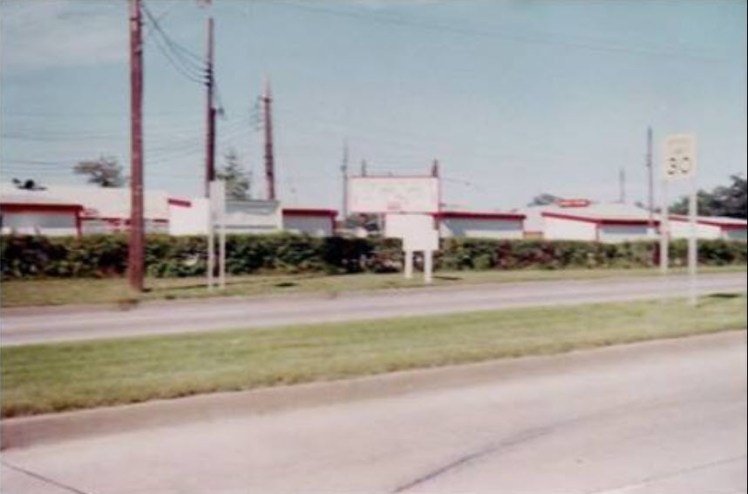
View of the Rockville Volunteer Fire Department Carnival buildings across from Beall’s Esso on Rockville Pike, circa 1960s. Photo credit: RVFD Photo Archives.
The Rockville Fire Department held its annual carnival during the month of August. The eight-night carnival was the staple of the organization’s fundraising for several decades. Locals came to the carnival every year to enjoy the rides, win raffle prizes, listen to the live music every night and most importantly, to eat the food. It was the perfect place to catch up with friends, ride a few rides and maybe win a gold fish that might actually remain alive by the time you got home.
Valuable prizes given away nightly. Prizes by General Electric:
- 4-Speed Record Player
- Vacuum Cleaner
- Portable Transistor Radio
- Roll Around Fans
- Toaster Ovens
It is exciting to note that for many years, a car was the grand prize given away at the carnival. The Dodge in the photo below was donated by Reed Brothers.
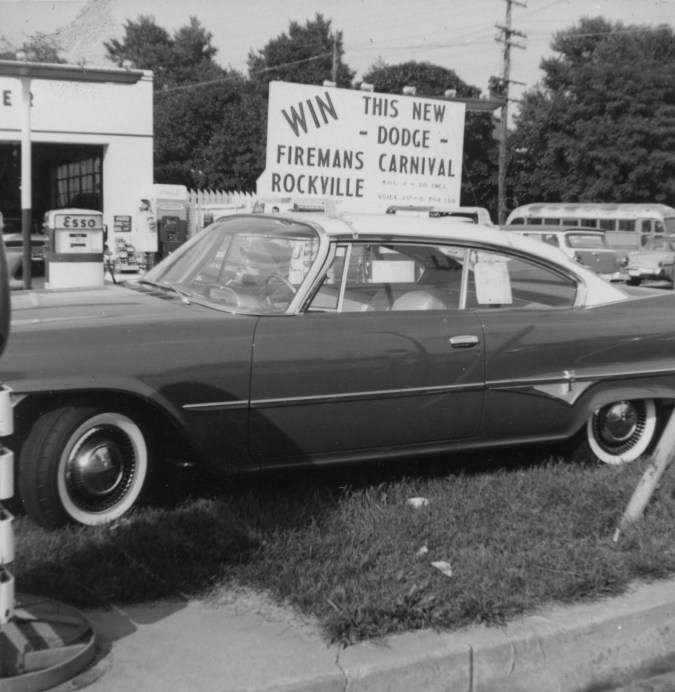
Automobiles were given away as Grand Awards in cooperation with local car dealers. Photo credit: RVFD Photo Archives.

Win this new Chevrolet! Photo credit: RVFD Photo Archives.

Family driving off carnival grounds in a new Chevrolet. Photo credit: RVFD Photo Archives.
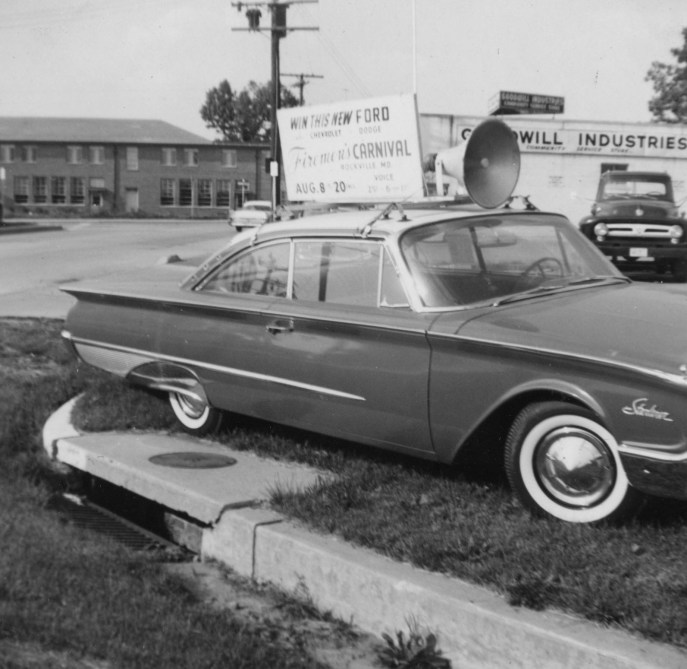
Win this new Ford! Photo credit: RVFD Photo Archives.
Beauty Contest, Wedding to Highlight Carnival
A public wedding and a bathing beauty contest for “Miss Rockville” highlighted the eight-night carnival on August 12, 1949. The contest winner receives $75 and have the honor of representing the firemen in a September contest at Sandy Spring for the title of “Miss Montgomery County Fireman of 1949.”

The Evening Star, August 17, 1949
From The Evening Star, August 17, 1949:
Rockville’s Volunteer firemen are beginning to believe in sawdust wedding aisles as lucky omens.
All 17 couples who in as many years have been married in public at the Rockville fireman’s carnival have lived happily ever after – at least without a divorce.
And the firemen are counting on this year’s couple, Arthur Fleming, 21, Rockville Post Office employee, and his 18 year old bride, Dorothy Lucille Campbell Fleming of Gaithersburg to maintain that record. The two were married last night at the carnival, and like their predecessors, they spoke their vows over a loud speaker in view of a merry-go-round and walked down a sawdust aisle edged with 5,000 onlookers.
Chief W. Valentine Wilson originated the public wedding at the Rockville Carnival back in 1932. The firemen provided a $500 set of furniture, the wedding license, ring, minister, bridal gown, bridegroom’s and ushers’ white tie and tails and flowers.
Some of the town folk weren’t too much in favor of the idea and almost talked a town minister out of performing the ceremony. Later they found out the ceremonies are all very solemn affairs with no frivolity and bystanders even whimpered. For the 17 weddings, State Fireman’s Association Chaplain James C. Minter has conducted the ceremonies. Most of the nuptials ran smoothly, but the Chief remembered one that edged on the border line. That was the time a bridegroom, kneeling at the altar with his bride, whispered, “I can’t get up.”
As to why the marriages have been such successes, Fire Department General Counsel David E. Betts, thinks he has the answer: “If they love each other enough to be married at a carnival public wedding under the populace’s eyes, they’ve got enough love to hold them together for life.”

1968 Carnival Program
The Music
Music has been a big part of the carnival over the years too, as big-name country acts performed at the fairgrounds. There were floor shows each night featuring artists such as Conway Twitty & the Twittybirds, Loretta Lynn, Buck Owens, Jimmy Dean, Patsy Cline, the Osborne Brothers, and many others.
Nightly entertainment featured attractions such as a trapeze artist, hillbilly comedy, Punch and Judy show, old fashioned hoedowns, the Jamboree Boys of television fame, a western rope spinning and whip act, thrilling acrobatic on the slack wire, comedy juggling act by Billy Dale, the Ringling Brothers circus clown, and the Blue Mountain Boys. And nightly dancing in the Pavilion to the music of Sid Graham’s “Five Tones.”
Also appearing were the Shirleyettes with Linda Rita Peluzo, a versatile young lady who danced, sang, and played the accordion. The Eng Sisters, a Chinese trio, entertained with modern song. Carol Bo Barnstead, a flaming baton twirler, appeared with the young Jean Kruppa and Bert Bottamilla on drums.
From The News, Frederick MD 07 August 1965:
Local talent such as the Rockville Municipal Band under the direction of Frank Troy, the Tune Twisters with the Darnell Sisters, and Johnny Glaze and the Night Hawks will round out the entertainment for the two week period. Proceeds from the carnival will go toward payment of a $15,000 Miller-Meteor Cadillac ambulance and a $62,000 Peter Pirsch, 100 foot aerial ladder which were put into service to meet the demands of a growing community.
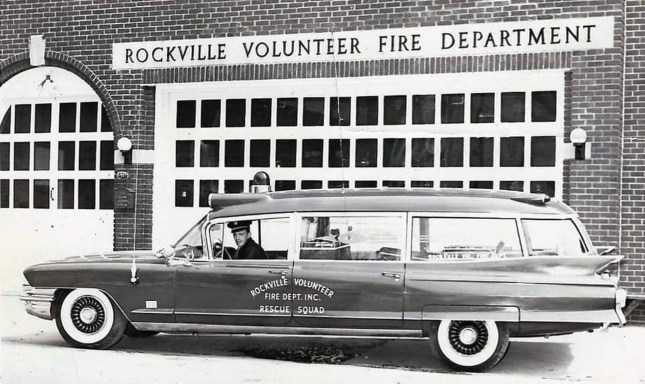
1961 Cadillac Ambulance by Miller-Meteor. Photo credit: RVFD Photo Archives.
The Games
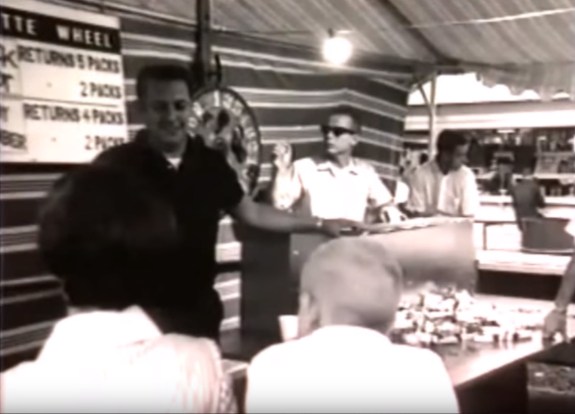
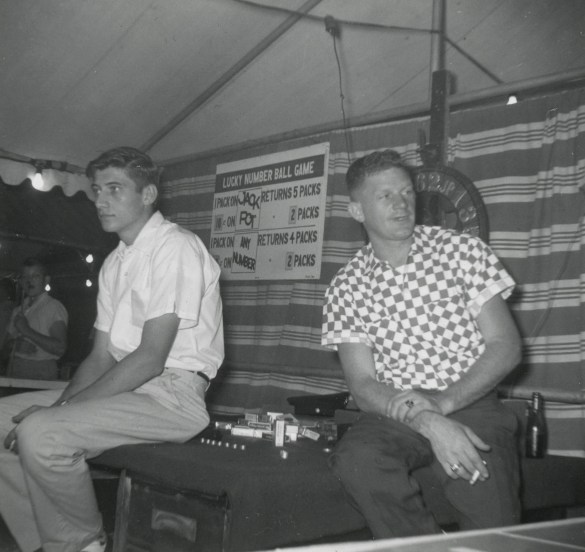
“Dime to play, dime to win, come on in!” The games – The Duck Pond, simply pick up a floating rubber duck out of the water, turn it over to see your prize. Dunk Tank, Rifle Range, Hoop-la (throw hoops around pegs), Balloon Pitch, Teddy Bear Toss (get ring completely around bear stand for 1st prize), Guess Your Age, Cigarette Wheel (spin the wheel and win unfiltered cigarettes)… Lucky Strikes, Camels, and other horrible brands. Lamps (ring toss over miniature lamps was a lot harder than it looked). Panda Bear Stand, ring a coke bottle to win one. Test your strength on the “High Striker” (driving a puck up a tower with a hammer to ring the bell). Rifle Range, 25 cents for shots with a carnival rifle at rotating ducks you just fired away for prizes. And for those a bit older, the favorite game was Bingo.
Cigarette wheel at RVFD Carnival. Photo credit: RVFD Photo Archives.
Lucky Number Ball Game at RVFD Carnival. Photo credit: RVFD Photo Archives.
Calling Bingo at RVFD Carnival, August 1961. Photo credit: RVFD Photo Archives.

The Rides
The heart of the historic fireman’s carnival was the rides – Ferris Wheel, Kiddy Automobiles, Merry-Go-Round, Kiddy Aeroplanes, Scrambler, Dipper Dive Bomber, Octopus, Paratrooper, Live Pony Rides, Kiddy Train, Kiddy Boat Ride, Space Chaser and Tank Ride. Ride the teacups they said, nobody gets dizzy on the teacups. Oh really? Well, let me introduce myself – I am the only person who always got dizzy on the teacup ride! Remember the Zipper, where you would be pelted with handfuls of coins as you went upside down? Ouch! For parents, a lot of enjoyment came from seeing their kids having such a good time. These are some samples of the rides that were featured at the carnival:
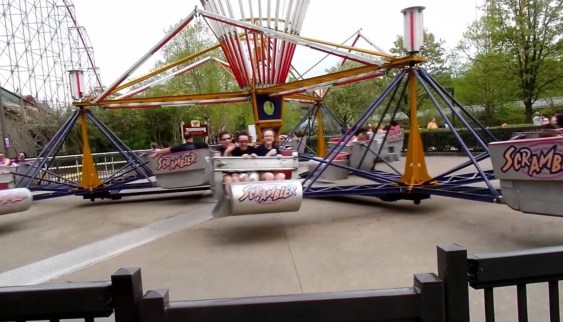
The Scrambler
This ride is fast — really fast. Proving that rides don’t have to go high to make you question all of your choices, The Scrambler is something you shouldn’t ride if you’ve eaten within your current lifetime. Picture this: the ride has three arms. On the ends of each of those arms are clusters of individual cars, each on a smaller arm of its own. When the Scrambler starts, the main arm and the little arms all rotate. The outermost arms are slowed and the inner arms are accelerated, creating an illusion of frighteningly close collisions between the cars and passengers. The Scrambler proves that you don’t have to go on a roller coaster to lose your lunch or have the wits scared out of you.
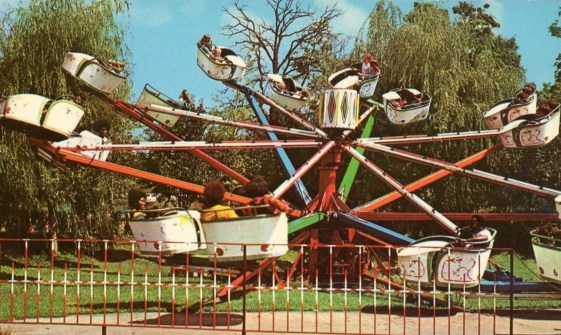
The Octopus
One of the most entertaining rides that you can go on at any carnival is called The Octopus. The arms go up and down multiple times during the ride, but it is the spinning action of the ride itself which causes the carts to automatically spin, making this one of the most fun rides ever created.

Paratrooper
The Paratrooper, also known as the Parachute Ride or Umbrella Ride is a type of carnival ride where the seats are suspended below a wheel which rotates at an angle. The seats are free to rock sideways and swing out as the wheel rotates.
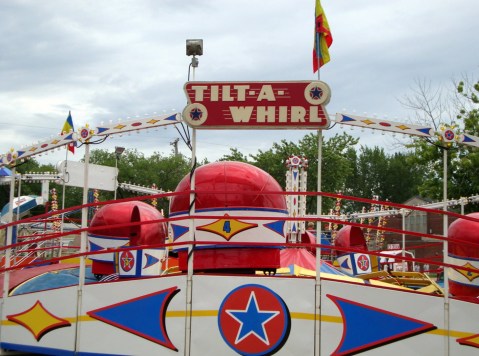
Tilt-a-Whirl
The Tilt-a-Whirl ride wildly spins in countless directions at variable speeds. Calculated chaos ensued. Those who look a little green or lose their lunch of hot dogs, cotton candy, and soda pop are probably just coming off a Tilt-a-Whirl.
The Food
Did I mention the food? Carnivals are a feast for the senses. The smells of food floods the air with the toasty, oily, salty smell of french fried potatoes mingled with scents of buttered popcorn, spicy pizza, burgers, hot dogs, and other tasty treats. Those french fries in a paper cone with vinegar… didn’t you just love those french fries? There was fried chicken that Colonel Sanders would have to salute. And as if that was not enough, there was snack time. The night would not be complete without cotton candy or a caramel apple. And I would be remiss to not mention the infamous funnel cake, which is either loved or hated; there is no middle ground.
For hundreds of children who grew up in the Rockville area, the carnival is where they held their first job. It was such a great tradition and a real community effort. Unfortunately, due to increased call volume, the fire department had to end the annual event. Carnival revenue has since been replaced by a combination of public funding, private donations, and commercial income.
It made a lot of money for the fire department, and by the end of each evening there were quite a few happy young girls to be seen in the crowd, carrying a large stuffed animal and accompanied by a smiling young man.
Sources of Information:
Library of Congress digital collection of Sanborn maps
Chronicling America digitized newspapers
Newspapers.com Historical Newspapers, largest online newspaper archive.
First Auto Races at Rockville Fair Speedway
If only the grandstands at the Rockville Fairgrounds could talk. The stories it could tell – it would tell stories of great racing – first on horses, bicycles and motorcycles, and then in cars. This grandstand could talk about the rich history of racing that took place on the half mile-long dirt track which attracted high-power cars operated by some of the most noted speed kings of the country.
The most delightful way to reach the Fair from Washington, DC was by trolley. The trolley line passed through one of the most beautiful suburbs of Washington and the fertile farms of Montgomery County. The landscape would have been just beginning to give a little evidence of the autumn harvest time approaching. The immense cornfields, with their large well-developed ears; the many orchards, with bright-colored apples; the deep green of the ripening meadow grasses, the contrasting freshly plowed furrows, in preparation for wheat sowing, make a rural landscape charming to all travelers.
The fairgrounds underwent great change in the early 1900s. The grounds were enlarged by the addition of about five acres. A half-mile race course was constructed, a new and grandstand was erected, and various other improvements were made to the buildings and grounds, all of which made the Rockville fairgrounds up-to-date in every respect. Montgomery County could well boast of the nicest fairgrounds in the State.
Early action shots like the ones in this post are rare, however, the following photographs were taken by Lewis Reed at the Rockville Fairgrounds in 1923. The photographs were from the first incarnation of the Fair, held by the Montgomery County Agricultural Society (1846-1932) in Rockville, and often known simply as the “Rockville Fair.”
THE FIRST RACE
From The Baltimore Sun, August 27, 1923:
This is the first year that a Rockville Fair has continued through Saturday. The extra day was added this time as an experiment, the management believing that by substituting new features the additional day could be made a success. Automobile races, the first ever held at Rockville, were the day’s principal attraction and they attracted a good-sized crowd.
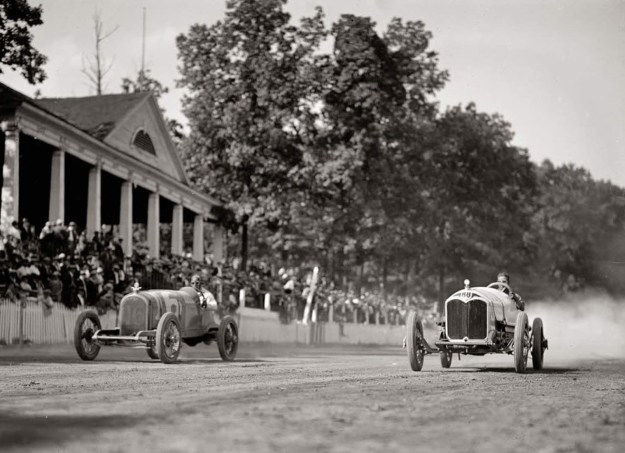
Rockville drew huge crowds for auto races. Rockville Fair, August 25, 1923. Photo by Lewis Reed

Dusty Action – 1923 photo of the exciting auto races at Rockville Fair. Five racers are just coming around the bend on this dirt track with their tires spinning up dust in their wake. Photo by Lewis Reed

Race car drivers deep in dust round a turn at the Rockville Fair auto races. Print made from a Lewis Reed glass negative.
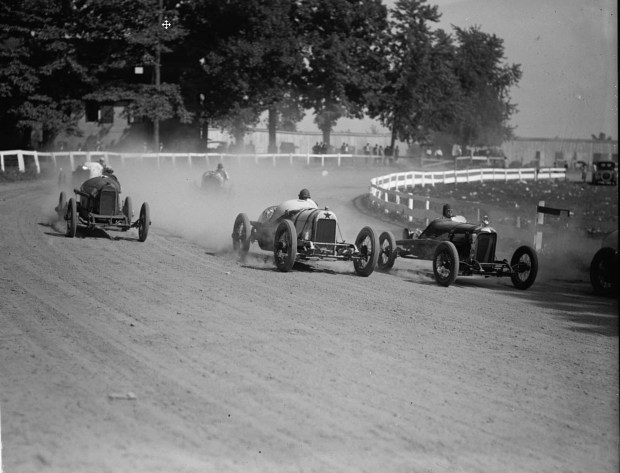
High-powered race cars rounding a wide, sweeping curve at the Rockville Fair auto races, August 25, 1923. Print made from a Lewis Reed glass negative

Two-man race car. Some early race cars included both a driver and a ‘riding mechanic’. One of the key jobs of the second man in a race car was to look backward and alert the driver to what was going on behind him. Photo by Lewis Reed
Early race car drivers were required to have a riding mechanic, otherwise it was voluntary. Riding mechanics, who in addition to being lookouts, kept an eye on tire wear and would even hop out of the car and run back through the infield to get fuel.
This photograph was featured as a part of the ‘London Array’ Series of Impossible Engineering that was broadcast on January 24, 2019 on Discovery’s Science Channel. The photograph was used on the program that featured a segment on the development of the race car.
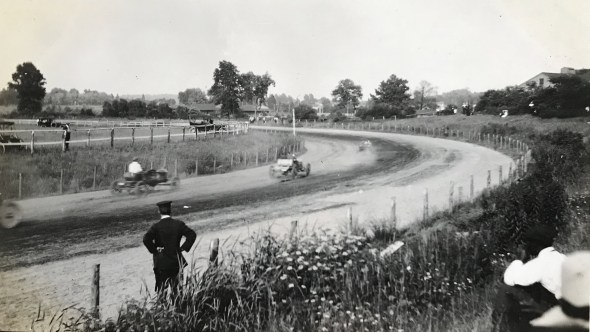
More dirt track action. Skinny tires make for slippery turns. Photo by Lewis Reed.
ALONG WITH AUTO RACES, AUTO POLO DEBUTED AT THE ROCKVILLE FAIR

From The Washington Post, August 25, 1923
Note in the program above, that in addition to racing, there were two auto polo events.
WHAT ON EARTH IS AUTO POLO?
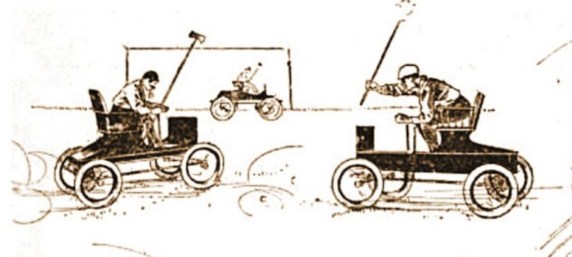
Given that early automobiles were marketed as replacement horses, it was inevitable that the game of auto-polo would be invented. The idea of playing polo with cars had been tossed around starting in about 1900. It took 10 years, and the Ford Model T, to make it practical.
In 1912, some people thought it would be a good idea to strip the bodies off Model Ts, and put together some two-car teams to whack a ball around with mallets. On July 12, they did just that, playing with oversized croquet mallets and a two-pound, basketball-sized ball. Two cars took the field, and two more tended their respective goals.
From The Daily News, Frederick, Maryland, August 24, 1923:
Thousands of people attended the Fair on Thursday, which was the biggest day of the week, at least from the attendance standpoint. By two-o’clock the grandstand was so crowded that even standing room was at a premium. The racing events of the afternoon were unusually good. As special grandstand features there were auto polo and stunt riding.
Any form of safety was completely absent, unless you count the occasional presence of a hat. The cars were protected with roll bars in back and around the radiator, but the drivers, not so much. The game consisted of five 10-minute periods. It was hard on drivers, cars, and the field. There was no limit on car substitutions, and as many as a half-a-dozen per team might be demolished during the game, along with the stands, goalposts, referees (on foot on the field) and anything else that got in their way.

1922 auto polo match in Los Angeles. The referees job is very dangerous as the cars careen about the field and smash into each other. Google stock image.
All we hope is that this lunatic game will not spread.Automobile Topics, Nov. 16, 1912
AUTO RACES MARK END OF 5-DAY ROCKVILLE FAIR
From The Sunday Star, Washington, DC, August 26, 1923:
Thrilling automobile races brought the annual Rockville Fair to a close this afternoon. The sport was as innovation so far as Rockville was concerned.
Seven high-powered cars, operated by some of the crack drivers of the country, participated. The events ranged from one to ten miles in distance, and some fast time was made. Excepting that of Thursday, the largest crowd of the five days was on hand.
Auto Polo Credit: May 2010 issue of Hemmings Motor News
Montgomery History’s Tuesday Talks Lecture Series
Mark your calendars for my upcoming Tuesday Talk on September 10!! My PowerPoint presentation is approx 40 minutes in length and will follow the dealership’s 97-year historic timeline. More than 100 photographs are featured, 70 of them rare, historic images taken by the dealership’s founder, Lewis Reed.

Upside Down to Prove Its Strength
The advertisement in this post does more than just simply pitch a product, it captures a moment in history. A moment in history when Lewis Reed’s Rockville Garage represented several franchise nameplates along with Dodge, including Hudson and Essex. The Hudson and Essex were sold at Reed Brothers from roughly 1917-1923. Rockville–Hudson-Essex–Garage, is highlighted in yellow in the ad below. In addition to franchise car dealers, there were also factory stores. In the early days, the factory stores did the national advertising. A factory store, also known as a branch store or branch dealer, was a dealership owned and run by the manufacturer. A list of area Dealers was placed in fine print at the bottom of the ads.
The upside down coach on the dealers sales floors to demonstrate strength and sturdiness of construction is what proved effective in selling the Hudson and Essex.
We make this test at our store to show the strong, rigid body construction of the Hudson and Essex Coaches. In this position it is supporting a crushing load of 2700 pounds. Come see it. Test the doors and windows, which operate with ease, showing a total absence of body strain.

Rockville Garage Hudson-Essex Advertisement: The Evening Star, Washington DC Thursday, March 1, 1923
Hudson introduced the Essex brand in 1919. The Essex was intended to compete with Ford and Chevrolet for budget-minded buyers. The Essex offered one of the first affordable sedans and by 1925 the combined Hudson and Essex sales made Hudson the third largest automobile manufacturer in the United States.
The Hudson Motor Company, assisted by advertising a stripped Coach body and a chassis, and by a display of the individual parts that go into the Hudson and Essex cars, resulted in the sale of 75 Hudson and Essex cars the first 10 days. During its production run, the Essex was considered a small car and was affordably priced. The Essex is generally credited with starting a trend away from open touring cars design toward enclosed passenger compartments. By 1922 the Essex Motor Company was dissolved and the Essex officially became a product of Hudson.
In 1923, the big news was the demonstration the values the Hudson and Essex purchasers received. The advertisement below demonstrates the strength of the rigid body construction of the Essex Coach.
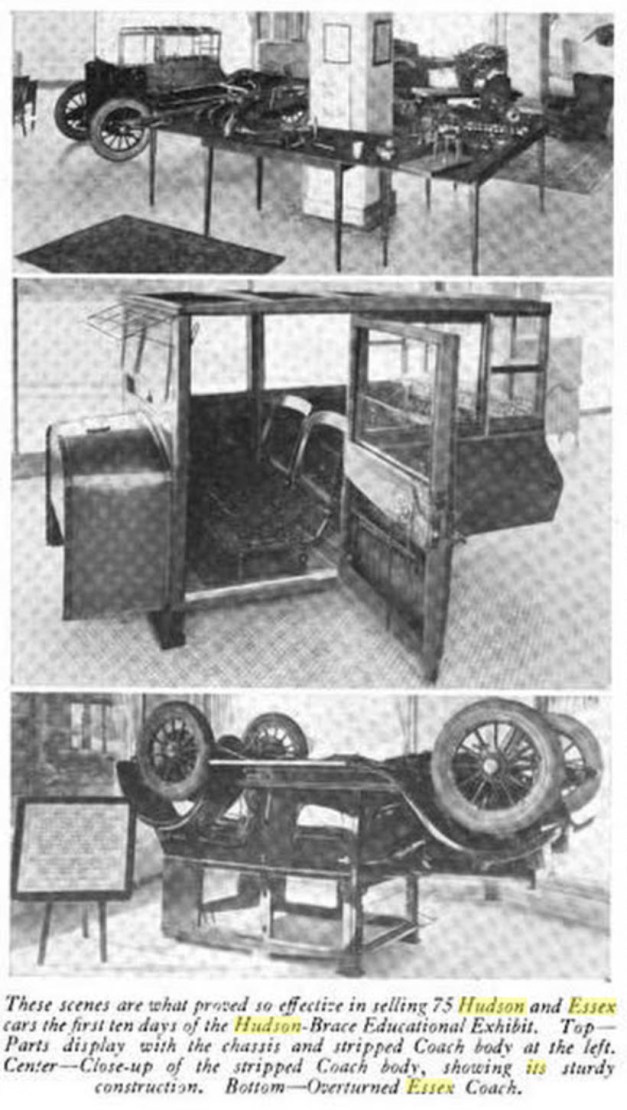
From The Hudson Triangle, Detroit Michigan, December 1, 1922.
Montgomery County Agricultural Society & Fair Beginnings (1846-1932)
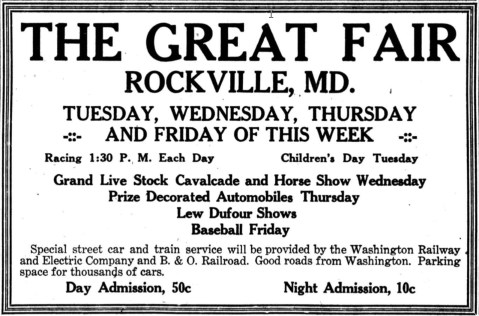 In 1846, James K. Polk was President of the United States, the U.S. flag had only 28 stars on it, and less than 1,500 people lived in Rockville. It also was the year that the Montgomery County Agricultural Society was organized, that began the tradition of the Montgomery County Fair in Rockville. A 12-member board of directors was chosen, headed by John P. C. Peter, President. The Montgomery County Fair opened two years later on the Pike in 1848, about where Richard Montgomery High School is today.
Discussions about farm improvements led to organized agricultural efforts. In 1846, Rockville farmers helped to establish the Montgomery County Agricultural Society. Two years later, Court House Square overflowed with displays of agricultural implements at the first county fair. The register of will opened his office for exhibits of household manufacturers. and the county clerk’s place teemed with fruits and vegetables. Women competed for cash prizes in the categories of homespun fabrics, fancy handwork, pickles, preserves, butter, cheese, and honey. Men exhibited livestock on the grounds of the Beall-Dawson House.
In a few years, the fair moved to Samuel T. Stonestreet’s woodlot adjacent to Saint Mary’s Church. The annual fair became a week-long gathering to showcase innovation, compete, and socialize. The property on the Rockville Pike was used until 1932, after which much of the land became Richard Montgomery High School.
From The Baltimore Sun Newspaper on September 20, 1848:
The Montgomery County Agricultural Fair held at Rockville, Maryland on Thursday and Friday last, the Journal of that place says, fully met the most sanguine expectation of its friends. The concourse of people was very large, and the stock, implements, and other articles exhibited, were the most perfect and beautiful. The Journal designs to publish the various reports of the committee—and the very able and interesting address of R. J. Bowie, Esq., and the other appropriate remarks submitted on the occasion, and says:
The exhibition was highly credible to the officers and members of the club, and to our country. We must reserve, for a more lengthy notice, the beautiful stock and implements of agriculture sent by gentlemen residing out of our county. We are gratified, indeed, that every thing went off gloriously, and the occasion will be long remembered by all who were present.
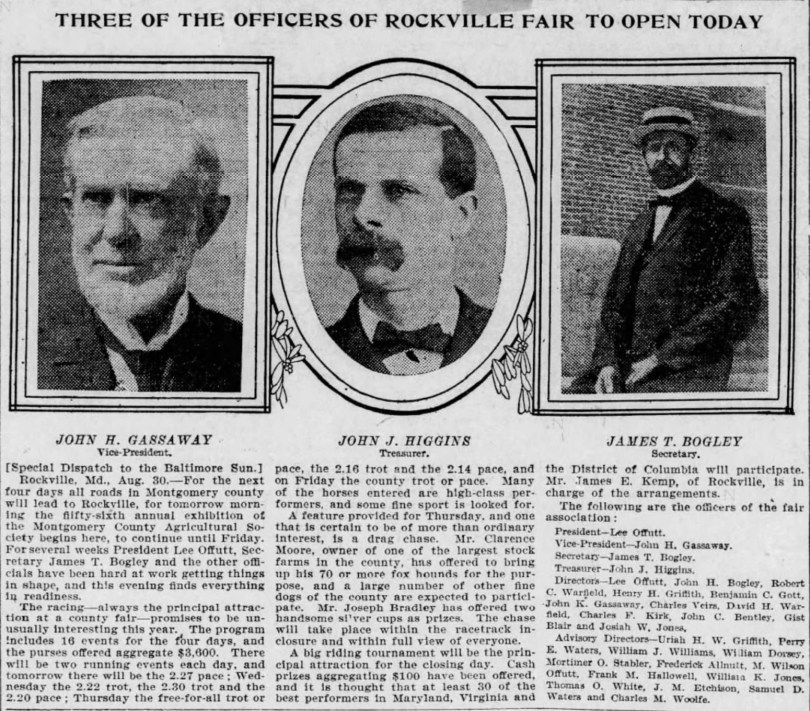
The Baltimore Sun, Sunday 31 August 1909
All the latest improved machinery in farm and garden implements were there, together with wagons, carriages, automobiles, trucks, and tractors. The display of cattle, sheep and hogs had long been one of the leading features at the Rockville Fair. Many fine herds of cattle, including Jerseys, Guernseys and other varieties were on exhibition. Two hundred of the finest horses in Montgomery County, along with many from the District of Columbia, nearby Virginia, and elsewhere were on exhibition. In this respect, the Rockville Fair was equal to that of any state.

Fair-goers in their finest stroll along the midway. Hats were a fashion requirement at the time, as were long flowing dresses and suits. Photo by Lewis Reed, ca. 1910
Many other attractions were provided, including the midway, merry-go-round, Ferris wheel, side shows, free exhibitions in front of the grandstand, horse racing, pony races, mule races, automobile contests, a parade of stock, horse show, dog show, poultry show, an automobile show, and clay pigeon shoots. The clay-pigeon shoot was one of the biggest events of its kind ever held in Maryland.

Ferris Wheel at the Rockville Fair. Photo by Lewis Reed, ca. 1910

Agricultural and various farm equipment exhibits. Photo by Lewis Reed, ca. 1910
The various departments were filled to overflowing with high-class exhibits. The main exhibition hall was devoted to farm products and garden products, household displays, flowers, fruits, etc. The household department had an endless array of preserves, jellies, canned fruits, bread, cakes, candles, pies, fancy articles, and works of art. Sanders & Stayman and E. F. Droop & Co. of Washington, had excellent displays of musical instruments in this hall. Examples of locally grown produce were abundant in the main hall. Peaches, apples, plums, damsons, cantaloupes and watermelons were piled up in tempting array. The poultry show was also a place of interest. Many fine chickens, turkeys, geese, ducks and pigeons were being shown.

Fair-goers meander through exhibits. Photo by Lewis Reed, ca. 1910

Can you hear me now? Photo by Lewis Reed, ca. 1910

Hundreds of cars parked in the fair parking lot. Photo by Lewis Reed, ca. 1910.
The Fair was always attended by large numbers of visitors from Frederick, Howard, and Carroll counties, the District of Columbia and Loudoun, Fairfax and Arlington counties, Virginia. Vehicles were assigned places all around the fairgrounds, and the park was completely surrounded. What is fascinating to me is, with all of these early cars painted in black, how on earth would you find your car?

Montgomery County Fairgrounds in the snow. Photo by Lewis Reed, ca. 1910
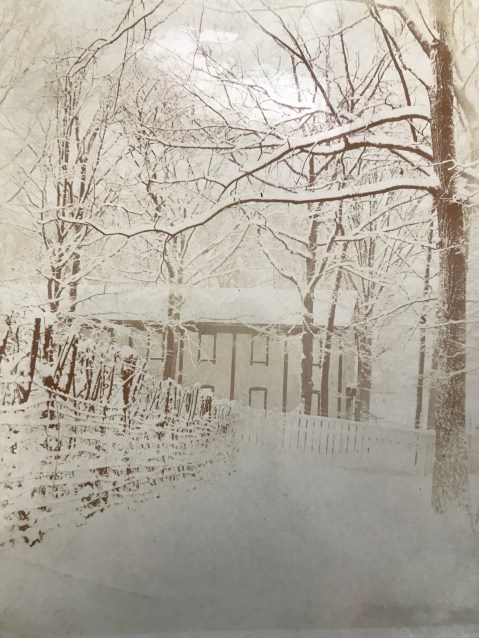
Montgomery County Fairgrounds Chicken House. Photo by Lewis Reed, ca. 1910

Sign on the left side of the building reads, “The Beautiful Caverns of Luray Souvenirs”. Photo by Lewis Reed, ca. 1910
Aftermath of War
During the war the fencing, outbuildings, stables, etc. were very badly used by both the Union and Confederate soldiers, necessitating considerable expenditure to restore the grounds to their ante bellum appearance. The Montgomery County Agricultural Society estimated a cost of nearly $8,300 to rebuild fences, lay out a new race track, repair fields, and reverse four years of use by the troops. Improvements were made comprising within about 16 acres a one-third of a mile long track, separate stables for 50 horses, a two-story frame building for the exhibition of field, garden and orchard products, household industries, and cattle and stock pens.
Bicycle Races
Bicycle races became very popular throughout the country and were an event at the Fairgrounds as early as 1915. The race track was a half-mile dirt racing oval with wide, sweeping curves and a grandstand for spectators, and was easily adapted for bicycles, harness racing, and the sport of car racing.

This circa 1915 photo of an early bicycle race at the Rockville Fairgrounds gives a sense of just how popular the sport was at the time. Photo by Lewis Reed
Harness Races

Rockville drew huge crowds for harness races. Photo by Lewis Reed, circa 1910
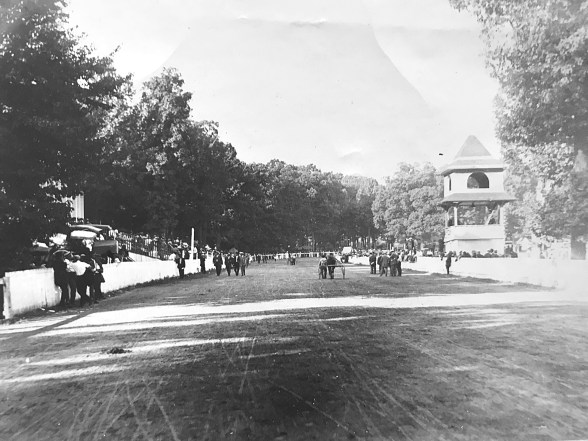
Harness race at the Rockville Fair, circa 1910. All those throngs of people had plenty to see. Photo by Lewis Reed

Harness racers rounding the bend on the racetrack, Rockville Fairground circa 1910. Photo by Lewis Reed

Bend on the harness racetrack, Rockville Fairground circa 1910. Photo by Lewis Reed

Race horse and two-wheeled sulkies (for trotting races) at the Rockville Fairground stables. Photo by Lewis Reed ca. 1910
Automobile Races
August 25, 1923 was the first year that the Rockville Fair continued through a Saturday. The extra day was added as an experiment, the management believing that by substituting new features, the additional day could be made a success. Automobile races, the first ever held at Rockville, were the day’s principal attraction and they attracted a huge crowd. The photos below taken by Lewis Reed reveal what auto racing looked like in the days before helmets, seat belts, air bags, and traction control.

Rockville drew huge crowds for auto races. Rockville Fair, August 25, 1923. Photo by Lewis Reed

Dusty Action – 1923 photo of the exciting auto races at Rockville Fair. Five racers are just coming around the bend on this dirt track with their tires spinning up dust in their wake. Photo by Lewis Reed

Race car drivers deep in dust round a turn at the Rockville Fair auto races. Print made from a Lewis Reed glass negative.
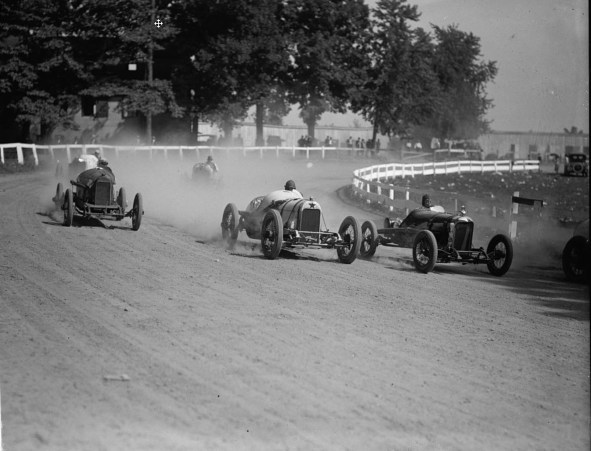
High-powered race cars rounding a wide, sweeping curve at the Rockville Fair auto races, August 25, 1923. Print made from a Lewis Reed glass negative
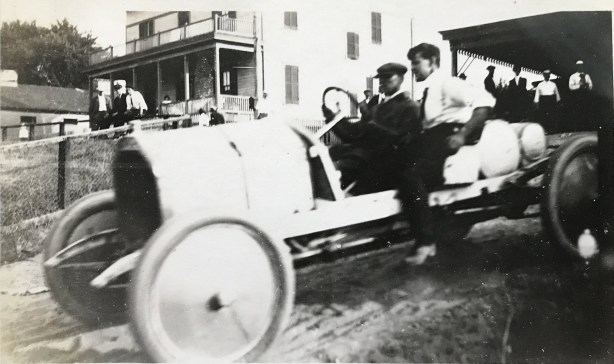
Two-man race car. Some early race cars included both a driver and a ‘riding mechanic’. One of the key jobs of the second man in a race car was to look backward and alert the driver to what was going on behind him. Photo by Lewis Reed
Early race car drivers were required to have a riding mechanic, otherwise it was voluntary. Riding mechanics, who in addition to being lookouts, kept an eye on tire wear and would even hop out of the car and run back through the infield to get fuel.

More dirt track action. Skinny tires make for slippery turns. Photo by Lewis Reed
Rockville Garage Displaying New Model Cars at Rockville Fair Grounds, 1918
The Fair also gave automobile dealers the opportunity to display their new models. Below is new car show time as fair-goers get their first glimpse at the latest models that Rockville Garage had to offer.
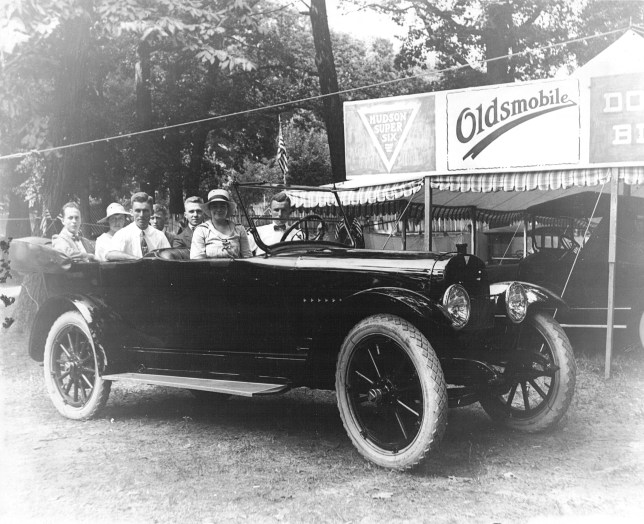
Anybody for a demonstration drive? Identified by the triangle logo on the grill and the number of passengers seated in it, the car appears to be a 1918 Hudson Super Six Seven Passenger Touring. Photo by Lewis Reed

Hudson Super Six, Oldsmobile, and Dodge Brothers Motor Cars on display. Lewis Reed in drivers seat.

Rockville Garage displaying their new models at the Rockville Fair Grounds. Photo by Lewis Reed

At Your Service Rockville Garage. Lewis Reed on the left
Fair Now History
From The Daily Mail (Hagerstown, Maryland) 23 Aug 1933:
The historic Rockville Fairgrounds, scene of many harness race programs, will be sold at a sheriff’s sale Friday afternoon at Rockville. The property consists of 26 acres, a dwelling and numerous stables, exhibition buildings and other structures. The sale is being made to satisfy a claim of a bank. It is rumored that the Montgomery County Board of Education will try to buy the grounds as a site for an elementary school and a future location for the entire Rockville educational plant.
Fair Ground Auctioned
From The Evening Sun (Baltimore, Maryland) 26 Aug 1933:
The Montgomery County National Bank submitted the only bid for the historic Rockville Fair Grounds at a public auction on August 25, 1933 to satisfy a bank’s claim. Its bid was $19,500.00 subject to a mortgage held by the Sandy Spring Savings Institution, and unpaid interest and taxes.
The Montgomery County Fair was reborn in 1949 and again started holding its annual Fair in Gaithersburg. On June 4th, 1949, hundreds of volunteers participated in an old-fashioned barn raising and 12 outbuildings were constructed in one day. The site of the new Montgomery County Agricultural Center was created.

June 4, 1949 – Construction of the cattle barns along the railroad tracks. Photo courtesy of Montgomery County Fair photo archives
Sitting on 62 acres, the Fair has more than 50 buildings that are filled with more than 5,000 animals every year. The Fair has animals, entertainment, food, commercial, home arts, arts and crafts exhibits, and many others for the whole family to enjoy.
The Montgomery County Fair is now today, one of the largest county Fairs in the State of Maryland.
References:
Chronicling America: Historic American Newspapers. Library of Congress
Newspapers.com: the largest online newspaper archive
Rockville, Portrait Of A City, Eileen S. McGuckian
Ag Center History
Books

Related Resources


Copyright Notice

Reed Brothers Dodge History (1915-2012) by Jeanne Gartner is licensed under a Creative Commons Attribution-NonCommercial 3.0 Unported License.
 Reed Brothers Dodge History 1915 – 2012
Recent Comments