
Reed Photo Collection Highlight: Early 20th Century Motorcars
Each of the images below from Lewis Reed’s Collection has a car included, whether as a center point of a family photo, in the background of life’s moments, or on a cross-country road trip. These photos give a snapshot not just of the cars at the time, but a peak into an important aspect of the everyday lives of County residents.
There were no paved highways for automobiles to shoot along at 60 and 70 miles an hour; just country roads, filled with ruts, sand, and mud, over which no one wanted to drive at the maximum speed of passenger cars, which was about 30 miles an hour. But every trip was a different adventure.

In the early 20th century, traveling cross-country by automobile was intimidating, if not a little bit dangerous. Cars were unreliable and roads were rough. The child in the photo is my mother, Mary Jane Reed Gartner. Photo by Lewis Reed
A cross-country road trip is a quintessentially American experience. It’s always an adventure, but in modern times it’s a relatively tame one: The roads are paved, signs point the way, and Siri always has your back. If cars had cup holders back then, these folks would be rolling with crystal goblets, not Big Gulps.
Come away with me, Lucille: In my merry Oldsmobile: Down the road of life we’ll fly: Automo-bubbling, you and I….

Ethelene Thomas Reed, who married Lewis Reed in 1921, is sitting in passenger seat of a circa 1918 Oldsmobile Club Roadster and her sister, Celeste Thomas Brown, is sitting behind her in the back seat. Photo by Lewis Reed

1918 Oldsmobile Roadster shown with Ethelene and her sister Celeste behind the wheel. Photo taken by Lewis Reed at the Clinton Clay Thomas family farm which was located on Butterfly Lane in Braddock, Maryland. Photo by Lewis Reed
Back in the early part of the last century when the automobile was still new and a novelty, it was often used for Kodak moments.

Two ladies posing in a 1911 Speedwell Touring car. Check out the humongous steering wheel! Photo by Lewis Reed
The photographs below was taken by Lewis Reed on one of his many cross country road trips. The car is a 1935 Dodge Touring Sedan with Maryland Dealer license plates. Note the rear-hinged “Suicide Door”. Cars of this era did not have seat belts, so there was nothing to hold a passenger in the car. The term “suicide doors” was therefore placed on vehicles with the rear-hinged door configuration, the theory being that the forward motion of the car could cause the door to fly open, possibly causing the unlucky person sitting next to the door to be pulled out of the car, or the door itself could be ripped from its hinges.
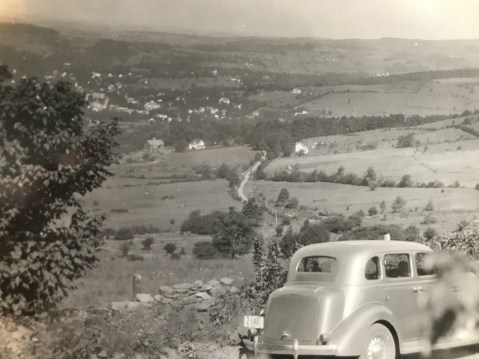
I have no idea what prompted my grandfather to take a photo at this location, but perhaps it was the amazing view in the background. Photo by Lewis Reed
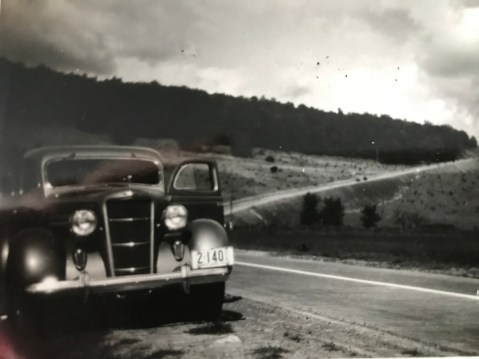
Lewis Reed’s 1935 Dodge Touring Sedan. Photo by Lewis Reed
In order for occupants of early 1920’s cars to remain warm during the cold winter months, especially when it was snowing, it was necessary for them to dress warmly and cover themselves with blankets. Note the car in the photo below is mostly open-bodied, with no windows and certainly no heat. Tire chains are on the rear tires. I cannot say with any certainty, but I believe it is Lewis Reed’s car with his wife and baby daughter, Mary Jane, sitting inside all bundled up.
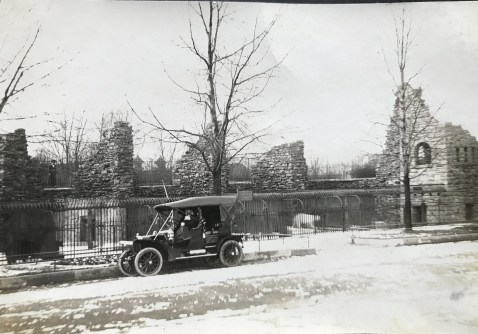
Buffalo Zoo Bear Pits, Buffalo, New York, ca. early 1920s. Photo by Lewis Reed.
Early motorists weren’t afraid to drive in the snow simply because they didn’t have 4-wheel drive and electronic assistance; they just got out and did it. Who would dare go out in these conditions today without an AWD SUV and heated seats?

Car stopped (stuck?) on snowbound road. Although no tire chains are in evidence, they might have been useful coming up that hill. Photo by Lewis Reed
Nobody really thinks about it today. If your car is too cold, then simply switch on the “heater” and soon your car will be warm. However, it wasn’t always that way. What passengers did back then, in the early days of motoring, was bundle up as if one was outdoors. This meant heavy clothing, winter gloves and snow boots. It wasn’t long, however, before car makers realized that a few comforts, like heat in the passenger compartment, or even some type of heated seating, would help sell cars.

There weren’t heaters in these old cars, so motorists had to really bundle up. Photo by Lewis Reed

Lewis Reed’s 1920 Oldsmobile stopped along Goshen Road outside rural Gaithersburg. Photo by Lewis Reed
In 1900 car owners were almost by definition wealthy, especially since they often employed chauffeurs: many wouldn’t have dreamed of trying to operate their own vehicles. The earliest car owners had no real repair business to turn to. To be a successful motorist in the early 1900s, you needed to have some sort of mechanical skills. Or you had to find someone who did. Wealthy people employed private chauffeur-mechanics to not only drive, but also maintain and repair their large, expensive automobiles — rather than learn to do it themselves. Chauffeurs would be in charge of everything to do with the owner’s motor vehicle including repairs and maintenance and cleaning this meant that early personal chauffeurs had to be skilled mechanics. Pierce-Arrow was one of the most common makers of luxury cars in the early 20th century. The price for one of these vehicles was sometimes as much as ten times the price of a standard touring car.
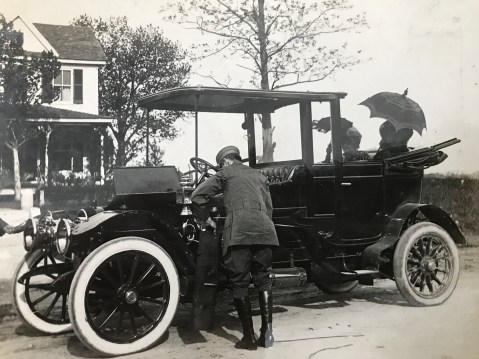
Two ladies with parasols are sitting in the landaulet section of an early Pierce-Arrow limousine, while chauffeur Lewis Reed tends to the motor. The rear portion of the limousine is partitioned from the driver with a glass shield, and covered by a convertible top, which you can see is currently in the lowered position behind the ladies. Ca. 1910

Chauffeur Lewis Reed (left) in the 1914 photo above poses with an unidentified family and their Pierce-Arrow Model 48.

Motor carnage. Photo by Lewis Reed, ca. 1920
Early automobiles were unreliable. They broke down frequently and needed to be pulled out of mud or snow by horses. They meant it back in the good old days when motorists were advised to “get a horse”. The photo shows William Beall in his 1915 Pullman in front of old St Mary’s Church and his younger brother Vernon on horseback “towing” him to Reed Brothers.
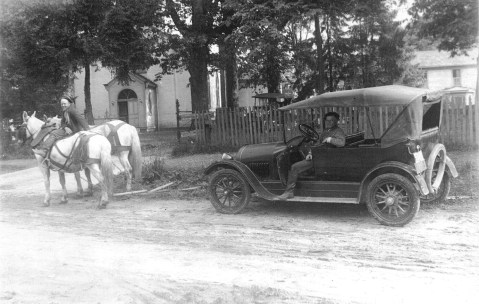
Early transportation powered by true “horsepower”. Photo taken by Lewis Reed, 1915
The touring car was one of the most common styles of automobile in the early decades of the 20th century. Nearly every auto manufacturer offered a vehicle in this style. Touring cars generally were denoted by an open body seating four or more people. Identified by the triangle logo on the grill and the number of passengers seated in it, the car below appears to be a 1918 Hudson Super Six Seven Passenger Touring. The Hudson and Oldsmobile were sold at Reed Brothers from roughly 1917 through 1923.
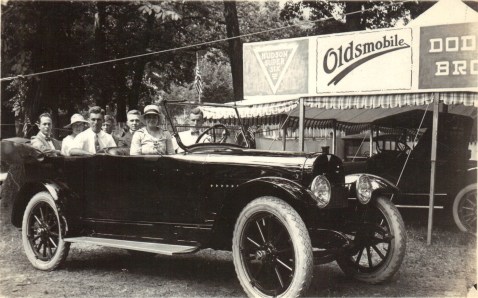
Anybody for a demonstration drive? Photo by Lewis Reed
Vehicles required much higher road clearances than modern cars due to the poor state of roads and tracks, hence the large diameter skinny tires of the day which were effective at cutting through mud to reach more solid ground.

Early touring car with its top down. The folded top behind passengers was known as the “fan” when in the down position. Photo by Lewis Reed
The popularity of the touring car began to wane in the 1920s when cars with enclosed passenger compartments (i.e. fixed steel roofs) became more affordable, and began to consistently out-sell the open cars.
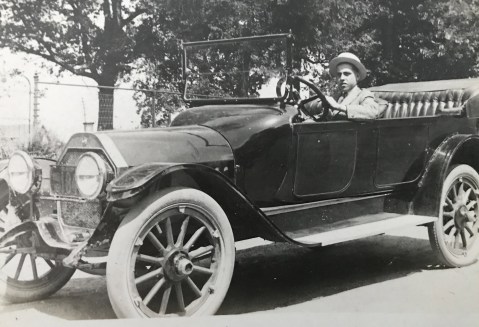
Early touring car. Photo by Lewis Reed
The touring car body style was popular in the early 20th century, being a larger alternative to the two-seat roadster. The photo below was taken in 1915 by Lewis Reed in front of the original Rockville Garage. Old St Mary’s Church is in the background. Note the unpaved dirt road on Veirs Mill Road. Rockville Garage was a distributor of Fisk Tires until circa 1918, when they replaced it with the Firestone brand. The car appears to be a 1916 Studebaker Roadster. The roadster was a sportier style of vehicle, usually a two-seater with a convertible canopy roof. Many manufacturers offered roadster versions of their larger touring car models.

This photo was taken by Lewis Reed across from Reed Brothers Dodge, circa 1915. Old St Mary’s Church is in the background. Photo by Lewis Reed.
Ever want to see how sausage is made? Well, okay – maybe not… but this interesting photo taken by Lewis Reed some 100 plus years ago allows you to see how 18 men managed to cram themselves into a 1910-1911 Pierce Arrow Model 48 7-Passenger Touring. Pierce-Arrow Motor Car Company in Buffalo, New York, produced some of the finest automobiles made and was one of the most popular high-quality cars of the time.

Photo by Lewis Reed
The automobile has affected this country more than any other invention of its time. Without automobiles, life as we know it would not be the same, and the changes that they have brought can be seen in every aspect of our lives.
Lewis Reed’s Pet Photography
While I was going through Lewis Reed’s photograph collection trying to get them all sorted, I started noticing how many images of people posing with pets and animals he had. I thought, everybody loves their pets. Everyone can relate to these photos. Most of the photos involve cats, but there are some depicting dogs, a pony, a squirrel, a cow, a chicken, a rabbit, and even a spider!
If you thought filling your camera roll with pet pics was a modern phenomenon, these photos prove otherwise. These never before seen pet photographs feature glimpses into the lives of every day people and their relationships with their pets at the turn of the 20th century.
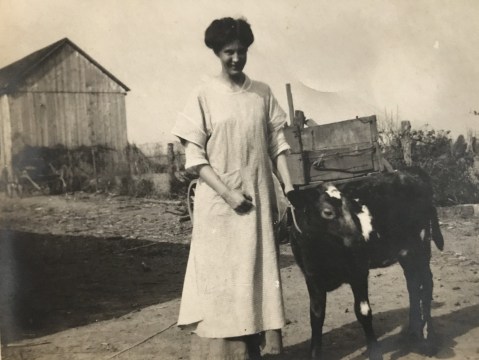
Lady and a calf pose for their portrait on a farm. Photo by Lewis Reed
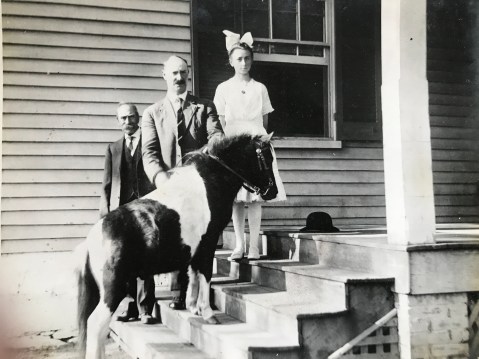
Family with a pony on the front porch. Photo by Lewis Reed

Girl with her pony. Photo by Lewis Reed

Girl riding in pony cart. Photo by Lewis Reed

Saddled up and ready to ride. Photo by Lewis Reed
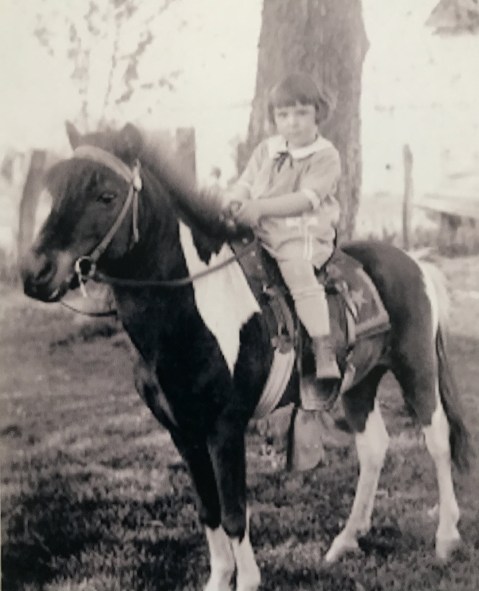
Lewis Reed’s 3 year old daughter, Mary Jane, sitting on a pony. Photo by Lewis Reed
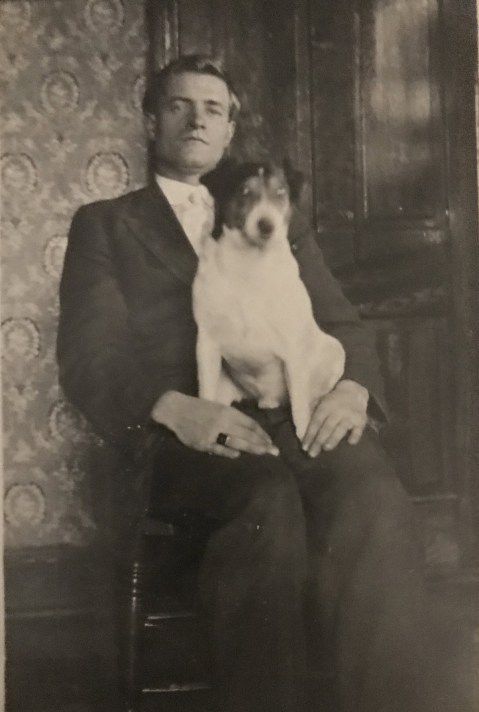
Man with his best friend. Photo by Lewis Reed
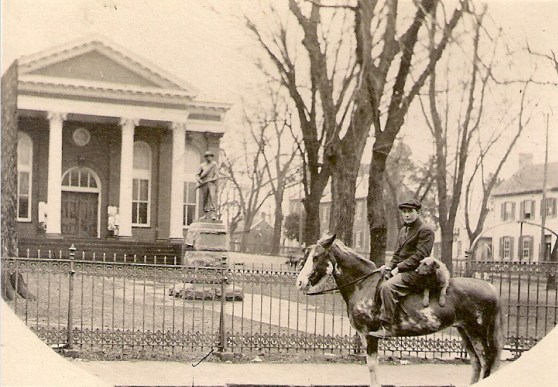
Man and his dog sitting on a horse in front of the Loudoun County Courthouse in Leesburg, Virginia. Photo by Lewis Reed
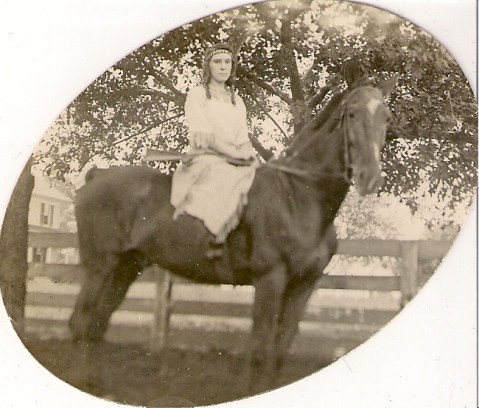
Woman holding a rifle on a horse. Photo by Lewis Reed

Man on a horse. Photo by Lewis Reed

Woman feeding chickens. Photo by Lewis Reed

Cat posing on chair. Photo by Lewis Reed

Cat in corn stalks and leaves. Photo by Lewis Reed

Cat relaxing in a chair. Photo by Lewis Reed

Cat portrait. Photo by Lewis Reed
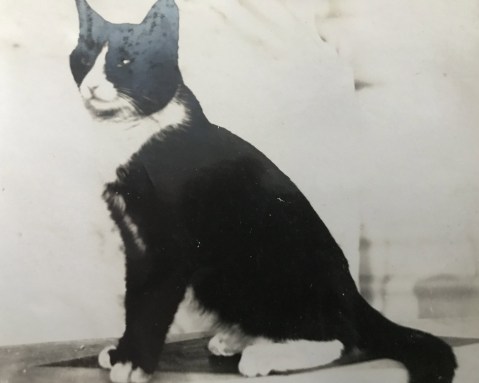
Cat portrait. Photo by Lewis Reed

Cat ready to pounce. Photo by Lewis Reed
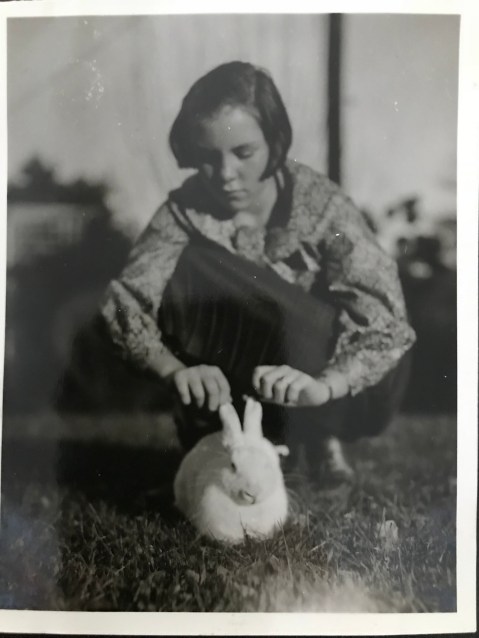
Lewis Reed’s daughter, Mary Jane, with her pet rabbit. Photo by Lewis Reed
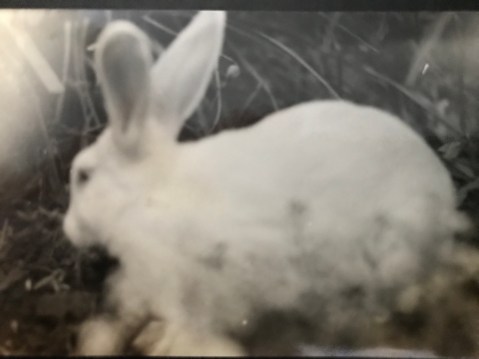
Pet rabbit. Photo by Lewis Reed
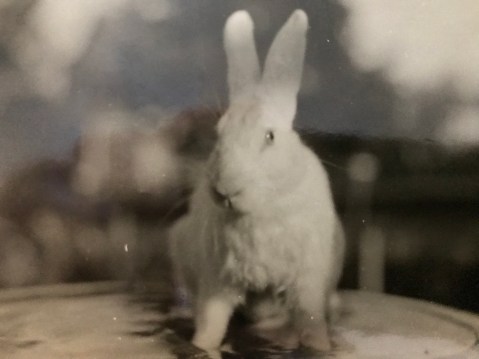
Pet rabbit. Photo by Lewis Reed
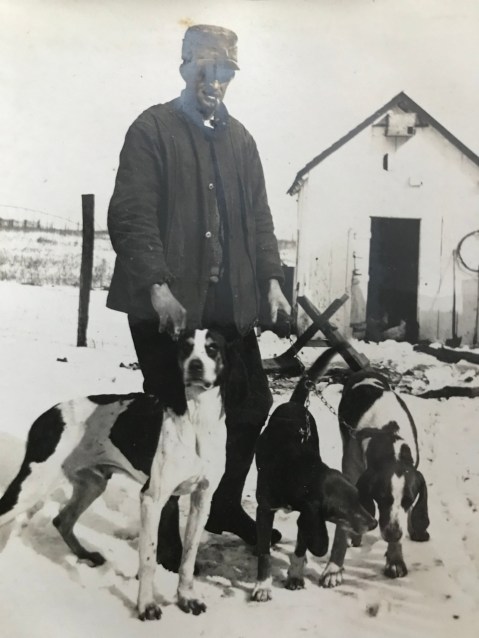
Hunter and his dogs. Photo by Lewis Reed

Boy and his horse. Photo by Lewis Reed
Cows are not the most athletic of creatures, they tend to just stand around a lot, so must be pretty easy to capture in a photo.

Farmer posing with a dairy cow. Photo by Lewis Reed
Getting up close and personal with a chicken can’t be easy. I imagine my grandfather sitting in the backyard for hours with his lens pointed at whichever chicken is closest to him in an effort to get the perfect shot. It’s pretty amazing the texture and detail he captured in this photo.
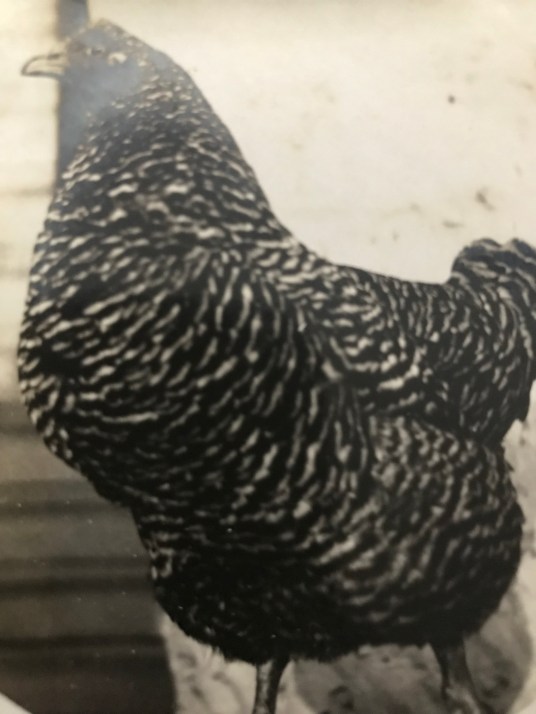
Backyard chicken. Photo by Lewis Reed

White Squirrel. Photo by Lewis Reed

Lewis Reed’s daughter, Mary Jane, with a St Bernard. Photo by Lewis Reed
In the early 1900s, Lewis Reed also trained his camera on a part of the world most of us try to ignore: spiders. This photograph is incredibly unique, both for its subject matter and use of magnification that shows the spider in such detail.
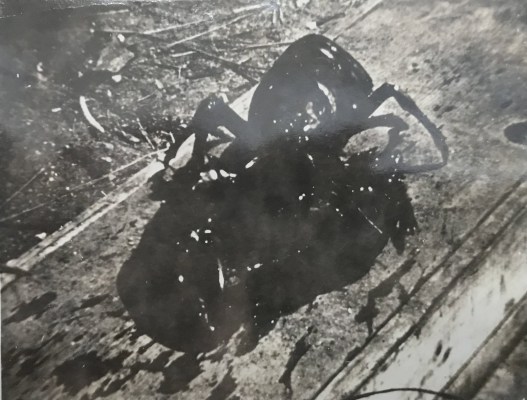
Spider! Photo by Lewis Reed
Rare Photos of the Wright Brothers at Fort Myer
On this day in September 17, 1908, Orville Wright and Lt. Thomas E. Selfridge test flew the Wright Flyer in a demonstration for the U.S. Army at Fort Myer, Virginia. Less than a thousand people witnessed the first flight at Fort Myer, because the general public was still doubtful that powered flight had been achieved. But Lewis Reed was there… and to commemorate that milestone, I have posted six original snippets of history that Lewis Reed captured through the lens of his camera that day.
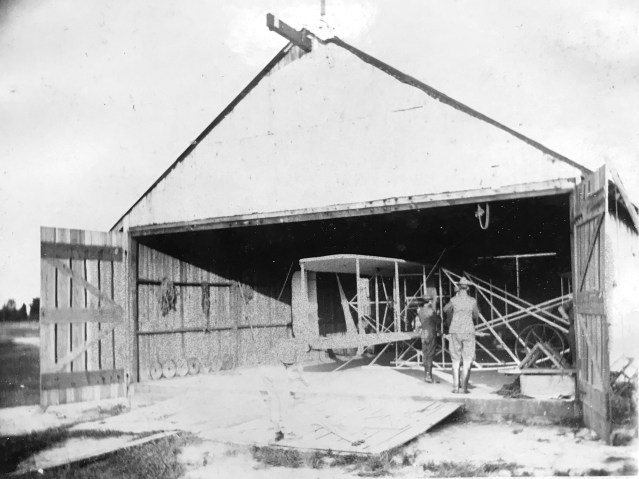
Soldiers at Fort Myer prepare to pull the Wright Military Flyer out of its temporary hangar. Photo by Lewis Reed

Curtiss Model D with tricycle undercarriage. Photo by Lewis Reed

Curtiss Model D. Photo by Lewis Reed

Wright Model B with skids. Photo by Lewis Reed

Another early aircraft from 1909 was the Bleriot XI monoplane. In the background a Rex Smith Aeroplane Company School is advertised on the side of a building. Photo by Lewis Reed
A Rex Smith Aeroplane Company School can be seen on the side of the building in the background. The founder, Rex Smith, was an inventor and a patent attorney. The Rex Smith Biplane was used in the successful April 3, 1911 U.S. Army Signal Corps experiments in wireless communications. The Signal Corps did not buy any Smith Biplanes, they did however use them from time to time to train pilots to fly the Curtiss aircraft at the same field.

Airplane Hangars at Fort Myers, Virginia. Photo by Lewis Reed
The Wrights would prove their machine’s qualifications at Fort Myer. They met or exceeded all of the Army’s specifications, including flying at 40 miles per hour, carrying a combined passenger weight of 350 pounds, maneuvering in any direction in the air, landing without damage, and flying for at least an hour non-stop, which was a world record at the time.
Today, the Wright brothers are legends, with their accomplishments being the storybook example of American perseverance and ingenuity.
Tribute to My Mother
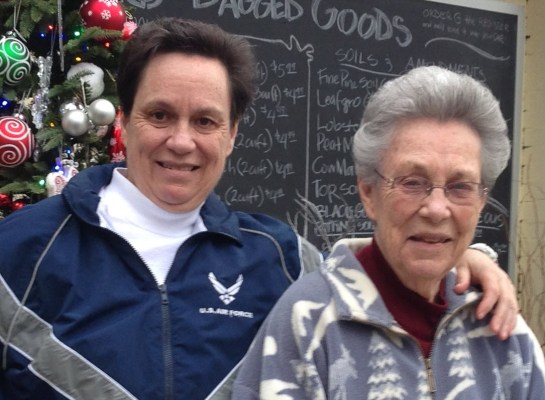
Me and my mom December 2014
Today is a very special post in honor of my mother, Mary Jane (Reed) Gartner. Today was also one of the hardest days of my life, when I answered my phone in the early hours of the morning to the news my mom had died. She was 96 years old. The nurse of Wilson Health Care Center at Asbury Methodist Village waited patiently as I tried to process the information. I was at a loss for words. Knowing I was about to devastate each member of my family with just three words — “Mom passed away” — was not a responsibility I wanted, but it was the one I had. With every number I dialed, my mom’s death became more real.
Losing the person who has literally been there for you your whole life is shocking. It’s heartbreaking. It’s life changing. But I find it helps to take the perspective that I didn’t really lose her. I know exactly where she is and where she’ll always be. She is alive in my memories and the link to all the history I share on this blog.
While it is hard to loose her, I know she is in a better place. She was never in pain and we all got to spend time with her before she went to sleep. Thanks mom, for the 69 years of love and support you have given me. May your soul rest in perfect peace.
I love you … your eldest.
Here is the link to her Obituary for friends and family who follow this blog: https://www.pumphreyfuneralhome.com/obituaries/Mary-Jane-Gartner?obId=7173479#/celebrationWall
Remember Full Service Gas Stations?

1940s Reed Brothers Dodge full service Gulf gasoline station with two attendants posing in front. Professional service was very important in the first half of the 20th century, so it was common for gas station attendants to wear the company uniform. Photo by Lewis Reed
Do you remember full service gas stations? I sure do. As a baby boomer growing up in the 60s, I remember Reed Brothers Dodge when it was a full service gasoline station. Reed Brothers was the first to sell Gulf gasoline to the motoring public in the Washington, D.C. area. In 1915, they began selling gas at their original location in Old Rockville at the triangle at Veirs Mill Road and Rockville Pike. Their first “gas station” consisted of a single pump. Reed Brothers Dodge offered full service gasoline for 55 years until they relocated to their new facility in 1970.

Circa 1957, Marvin Shultz pumps gas into a truck at Reed Brothers Gulf Gas Station. Marvin began as Manager of Reed Brothers full service Gulf Gasoline and Service Station when it was located at its original location at the intersection of Veirs Mill Road and Rockville Pike. Photo courtesy of the Shultz family.
The uniformed attendant would greet the customer by name, fill the car up with gas, wipe the windshield, check the tire pressures and check under the hood. Back then, getting a tank of gas could take up to 10-15 minutes per person. I used to love to hear the bell ding after every gallon pumped. Gulf had orange foam balls you could place on your car’s antenna and they also gave away things like pens, key chains, calendars and road maps. But for the most part, gas stations today resemble convenience stores more than a one-stop haven for all things automotive. Some changes are for the better, but there are some amenities that are missed.
The first uniformed gas station attendants appeared at Reed Brothers Dodge around 1920. The Gulf station included a manager and four attendants. Attendants worked long hours in all weather, possessed a thorough knowledge of service requirements for various automobile makes and models, improvised quick repairs on the spot, provided directions to lost travelers, and did it all with a smile. The men dressed in uniforms and caps in the photo below were Gulf Gasoline Station attendants. Three of the original gas station attendants were Walter (Bud) Beall, Otis Beall and John Burdette.

Reed Brothers Dodge Sales & Service staff and Gulf Gasoline Attendants, circa 1920s. Photo by Lewis Reed
Gas station attendants used to be as well-dressed as police officers and firefighters, right down to the snappy hat and bow tie. The uniform shirt usually had the company logo stitched on one breast pocket and the employee’s embroidered nameplate on the other. The attendant also had a roll of fives and singles in his shirt pocket so that he could make change.
Black rubber hoses used to snake across the pavement. They were hooked up to a bell inside the building and the “ding” signaled for an attendant to dash over to the driver’s window and ask, “Fill ‘er up? Every attendant had a huge rag hanging out of his back pocket that he used to wipe the oil dipstick. Then, much like a sommelier proffering a sample of a vintage wine, he’d present the dipstick to the driver for his inspection. He would then use his squeegee to carefully clean those panoramic windshields of the era with just a few expert swipes. All this whether the customer had purchased 50 cents worth or a tank full of gas.
In earlier times, lost motorists could pull into any service station and get detailed, accurate directions. The attendant would often mark on a road map as a visual aid and then let the driver take it with him, free of charge. In fact, it was expected that gas stations in any given area had a rack full of complimentary road maps. Gulf was the first oil company to use maps to promote its pump attendants as courteous, helpful, and reliable sources of local tourist information, as seen in this 1933 ad. However, you won’t find many road maps available today thanks to navigation provided by smartphones, Garmin and other built-in-car GPS systems.

Reed Brothers Service Station provided restrooms for the traveling public. Patrons wanted clean and safe facilities. In addition to the Gulf signage there is a small, barely visible sign below that promotes, “Clean Rest Rooms” which assured the traveler that the restrooms were well maintained. Gulf was the first oil company to promote clean restrooms as a customer benefit.
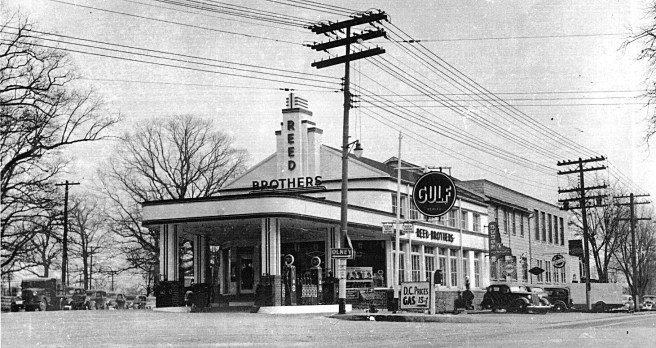
1936 — Reed Brothers Dodge canopied Gulf Gas Station. A closer look reveals the price of gasoline as 15 cents. On the right attached to a telephone pole is a sign pointing the way to Olney. In addition to the Gulf signage there is a small, barely visible sign below that promotes, “Clean Rest Rooms”. Photo by Lewis Reed
We’ve come a long way since these times. We pull up, pump our own gas, stick a plastic card in a machine and go. No human contact required. That’s progress, one supposes.
Books

Related Resources


Copyright Notice

Reed Brothers Dodge History (1915-2012) by Jeanne Gartner is licensed under a Creative Commons Attribution-NonCommercial 3.0 Unported License.
 Reed Brothers Dodge History 1915 – 2012
Recent Comments