
Artist’s Rendering of New Formalist-Influenced Reed Brothers Dodge Dealership

After 55 years at the original location at the triangle at Veirs Mill Road and Rockville Pike, Lee Gartner purchased 4.37 acres of land from Eugene Casey and relocated Reed Brothers Dodge to a new state-of-the-art showroom and Dodge/Chrysler/Jeep service complex on Route 355 at 15955 Frederick Road in Rockville Maryland.
The new building, a complete automotive sales and service facility marked Reed Brothers 55th year of selling Dodge’s. The state-of-the-art dealership contained the newest customer-focused features throughout which combined technology and comfort. Design and construction of the new dealership was managed by the Glen Construction Company of Gaithersburg.
In 1948, General Motors produced their first guide to help shape the look of their auto dealerships. Entitled, “Planning Automobile Dealer Properties“, the guide provided ideas and building layouts “for car sales, administration and personnel, service, parts and accessories, and store front details—including everything from the showroom to the janitor’s closet.” Based on the success of this model, other car brands also adopted strict design standards for their dealerships.
The Reed Brothers Dodge dealership in Rockville (1970), demolished in 2012, was an example of a dealership with a New Formalist influence. Hand-drawn architectural rendering by Cooke Brackett, Washington, D.C.
Character-defining elements of auto dealerships representative of this Period include, but are not limited to:
- One story
- Rectangular form with secondary service areas
- Flat roofs are most prevalent
- Large expansive showroom windows and minimal windows at service areas
- Extensive use of corporate branding including street signs, rooftop signs, and various brand color schemes
- Set back from, and parallel to, the adjoining major roadway
First Rockville Auto Races, August 25, 1923
From The Evening Star (Washington, DC) 24 August 1923
ROCKVILLE AUTO RACES LISTED FOR TOMORROW
Speed records will be placed in jeopardy at Rockville Fair tomorrow afternoon when a half score of professional drivers will compete in a seven-event program.
Featuring the program is the record trials in which Frank Ripple, Canadian speed star and dirt track champion will drive his 140 horsepower aeroplane motor in an effort to hang up some new marks. Every driver on the track will be eligible to enter the time events, but speed fans look to Ripple.
Two foreign machine and six American-built cars are listed to start.
Early action shots like the ones in this post are rare, however, the following photographs were taken by Lewis Reed at the Rockville Fairgrounds in 1923. The photographs were from the first incarnation of the Fair, held by the Montgomery County Agricultural Society (1846-1932) in Rockville, and often known simply as the “Rockville Fair.”
THE FIRST RACE
From The Baltimore Sun, August 27, 1923:
This is the first year that a Rockville Fair has continued through Saturday. The extra day was added this time as an experiment, the management believing that by substituting new features the additional day could be made a success. Automobile races, the first ever held at Rockville, were the day’s principal attraction and they attracted a good-sized crowd.
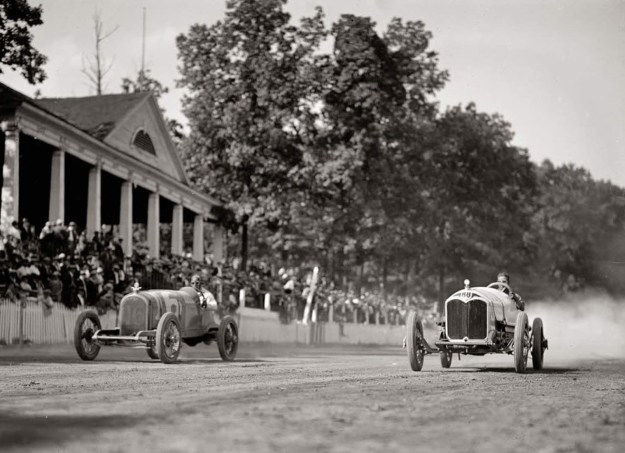
Rockville drew huge crowds for auto races. Rockville Fair, August 25, 1923. Photo by Lewis Reed

Dusty Action – 1923 photo of the exciting auto races at Rockville Fair. Five racers are just coming around the bend on this dirt track with their tires spinning up dust in their wake. Photo by Lewis Reed

Race car drivers deep in dust round a turn at the Rockville Fair auto races. Print made from a Lewis Reed glass negative.
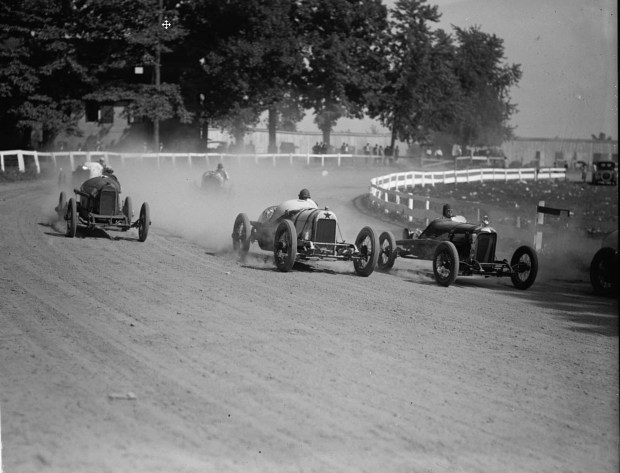
High-powered race cars rounding a wide, sweeping curve at the Rockville Fair auto races, August 25, 1923. Print made from a Lewis Reed glass negative

Two-man race car. Some early race cars included both a driver and a ‘riding mechanic’. One of the key jobs of the second man in a race car was to look backward and alert the driver to what was going on behind him. Photo by Lewis Reed
Early race car drivers were required to have a riding mechanic, otherwise it was voluntary. Riding mechanics, who in addition to being lookouts, kept an eye on tire wear and would even hop out of the car and run back through the infield to get fuel.
This photograph was featured as a part of the ‘London Array’ Series of Impossible Engineering that was broadcast on January 24, 2019 on Discovery’s Science Channel. The photograph was used on the program that featured a segment on the development of the race car.
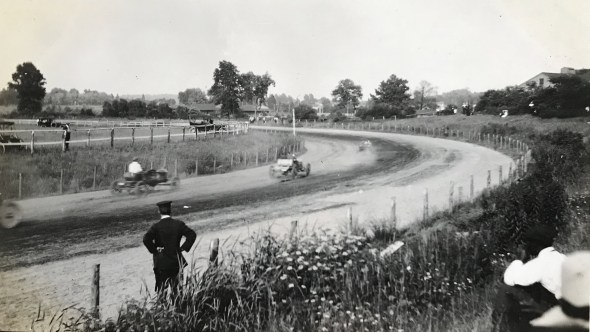
More dirt track action. Skinny tires make for slippery turns. Photo by Lewis Reed.
ALONG WITH AUTO RACES, AUTO POLO DEBUTED AT THE ROCKVILLE FAIR

From The Washington Post, August 25, 1923
Note in the program above, that in addition to racing, there were two auto polo events.
WHAT ON EARTH IS AUTO POLO?
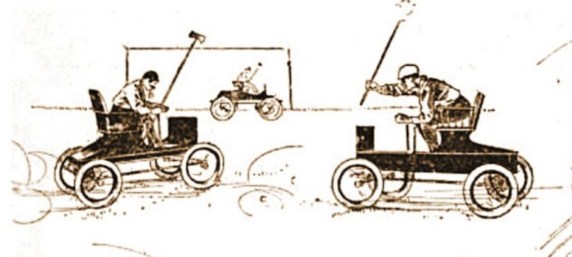
Given that early automobiles were marketed as replacement horses, it was inevitable that the game of auto-polo would be invented. The idea of playing polo with cars had been tossed around starting in about 1900. It took 10 years, and the Ford Model T, to make it practical.
In 1912, some people thought it would be a good idea to strip the bodies off Model Ts, and put together some two-car teams to whack a ball around with mallets. On July 12, they did just that, playing with oversized croquet mallets and a two-pound, basketball-sized ball. Two cars took the field, and two more tended their respective goals.
From The Daily News, Frederick, Maryland, August 24, 1923:
Thousands of people attended the Fair on Thursday, which was the biggest day of the week, at least from the attendance standpoint. By two-o’clock the grandstand was so crowded that even standing room was at a premium. The racing events of the afternoon were unusually good. As special grandstand features there were auto polo and stunt riding.
Any form of safety was completely absent, unless you count the occasional presence of a hat. The cars were protected with roll bars in back and around the radiator, but the drivers, not so much. The game consisted of five 10-minute periods. It was hard on drivers, cars, and the field. There was no limit on car substitutions, and as many as a half-a-dozen per team might be demolished during the game, along with the stands, goalposts, referees (on foot on the field) and anything else that got in their way.

1922 auto polo match in Los Angeles. The referees job is very dangerous as the cars careen about the field and smash into each other. Google stock image.
All we hope is that this lunatic game will not spread.Automobile Topics, Nov. 16, 1912
AUTO RACES MARK END OF 5-DAY ROCKVILLE FAIR
From The Sunday Star, Washington, DC, August 26, 1923:
Thrilling automobile races brought the annual Rockville Fair to a close this afternoon. The sport was as innovation so far as Rockville was concerned.
Seven high-powered cars, operated by some of the crack drivers of the country, participated. The events ranged from one to ten miles in distance, and some fast time was made. Excepting that of Thursday, the largest crowd of the five days was on hand.
Auto Polo Credit: May 2010 issue of Hemmings Motor News
Reed Brothers Third Annual Goodyear Dealers Zeppelin Race Winner July-August 1931
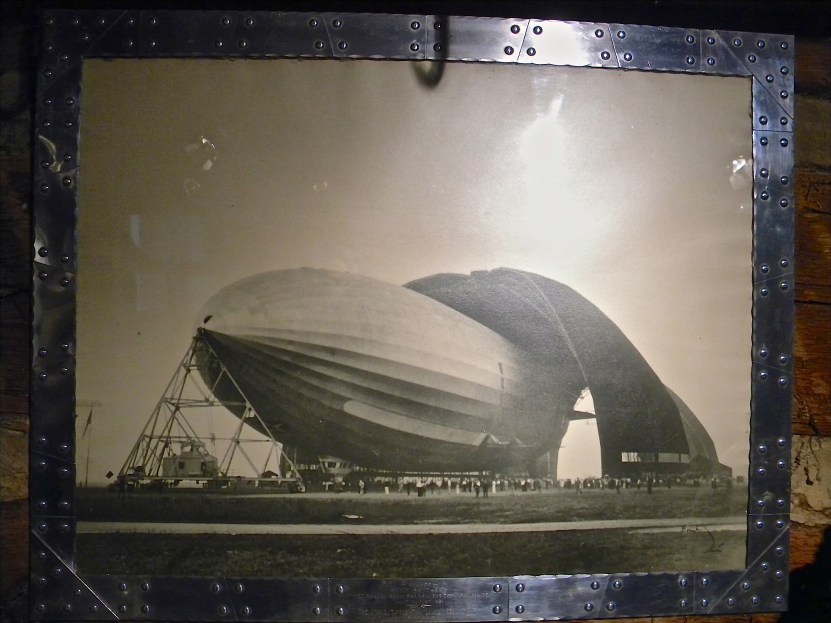
MARGARET BOURKE-WHITE, 1931 REED BROTHERS THIRD ANNUAL GOODYEAR DEALERS ZEPPELIN RACE WINNER
In 1931, the Goodyear Zeppelin Company produced a series of framed prints as rewards for Goodyear dealers as prizes for high sales. Sales was based on a two months quota, and participated in by thousands of dealers all over the country. The print shows the maiden launch of the USS Akron leaving the Goodyear Zeppelin air dock at Akron, Ohio. The engraved plaque at the bottom center of the frame reads, “Winner – Reed Brothers, Third Annual Goodyear Dealers Zeppelin Race. July – August 1931.” This frame is made of duralumin used in the girder construction of the United States Airship “AKRON” built by the Goodyear Zeppelin Corporation”. The print is signed in the lower right-hand corner by the famed 20th century photographer, Margaret Bourke-White. During the early years of the Depression, Goodyear was one of Bourke-White’s most important clients. She made this image of the airship Akron when it was removed from its hangar for the first time.
Built in 1929, the almost unbelievably huge Goodyear air dock in Akron, Ohio, was created as a space where blimps, airships, and dirigibles could be constructed. Evidently building such a massive space created problems, such as indoor rain, and putting the whole thing on rollers so that it could expand and contract with the seasons.
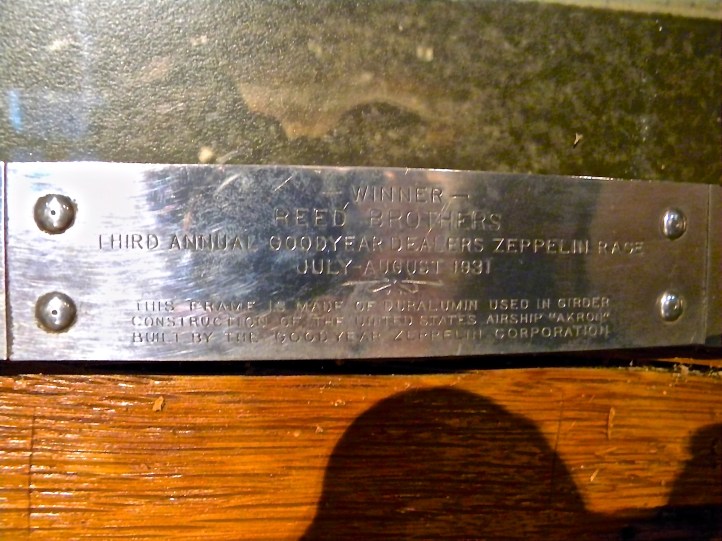
Inscription Plaque
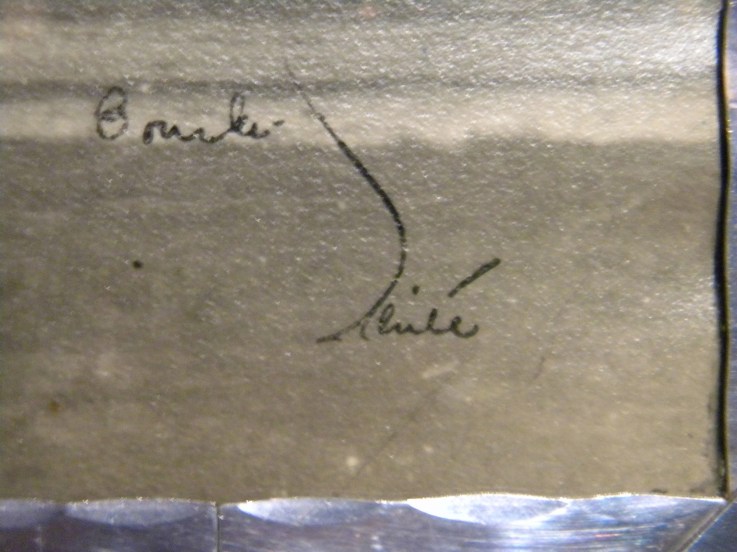
Photo is signed in the lower right corner by famed 20th century photographer, Margaret Bourke White
The USS Akron, first of a class of two 6,500,000 cubic foot rigid airships, was built at Akron, Ohio. Commissioned in late October 1931, she spent virtually all of her short career on technical and operational development tasks, exploring the potential of the rigid airship as an Naval weapons system. During the remainder of 1931 and the early part of 1932, the Akron made flights around the eastern United States and over the western Atlantic, including one trial of her capabilities as a scouting unit of the fleet. While beginning a trip to the New England area, Akron encountered a violent storm over the New Jersey coast and, shortly after midnight on 4 April 1933, crashed tail-first into the sea. Only three of the seventy-six men on board survived this tragic accident. During the search for other possible survivors, the Navy non-rigid airship J-3 also crashed, killing two more men.
Note: Margaret Bourke-White (1904 1971) is best known as the first foreign correspondent to be permitted to take photographs of Soviet industry, the first female war correspondent, and the first female correspondent permitted to work in war zones.
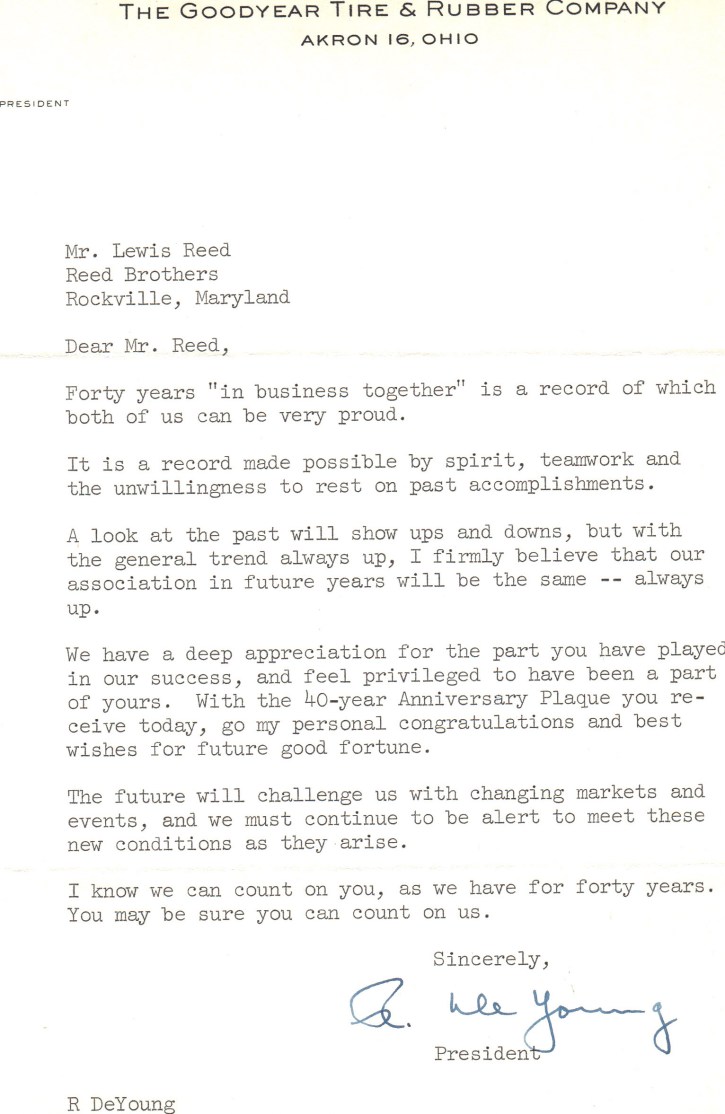
40th Anniversary with Goodyear
Lewis Reed was recognized by Goodyear Tire & Rubber Co. for reaching his 40th year as a Goodyear dealer. Reed Brothers Dodge began selling Goodyear tires in the 1920s. Below is a letter from Russell DeYoung thanking Lewis Reed for his 40 years “in business together”.
SECO, 1914: Rockville’s First Movie Theater
Around the turn of the century, people began to think about places filled with seats where movies could be shown. Budding exhibitors took existing stores, gutted them, decorated the fronts, and installed seats. They added screens, sat a piano player under the screen and built tiny booths for the primitive projectors. With a staff made up of friends and family as cashiers, doormen, ushers, and projectionists, they were ready to make their fortunes.
The Seco, Milo, Arcade, and Villa Theaters presented movies in buildings on the main street in Rockville, Maryland from the 1920s through the 1960s.

This image of the Suburban Electrical Company (SECO) shows how it looked in 1914. The upper story of the building was the living quarters of Mr and Mrs B. F. Hicks. The building was later acquired by W. Valentine Wilson, who tore it down and replaced it with the “SECO” Theater. The ground floor was made into a moving picture theater. Posters can be seen displayed on the front of the building. Photo by Lewis Reed.
The SECO theater in Rockville was opened for silent films and vaudeville shows around 1915 in what had been a general store dating back to Civil War days by W. Valentine Wilson. Prior to its opening, impromptu showings of films were held around the county at various stores and commercial buildings. It was perhaps the earliest movie house in Montgomery County and drew patrons from as far away as Mt. Airy in Frederick County.
Mr Wilson had operated an electrical business in the building and the SECO got its name from that business, the Suburban Electrical Company. The earliest ad for the SECO is in the Montgomery County Sentinel of October 22, 1915:
Shows four times a week – Monday, Tuesday, Thursday, and Saturday. Our Monday night feature shows are the finest ever exhibited in Rockville and the management will continue to give nothing but the best of film service to the town.
On Saturday, October 23, we will feature Sally Crute and Augustus Phillips in a strong three-reel drama entitled, “Her Vocation,” with two other reels of laughter and side-shakes. … You never waste time by enjoying SECO moving pictures.
The SECO ran 10 films days after the first-run theaters in downtown Washington and had protection over the rival Takoma, Tivoli, and York theaters. A July 1916 advertisement read, “Paramount pictures at the SECO Theater three times every week, Monday, Thursday, Saturday, starting at 7:30 P.M.”
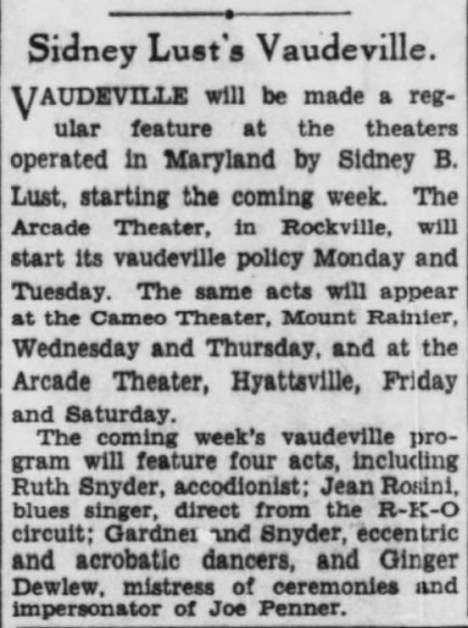
By the mid-1920s, the SECO had moved to 509 Commerce Lane. Sidney Lust took over the operation of this theater between 1931 and 1935 and renamed it the Arcade Theater. He installed a sound system in the Arcade for $2,250 in 1932 and closed it down on April 21, 1935. He opened the new Milo later that year.

North side of Commerce Lane near the courthouse. Right to left: H. Reisinger Bakery, W. Hicks General Store, Suburban Electrical Company (SECO), and a two-story dwelling. Note the trolley car on the left. Photo by Lewis Reed, 1914.
Wilson also owned the SECO in Silver Spring that opened on November 7, 1927. Costing $60,000 to build, Silver Spring’s SECO had 500 seats and featured a 12×16 ft. screen and a projection system “said to be the latest word in motion pictures machines.”
Several Rockville businesses closed their doors during the depression. Some suffered from modern competition, and the economic downturn finished them off. Val Wilson’s 1929 purchase of a new organ to accompany silent movies at his SECO Theatre was the final straw for an enterprise losing ground to the “talking pictures” or “talkies”.
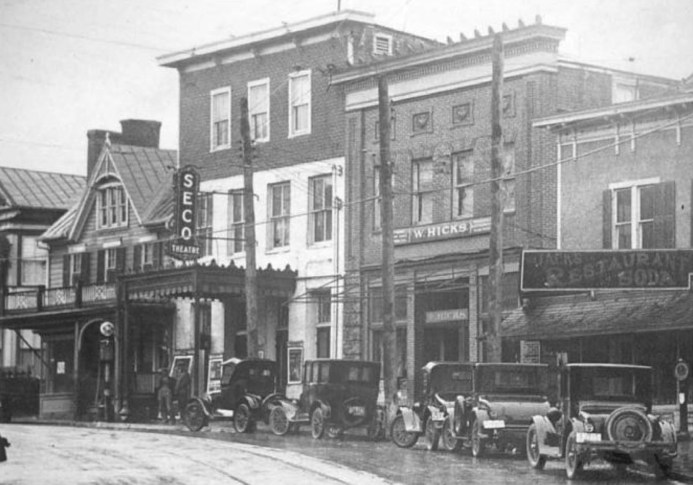
This image of W. Valentine Wilson’s Seco Theater shows how it looked after its move from 402 Montgomery Ave to 310/509 Commerce Lane. Date unknown. (The Robert A. Truax Collection)
From The Evening Star, Washington, DC 25 Jul 1935:
One of the most modern theater, store and office buildings in this section of the country will be opened here September 1 when work is completed on the new Milo Theater on the site of the old Lincolnway Inn.
The structure is being erected by Rufus E. Milor of Rockville, contractor and owner, at a cost of $100,000, and it will contain two stores and 14 office rooms in addition to the theater, which is named for the owner of the building. The two stores, Peoples Drug Store and Sanitary Grocery, Co. will flank the theater lobby.
A two-story building with a modernistic, white limestone front, the new structure will be an attractive addition to Rockville’s business section. In addition to the main structure, Milor is building a new restaurant on an adjoining lot.
A paved parking area large enough to accommodate 300 cars will be opened at the rear of the main building.
Sidney B. Lust, owner of a chain of theaters in and around Washington, will operate the Milo. A stage to take care of any vaudeville requirements will be built, and the theater will seat 750.
The Evening Star, Washington, DC 12 August 1934

The Milo Theater (120 Commerce Lane) was designed by John J. Zink and named after its owner, Rufus E. Milor. It opened in October 1935 and lasted until 1969. Sidney Lust operated it until 1955. The name was changed to the Villa in 1956. Google Image
The theatre continued through to the late 1960s. Seating about 700+, in the mid 1950s, the name was changed to the Villa by new owners. The old movie house has since been torn down years ago, and the site built over. In a 1914 Theatre Guide, the Rockville Opera House was found listed, with theatre seating on the second floor of the building.
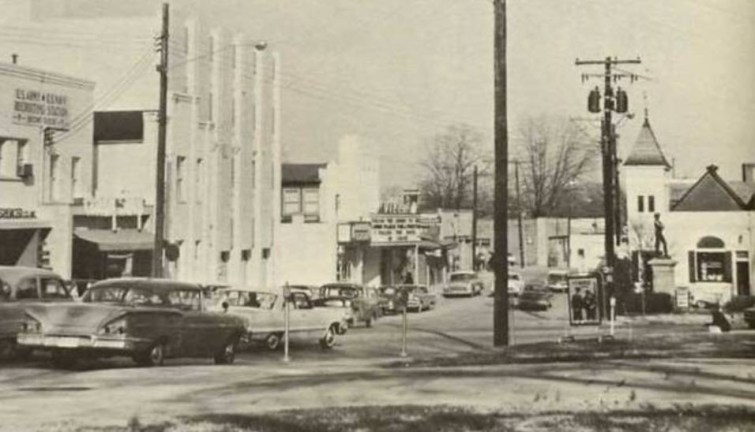
A 1963 photo of the Milo Theatre when it went by the name of the Villa. Google Image
Sources: Motion Picture Exhibition in Washington, DC: An Illustrated History of Parlors, Palaces and Multiplexes in the Metropolitan Area, 1894-1997
Newspapers.com online archive
“Maryland’s Motion Picture Theaters” Images of America Series
Then & Now: The Tomb of Washington
In this “Then & Now” feature, I have combined one of Lewis Reed’s original photograph’s for “then” and paired it with a Google composite image to show how The Tomb of Washington has transformed over the years.
THEN: George Washington died in his bedchamber at Mount Vernon on December 14, 1799. His last will outlined his desire to be buried at home at Mount Vernon. Washington additionally made provisions for a new brick tomb to be constructed after his death, which would replace the original yet quickly deteriorating family burial vault. In 1831, Washington’s body was transferred to the new tomb, along with the remains of Martha Washington and other family members.
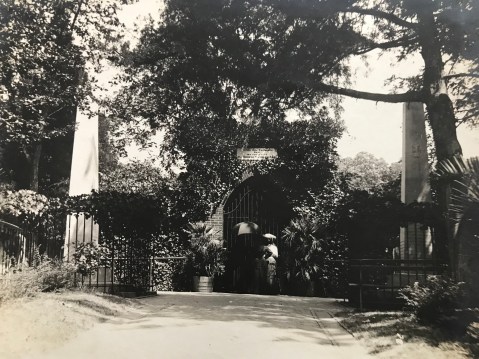
George Washington’s at Tomb Mount Vernon, Virginia. Photo by Lewis Reed
NOW: Today, the gently wooded enclosure that surrounds the Washingtons’ final resting place is a lovely, fitting space to pay homage to the Father of Our Country and the first First Lady.

A composite image of the tomb today.
Books

Related Resources


Copyright Notice

Reed Brothers Dodge History (1915-2012) by Jeanne Gartner is licensed under a Creative Commons Attribution-NonCommercial 3.0 Unported License.


Recent Comments