
Snapshots in Time: Reed Brothers Dodge Then and Now
Reed Brothers Dodge occupies a distinctive place in Montgomery County’s commercial and transportation history, operating as a family-run dealership for nearly a century and weathering profound shifts in American life. Established in 1915 by automobile pioneer Lewis Reed and later joined by his brother Edgar, the firm grew from a modest Rockville garage into one of the nation’s oldest continuously operated Dodge dealerships, surviving two world wars, economic downturns, and repeated upheavals in the auto industry. “Snapshots in Time: Reed Brothers Dodge Then and Now” examines this trajectory through paired historical and contemporary images, inviting readers to view the dealership not simply as a business, but as a long-running institution that helped drive Montgomery County’s transition from rural crossroads to modern suburb. (click images to enlarge)


The black-and-white photograph on the left shows Lewis Reed’s original Rockville Garage in 1915, located at the intersection of Veirs Mill Road and Rockville Pike. In the early days of the automobile, many dealerships evolved from existing repair garages, and Rockville Garage was no exception. That same year, Lewis Reed became a partner with Robert L. and Griffith Warfield. The Warfield brothers later purchased the building in July 1915 from Lee Ricketts and Sons, who had operated the local Overland agency. The business continued under the Rockville Garage name until, shortly after Edgar Reed joined his brother, it was renamed at the suggestion of the late Judge Edward Peter.
The image on the right is a 1970 artist’s rendering of the new Reed Brothers Dodge dealership, representing a pivotal moment in the company’s history. After 55 years at the original downtown triangle location, Lee Gartner purchased 4.37 acres from Eugene Casey and relocated the business to a modern facility at 15955 Frederick Road in Rockville. Featuring a contemporary showroom and a full Dodge, Chrysler, and Jeep service complex, the new site marked the beginning of a new era, while carrying forward a legacy that began nearly six decades earlier in a modest corner garage.


The black and white photograph above, taken by Lewis Reed, shows the original Reed Brothers Dodge dealership nearly 80 years ago… and on the right is the same location today, now known as Veterans Park. In the 1970s, the site was briefly called Francis Scott Key Memorial Park, before being permanently rededicated as Veterans Park in 1988 to honor those who served. During the late 1960s, the State of Maryland acquired the property to widen Route 355. The remaining portion of land was donated to the City of Rockville, and a small street created behind the dealership was named “Dodge Street”—a lasting tribute to the more than 50 years Reed Brothers Dodge called that location home. What was once a center of automotive innovation has been transformed into a quiet place of remembrance, but the legacy of Reed Brothers Dodge remains forever etched in the street signs and stories of Rockville’s past.


These photographs show the intersection of King Farm Boulevard and Frederick Road; the site where Reed Brothers Dodge stood proudly for more than 40 years. The image on the left, captured by Google Street View in April 2012, shows the dealership just before it closed its doors for the last time.
Today, the legacy of Reed Brothers Dodge continues in a new form. On the right, the property is now home to The Reed, a rebranded apartment complex that pays tribute to the site’s deep roots in local history. In early 2025, the familiar Bainbridge name officially disappeared from 15955 Frederick Road in Rockville. Along with the signage, the apartment complex underwent a complete rebranding, now honoring the legacy of the Reed family and the dealership that once stood there. Though the building is gone, the memory of Reed Brothers Dodge remains deeply rooted in the landscape and spirit of the community.


The black and white photograph above was taken by Lewis Reed in 1915, looking west from the site of his original Rockville Garage. Visible in the image is the dealership’s very first “gas station”—a single pump. In the distance, an early trolley car makes its way along Main Street (now Rockville Pike), part of a transit line that operated from 1900 to 1935, running past Reed Brothers Dodge. Also visible in the background is the historic St. Mary’s Cemetery, a landmark that still exists today.
Fast forward to the present, and the same view seen on the right looks dramatically different. The once-quiet corridor has evolved into what locals now affectionately call “the mixing bowl,” a complex web of modern roads, traffic signals, and constant motion. While the landscape has changed, the photo offers a rare window into the early days of Rockville’s automotive and transit history.


The “then” photograph above was taken by Lewis Reed in 1953 at the corner of East Montgomery Avenue and Dodge Street. It captures the newly constructed building, which housed the showroom along with the parts and service departments. When the State of Maryland widened the surrounding roads in 1970, the connector street behind the dealership’s original location was officially named “Dodge Street,” a nod to the many years Reed Brothers Dodge operated there—from 1915 to 1970.
The “now” image on the right is a Google Maps view of the same location, captured in 2016—64 years later—showing just how dramatically the area has changed over time.


Both of the “then and now” images above are Google Maps Street View photographs taken just ten years apart. The image on the left shows Reed Brothers Dodge in 2007, while the image on the right captures the same site after its transformation into the Bainbridge Shady Grove Metro Apartments.
In early 2025, the familiar Bainbridge name officially disappeared from 15955 Frederick Road in Rockville. Along with the signage, the apartment complex underwent a complete rebranding. Today, the property is known simply as The Reed, a name that pays tribute to the site’s deep roots in local history.


The 1917 photo on the left is the original Rockville Garage located at the intersection of Veirs Mill Road and Rockville Pike, 100 years ago. Note the unpaved dirt road on Rockville Pike and trolley tracks running past the Rockville Garage. Both photographs were taken by Lewis Reed on the Rockville Pike side of the dealership.
On the right, is the same location 50 years later of the Reed Brothers Dodge Gulf Gasoline station. Due to changes in the highway, Reed Brothers began an extensive remodeling and rebuilding program. Two-thirds of the original location at the junction of then Route 240 and Veirs Mill Road was razed and a modern Gulf Service Station was erected.


On the left is a mid-1960s view from the corner of Veirs Mill Road and Dodge Street showing the new building for Reed Brothers Service Department. On the right is a Google street view image of the same location today, 50 years later.


The photograph on the left shows a side view of the Rockville Garage, including its two-story addition to the original shop, taken nearly a century ago. The first floor housed the service department, while the upper level was used for parts storage. A tall chimney, likely connected to a coal furnace, provided heat, and the abundance of windows flooded the workspace with natural light for servicing early automobiles. By this time, Firestone Tire signage had replaced the earlier Fisk brand sold at Rockville Garage in 1915.
The photograph on the right was taken in 1968 from the same location, roughly 50 years later. By then, major highway changes had dramatically altered the site. Nearly two-thirds of the original property at the junction of what was then Route 240 and Veirs Mill Road had been razed, making way for a modern Gulf service station.


The beginning and the end at 15955 Frederick Road: 1970 and 2013.
The photograph on the left shows the dealership’s newly completed building in 1970, following its move from the original location at the triangle formed by Veirs Mill Road and Rockville Pike. This modern facility marked Reed Brothers Dodge’s 55th year of selling Dodge vehicles and signaled a new chapter for the business.
The image on the right was taken on May 16, 2013. The building stands vacant, photographed on the very day demolition began, bringing nearly a century of automotive history at this location to a close.


The photograph on the left shows rows of beige and baby-blue cars lined up neatly in the side lot. Just across the road stands King Farm, dominated by its large barn painted with the words “Milk for Thompson’s Dairy,” long before the land was transformed into a dense mixed-use community. At the time, Lawson King’s dairy cows grazed in fields only a few feet from the roadway. At its height, King Farm was the area’s largest milk producer and had remained in agricultural use for nearly 75 years before development was approved in 1996.
The image on the right was taken from the same vantage point in 2009, more than three decades later. The familiar barn still rises in the background, but the surrounding fields are gone, replaced by the streets, buildings, and neighborhoods of what is now known as King Farm.
Looking at these images side by side, it’s clear that progress doesn’t erase history, it builds on it. Streets may widen, buildings may disappear, and businesses may move on, but traces of what once was are still there for those who know where to look. Lewis Reed’s photographs give us a rare anchor to the past, allowing today’s landscape to be seen with new eyes. In comparing then and now, we’re reminded that Rockville’s story is not just about change, but about continuity, memory, and the people who lived and worked along these streets long before us.
Off-Season at the Montgomery County Fairgrounds, 1910
These winter photographs, taken around 1910 by Lewis Reed, offer a rare glimpse of the Montgomery County Fairgrounds during its off-season; long before crowds, exhibitions, and midway sounds returned each year. Covered in snow and largely still, the fairgrounds appear almost contemplative, preserving a moment in time that contrasts sharply with the bustle normally associated with the annual fair.
The Montgomery County Fair was held in Rockville from 1846 until 1932, serving as one of the county’s most important agricultural and social gatherings. Farmers, merchants, families, and visitors from across the region—including Washington, D.C.—came together to celebrate livestock, crops, craftsmanship, and community. Yet photographs of the fairgrounds outside the fair season are uncommon, making these images particularly significant.
Lewis Reed’s photographs show the grounds at rest. Snow blankets the open spaces, softening the outlines of fences and walkways. Buildings stand closed for the winter, including the Poultry House, which would have been a hive of activity during fair time. In these images, the structures themselves take center stage, revealing their form and placement without the distraction of crowds.
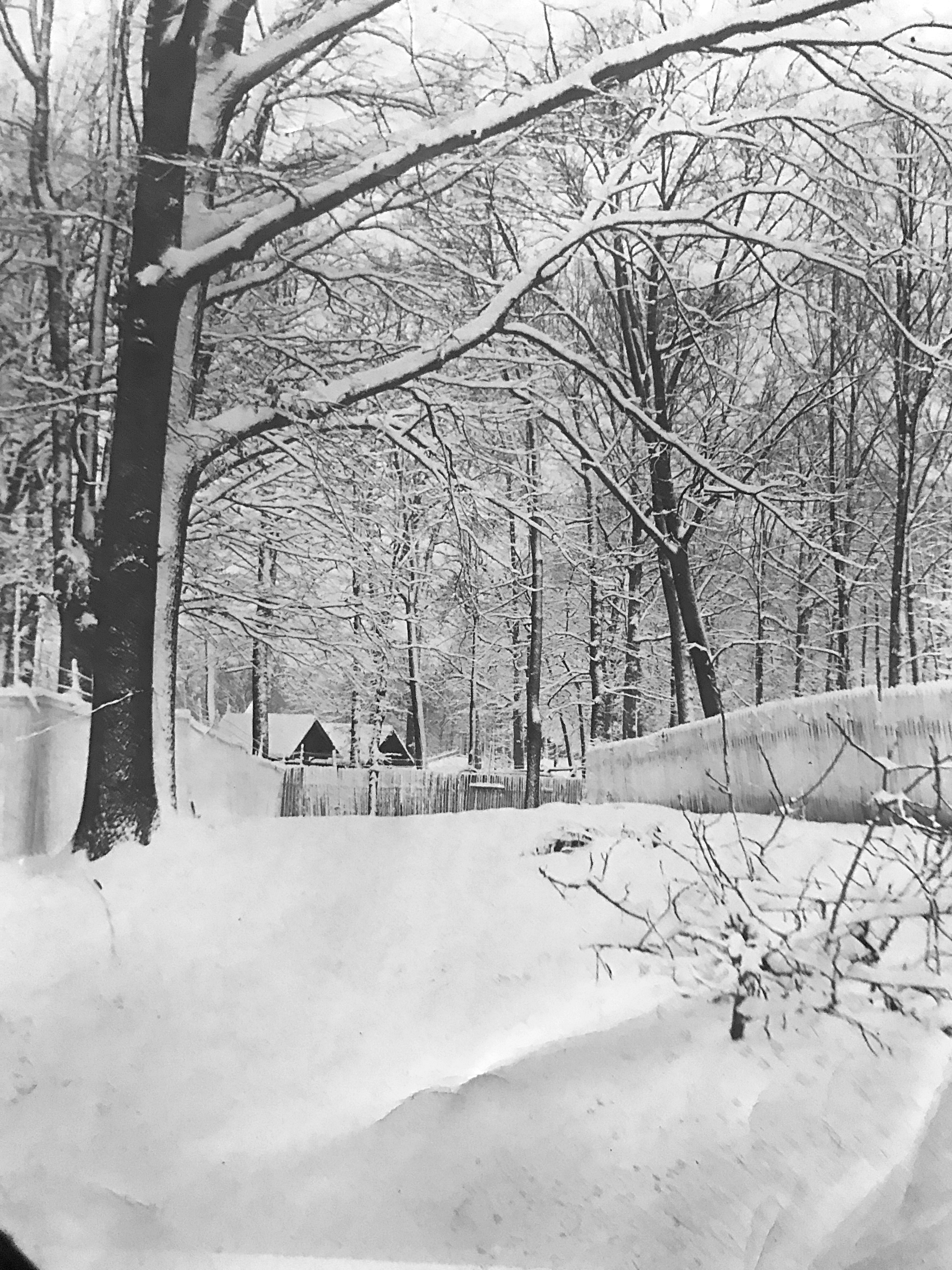
Snow blankets the fairgrounds in this early 20th-century photograph by Lewis Reed. Images such as this offer a rare view of the fairgrounds outside the fair season, documenting the site as it appeared in everyday use.
Reed’s work is notable not only for its subject matter, but for its documentary value. At a time when photography was still a deliberate and technical process, his images captured everyday scenes that might otherwise have gone unrecorded. Today, they provide visual evidence of how the fairgrounds looked and functioned in the early twentieth century, as well as a reminder of the role photography played in preserving local history.
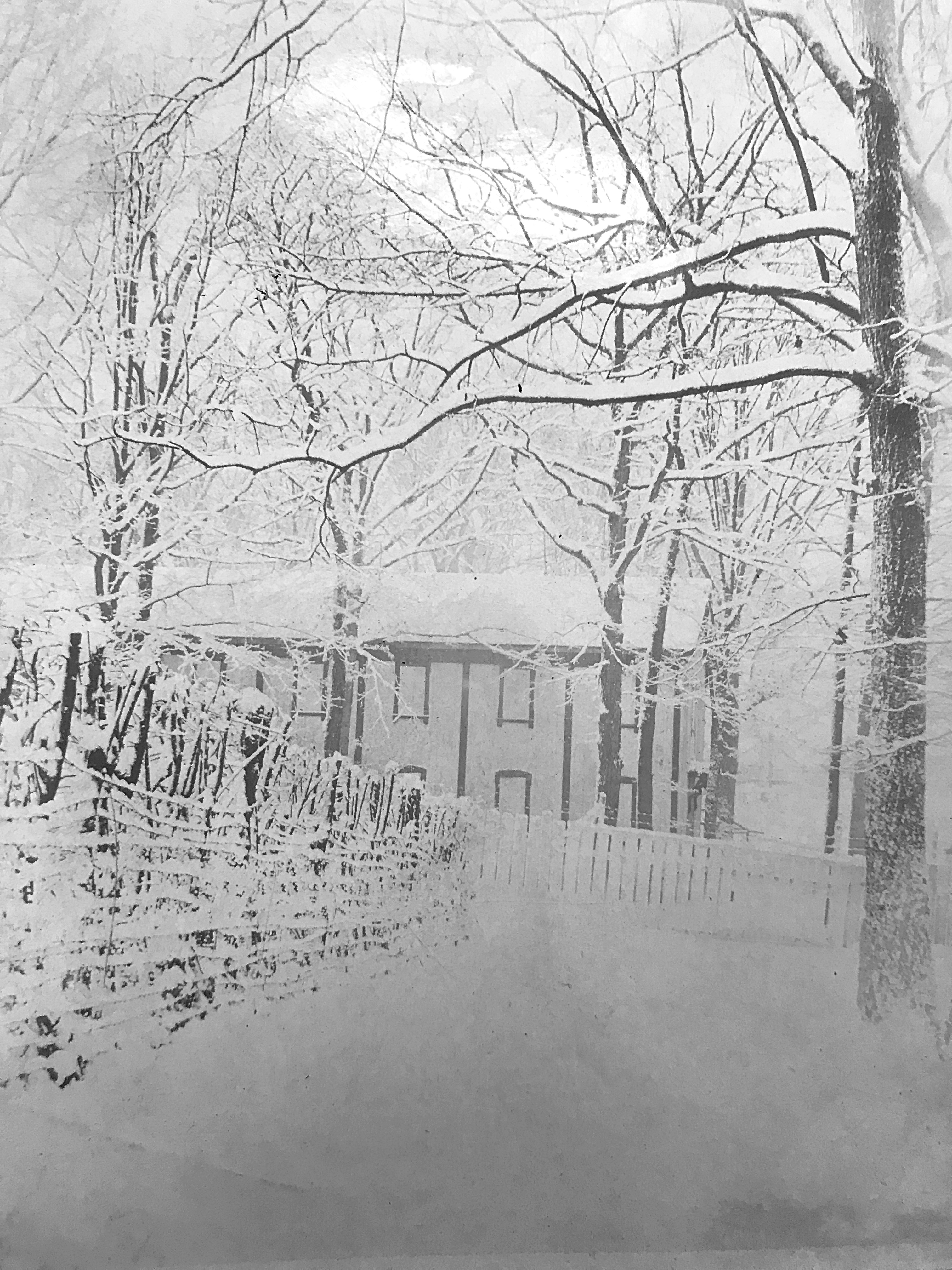
The Poultry House at the Montgomery County Fairgrounds, photographed by Lewis Reed during the winter of 1910. Closed for the season, the building would later host livestock exhibits during the annual Montgomery County Fair.
Viewed more than a century later, these snowy scenes connect us to a slower pace of life and to a Montgomery County that was still largely rural. Thanks to Lewis Reed’s careful eye and willingness to document the ordinary as well as the celebrated, these winter moments at the old fairgrounds endure.
Snow, Tinsel, and Memories: A Century of Christmas at the Reed Family Home
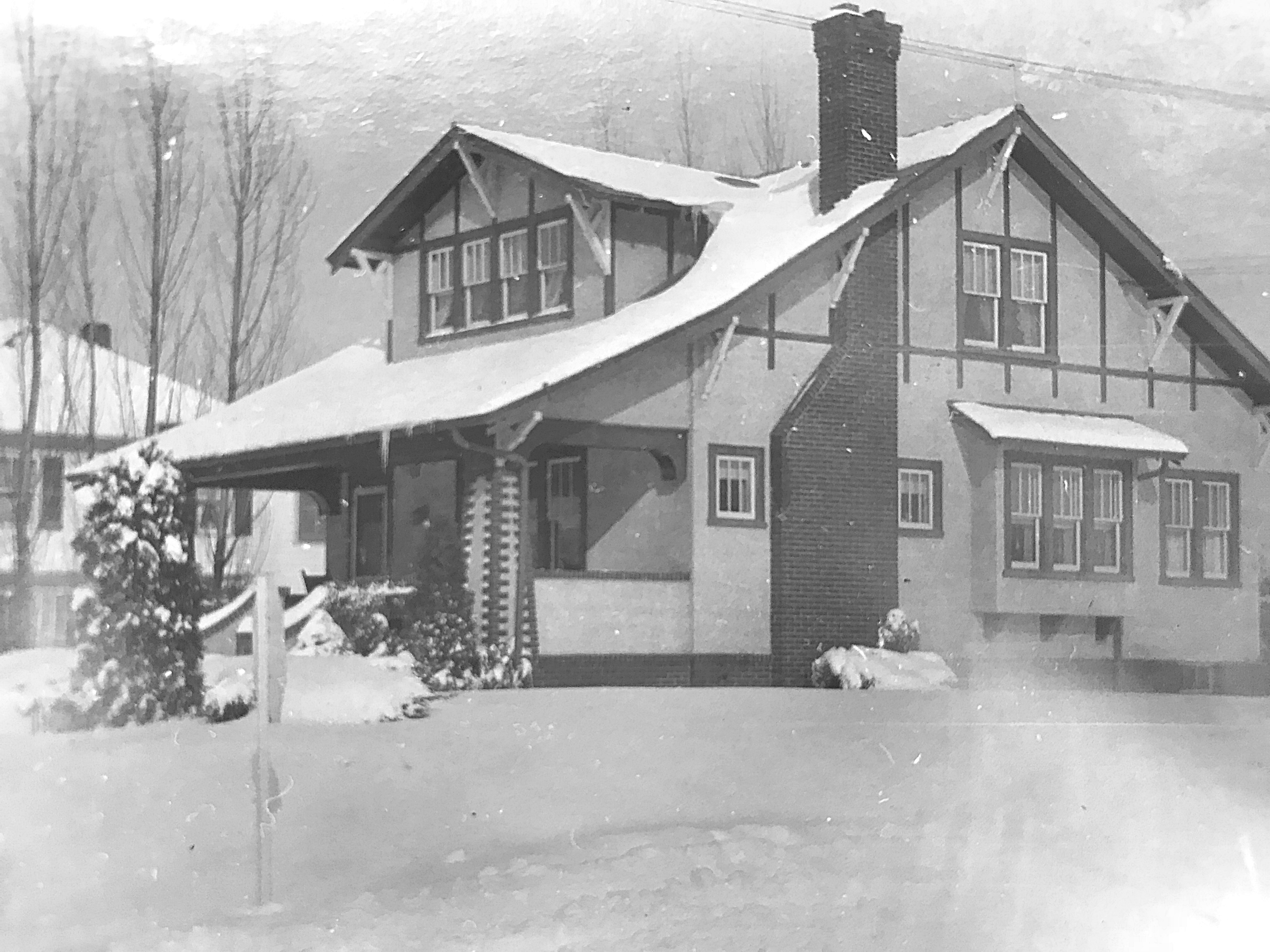
Lewis Reed’s craftsman-style home, looking rather solitary on a snowy day. Photo by Lewis Reed.
With only a few days left until Christmas, I thought it might be fun to take a look at some photos from Lewis Reed’s collection that show us what Christmas trees used to look like 100 years ago. In those days, there was not wide-spread agreement on exactly what a tree should look like, which made for a lot of creativity. Not surprisingly, they were very different than the perfectly shaped tress we have on display today.
The trees were big back then and always fresh. They went right to the ceiling and were very wide. Early Christmas trees were generally fastened onto a flat board surrounded with fence-rails, snow villages and carpeted with cotton blankets of snow. The tree in the photo below has an abundance of tinsel, which grew in popularity to the point that, by the 1920s, it was common to nearly cover the tree in the decorative material.
So, what is tinsel (aka icicles) exactly? Originally made from strands of silver alloy, tinsel was in fact first used to decorate sculptures. It was only later that it became a Christmas tree decoration, employed to enhance the flickering of the candle flames. In the 1950s, tinsel became so popular that it was often used as a substitute for Christmas lights.
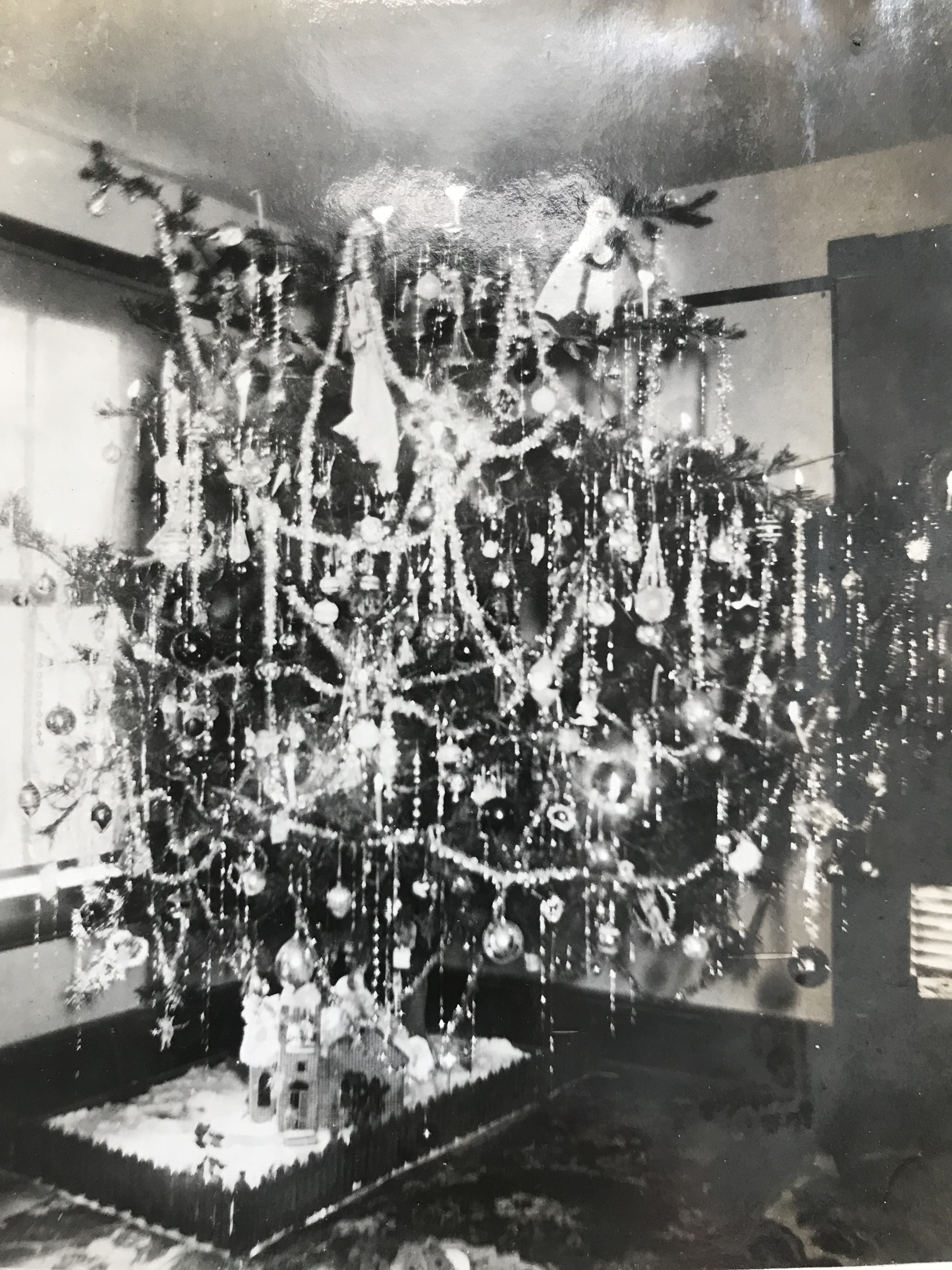
A small snow scene with what appears to be a miniature church is arranged at the foot of the Christmas tree. A popcorn garland adorns the tree. Photo by Lewis Reed
So, where did Washingtonians get their trees?
From The Evening Star, Washington, DC 23 December 1923:
Conduit Road on the long stretch between Glen Echo and Great Falls for many years has been a favorite hunting ground where hundreds and hundreds of families have customarily obtained scrub pine trees for Christmas week. Usually there is plenty of holly and some mistletoe to be found in the rugged and rolling hill lands which are the gateway to Great Falls.
In the early 1900s, Christmas trees weren’t the uniform, perfectly trimmed evergreens we see today. They were large, often reaching the ceiling, and proudly displayed their natural, sometimes misshapen forms. Families fastened them to flat boards, surrounded them with fence rails, and carpeted the ground with cotton blankets to mimic snow. Tinsel, originally made from strands of silver alloy, became a staple used to catch the flicker of candlelight and later, as a substitute for electric lights by the 1950s.
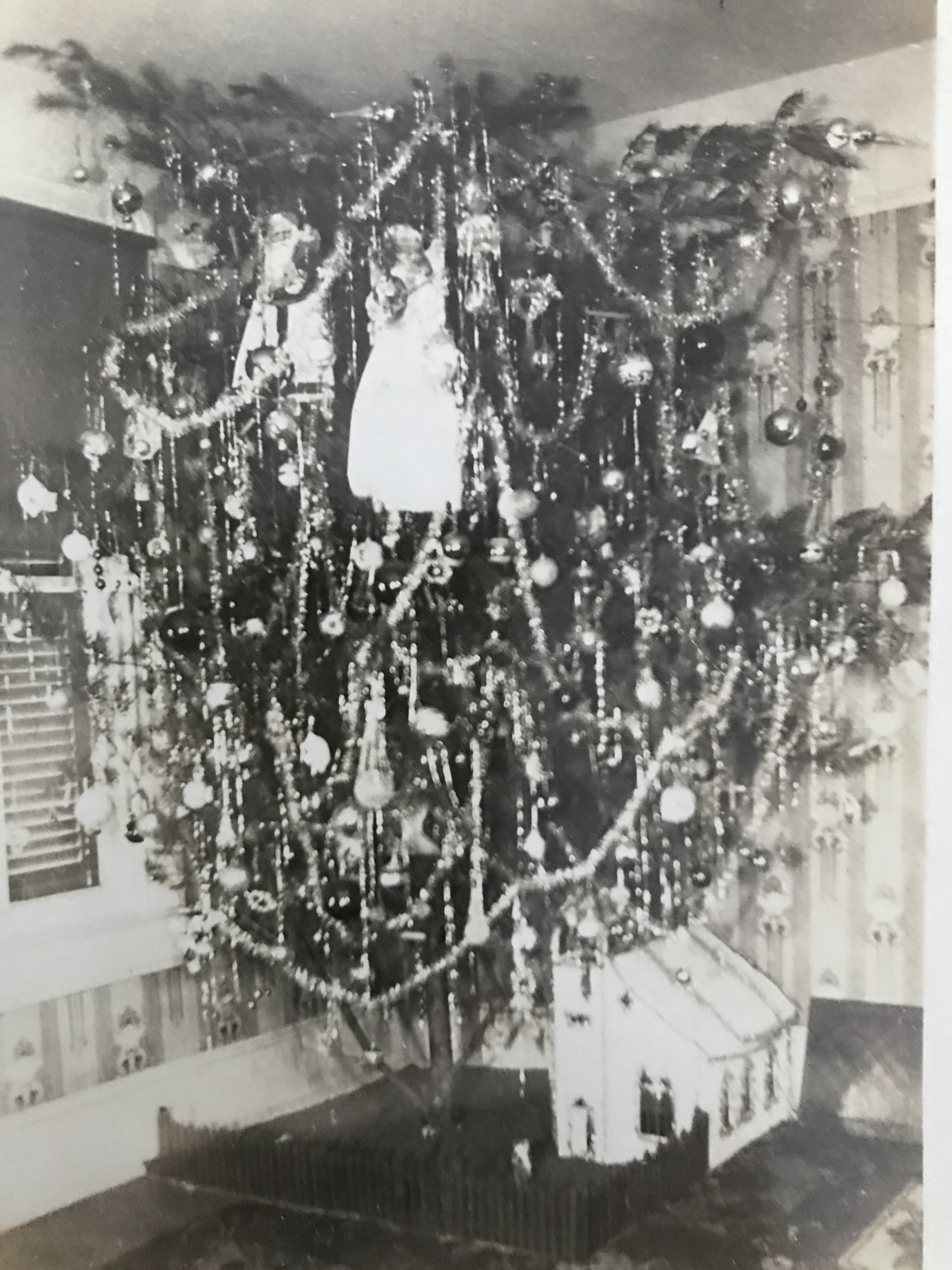
No room for a star on the top of this tree! And just look at those big Santa and Angel dolls. Other fun little details are notable, including a miniature church with picket fence is arranged at the base of the tree. Photo by Lewis Reed
There’s a fine art to decorating Christmas trees that’s been developing since over 100 years ago. People consider lights, garland, ornaments, skirt, and more. But one thing that’s hard to resist sometimes is just filling every available space with decorations. Clearly, that was the case years ago, too. What I like about these trees is that they are so randomly shaped and even misshapen. Folks back then didn’t trim them down to a more aesthetically pleasing symmetry like we do today.
The tradition of building miniature Christmas village landscapes, including houses, animals, and other hand-crafted wooden figures, began with the Pennsylvania Dutch in the late 1800s. Mass-produced cardboard houses, sold in dimestores, became popular in the mid-20th century. Today, these villages in good condition can be highly collectible.
Below are photos of Lewis Reed’s snow village set up under the Christmas tree decorated with vintage ornaments, tinsel, and lights. I don’t remember the odd-shaped Christmas trees, but I do remember having a lot of fun helping my grandfather set up the miniature landscapes with the varied figures, little houses, and trees at Christmastime each year. It seemed like a holiday village right out of a storybook.
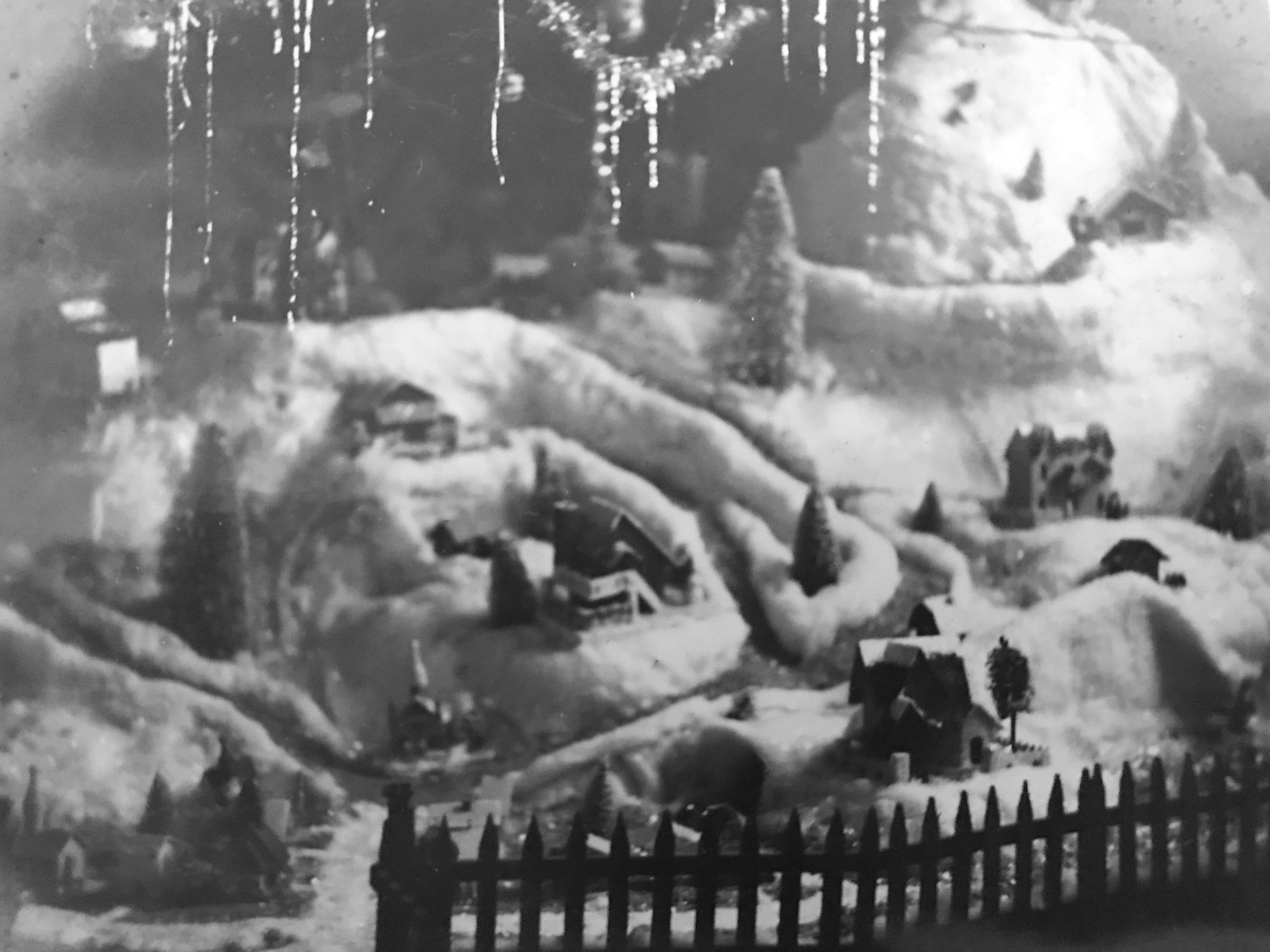
A rustic picket fence is used to set off the village display. Dangling strands of tinsel hang below the tree. Photo by Lewis Reed
The snow villages were set up in Lewis Reed’s basement on top of a big table beneath a small Christmas tree. He made the snow scenes entirely by hand using wire-covered cardboard and balled up paper to make hills and pathways. The little houses and figurines would fit into the landscape with cotton ‘snow’ all around; and lights would be wired underneath.
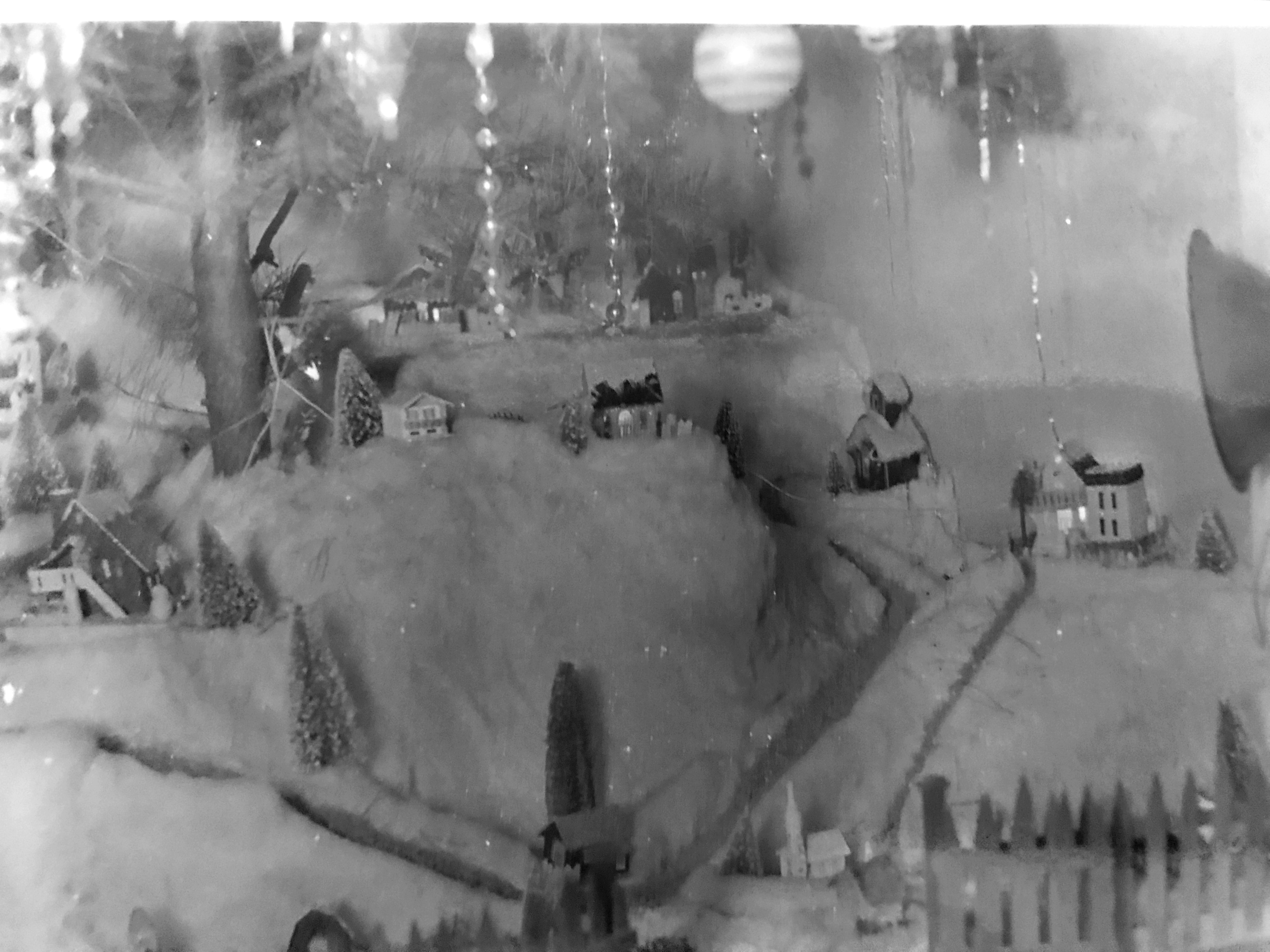
Little houses, churches, fences, trees, and pathways were added to the scene. Some of the houses have charming light effects in the windows. The roofs of the houses were decorated with fake snow. Photo by Lewis Reed
These early Christmas villages were the forerunners of today’s elaborate holiday displays, most famously popularized by Department 56. What began as simple, handmade scenes beneath family Christmas trees eventually evolved into the collectible ceramic villages that fill shelves and mantels during the holidays today.
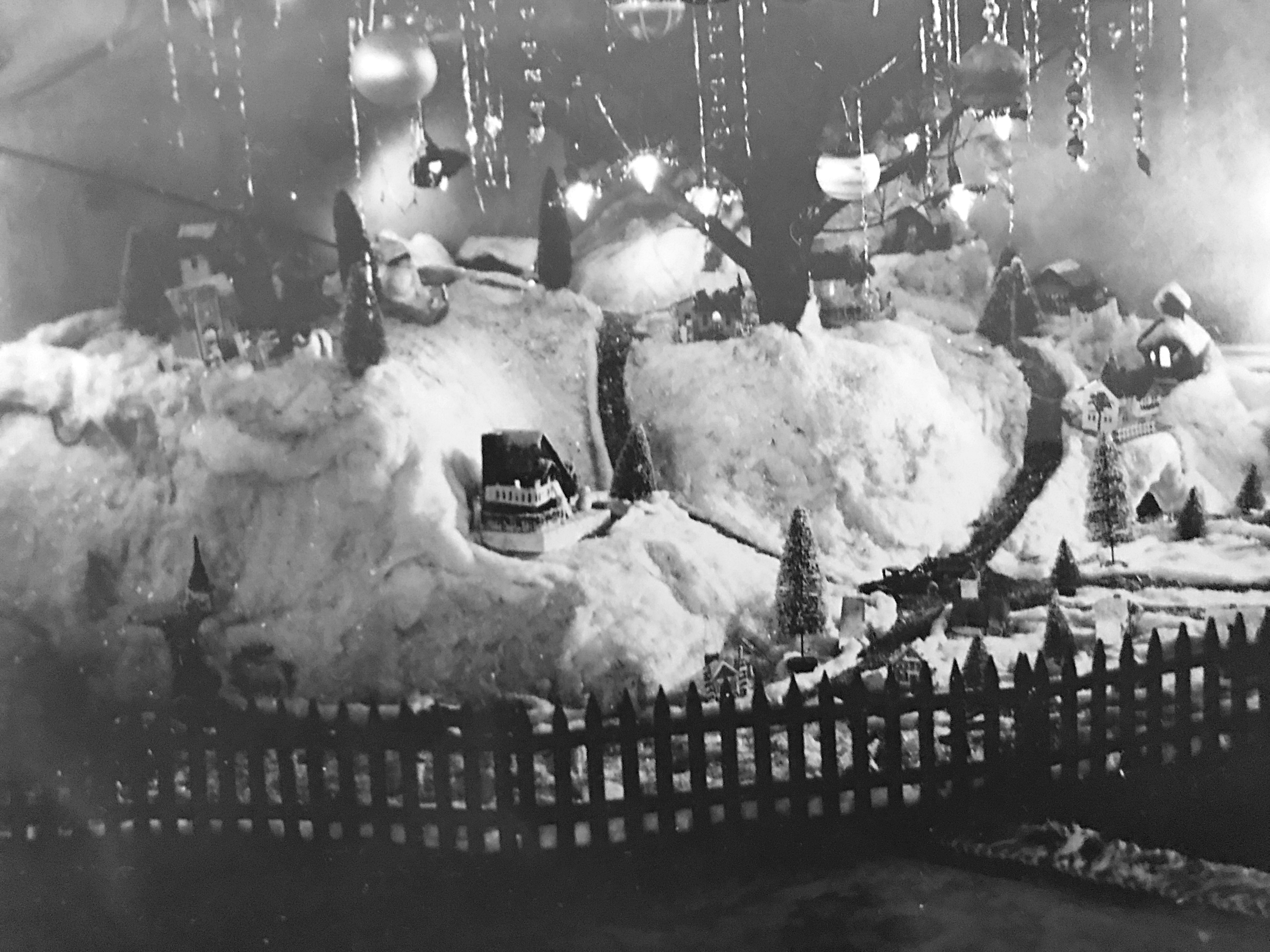
Old-fashioned lights can be seen on the tree, along with lit windows in the houses. The miniature houses usually had holes in the back or the bottom through which tiny lights were placed to provide illumination. Photo by Lewis Reed
Thanks for taking the time to visit. May your Christmas be merry, your New Year bright, and your holidays filled with everything that brings you joy. Stay safe and enjoy the season with family and friends!

Winter’s Harvest: Ice-Cutting in 1910 Montgomery County
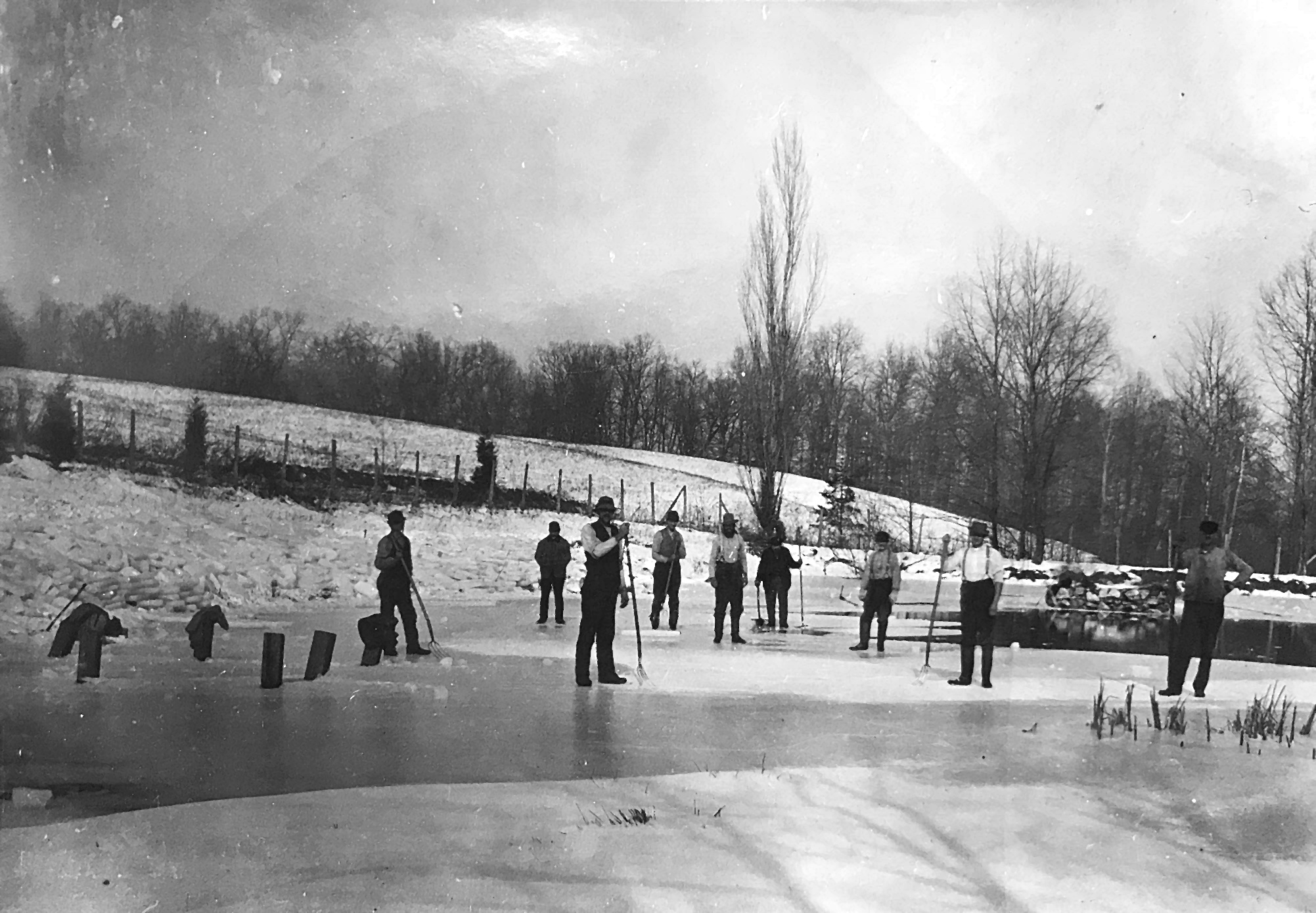
Men harvest ice with pitchforks and hand saws on a frozen pond in Darnestown, circa 1910. Stacked blocks line the shoreline, ready for storage in nearby ice houses. Photo by Lewis Reed.
Most people wouldn’t consider the winter months of December through February a season of harvest in Montgomery County. But in our not so distant past, this was harvest time for—ICE. Rivers, lakes and ponds were generally frozen and ice was harvested like a winter crop to keep food cold all summer long.
Much of what we know visually about this era survives thanks to Lewis Reed, founder of Reed Brothers Dodge, and one of the county’s most prolific early photographers. Among his many surviving images is a striking photograph of men harvesting ice on a Darnestown pond around 1910. In it, workers stand poised with their tools, the frozen surface carved into neat glistening blocks ready for transport.
Ice harvesting wasn’t merely a winter job; it was a community effort that tied households, farms, and businesses together. Timing was everything. Too early in the season, the ice was fragile and dangerous; too late, and the freezing window had passed. Because the work involved standing on frozen water with sharp tools and heavy loads, it carried genuine risk. Yet despite the hazards, these annual harvests were essential to community well-being. The ice collected in the winter months might be keeping milk or meat cold on farms well into August.
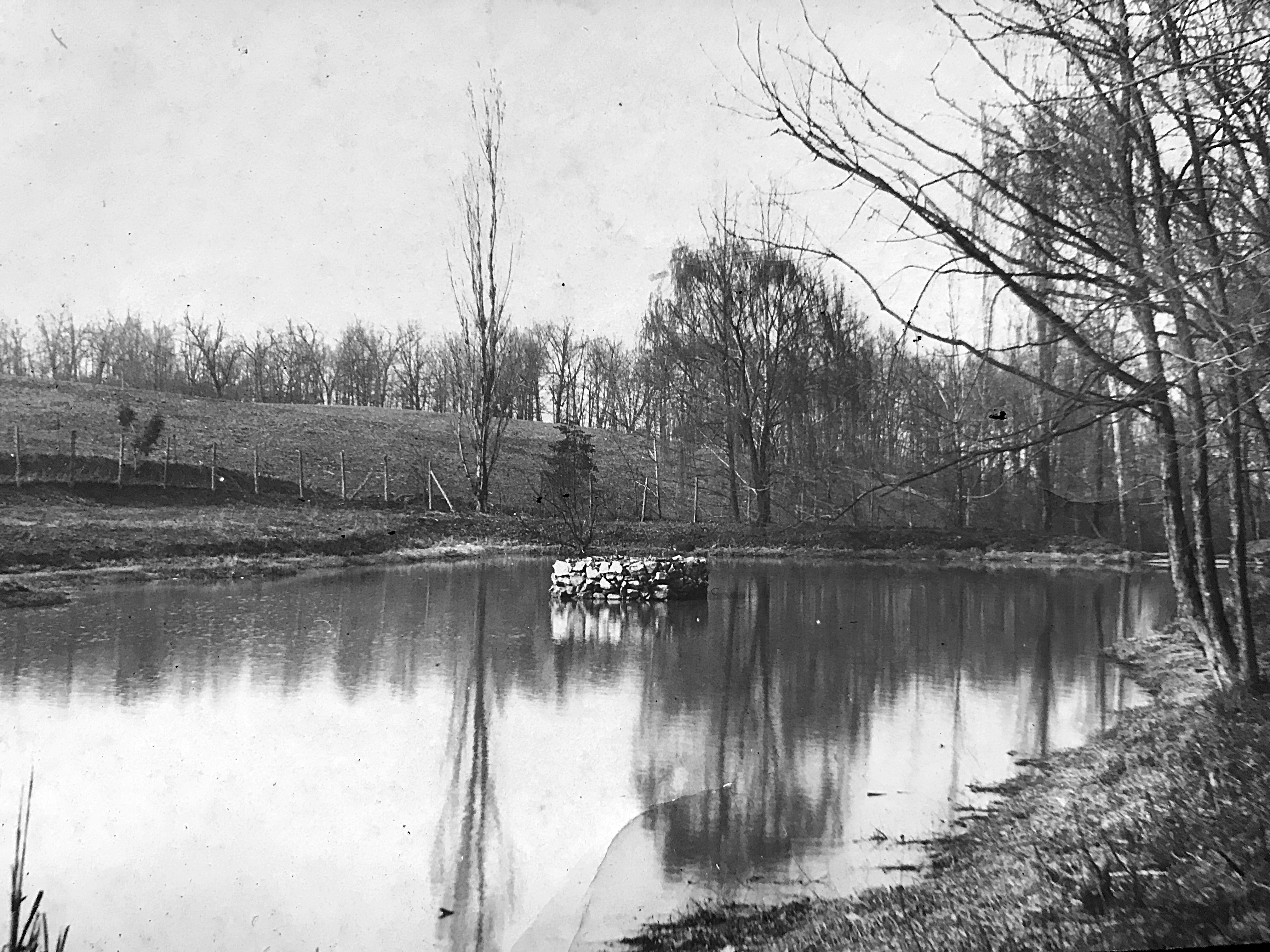
The same pond once used for ice harvesting, seen here ice-free. Photo by Lewis Reed, 1910.
From The Evening Star, Washington, D.C. December 22, 1904
ROCKVILLE AND VICINITY GENERAL NEWS
The cold weather of the past ten days has frozen the ponds and creeks throughout this county to a thickness of six or seven inches, and the ice harvesting is now the order of the day. The quality of the ice is not regarded as first-class, however, and for this reason many persons will defer filling their houses until later in the winter.
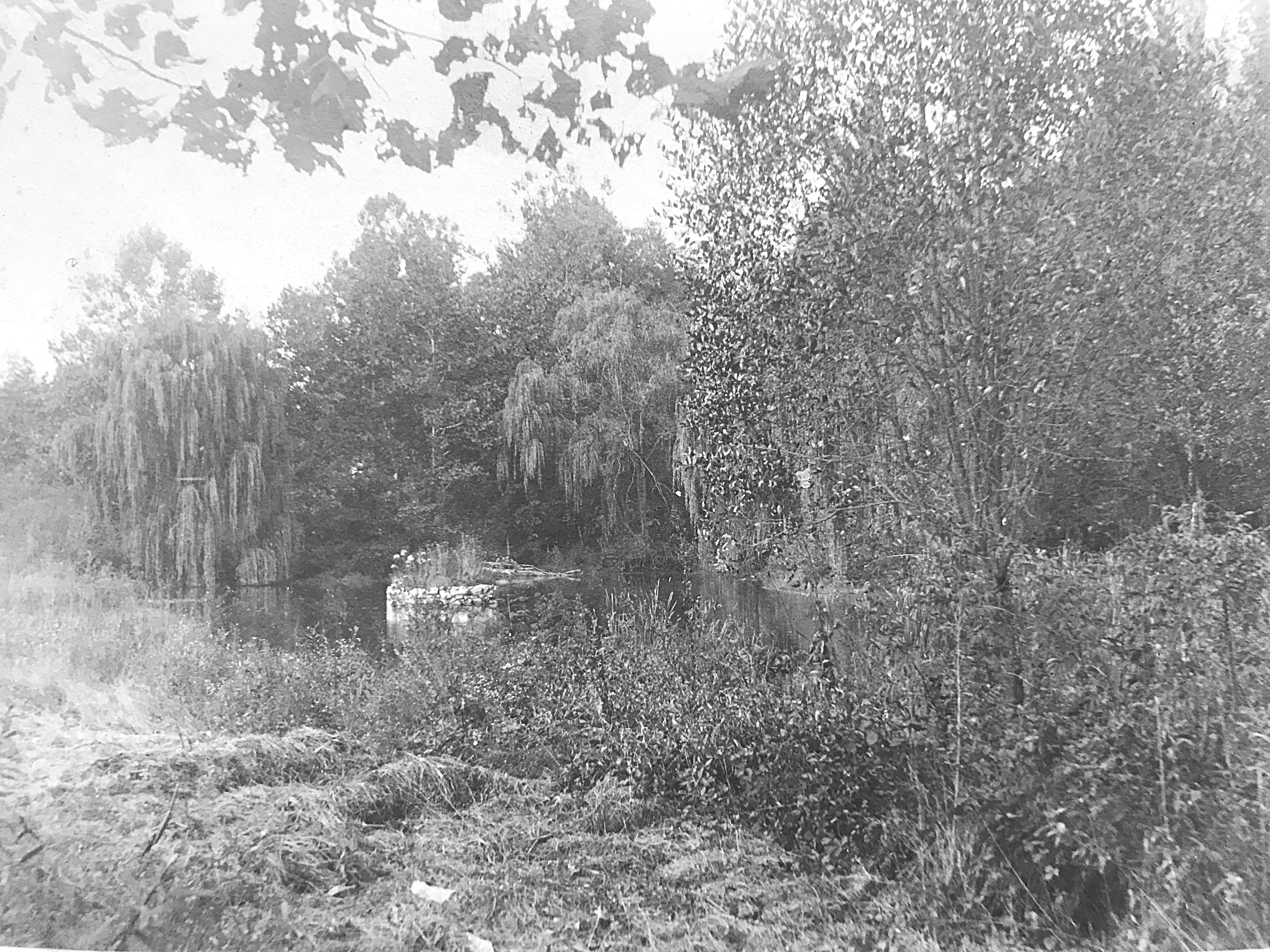
Summertime view of the same pond, seen from a different vantage point. Photo by Lewis Reed, 1910.
As we look back more than a century later, these images invite us to appreciate not only the hard labor that made year-round food storage possible, but also the photographers like Lewis Reed who understood the importance of documenting everyday life. Thanks to his lens, we can still witness this fleeting moment of Montgomery County’s past; a time when winter’s cold was not an inconvenience, but a resource to be harvested, stored, and relied upon long after the ice had melted.
Celebrating a Visionary: Lewis Reed’s Enduring Legacy on His 138th Birthday
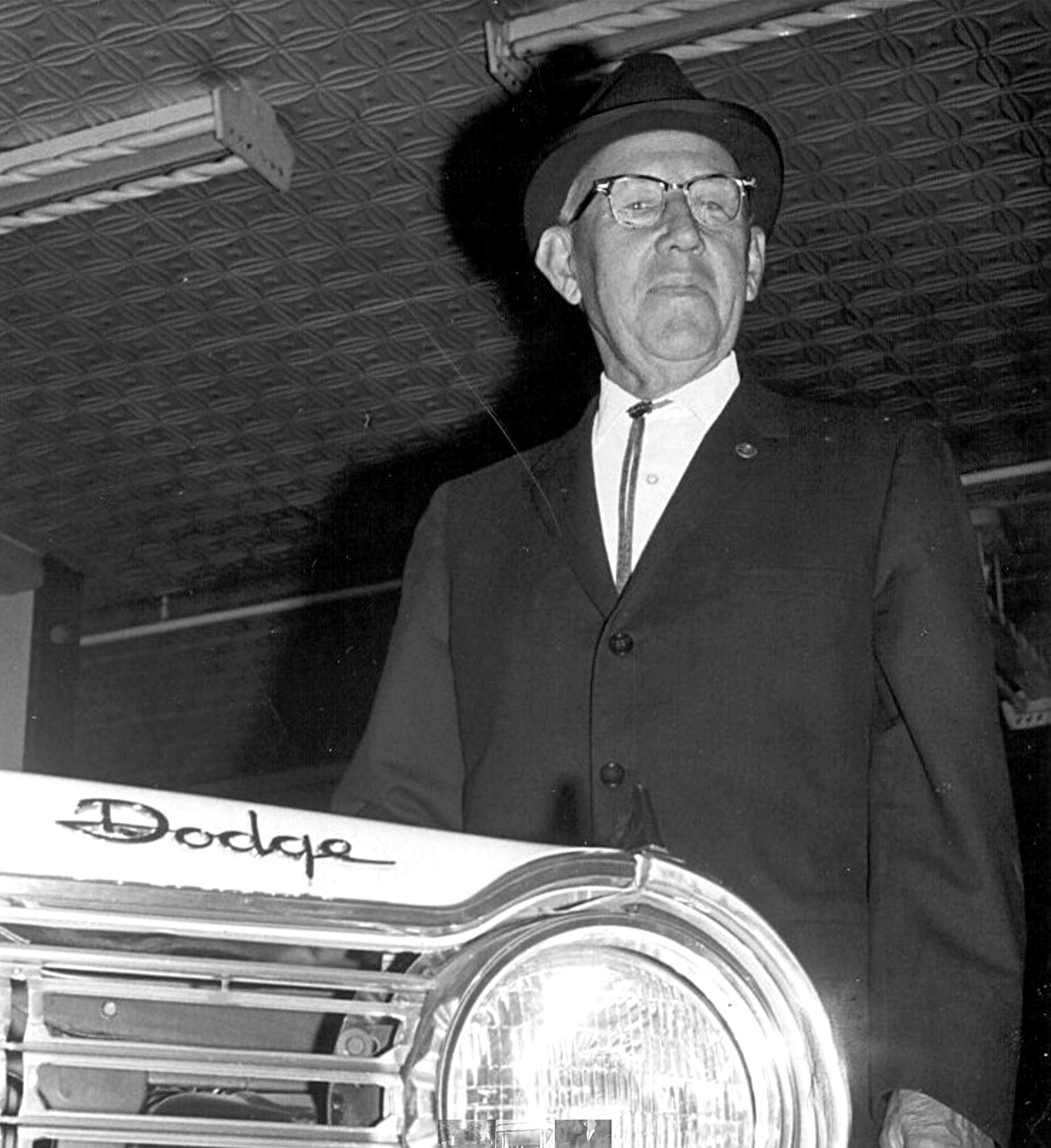
Lewis Reed in the showroom of Reed Brothers Dodge, 1965 – a rare glimpse of the founder near the close of his long career in the automobile business.
Rockville’s story is deeply intertwined with the life and dedication of Lewis Reed, whose vision and community spirit transformed local life. Born on November 25, 1887, Reed left an indelible mark not just as a pioneering businessman but as a devoted citizen whose legacy endures in Rockville’s culture and landscape today.
Lewis Reed laid the foundation for Reed Brothers Dodge, one of the nation’s oldest Dodge dealerships. After acquiring his initial interest in the Rockville Garage in January 1916, Reed gradually expanded his ownership until 1919, when he became the sole proprietor. He soon welcomed his brother Edgar, giving rise to a new chapter as Reed Brothers Dodge. What started as a simple garage quickly became a center for innovation, where early Rockville motorists found not just fuel and repairs but a gathering place at the dawn of the automobile.
The legacy of Reed Brothers Dodge in Rockville is reflected in enduring landmarks and recent changes throughout the community. “Dodge Street” remains a tribute to the dealership’s historic impact, named for its association with Reed Brothers Dodge and its essential role in Rockville’s automotive and civic landscape. The site at 15955 Frederick Road, once branded as “Bainbridge Shady Grove Metro Apartments,” has recently undergone significant rebranding in both name and appearance. The apartment complex that opened over a decade ago is now called “The Reed,” a choice that honors the dealership’s longstanding history in the area. This rebranding reflects an appreciation of local heritage, ensuring that the Reed name continues to be woven into the fabric of Rockville life.
Lewis Reed’s impact extended into local heritage and visual history. He was also a passionate amateur photographer, leaving behind a vivid pictorial history of both Rockville and Montgomery County’s transformation. Lewis Reed’s photographs are preserved and showcased through three significant historical online exhibits on Montgomery History’s website. These exhibits feature hundreds of images capturing iconic structures, streetscapes, homes, and towns across Montgomery County, including Rockville, Gaithersburg, and Germantown. They pair Reed’s early 20th-century photographs with modern recreations by his grandson, Barry Gartner, providing historical context and illustrating both timeless constancy and dramatic changes in the region. The exhibits include “Reed Brothers Dodge,” highlighting the dealership’s long history; “Montgomery County, Then and Now,” focusing on paired historic and current images; and “Montgomery County, 1900-1930: Through the Lens of Lewis Reed,” emphasizing his extensive photographic documentation of rural life and local landmarks.
As we celebrate the birthday of Lewis Reed, we honor not only the founder of Reed Brothers Dodge, but also a visionary whose dedication and spirit greatly shaped Rockville and Montgomery County. His legacy lives on through the enduring Reed name, cherished historical photographs, and the lasting impact of his entrepreneurial and community contributions. Today, Lewis Reed remains an inspiring example of how one individual’s passion and commitment can leave a profound mark on a community’s history and future. On this special day, we remember and celebrate his remarkable life and the heritage he created for generations to come.
Books

Related Resources


Copyright Notice

Reed Brothers Dodge History (1915-2012) by Jeanne Gartner is licensed under a Creative Commons Attribution-NonCommercial 3.0 Unported License.
 Reed Brothers Dodge History 1915 – 2012
Recent Comments