
Fill’er up! Texaco Tanker Truck
The 1917 photo below is the Reed Brothers original Rockville Garage located at the intersection of Veirs Mill Road and Rockville Pike. To the right is a Texaco Gasoline Filling Station sign. One very tall Texaco branded fuel pump can be seen in this photo along with two Texaco Petroleum refueling trucks. The gas pump globe on the top advertises the gas company name and logo. Parked in front is a line-up of some very early Dodge Brothers Motor Vehicles.
Note the unpaved dirt road on Rockville Pike and trolley tracks running past the dealership. From 1900-1935, the trolley cars went past Reed Brothers Dodge as they traveled up Rockville Pike. Major stops along the line included Georgetown, Alta Vista, Bethesda, Montrose, Halpine, the Fairgrounds, Courthouse Square, and Chestnut Lodge.

1917 Original Rockville Garage with 2 story addition. Note the Texaco Filling Station signage and the Texaco Petroleum fuel truck refilling the single pump in front. Photo by Lewis Reed
At some point between prior to 1920, Reed Brothers Dodge changed over from selling Texaco and became a Gulf Gasoline dealer. Reed Brothers had the first Gulf gas station in the still-rural Washington D.C. area. (click on images to enlarge)

1917 Texaco tanker truck. Photo by Lewis Reed
A Texaco Petroleum Truck sits in front of Rockville Garage after delivering its load of fuel. On the side of the tanker is a hinged wooden box carrying 2-drums of a Texaco product. The delivery driver seems to be wearing his best suit on this job, something that you don’t see these days at all.
In addition to Texaco gasoline, Rockville Garage also carried a full line of Texaco lubricants, Fisk tires, Willard batteries and many other well known brands of merchandise.
The most essential vehicle of the early 20th century had to have been the tanker truck. In the pioneering period of tanker trucks, 1910 to 1920, the Texas Company was among many that were fitted with tanks to carry refined products such as gasoline, kerosene and fuel oil.
Montgomery County Police Department 99th Anniversary
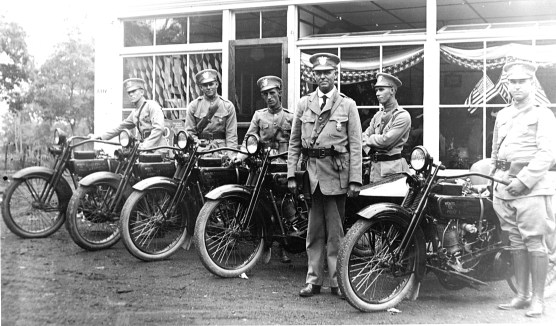
This is the first known photograph of the entire MCPD. Pictured left to right: Earl Burdine, Lawrence Clagett, Guy Jones, Chief Charles Cooley, Leroy Rodgers, and Oscar Gaither. Photo taken by Lewis Reed on July 4, 1922.
July 4th marks the 245th anniversary of the birth of our nation and the 99th anniversary of the beginning of the Montgomery County Police Department. Cattle rustling, bootlegging and stealing poultry were among the most common crimes when Montgomery County hired its first police chief and five officers in July 1922. So widespread was the theft of chickens and turkeys that some residents employed a homespun form of crime prevention by cutting off a specific claw on their birds to identify them. “Officers knew who all the chicken thieves were,” said one historical account of the era put together by the police department, “and upon getting a report of missing Rhode Island Reds, or some other breed, would head straight for the thieves’ hideaway to try to catch them ‘red handed’ before the birds got to the frying pan.”
Posing in front of Reed Brothers Dodge on July 4, 1922 Chief Charles Cooley, center, and his men of the first mounted unit of the Montgomery County Police Force, were on their first day of duty. For several years, since there was no police station, the officers would meet for “roll call” on the steps of the Red Brick Courthouse in Rockville at 2:00 p.m. every day to let each other know they were alive and well. Chief Cooley was given the privilege of a Model T Ford. The chief was paid $1,800 a year (the chief now gets $112,564) while the officers got $1,500. Each of the officers was issued a Harley-Davidson motorcycle, a .38 Smith & Wesson handgun, a black jack, law book and was allotted $300.00 a year for the upkeep of their motorcycle. Jones patrolled Silver Spring, Rodgers the Bethesda-Chevy Chase area and Burdine, Clagett and Gaither the Upper County areas.
The county’s population in the early 1920s was just 35,000 (it’s now more than 800,000). Much of the county was farmland, which accounted for the thefts of livestock. It also was the Prohibition era, when bootlegging and moonshine still factored routinely on an officer’s shift.
The officers worked 14 hours at night, 10 hours in the day, with two days off every two weeks. But they were on call at all times. Since there was no mobile radio contact (the first one-way radio system was installed in cars in the early 1930s), the officers tended to hang around the courthouse or a local firehouse that had a phone.
One of the officers came up with the idea of placing a flashing red beacon light on a pole atop the Rockville courthouse. When flashing, it would alert police that they had a call or were wanted at the office. In 1927, similar lights were used at district stations in Silver Spring and Bethesda.
Congratulations MCPD and thank you for your many years of service!
Introduction of School Buses in Montgomery County
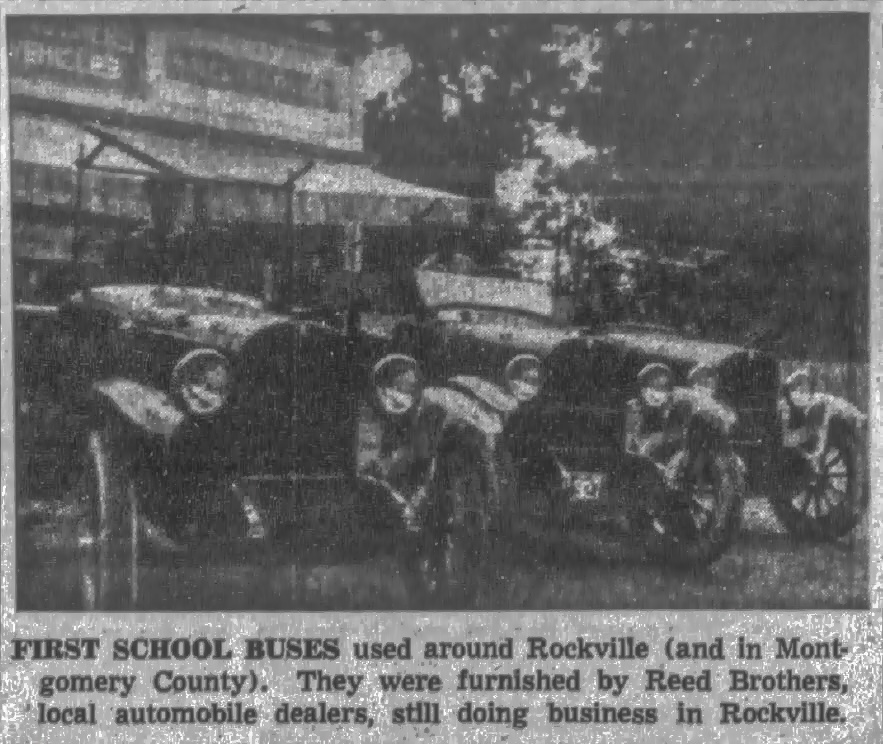
Your parents and grandparents have probably told you stories of walking miles to get to school – uphill both ways of course. Today, most kids take the school bus. In fact, if you were a grade school student the late 1950’s, a Dodge school bus might have been your ride. The first school buses used around Rockville (and in Montgomery County) were furnished by Reed Brothers Dodge.
From The Montgomery County Sentinel, May 21, 1959:
In the 1940s, the school bus started to become a profitable trend, so other companies began to jump on the bandwagon to create their own versions. Fifty years prior, Wayne Works and Blue Bird were the main producers, but around this time mainstream companies like Ford and Dodge used their vast resources to further innovation.

Following the end of WWII, the number of children exploded in America, and that necessitated another redesign for buses. This time they didn’t get wider or safer; this time they got a lot longer. Adding all that length increased overall capacity to around 100 students. It was around this time that the infamous yellow paint job became a national standard as well, so this is the beginning of the school buses we know today.
Then & Now: Historic Mathias Point Lighthouse
“Then and Now” photos are an excellent way to explore the passage of time. In this special post, I have combined one of Lewis Reed’s original photograph’s for “then” and matched it with a corresponding contemporary shot for “now”. Taken approximately 50 years apart, these photos show Mathias Point Lighthouse, then and now.
Mathias Point Lighthouse (THEN):
Mathias Point Lighthouse was placed at the edge of a shoal jutting out from a major bend in the Potomac River. This point was considered one of the most dangerous navigation problems on the river. In the summer of 1873, the United States naval steamer Frolic went ashore and remained grounded for over two weeks. It was eventually floated out at a cost of nearly $6,000. After much debate in Congress, $40,000 was finally appropriated in 1874. Originally, a day beacon was approved for Mathias Point and light for Port Tobacco Flats. After a delay of almost two years, the two sites were switched.
Plans were drawn up for Mathias Point and the design was like no other screwpile on the Bay. The design included 3 levels, unlike the other 2-level cottages on the Bay. It had a large second floor and smaller third floor which resulted in a “wedding cake” profile. It also had an unusual amount of ornate detailed woodwork. The pilings were angled inward to the base of the lighthouse, which was also different from other screwpile designs. The house was white with a brown roof and green shutters. Construction started in September 1876 and commissioned December 20, 1876.
The light was automated in 1951 and was monitored by the keeper of Maryland Point Light. In 1961 the light was decommissioned the beautiful lighthouse at Mathias Point was dismantled.

Mathias Point Light, Potomac River, near the Port Tobacco River, Maryland. Photo by Lewis Reed, 1915.
Mathias Point Lighthouse (NOW): The current light is a steel tower on the original screwpile supports and displays a 44-foot high, 6 second flashing green light. The current light can be viewed from the Mt. Bethel Recreation Center at Mathias Point in Virginia. As of 2020, it is still an active aid to navigation.
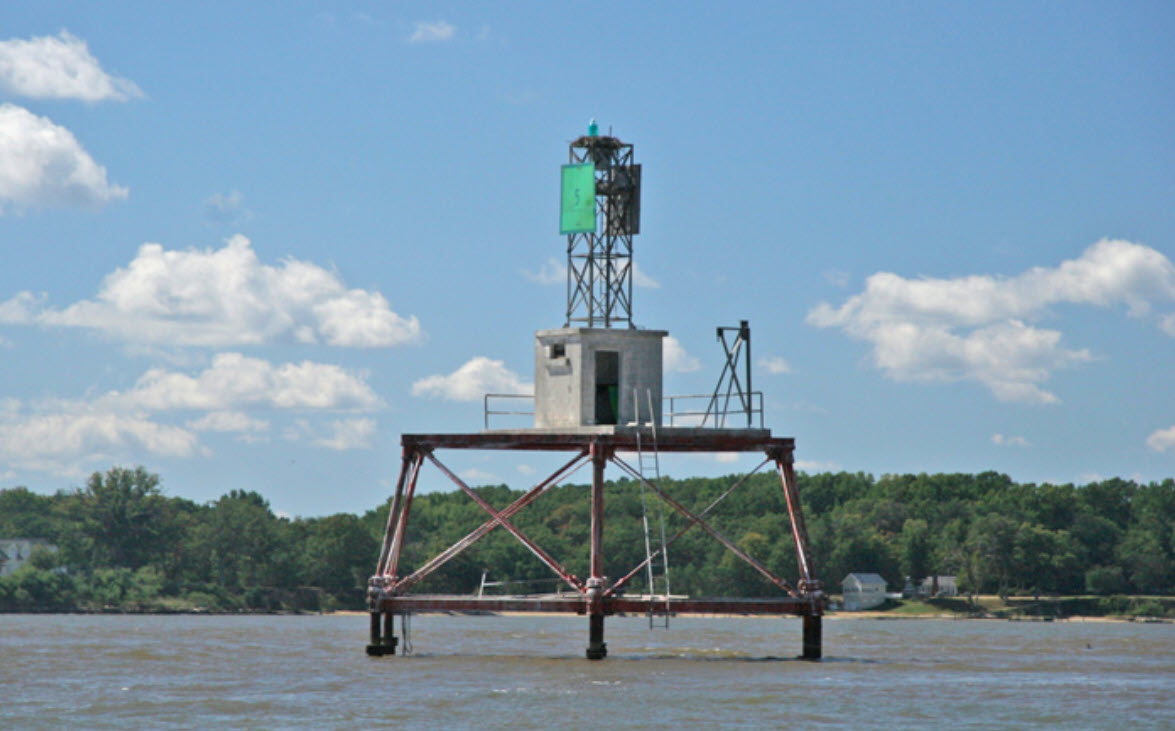
Mathias Point Light in the Potomac River in Maryland is no longer standing, now a beacon.
Lewis Reed Glass Plate Negatives Collection
Lewis Reed’s love of photography began at a very young age, at a time when most families did not own a camera. The oldest photo in his collection (Fearon’s Pharmacy, pictured below) is dated 1898, which would have made him around 11-12 years old when he started using a camera.

Vinson’s Drug Store Fearon’s Pharmacy (as named in the window). (also Owen’s and Vinson’s at other times). L to R Tom Talbott, Wardlow Mason, Otho Talbott, unknown, Dr. Fearon. Photo by Lewis Reed, ca. 1898.
The print below was originally made from Lewis Reed’s glass negatives collection. His full collection dates from about 1898 to 1960, and includes 280 glass negatives and 2500+ photographic prints, the majority of them more than 100 years old. The early 1900s were considered by many to be the golden era of early photography, because of its new availability to the public and somewhat simplified production methods. Many of Lewis Reed’s early photographs are now part of Montgomery History’s photo archives.
The following is an excerpt taken from the Summer 2011 edition of the Montgomery County Historical Society Newsletter.
The Sween Library was recently given a collection of 280 glass plate negatives, showing Montgomery County in the early 20th century. Lewis Reed was a well-known photographer in the county as well as owner (along with his brother Edgar) of Reed Brothers, the Rockville automobile dealership. The collection was donated to the Society by Mr. Reed’s daughter, Mary Jane Reed Gartner.
There are scenes of different areas of the county, buildings, events such as the county fair, and local people. These are a welcomed addition to our growing graphics collection.

Print made from a Lewis Reed glass negative, showing the Reed Brothers dealership in 1922. On the top left, you can see a crack in the glass.
The photograph below shows Lewis Reed and his family posing in front of a camera set up on a tripod. Lewis Reed is holding a dry glass plate encased inside a holder in his left hand to protect it from the light. Because Lewis used dry plates, he could carry them to locations and expose them, then carry them back to his darkroom to process them. He developed all of his own photographs in a darkroom in his house — in the kitchen, to be exact — and worked at night to develop the negatives. He likely needed considerable chemical and technical knowledge to develop the plates and print photographs.
On location, once he had identified the subject of the potential photograph, the dry glass plate holder would be inserted into the camera, the cover would be removed from the holder to reveal the negative, the lens cover quickly removed to take the photograph and re-covered, and finally the plate holder cover replaced before it was taken out of the camera. Lewis Reed wrote in pencil on the back of the holder a brief subject description. The image on the negative would then be stored to develop at a later point in a darkroom.

Nel Thomas Hollis, Ethelene Reed, daughter Mary Jane, and Lewis Reed at West Virginia Coal Mine, ca. 1926.
Photography became a lifelong passion for Lewis Reed that expanded in later years to include movies that he made not only of his family, but on his several trips to various parts of the world. The majority of photo prints from his albums were taken during the early part of the 20th century (ca. 1900-1930). His entire collection spans more than six decades and showcases his love for people, automobiles, events, landmarks, and travel throughout the first half of the 20th century.
He had a great eye for composition and seemed to be drawn to historical events and landmark locations, including the Smithsonian, Capitol, Union Station, Old Post Office, Library of Congress, Raleigh Hotel, grading of Massachusetts Ave in DC, and Key Bridge. There are also photographs of many non-Maryland locations including the historic landmark “Lucy the Elephant”, Gettysburg Battlefield/Monuments, Mount Vernon, Pennsylvania Monument and United States Regulars Monuments while under construction, and Quebec Bridge (the 8th Wonder of the World).

Wright Brothers Military Flyer in its hangar at Fort Myer, Virginia. Photo by Lewis Reed, 1908
Other highlights include Montgomery County Grist Mills, Rockville’s first pipe stem water tower, 1939-1940 New York World’s Fair, and rare photos of the Wright Brothers Flyer in a demonstration at Fort Myer, VA. Especially stunning are images of the aftermath of the 1936 Gainesville Georgia tornado, one of the deadliest tornadoes in American history. He also took aftermath photos of the 1929 Montgomery County F3 Tornado that devastated northeastern Montgomery County.
If there’s an historical wayside marker on the side of the road in Montgomery County, chances are, one of Lewis Reed’s images is on it. Some of the markers that display his photographs include the Andrew Small Academy Marker in Darnestown, The Origins of Darnestown Marker, Baltimore & Ohio Railroad Station Marker in Gaithersburg, From Trolley to Trail Marker in Bethesda, Clinton A.M.E. Zion Church Marker in Rockville and the 19th Century Crossroads Marker in Darnestown.

B&O Railroad Station Historical Marker located on South Summit Avenue in Gaithersburg, MD.

Baltimore & Ohio Railroad Station in Gaithersburg. Original photograph displayed on the marker taken by Lewis Reed in 1911.
Of particular interest is Lewis Reed’s collection of manipulated photographs. He was 100 years ahead of his time by creating special effects to images long before the convenience and efficiency of digital photography and Photoshop were ever imaginable. Lewis Reed used a wide variety of effects, including hand-tinting, double exposure, applied handwork, and creating images that made it look as if there were ghosts in the picture. It’s pretty amazing how his early photography shows such versatility and creativity considering the limited tools that were available at the time.

A double exposure image of Lewis Reed’s brother, Edgar, seated on both sides of a table. Photo by Lewis Reed
In the double exposure photo above, Lewis Reed’s brother, Edgar, is playing cards with himself. The thing to look out for is to see that nothing inanimate in the scene is moved during the time of making the two pictures — in this case, you can tell the angle of the camera changed slightly when Edgar moved to the other side of the table for the second shot.
His photographs comprise a remarkable historic record of Montgomery County life in the early 20th century.
Books

Related Resources


Copyright Notice

Reed Brothers Dodge History (1915-2012) by Jeanne Gartner is licensed under a Creative Commons Attribution-NonCommercial 3.0 Unported License.


Recent Comments