
The First Shenandoah Apple Blossom Festival May 3, 1924

Here the parade participants circle the racetrack as spectators view the parade from a grandstand. There was no caption on this photo, but I’m guessing it might possibly be the VMI Regimental Band. Photo by Lewis Reed, 1924
The first Apple Blossom Festival in Winchester was held 95 years ago on May 3, 1924. It was a one-day event featuring a parade, the crowning of Queen Shenandoah, and a program of interpretative dance. To kick off the celebration, the parade assembled at the old fairgrounds just off Fairmont Avenue and marched through the streets of Winchester to the Royal Pavilion on the grounds of Handley High School.
Beginning in 1925, the first of three pageants was professionally produced by the John B. Rogers Production Company and staged on a dais at the fairgrounds. In 1928 the outdoor pageants were moved to the steps and esplanade of Handley High School. The pageant earned a reputation as being one of the most beautiful outdoor extravaganzas in the nation. The festival was suspended during World War II, and resumed in 1946 with its first celebrity grand marshals, Bing Crosby in 1948 and Bob Hope in 1949.
Since its beginnings in 1924, the festival has grown over the years to a ten-day celebration with over 30 events, including two huge parades, a carnival, dances, concerts, a 10K race, wine festival, golf tournament, and much more.
These photos from Lewis Reed’s album are what appears to be some of the very first photos of the Shenandoah Apple Blossom Festival held at the old fairgrounds in Winchester, Virginia. As always, click on an image to enlarge.

The B&O Railroad had a float in the Apple Blossom Parade. Photo by Lewis Reed, 1924
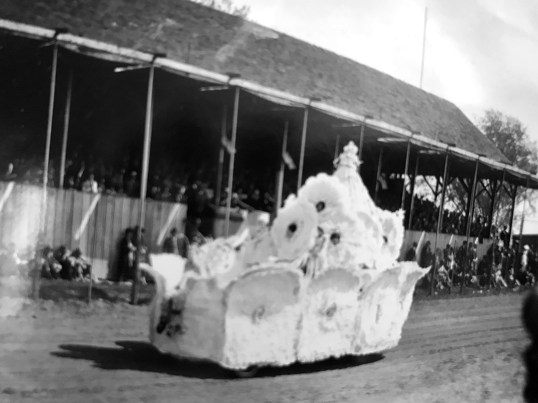
Photo by Lewis Reed, 1924
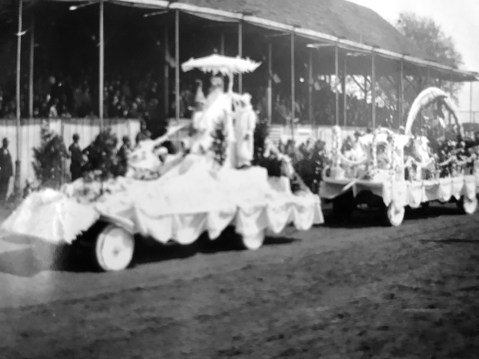
Photo by Lewis Reed, 1924

Photo by Lewis Reed, 1924
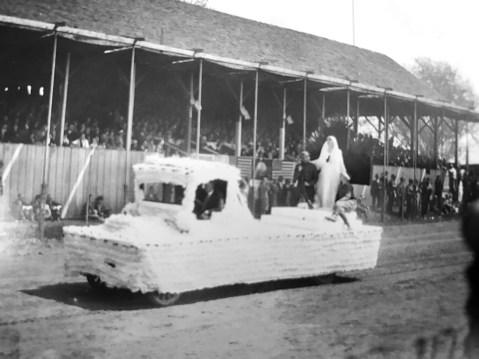
Photo by Lewis Reed, 1924
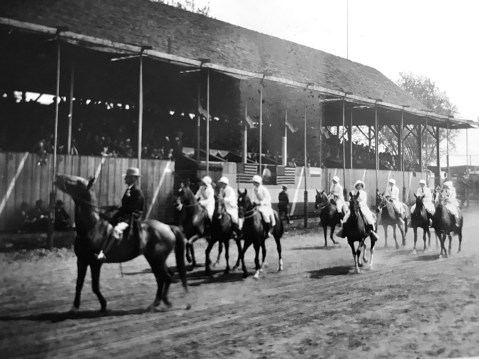
Photo by Lewis Reed, 1924

Photo by Lewis Reed, 1924
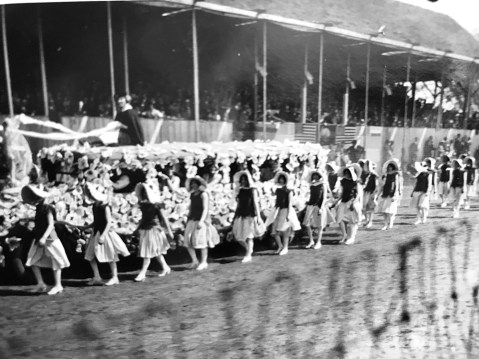
Photo by Lewis Reed, 1924
Source: thebloom.com
May 2, 1929 Montgomery County Tornado Disaster (Aftermath)
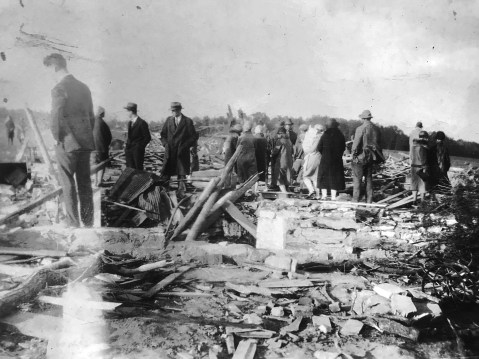
Spectators view the destruction at the Benson farm, May 1929. Photo by Lewis Reed
Ninety years ago today, one of the worst tornado outbreaks in area history devastated a part of Montgomery County Maryland. At about 9 p.m. on Thursday, May 2, 1929, northeastern Montgomery County was struck by an F3 tornado, part of a large storm system that caused devastation from Florida to Ohio. The weekly Montgomery County Sentinel reported on May 10th that the “wind storm of cyclonic power . . . was of limited width and serpentine on its course. Everything in its path met with destruction.” These previously unpublished photographs were taken by Lewis Reed “after the tornado of May 2, 1929”.

May 1929. Photo by Lewis Reed
The damage in the county was limited to the rural Unity area, north of Brookeville. The Sentinel article detailed each affected farm, noting that “thousands of persons from far and near visited the scene for several days to look upon the indescribable wreckage.”

May 1929. Photo by Lewis Reed
From the Sentinel: “The storm showed its first violence upon the farm of Mr. J. William Benson. There it destroyed every building – the dwelling house, large barn, 117 feet long, including an attached shed, and all other outbuildings.” The farm was unoccupied, but furniture belonging to “a prospective tenant” was destroyed. Mr. Benson’s apple orchard was also significantly damaged, and the article claimed that “many [trees] were lifted into the air, carried over woods and landed several miles away.”
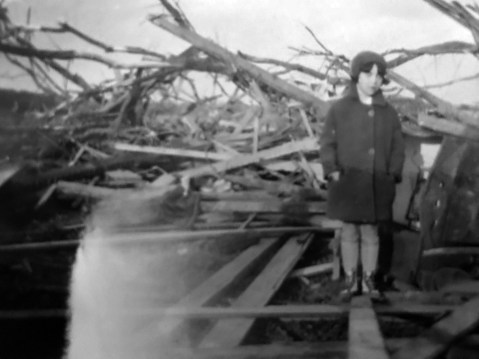
Lewis Reed’s daughter, Mary Jane, May 1929. Photo by Lewis Reed
The fire departments of Rockville, Gaithersburg and Sandy Spring responded to the call made by farm worker James Leizear, who “extricated himself from the wreckage” and ran half a mile to a neighbor’s house to summon help.
The Post reported on May 4th that 28 people in Maryland and Virginia had been killed by tornadoes during the storm; most of the casualties were in Virginia, where an elementary school was struck full-force and at least 18 children died. In Montgomery County, the local Red Cross Chapter formed a citizen committee to raise funds “for relief of the sufferers.”

May 1929. Photo by Lewis Reed
Note: These photographs were undated and unlabeled in my grandfather’s collection. My mother, Mary Jane (Reed) Gartner, who is seen above when she was almost 7 years old, positively identified these photographs and just about pinpointed the location! She is almost 97 years old! It’s amazing the things you remember from your early childhood.
Information Source: A Fine Collection
Then & Now: Thomas & Co. Cannery in Gaithersburg
“Then and Now” photos are an excellent way to explore the passage of time. In this special post, I have combined one of Lewis Reed’s original photograph’s for “then” and matched it with a corresponding contemporary shot for “now”. Taken approximately 100 years apart, these photos show the Thomas and Company Cannery in Gaithersburg, then and now.
Thomas & Company Cannery (THEN): The largest and longest-lived cannery in Montgomery County, the Thomas and Company Cannery operated from 1917 until 1962. While Baltimore had been the center of the canning industry in the 19th century, the outbreak of World War I created a need to rationalize. Frank and Clyde Thomas were leaders in the 20th century canning industry in Maryland. In 1917, the Thomas family opened a cannery in Gaithersburg, the first in Montgomery County. The factory was the focus of local industry and economy, providing an important market for farmers, and employment for local migrant workers.
The factory canned peas, pumpkin and corn, supplied both the local retail market and the war effort during WW I and II. During the war years, the cannery expanded operations and functioned on a three shift schedule to provide vegetables for shipment to troops. After the war, the cannery continued to produce vegetables under the brand names MY-T-NICE, EVER-GOOD, BARBARA FRITCHIE and ON-TOP corn, peas and succotash.
Built along the B & O Railroad to facilitate shipping, the brick cannery had three main parts: the central processing station, the shipping section and boiler plant. The cannery was designated a Gaithersburg landmark in 1987.

Circa 1917 photo taken behind the Thomas and Company Cannery in Gaithersburg. The Cannery was the first and largest vegetable cannery in Montgomery County. It closed in 1963 after fire damage and lay empty until its recent restoration. Photo by Lewis Reed.

Thomas & Company Cannery (NOW): The building saw various uses after the closing of the Cannery, but then lay empty until its recent restoration for office and commercial use.

Source: Maryland Historical Trust
Then & Now: Cherry Blossoms on the Tidal Basin
Time passes, but the cherry blossoms always come back. Seeing the cherry blossoms is a time-honored D.C. tradition that dates back to 1912, when Tokyo gifted 3,020 cherry trees to the U.S. in an act of friendship. While many of the original trees have been replaced, the Tidal Basin’s beauty has persisted for more than a century. Each spring, more than 1.5 million visitors descend upon Washington, D.C. each year to admire the 3,000-plus trees. The three-week-long National Cherry Blossom Festival, which runs from March 20 – April 14, 2019, is full of events that honor both American and Japanese cultures and represents a close bond forged between the two countries that began with Tokyo Mayor Yukio Ozaki’s gift of the trees back in 1912.
Here’s a great “then and now” comparison shot of the Cherry Blossoms on the Tidal Basin in Washington, D.C. from the 1930s and 2019.
Cherry Blossoms on the Tidal Basin (THEN): From Lewis Reed’s collection of photographs. Cherry blossoms in bloom along the Tidal Basin, circa 1930s with my mother, Mary Jane (Reed) Gartner.

Cherry blossoms in bloom along the Tidal Basin with my mother, Mary Jane (Reed) Gartner. Photo by Lewis Reed, ca. 1930s
Cherry Blossoms on the Tidal Basin (NOW): The “now” photo is a google image of approximately the same location… some 80 years later. According to the National Park Service, the 2019 cherry blossom peak bloom period began on April 1. The best viewing of the cherry blossom trees typically lasts four to seven days after peak bloom begins, but the blossoms can last for up to two weeks under ideal conditions.

Cherry blossoms in bloom along the Tidal Basin today.
Fun facts about Washington, DC’s cherry blossoms
- The first donation of 2,000 trees, received in 1910, was burned on orders from President William Howard Taft. Insects and disease had infested the gift, but after hearing about the plight of the first batch, the Japanese mayor sent another 3,020 trees to DC two years later.
- The first two trees were planted on the north bank of Tidal Basin in March 1912, and they still stand today. You can see them at the end of 17th Street Southwest, marked by a large plaque.
- It’s against the law to pick the cherry blossoms in Washington DC. While there aren’t any subtle wire fences or stern security guards like in a museum, any attempts to create your own corsage may very well land you a fine.
- The majority of the cherry blossom trees around the Tidal Basin are of the Yoshino variety. But another species, the Kwanzan, usually blooms two weeks after the Yoshino trees, giving visitors a second chance to catch the blossoms.
- The average lifespan of a cherry blossom tree is only 20 to 30 years, but nearly 100 of the original trees from 1912 still thrive at the Tidal Basin due to the maintenance of the National Park Service.
- No, they’re not all from 1912, reinforcements are sometimes necessary. New trees have been regularly planted, including in 1965, the late 1980s, 1999 and from 2002 to 2006, according to the NPS.
Then & Now: Old Post Office and Clock Tower Washington, DC
Old Post Office and Clock Tower (THEN): Seen in the black & white photograph taken by Lewis Reed in 1910, is the Old Post Office building in Washington, D.C. The Old Post Office, listed on the National Register of Historic Places as the Old Post Office and Clock Tower and located at 1100 Pennsylvania Avenue NW in Washington, D.C., was begun in 1892, completed in 1899. It is the second-tallest structure in the nation’s capital, after the Washington Monument. Adjoining the building to the right is the E. H. Snyder Tailors Shop and Washington Utilities Company.

Old Post Office, 1910. Photo by Lewis Reed
Trump International Hotel and Clock Tower (NOW): Though DC residents might call it the Old Post Office out of habit, it now houses the Trump International Hotel. Even though it has been renovated into a luxury hotel, the Old Post Office Pavilion Clock Tower remains open to the public and run by the National Park Service.

Trump International Hotel and Clock Tower in Washington, DC today
Source: Wikipedia
Books

Related Resources


Copyright Notice

Reed Brothers Dodge History (1915-2012) by Jeanne Gartner is licensed under a Creative Commons Attribution-NonCommercial 3.0 Unported License.
 Reed Brothers Dodge History 1915 – 2012
Recent Comments