
Lewis Reed Photos in Film Premiere: The Three (Known) Lynchings of Montgomery County, Maryland
These are screenshots of three of Lewis Reed’s photographs that appeared in the premiere screening of “The Three (Known) Lynchings of Montgomery County, Maryland” held Sunday, November 15, 2020 at a virtual event sponsored by the Montgomery County Lynching Memorial Project. (click any image to view photo gallery)


Jay Malin, filmmaker and photographer:
I haven’t seen anything else that gives as good an idea of what Darnestown or Rockville or an ordinary road in the county looked like in the day of the horse and buggy…. As a photographer, I know we most often fail to photograph the aspects of daily life that would really be of interest to future generations. So to have a photo of a horse and buggy on a county road or of the almshouse, which is probably the last thing most people would have thought to photograph, is really great.
I know if my grandfather was here today, I am certain he would be truly humbled and pleased that his photography is being used to help educate future generations.
Lewis Reed’s photos have also been featured in historical television programming, including on the national television show American Pickers, Science Channel Impossible Engineering, Maryland Public Television, and the American Experience History Series on PBS.
Montgomery County Lynching Memorial Project
Jay Mallin Photos
A Look Back at What Halloween in Montgomery County Looked Like 100 Years Ago
Ever wondered how Montgomery County families celebrated Halloween 100 years ago? Thanks to the these photographs from Lewis Reed’s collection, we can travel all the way back to 1914.
At the turn of the century, women often wore their regular clothes topped with homemade masks. The first Halloween costumes were usually worn by women and reflected the idea of masquerades that was extremely popular in the early 1900s. People only began to buy manufactured costumes in the second and third decades of the 20th century.

Halloween, ca. 1914. These women are holding homemade Halloween masks for their upcoming celebration. Photo by Lewis Reed
Oh the good ol’ days, when wearing a mask was enough to be dressed up for celebrations! Do you know how your ancestors’ celebrated Halloween? Newspapers are a great source to get a better understanding of life in the past. This special post is a look back through newspaper articles and Lewis Reed’s photographs at how Halloween was celebrated 100 years ago.
Stocked Stores: Stores were stocked with all the Halloween supplies needed for a fun celebration. Below is an ad for costumes and masquerade suits for those participating in Halloween parties and other seasonal affairs.

The Washington Post, October 30, 1916
Dancing and Parties: Halloween parties and dancing were enjoyed by many. Some announcements even included a list of guests in attendance!

The Baltimore Sun, November 3, 1912
Here is the description of a Halloween party from the Society Section of the November, 1916 issue of The Evening Star (Washington, District of Columbia):
A Halloween party was given last evening… and a merry evening spent by those present. The reception hall, living and dining rooms were artistically decorated with autumn leaves, lanterns, chrysanthemums and orange and black streamers. The evening was spent in old-fashioned games, concluding with the entire assemblage gathering about an open fireplace in the dark, while the guests were led by a ghost through various parts of the darkened home. The evening’s entertainment concluded with music, dancing and the serving of refreshments.
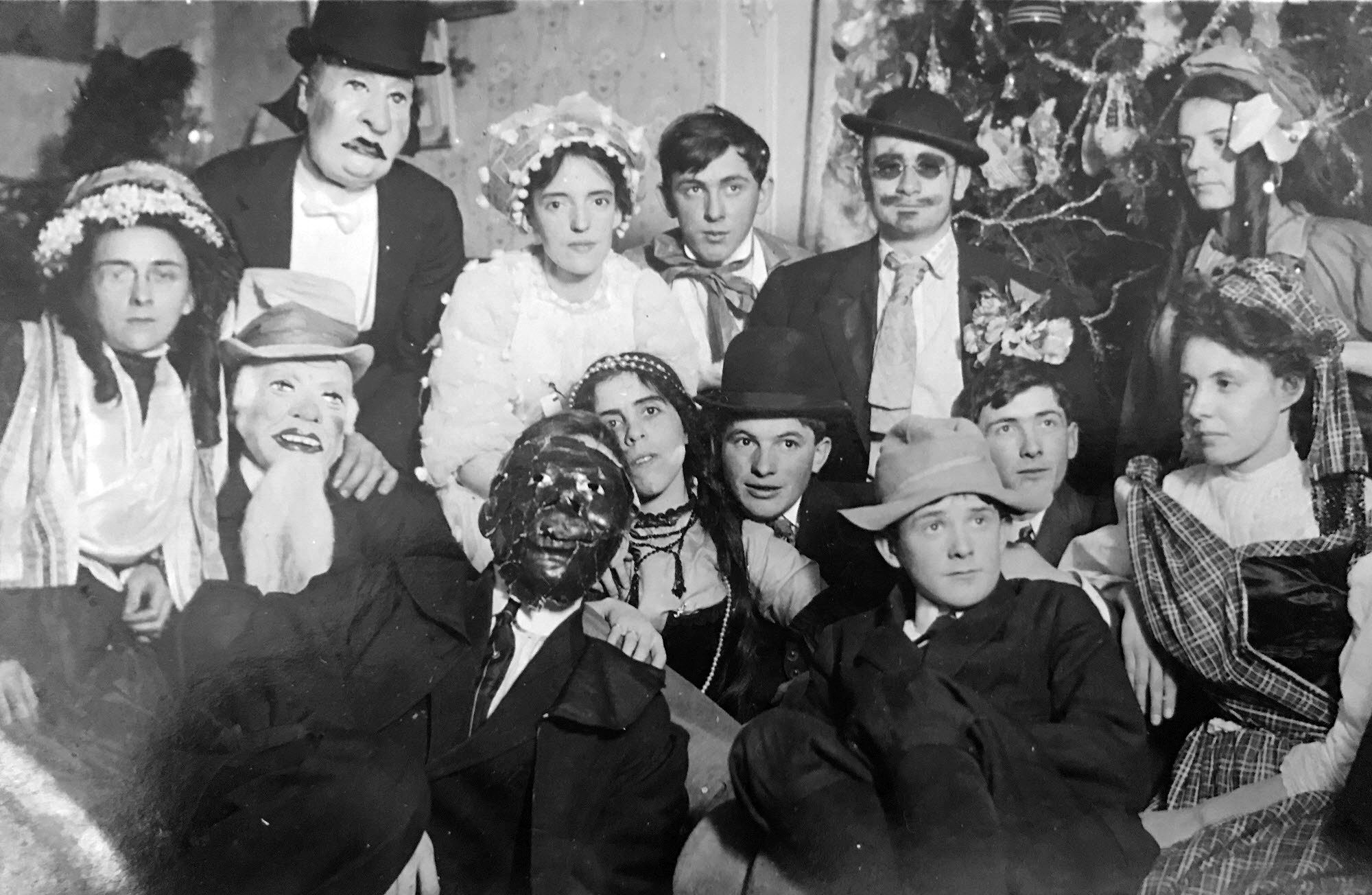
This photo captures a moment from a Halloween gathering over 100 years ago. Photo by Lewis Reed
Any sort of Halloween festivities demanded some sort of refreshment. In addition to traditional pumpkin pies and molasses cookies, a suggested dish to serve at Halloween parties was a Halloween salad.

Halloween Pranks: Witches and goblins, ghosts and mischief-making youngsters were permitted to enjoy all the Halloween revelry they liked … BUT DON’T THROW FLOUR. Yes, apparently in the early 1900s, there wasn’t much to do for entertainment, so kids would knock on doors on Halloween night and throw flour at whoever answered. To the modern observer, some of the traditions of Halloween 100 years ago are downright bizarre.
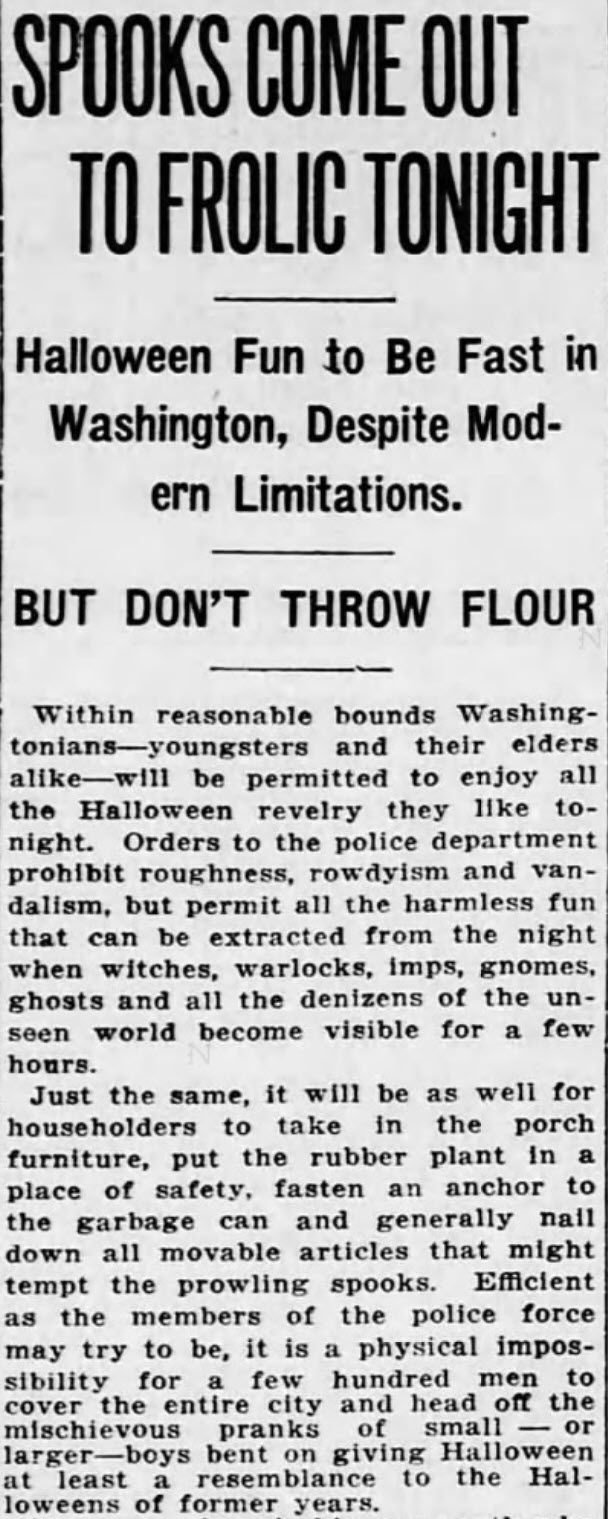
The Evening Star, October 31, 1916
Halloween Parades: Halloween parades actually began because pranks and mischief had gotten out of control. By 1920, there was a push to turn Halloween into a holiday centered around community gatherings and festive Halloween parades, rather than mischief.
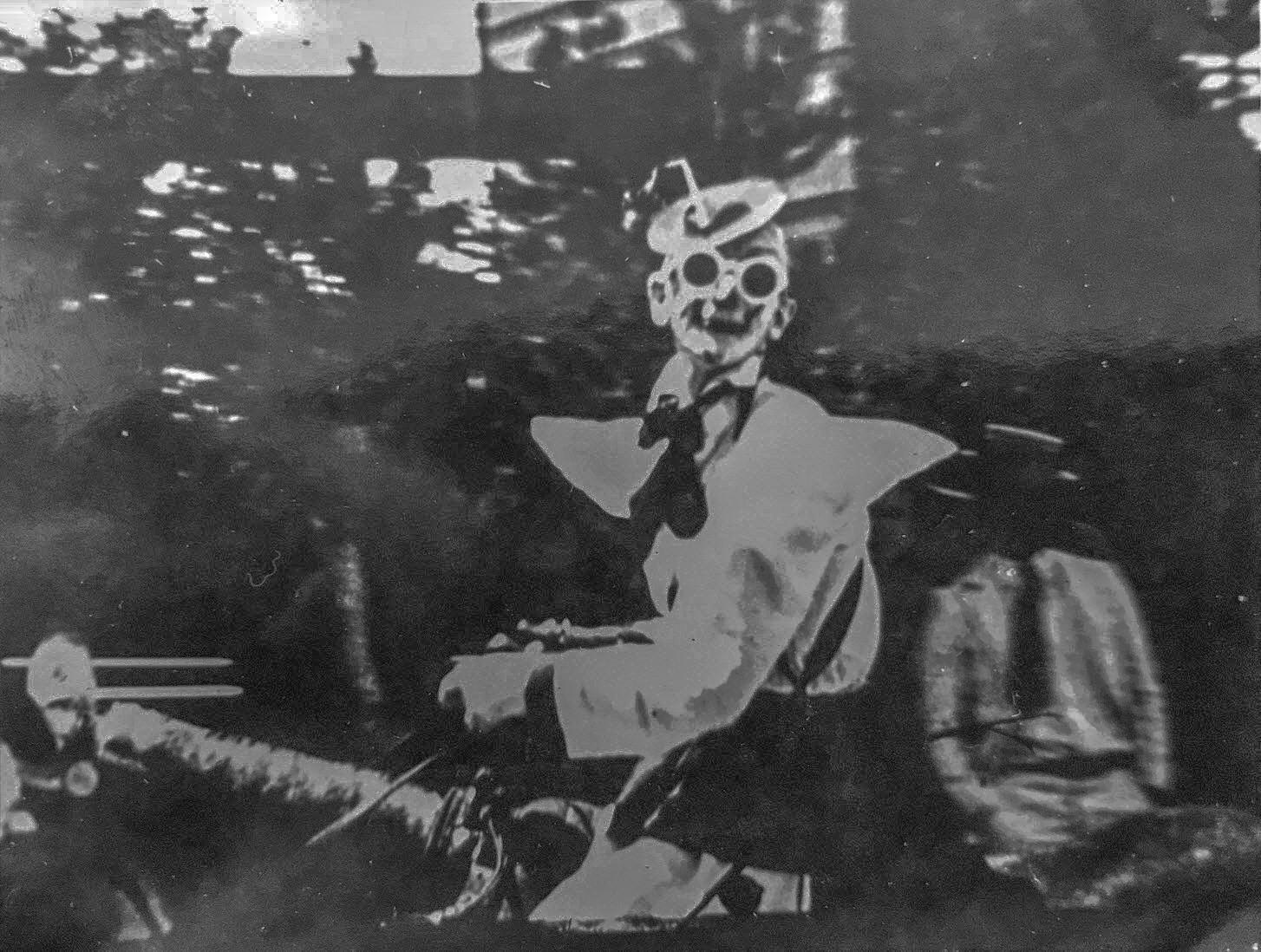
There is something undeniably creepy about this clown in sunglasses riding on a horse in a Halloween Parade. Location is unknown. Photo by Lewis Reed
With the convergence of a full moon, a blue moon, and daylight saving time — plus the unprecedented events of this year — Halloween 2020 will truly be one to remember. In fact, a Halloween such as this won’t happen again for at least another 152 years. Wishing all my friends, followers, and visitors of this blog a very safe and happy Halloween!
The Legendary Lake House Hotel of Horror, Then & Now
With Halloween just around the corner, I thought it would be fun to feature a photograph that Lewis Reed took of the Saylorsburg Lake House Hotel, now the site of Hotel of Horror. The aging Lake House Hotel in Saylorsburg, Pennsylvania, once a vibrant Poconos retreat, was a popular hotel for the region’s tourists who were looking for fun on nearby Saylors Lake. During the hotel’s heyday, its staff was booking rooms a year in advance. Today, the former hotel’s fame is generated from its annual Halloween haunted-house attraction.
Lake House Hotel (THEN): The legend of the Lake House Hotel spans more than two-hundred years. According to local folklore, during World War II, many of the employees at the Lake House were called to assist in the Pennsylvania National Guard, leaving the local asylum with one lone security guard to watch over the entire building. The inmates escaped, made their way to the hotel and took it over. The insane patients performed experiments on the guests. What was once a renowned resort for the rich and famous, became a torture chamber.
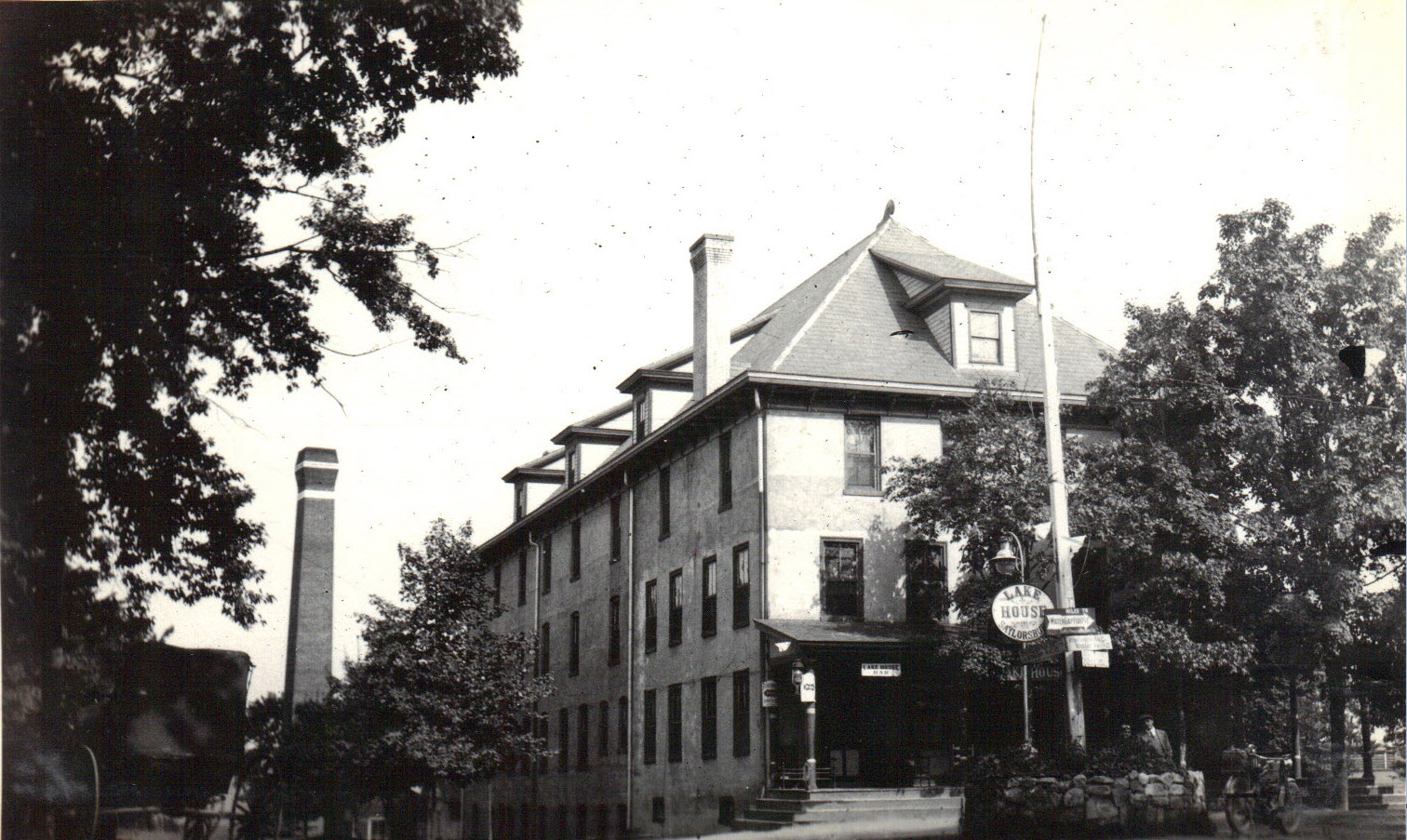
Saylorsburg Lake House Hotel. Photo taken by Lewis Reed, 1915.
Hotel of Horror (NOW): The hotel was purchased in 1990 and turned into an Antique Co-Op, and then in 1992 saw its first haunted house attraction. This 2020 season will celebrate the 28th year that the Hotel of Horror has been fascinating and horrifying legions of fans from the far reaches of the United States and even internationally. To all the readers of this blog: Have a spooky, enjoyable and very safe Halloween!

Welcome to The Hotel of Horror, The Pocono Mountains Premier Haunted House Attraction
Thomas Kelley’s Pumpkin Patch, Early 1900s
When the leaves begin to change and the air takes on a chill that means it’s time for one thing – pumpkin picking! This is a rare photograph of three well-dressed men pumpkin picking in Thomas Kelley’s field of pumpkins in Pleasant Hills, circa early 1900s. Tom Kelley farmed much of the land around the Pleasant Hills homestead and was famous for his “Kelley Corn” farm wagon of fresh dairy produce during the summer months, as well as the corn that fed visitors to the Montgomery County Fair each August and, of course, his pumpkin patch in the fall.
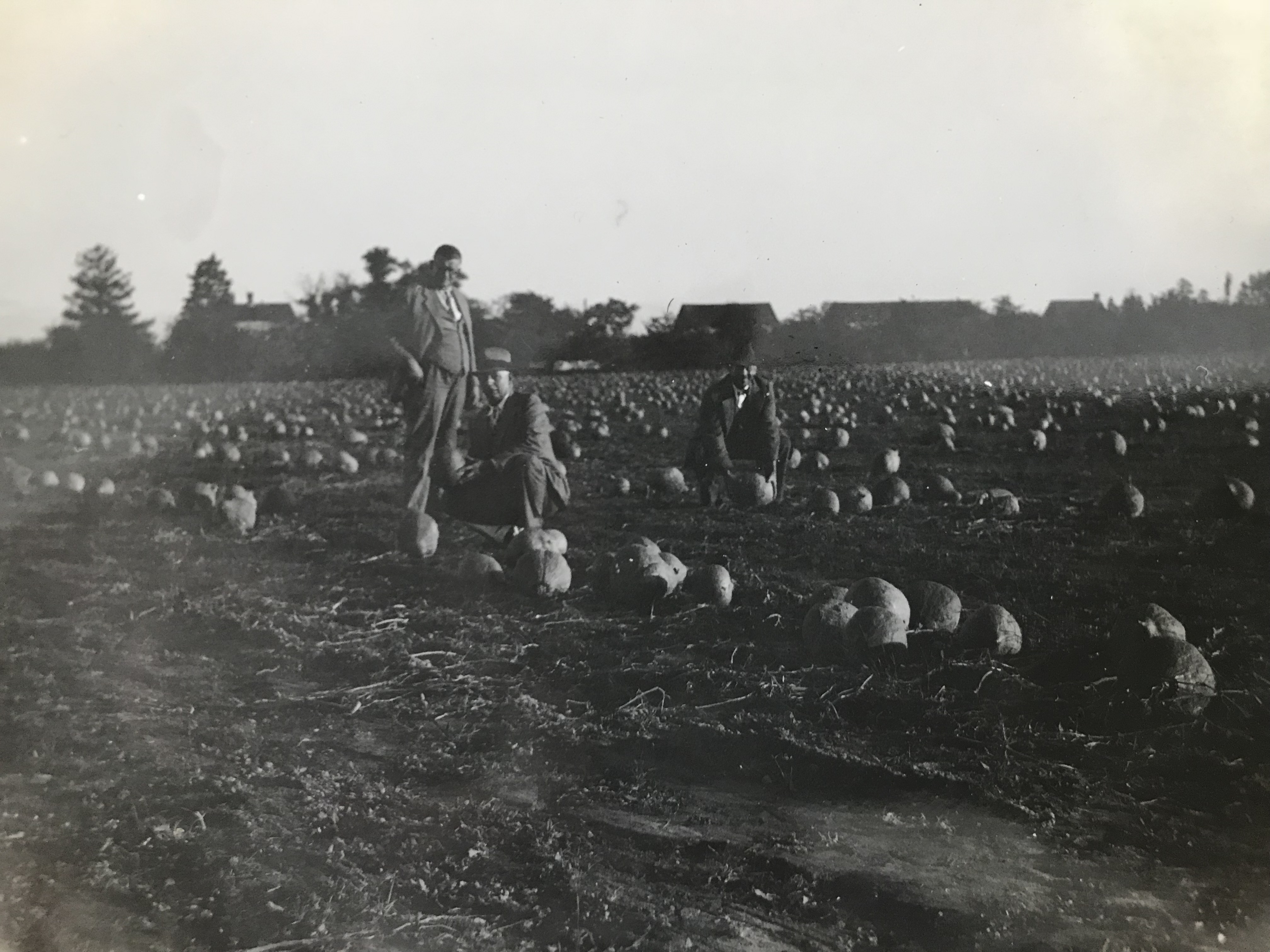
Pumpkin picking in Thomas Kelley’s Pumpkin Patch, Darnestown, Maryland circa. early 1900s. Photo by Lewis Reed
Sept 17, 1908: Testing the Wright Military Flyer at Fort Myer, VA
On this day in September 17,1908, the first military airplane in the world, built by the Wright brothers for the Army Signal Corps, made its first flight at Fort Myer, Virginia. Less than a thousand people witnessed the first flight at Fort Myer, because the general public was still doubtful that powered flight had been achieved. But Lewis Reed was there… and to commemorate that milestone, I have posted six original snippets of history that Lewis Reed captured through the lens of his camera that day.

Soldiers at Fort Myer prepare to pull the Wright Military Flyer out of its temporary hangar. Photo by Lewis Reed
Five years after the first successful flight at Kitty Hawk, Orville Wright and Thomas E. Selfridge test flew the Wright Flyer in a demonstration for the U.S. Army at Fort Myer, VA. The Army was considering contracting Wright’s aircraft to use as a military airplane, but, in order to win the contract, he needed to demonstrate the plane’s ability to carry a passenger. Twenty-six-year-old Lt Thomas E. Selfridge volunteered to be a passenger that day. Orville Wright succeeded in keeping the Wright Flyer aloft for one minute and 11 seconds. After more than four minutes in the air, the airplane crashed to the ground from a height of about seventy-five feet after a propeller blade broke and the machine went out of control. Orville Wright was severely cut and bruised and his passenger, Lt. Thomas Selfridge, became the first powered-aviation fatality.
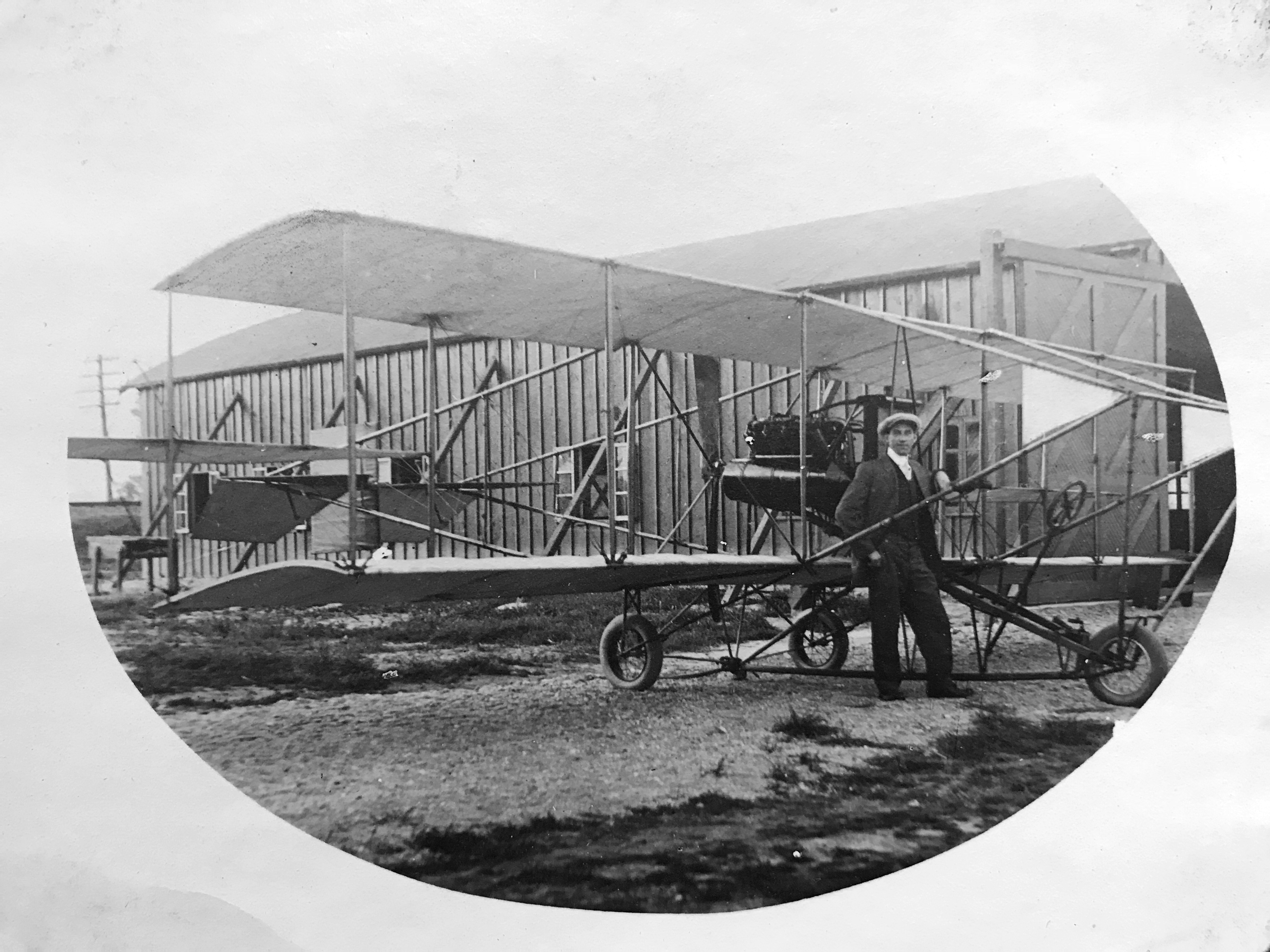
Curtiss Model D with tricycle undercarriage. Photo by Lewis Reed
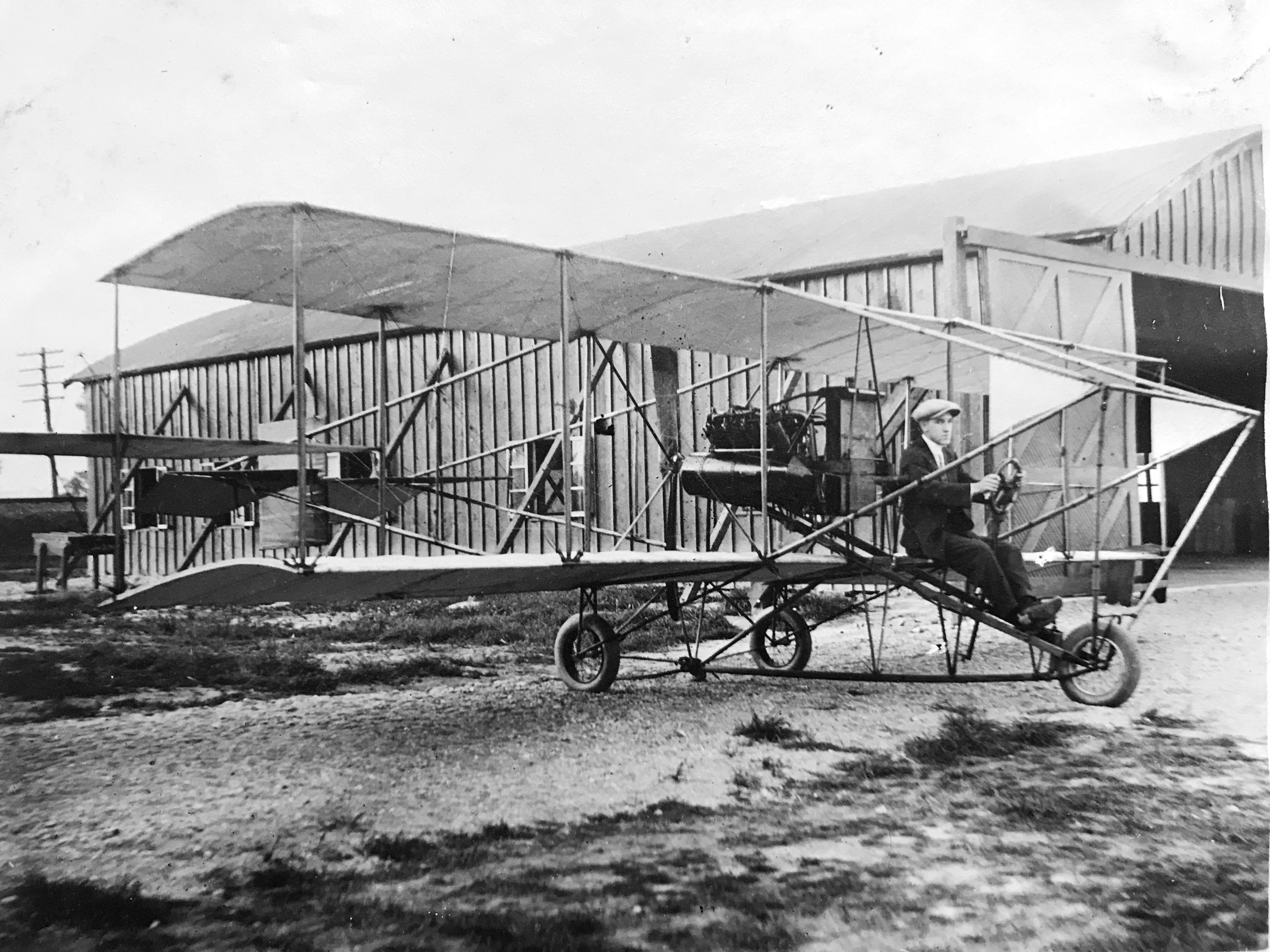
Curtiss Model D. Photo by Lewis Reed

Wright Model B with skids. Photo by Lewis Reed

Another early aircraft from 1909 was the Bleriot XI monoplane. In the background a Rex Smith Aeroplane Company School is advertised on the side of a building. Photo by Lewis Reed
A Rex Smith Aeroplane Company School can be seen on the side of the building in the background. The founder, Rex Smith, was an inventor and a patent attorney. The Rex Smith Biplane was used in the successful April 3, 1911 U.S. Army Signal Corps experiments in wireless communications. The Signal Corps did not buy any Smith Biplanes, they did however use them from time to time to train pilots to fly the Curtiss aircraft at the same field.

Airplane Hangars at Fort Myers, Virginia. Photo by Lewis Reed
The Wrights would prove their machine’s qualifications at Fort Myer. They met or exceeded all of the Army’s specifications, including flying at 40 miles per hour, carrying a combined passenger weight of 350 pounds, maneuvering in any direction in the air, landing without damage, and flying for at least an hour non-stop, which was a world record at the time.
Today, the Wright brothers are legends, with their accomplishments being the storybook example of American perseverance and ingenuity.
Books

Related Resources


Copyright Notice

Reed Brothers Dodge History (1915-2012) by Jeanne Gartner is licensed under a Creative Commons Attribution-NonCommercial 3.0 Unported License.
 Reed Brothers Dodge History 1915 – 2012
Recent Comments