
Rockville’s Park Avenue Motorcycle Club, 1912

First motorcycle club in Rockville, Maryland. One Harley Davidson, one Indian, and Three Excelsior motorcycles on Park Avenue, 1912. Lewis Reed, far left.
Take a step back in time with this glimpse into an almost forgotten era of Montgomery County history in the early 20th century… the motorcycle era.
Motorcycle clubs began forming in the early 1900s as manufacturers stressed the social, sporting, and healthy outdoors potential of the motorcycle. Both Lewis and Edgar Reed, along with brother-in-law Bernard Hanshew, began their riding adventures with a group of friends from the Park Avenue community in Rockville in the early 1900s.
Historically, riding motorized bikes, like horses, began as a gentleman’s sport. In the early days of motorcycling, propriety dictated that a gentleman be presentable when he went out for a spin. Full-length boots derived from horseback riding and a sporty cap with goggles were adapted to the new pursuit of motorcycle riding.

On Park Avenue, ca. 1912. L-R: “Happy” Hicks, Lewis and Edgar Reed, Frank Higgins, and Alvin Luctor.
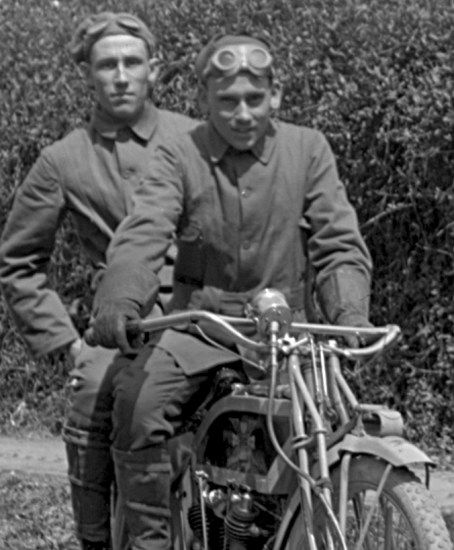
Lewis (back) & Edgar Reed
Early motorcyclists were often pictured in riding groups. From its beginnings, motorcycling developed very much as a social activity. Gentlemen of the day often used it to spice up their sunny weekends and impress ladies.

The Reed motorcycle gang on Rt 118 in Darnestown.

Edgar Reed and an unidentified lady on an Excelsior motorcycle.

Motorcyclists on Rt 118 in Darnestown. Edgar Reed, middle

Left – right: Lewis Reed with camera, Edgar Reed, Bernard Hanshew. The photo was taken 1914 in Harper’s Ferry, West Virginia. The wooden frame Victorian-style train station dating from 1889 can be seen in the background.
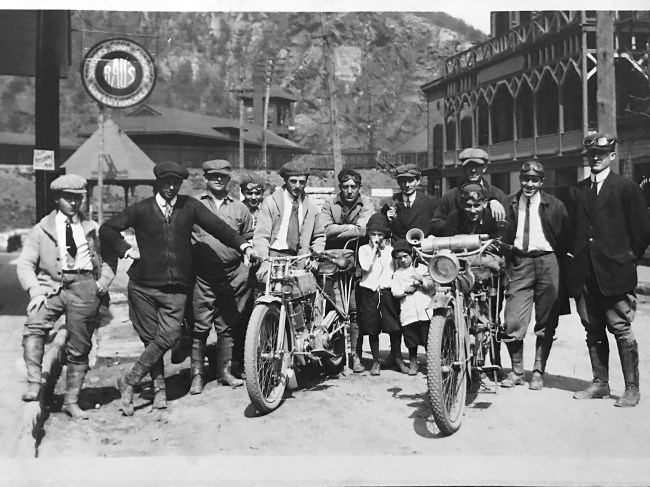
Harper’s Ferry, West Virginia, 1914
Happy Valentine’s (and Ferris Wheel) Day!

Ferris Wheel at Rockville Fair, circa 1920s. Photo by Lewis Reed
Did you know that February 14th is not only Valentine’s Day, but also Ferris Wheel Day? This unofficial national holiday is held on this day to honor the birth of the inventor of the Ferris Wheel, George Washington Gale Ferris, Jr. What better way to celebrate Ferris Wheel Day than enjoying this old photograph of the Ferris Wheel taken at the Rockville Fairgrounds, courtesy of Lewis Reed. The fairgrounds were just outside Rockville, about where Richard Montgomery High School is today. The Fair lasted four days, from August 21st to the 24th, and drew visitors from local counties, Washington, and Baltimore.
For the singles and the “enough already with the Valentines”, here is your perfect alternative excuse. Go wish all your friends and family a Happy Ferris Wheel Day!
Life Before Ice in Montgomery County (1910)
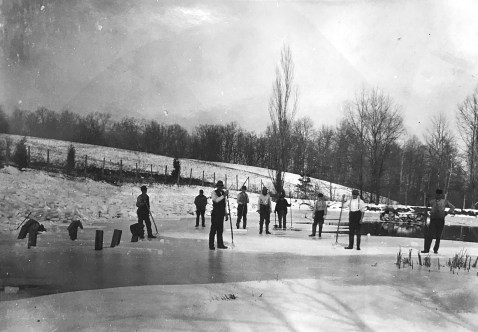
Men harvesting ice with pitchforks and hand saws in Darnestown, Maryland. Photo taken by Lewis Reed in 1910. Note the blocks of ice stacked up along the shoreline. The exact location of the pond is unknown.
Got ice? Usually, we don’t think about ice very often, unless there’s none in the freezer. Before the first successful ice-making machines were built, ice for refrigeration was obtained through a process called “ice harvesting.” Ice cutters used to risk their lives by going out onto frozen ponds with saws, tongs, and pitchforks and methodically cut and dragged blocks of ice which would be stored in hay-packed ice houses. But people did not put ice in drinks as we do now. The possibility of debris having been in the water as it froze – even a bug now and then – discouraged the idea.
Ice houses were dug into the ground to keep the temperature low; double-thick walls were often filled with sawdust for further insulation, and the blocks themselves were packed in sawdust or straw. When you wanted some ice for drinks or to make ice cream, you wouldn’t pull out a whole block; ice picks, chisels, hatchets and shavers were used to get just what you needed.

Same pond in summertime without ice. Photo by Lewis Reed, 1910.
I’m not exactly sure what the structure is in the middle of the pond, but “google” said it could be an outlet structure to keep the water surface in the pond at its optimum level, which usually coincides with the maximum water level designed for the pond. If anyone knows exactly what it is, please leave a comment.

Same pond in summertime from a different perspective. Photo by Lewis Reed, 1910.
From The Evening Star, Washington, D.C. December 22, 1904
ROCKVILLE AND VICINITY GENERAL NEWS
The cold weather of the past ten days has frozen the ponds and creeks throughout this county to a thickness of six or seven inches, and the ice harvesting is now the order of the day. The quality of the ice is not regarded as first-class, however, and for this reason many persons will defer filling their houses until later in the winter.
Next time you drop a few ice cubes into a glass or take out a frozen piece of meat from the freezer, perhaps give a momentary thought to how much we take for granted the ability to have ice cold drinks, preserved foods that can be stored for months, ice cream, cold frothy beer, and so many perishable food products. Refrigeration is a modern convenience that we just can’t live without and certainly one that I take for granted … or took for granted until I wrote this!
Christmas Trees and Snow Villages from a Century Ago
With only a few days left until Christmas, I thought it might be fun to take a look at some photos from Lewis Reed’s collection that show us what Christmas trees used to look like a century ago. In those days, there was not wide-spread agreement on exactly what a tree should look like, which made for a lot of creativity. Not surprisingly, they were very different than the perfectly shaped tress we have on display today.
The trees were big back then and always fresh. They went right to the ceiling and were very wide. Early Christmas trees were generally fastened onto a flat board surrounded with fence-rails, snow villages and carpeted with cotton blankets of snow. The tree in the photo below has an abundance of tinsel, which grew in popularity to the point that, by the 1920s, it was common to nearly cover the tree in the decorative material.
So, what is tinsel (aka icicles) exactly? Originally made from strands of silver alloy, tinsel was in fact first used to decorate sculptures. It was only later that it became a Christmas tree decoration, employed to enhance the flickering of the candle flames. In the 1950s, tinsel became so popular that it was often used as a substitute for Christmas lights.
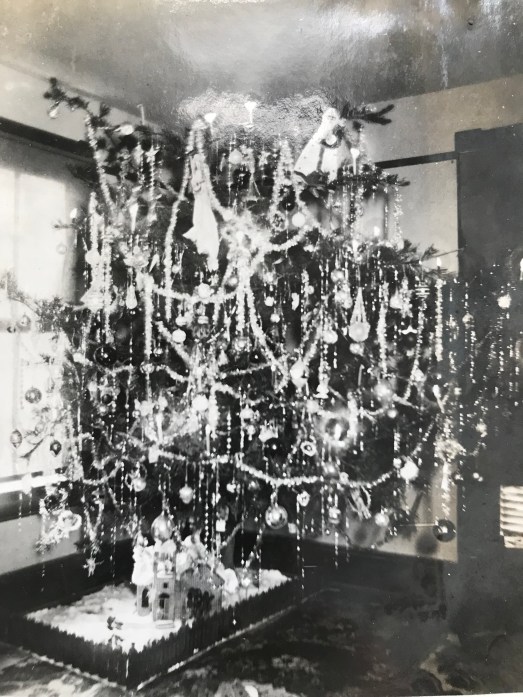
A small snow scene with what appears to be a miniature church is arranged at the foot of the Christmas tree. A popcorn garland adorns the tree. Photo by Lewis Reed
So, where did Washingtonians get their trees?
From The Evening Star, Washington, DC 23 December 1923:
Conduit Road on the long stretch between Glen Echo and Great Falls for many years has been a favorite hunting ground where hundreds and hundreds of families have customarily obtained scrub pine trees for Christmas week. Usually there is plenty of holly and some mistletoe to be found in the rugged and rolling hill lands which are the gateway to Great Falls.
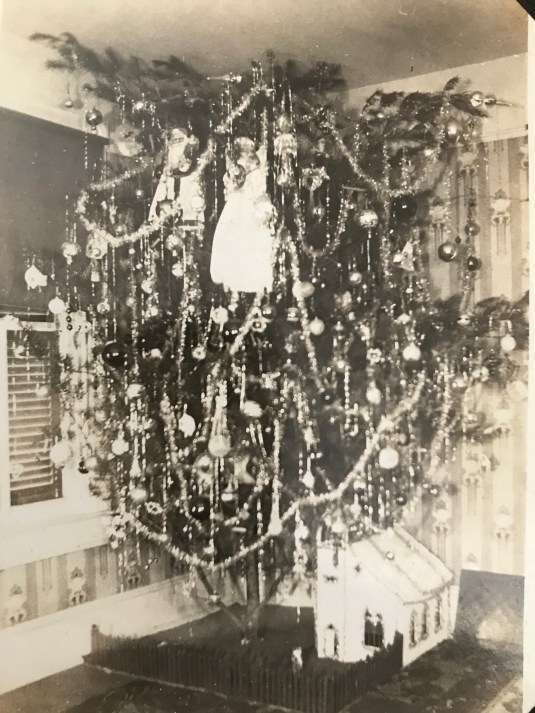
No room for a star on the top of this tree! And just look at those big Santa and Angel dolls. Other fun little details are notable, including a miniature church with picket fence is arranged at the base of the tree. Photo by Lewis Reed
There’s a fine art to decorating Christmas trees that’s been developing since over 100 years ago. People consider lights, garland, ornaments, skirt, and more. But one thing that’s hard to resist sometimes is just filling every available space with decorations. Clearly, that was the case years ago too. What I like about these trees is that they are so randomly shaped and even misshapen. Folks back then didn’t trim them down to a more aesthetically pleasing symmetry like we do today.
The tradition of building miniature Christmas village landscapes, including houses, animals, and other hand-crafted wooden figures, began with the Pennsylvania Dutch in the late 1800s. Mass-produced cardboard houses, sold in dimestores, became popular in the mid-20th century. Today, these villages in good condition can be highly collectible.
Below are photos of Lewis Reed’s snow village set up under the Christmas tree decorated with vintage ornaments, tinsel, and lights. I don’t remember the odd-shaped Christmas trees, but I do remember having a lot of fun helping my grandfather set up the miniature landscapes with the varied figures, little houses, and trees at Christmastime each year. It seemed like a holiday village right out of a storybook.

A rustic picket fence is used to set off the village display. Dangling strands of tinsel hang below the tree. Photo by Lewis Reed
The snow villages were set up in Lewis Reed’s basement on top of a big table beneath a small Christmas tree. He made the snow scenes entirely by hand using wire-covered cardboard and balled up paper to make hills and pathways. The little houses and figurines would fit into the landscape with cotton ‘snow’ all around; and lights would be wired underneath.
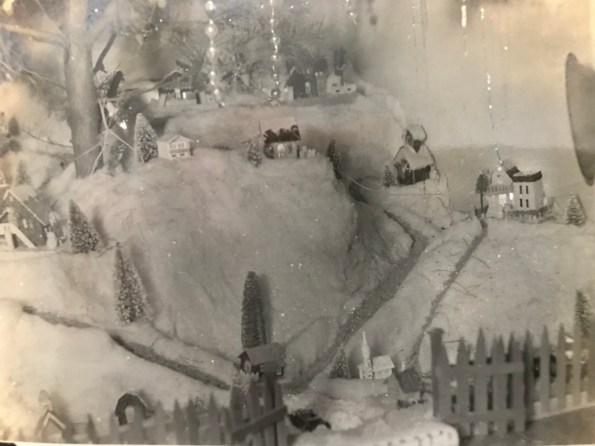
Little houses, churches, fences, trees, and pathways were added to the scene. Some of the houses have charming light effects in the windows. The roofs of the houses were decorated with fake snow. Photo by Lewis Reed
These Christmas villages were precursors of the Holiday Villages that were made popular by Department 56 that you see today.

Old-fashioned lights can be seen on the tree, along with lit windows in the houses. The miniature houses usually had holes in the back or the bottom through which tiny lights were placed to provide illumination. Photo by Lewis Reed
Wishing all of you who have stopped in to visit a very Merry Christmas and Happy New Year! Stay safe and enjoy the holiday season with friends and family!

Before There Was Photoshop, There Was Lewis Reed…
If you take a look at the state of photography today, such as the advances of digital cameras and the artful image manipulation by Photoshop, it is easy to forget that back in the 1900s photographers couldn’t just go into a computer program and change their images any way they wanted. They did what they could with the tools they had. Double image exposure was one tool Lewis Reed had in his photography tool belt. He was doing crazy things to images and creating humorous effects over 100 years ago. With double exposure technique, you could create certain effects like placing the same person on both sides of a picture simultaneously. Photographs were pieced together in the darkroom from separate photographs.
Spotting these manipulated photos in Lewis Reed’s extensive collection has been both easy and difficult. It wasn’t until I viewed the high resolution scan that the modification jumped out at me. The photograph below taken at Black Rock Mill, highlights Lewis Reed’s photo manipulation. (click image to enlarge)

This is a double exposure photograph of Lewis Reed and the same two ladies with bundles of flowers appearing twice – standing on a bridge over Seneca Creek at Black Rock Mill – and on the left at the foot of the bridge. Photo by Lewis Reed, ca. 1905
With double-exposure technique, Lewis Reed learned how to make a subject appear twice in a frame, as if they had an identical twin. To capture these images, he would snap a picture of the subject in one position. Then, he would have to move into another pose before the following photo was shot. Rotating lens caps and special glass plates (the precursor to film) were also part of the process. The final image was then pieced together and developed in the darkroom from the separate photographs. The result was a playful and surreal approach to early photographs.
Double exposure technique often left a telltale vertical line running down the center of the image that is lighter than the left and right sides — a fuzzy stripe separating the two exposures. This is the area where the two exposures overlapped. The picture is lighter where the images overlap because the exposure value is doubled (causing over-exposure) in that specific vertical area. The left half of the image (standing at the foot of the bridge) ends where the light band becomes dark on the right side. And vice versa for the right half of the image (standing on top of the bridge).
Today we are accustomed to Photoshop and people manipulating images, but back in the early 1900’s photo manipulation was used as a form of whimsy.
Books

Related Resources


Copyright Notice

Reed Brothers Dodge History (1915-2012) by Jeanne Gartner is licensed under a Creative Commons Attribution-NonCommercial 3.0 Unported License.
 Reed Brothers Dodge History 1915 – 2012
Recent Comments