
Snowy Day in 1910 at the Old Montgomery County Fairgrounds
As we’re currently experiencing cold, snowy, icy weather, what better time than now to post these snowy pictures of the old Montgomery County Fair. These snowy images of the Fairgrounds were taken by Lewis Reed in 1910.
From 1846-1932, the Montgomery County Fair took place in Rockville with competitions, entertainment, and food that attracted people from Montgomery County and Washington, DC.

Montgomery County Fairgrounds. Photo by Lewis Reed, ca. 1910
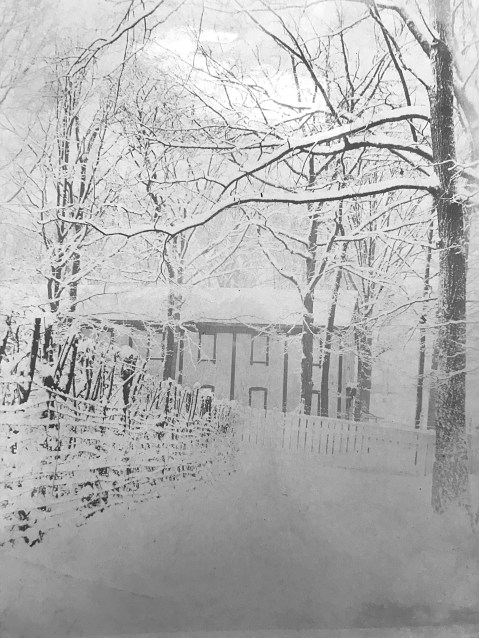
Montgomery County Fairgrounds Poultry House boarded up for the winter. Photo by Lewis Reed, ca. 1910
May 2, 1929: Montgomery County’s Deadliest Tornado (Aftermath Photos)
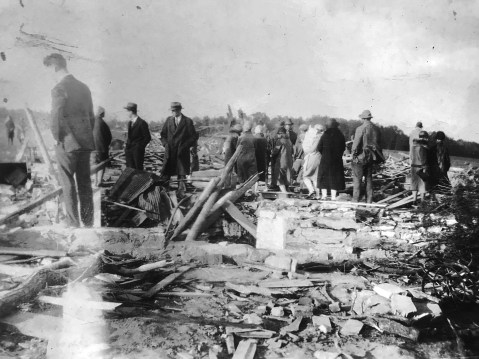
Spectators view the destruction at the Benson farm, May 1929. Photo by Lewis Reed
Ninety-four years ago today, one of the worst tornado outbreaks in area history devastated a part of Montgomery County Maryland. At about 9 p.m. on Thursday, May 2, 1929, northeastern Montgomery County was struck by an F3 tornado, part of a large storm system that caused devastation from Florida to Ohio. The weekly Montgomery County Sentinel reported on May 10th that the “wind storm of cyclonic power . . . was of limited width and serpentine on its course. Everything in its path met with destruction.” These photographs were taken by Lewis Reed “after the tornado of May 2, 1929”.

May 1929. Photo by Lewis Reed
The damage in the county was limited to the rural Unity area, north of Brookeville. The Sentinel article detailed each affected farm, noting that “thousands of persons from far and near visited the scene for several days to look upon the indescribable wreckage.”

May 1929. Photo by Lewis Reed
From the Sentinel: “The storm showed its first violence upon the farm of Mr. J. William Benson. There it destroyed every building – the dwelling house, large barn, 117 feet long, including an attached shed, and all other outbuildings.” The farm was unoccupied, but furniture belonging to “a prospective tenant” was destroyed. Mr. Benson’s apple orchard was also significantly damaged, and the article claimed that “many [trees] were lifted into the air, carried over woods and landed several miles away.”
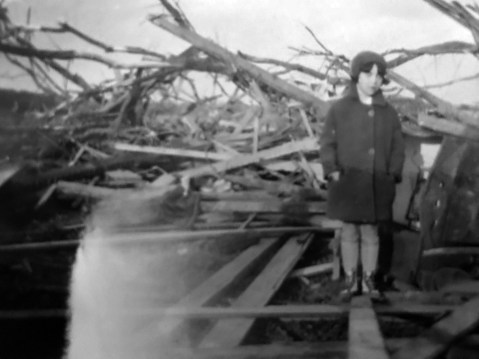
Lewis Reed’s daughter, Mary Jane, May 1929. Photo by Lewis Reed
The fire departments of Rockville, Gaithersburg and Sandy Spring responded to the call made by farm worker James Leizear, who “extricated himself from the wreckage” and ran half a mile to a neighbor’s house to summon help.
The Post reported on May 4th that 28 people in Maryland and Virginia had been killed by tornadoes during the storm; most of the casualties were in Virginia, where an elementary school was struck full-force and at least 18 children died. In Montgomery County, the local Red Cross Chapter formed a citizen committee to raise funds “for relief of the sufferers.”

May 1929. Photo by Lewis Reed
Note: These photographs were undated and unlabeled in my grandfather’s collection. My mother, Mary Jane (Reed) Gartner, who is seen above when she was almost 7 years old, positively identified these photographs and just about pinpointed the location! It’s amazing the things you remember from your early childhood.
Sources of Information:
A Fine Collection
The Montgomery County Sentinel, May 10, 1929
Montgomery Magazine Wheels and Deals Feature
 Reed Brothers is very proud and honored to be featured in the month of August/September 2022 Montgomery Magazine, “Then & Now” section. The black and white photograph above shows the expansion of Reed Brothers Dogde showroom and Gulf Gasoline Station that took place in 1941. At about the same time as the gas station was remodeled, Lewis Reed split up the Sales and Parts and Service operations by constructing a complete new building that was located at the intersection of at Montgomery Avenue and Dodge Street.
A closer look at the photo reveals the price of gasoline as 15 cents. On the right attached to a telephone pole is a sign pointing the way to Olney. In addition to the Gulf signage there is a small, barely visible sign below that promotes, “Clean Rest Rooms”.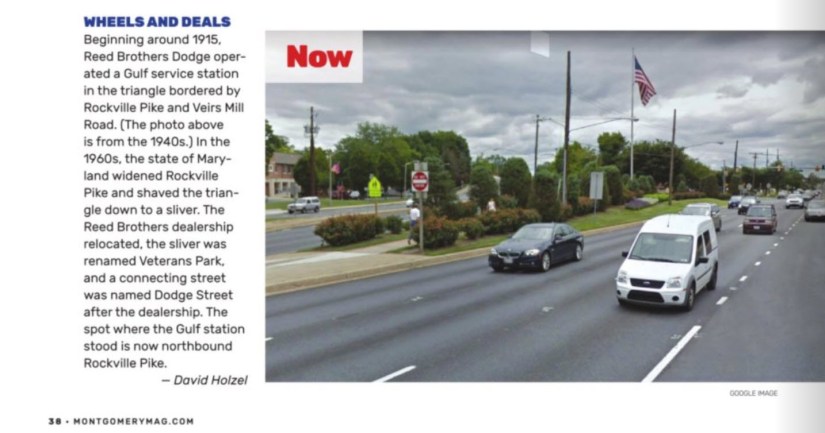
The color photograph above, is the dealership’s location today, now known as Veterans Park. In the 1970s, the site was known as the Francis Scott Key Memorial Park, and later in 1988, it was permanently rededicated as Veterans Park. In the late 1960s, the state of Maryland acquired the land to widen Rt 355 and donated the remaining sliver to the City. The State of Maryland named the connector street behind the dealership’s original location “Dodge Street” following the dealership’s 1941 expansion.
Montgomery Magazine is a lifestyle magazine, with timely articles on county leaders, entertainment, sports, neighborhood and restaurant profiles, entrepreneurs, historic landmarks then and now, plus seasonal special sections of local interest.
Find the issue online at: http://digital.montgomerymag.com/issues/August-2022/index.html
Some of the Earliest Occupations in Montgomery County
Do you know what a Qwylwryghte, a Stock Maker, or a Hackneyman does? These are some of the old occupations, of which many are archaic, that may show up on old documents relating to our ancestors. Some of the occupations do not exist today or are called other names. Below you can find representations of many varied occupations that Montgomery County residents engaged in during the early 20th Century, though the list is not at all comprehensive.
Blacksmith/Wheelwright/Cabinet Maker
A qwylwryghte — don’t ask me to pronounce it! — is one who makes wheels, or works with wood.

Philip Reed (1845-1918) outside his blacksmith shop in Darnestown, ca. 1901
Formerly located on Darnestown Road near the intersection of Seneca Road, Philip Reed operated a blacksmith, wheelwright, and cabinet making business next to his home. These occupations overlapped due to the similar skills they required: the same metal-working tools that were used for horseshoeing could be used to make wheel-rims and other metal wagon parts; the same woodworking skills that created wagons could be used to make pieces of furniture for the home. As late as 1910, there were still approximately 60 blacksmith shops in the county.
Stock Maker

Philip Reed (1845-1918), Maker of Gunstocks for Sportsmen
From the June 13, 1940 edition of The Montgomery County Sentinel:
We also read that Philip Reed built up great fame for the town as a maker of gun stocks for sportsmen – he was the father of the Reed Brothers, our local auto dealers. Edgar Reed tells us his grandfather was a cabinet maker and wood carver, but that the wood working talent no longer seems to run in the family.
A Stock Maker carves gun stocks from wood (usually walnut) and fits them to the metal parts of the gun (receiver and barrel). Very high grade firearms may have stocks fashioned from very costly blanks, mostly of one of the walnut varieties, specially chosen for its rare and highly figured grain. The fashioning of high end gun stocks calls for an extremely high level of skill and craftsmanship.
Liveryman
The meaning of Hackneyman is a man who hires out horses and carriages.
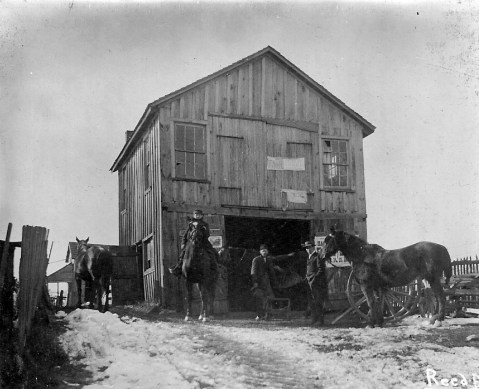
An unidentified livery stable in Montgomery County.
Closely related to the blacksmithing and wheelwrighting industry, the livery-stable keeper provided horses that were used in everyday tasks and transportation. The liveryman boarded horses for rent and also provided carriages and wagons. Compared to our modern world, the blacksmith-wheelwright correlates to the auto repair shop, and the livery to the car rental business.
School Teacher
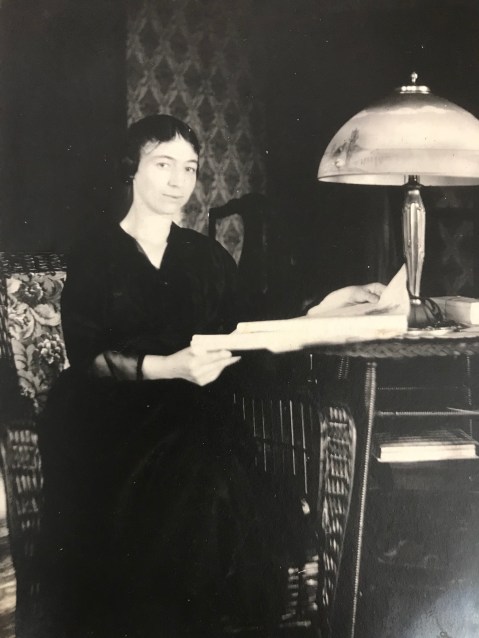
Ethelene Reed
At the turn of the century, teaching was one of the only respectable fields open to educated women who wanted to work. Many unmarried women worked as teachers during the 1900s, and in the early days, they were often required to leave the profession once they were married. The 1920 census indicates that Lewis Reed’s wife, Ethelene (pictured above), was a teacher in the Maryland public school system until her daughter Mary Jane was born in 1922.
Ice Cutter

Men harvesting ice with pitchforks and hand saws on a pond in Darnestown, 1910. Note the blocks of ice stacked up along the shoreline.
Most people wouldn’t consider the months of January and February a season of harvest in Darnestown, Maryland. But in our not so distant past, this was harvest time for—ICE. Rivers, lakes and ponds are generally frozen and ice was harvested like a winter crop to keep food cold all summer long. Before modern refrigeration, ice for refrigeration was obtained organically through a process called “ice harvesting.” Ice cutters would risk their lives going out with saws, tongs, and pitchforks to methodically cut and drag blocks of ice from a nearby frozen pond. Those blocks would then be stored in hay-packed ice houses, later distributed throughout towns and cities during the heat of summer. However, people did not put ice in their drinks as we do now. The possibility of debris having been in the water as it froze – even a bug now and then – discouraged the idea.
Store Clerk/Cashier
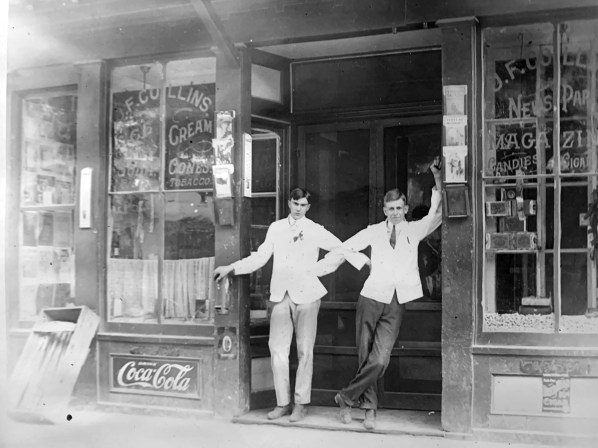
Clerks at J. F. Collins General Store on East Montgomery Avenue in Rockville, 1914. At left is A. F. “Seen” Beane, who bought this store from Collins in the 1920s and continued doing business in downtown Rockville until his retirement in the 1960s.
The cash register was invented in the late 1800s, and by the 1900s almost every retail organization had one. Store owners sometimes conducted business with their customers, but the more lucrative establishments would hire one or more clerks as assistants to interact with the public. By 1915, more than half of all clerical workers tended to be young women.
Chauffeur-Mechanics

Chauffeur Lewis Reed is tending to the motor, 1910
Chauffeur-mechanics of the early 1900s were the first group to earn a living working on automobiles. At the dawn of the early 20th century, society was transitioning from horse-drawn carriages to automobiles. Having grown up in a blacksmith family, Lewis Reed was well positioned to move to the new technology. The 1910 census indicated that 23-year-old Lewis Reed was working as a machinist. Lewis Reed worked as a chauffeur from roughly 1910-1914, before he became involved in the business of selling and repairing automobiles.
Motorman and Conductors

Motorman and conductor on a Georgetown trolley car, ca. 1908
The debut of Rockville’s trolley cars in 1900 marked the beginning of a golden age of local mass transit. Each car had a two-man crew (a conductor and a motorman) one to operate the car and the other to collect fares.
Mill Worker

Two workers pose inside an unknown mill.
A mill is a building equipped with machinery that processes a raw material such as grain, wood, or fiber into a product such as flour, lumber, or fabric. In the 18th and 19th centuries, mills were powered by water in creeks or rivers. In a flour mill, water flowing over the mill wheel was converted by gears into the power to turn one of two burr stones. Kernels of wheat were then ground between the two stones. The grinding removed bran (the outer husk) from the wheat kernel, and then crushed the inner kernel into flour.* Flour mills were an important part of rural communities across the country, including Montgomery County, and millers were respected members of their community.
Farmer

An agricultural tractor powered by a steam engine, a design used extensively in the late 19th and early 20th centuries.
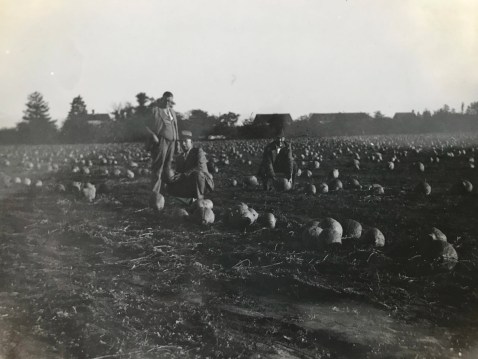
Thomas Kelley’s Pumpkin Field, early 1920
Above is a photograph of three men in suits pumpkin picking in Thomas Kelley’s field of pumpkins in Pleasant Hills, circa 1920. Tom Kelly farmed much of the land around the Pleasant Hills homestead and was famous for his “Kelly Corn” farm wagon of fresh dairy produce during the summer months, as well as the corn that fed visitors to the Montgomery County Fair each August and, of course, his pumpkin patch in the fall.The turn of the century was a time of transition, and the families who went from horses to tractor horsepower witnessed the birth of mechanization on the farm. The newest farm machinery to hit the market near the turn of the 20th century were traction engines powered by steam; essentially the predecessor to today’s modern farm tractor. They could plow, they could haul, and you could put a big belt on the fly wheel and drive a saw mill. The engines would normally run on coal, wood, or even straw: whatever would sustain a fire.
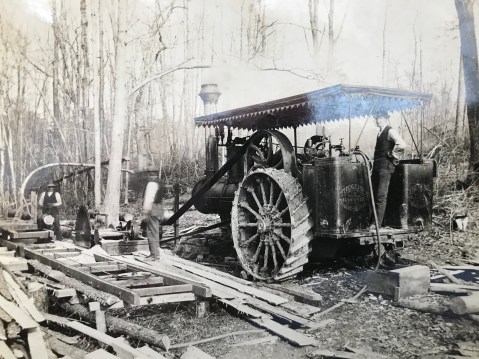
Francis Flack of Montrose on steam tractor with roof, 1909. Built by Geiser Manufacturing Company, makers of the Peerless line of steam tractors.
Steam helped improve the efficiency of most farm chores, including plowing, planting and harvesting. And steam-powered equipment also was used for other heavy duty tasks, including rock crushing and wood cutting, to aid in clearing the land. Francis A. Flack (1875-1961), a life-long resident of Montgomery County, was a successful farmer in the lower section of the county near Garrett Park. The work depicted below–sawing felled trees into usable lumber–took place on his farm in 1909. Flack is pictured in the lower left photo.
I remember that engine as though I had seen it only yesterday, for it was the first vehicle other than horse drawn that I had ever seen. It was intended to drive threshing machines and power sawmills and was simply a portable engine and a boiler mounted on wheels.
It was the steam traction engine that inspired Ford to design and manufacture automobiles. By the early 1930s, gasoline-powered farm equipment, evolved from the automobile industry, had mostly replaced steam powered machines.
Road Worker (Heavy Equipment Operator)


Building a road requires moving earth and rocks, leveling the roadbed and digging trenches for drainage ditches. These tasks fell to those who operated the large steam-powered excavating machines and steam shovels. Pictured above are rare, historical photographs that Lewis Reed took of the construction of Massachusetts Avenue in Washington, DC as it was being graded in 1912. (click on thumbnails to view gallery)
A steam shovel is a large steam-powered excavating machine designed for lifting and moving large amounts of heavy material such as rock and soil. Steam shovels played a major role in public works in the late 19th and early 20th centuries. When digging at a rock face, the operator simultaneously raises and extends the dipper stick to fill the bucket with material. When the bucket is full, the shovel is rotated to load the railway car. Steam shovels usually had a three-man crew: engineer, fireman and ground man.
Census Taker
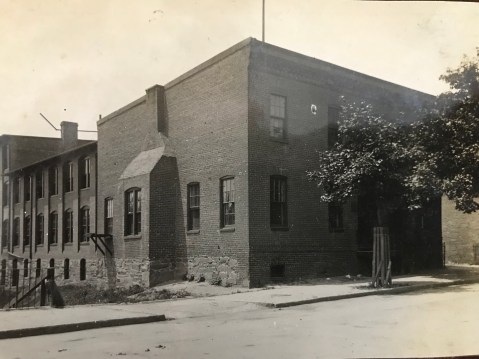
Two-story building that housed Hollerith’s card manufacturing plant, assembly plant, repair shop, and development laboratory, as it appeared in 1911.
Gallery of Early 20th Century General Stores in Montgomery County
Some of the earliest general merchandise stores in Montgomery County were located in Rockville, and on the roads leading to it. They were community-oriented businesses: the owners were friendly and knew all the locals. Day books kept by merchants at this time indicate they kept open accounts for their customers, allowing them to buy items on credit, and occasionally accepted payment of items in trade rather than currency. Toward the end of the century, some general stores found it more profitable to stop being “general” and specialized stores (selling only drugs, hardware, or farming equipment) became more common.
Rockville Business District, 1914
The heart of Rockville’s business district ran east-west on East Montgomery Avenue and Commerce Lane, spanning approximately eight blocks. Proximity to the courthouse influenced many hotels, professionals, and businesses to locate along East Montgomery Avenue, Commerce Lane (now West Montgomery Avenue), and Washington Street. Craftspeople and merchants often lived on the second story of their building or in a dwelling house next door.
The shops sold groceries, baked goods, sewing machines, hats, lumber, and hardware. Families lived above their stores, renting rooms to others. From right to left is the H. Reisinger Bakery, Confectionery, Ice Cream and Lunch Room, 5 and 10-cent Bargain Store, W. Hicks General Store, Suburban Electrical Company (SECO), and a two-story dwelling.

A view of the North side of Commerce Lane near the courthouse. Right to left: H. Reisinger Bakery, W. Hicks General Store, Suburban Electrical Company (SECO), and a two-story dwelling. Note the trolley car approaching from the left. Photo by Lewis Reed
W. Hicks General Store, 1914
Washington Hicks operated the general or dry goods store in Rockville from the late 19th century until 1940. His son W. Guy Hicks continued to run the store until his retirement in the late 1950s. The upper story of the building was the living quarters of Mr and Mrs B. F. Hicks. The building was later acquired by W. Valentine Wilson, who tore it down and replaced it with the “SECO” for Mr Wilson’s Suburban Electric Company. The ground floor was made into a moving picture theater in 1915. Sidney Lust took over the operation of this theater between 1931 and 1935 and renamed it the Arcade. He closed it down on April 21, 1935 and opened the new Milo later that year.
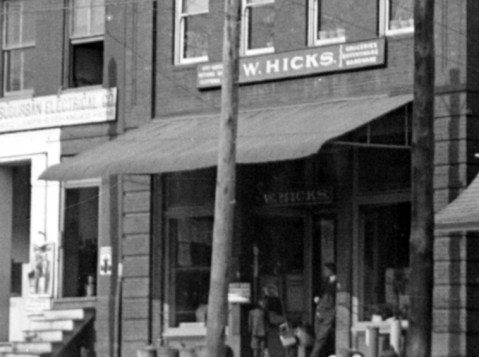
Washington Hicks operated this dry goods store in Rockville from the late 19th century until 1940. His son W. Guy Hicks continued to run the store until his retirement in the late 1950s. The photo shows the storefront in 1914. Photo by Lewis Reed
H. Reisinger Bakery & Confectionary, 1914
Below: H. Reisinger Bakery, Confectionery, Ice Cream and Lunch Room, 5 and 10-cent Bargain Store on Montgomery Avenue, Rockville. Prices were very low– in 1899 and 1900 Reisinger’s regularly advertised bread for 4 cents a loaf– yet wages were low also.
From The Baltimore Sun, 22 Sep 1912, Help Wanted Section:
WANTED – A sober, reliable all-around CAKE BAKER and ICE CREAM MAKER for retail trade; $14 per week, board and lodging. H. REISINGER Rockville, Md.

H. Reisinger Lunch Room Montgomery Ave, 1914. Photo by Lewis Reed
General Store at Quince Orchard, 1906
A small school for white children was established on the northeast corner of Darnestown and Quince Orchard Roads around 1850. It was damaged during the Civil War and eventually burned down in 1873. The school was rebuilt on the same site in 1875 but was moved across the road next to Pleasant View Methodist Church in 1902 after the fire destroyed the school for black children. The General Store at Quince Orchard was built on the same site shortly after the school building was moved.

General Store at Quince Orchard, 1906. Photo by Lewis Reed
Windsor Store in Darnestown, Early 1900s
Mr James Windsor, grandfather of Curry England, opened the Windsor Store at the corner of Seneca and Darnestown Roads in approximately 1878. He operated the store for many years, and also served as Darnestown’s Postmaster for some 20 years. During the 1800s mail arrived three times a week by stagecoach from Rockville and local people gathered for the arrival, creating a regular social event. The Darnestown Post Office was discontinued in 1911. The Windsor building survived until 1969, when it caught fire and burned to the ground.

James S. Windsor Store Darnestown, early 1900s. Photo by Lewis Reed
Downtown Germantown, ca. 1906
The original downtown Germantown was located at the intersection of Route 118 and Clopper Road. At the turn of the 20th century, most of the activity shifted to the railroad station and mill. General stores, a post office, a bank, and houses were constructed in this new downtown area. Everything from lengths of cloth to a medium rare steak could be purchased at the general store and post office on the right. Opposite the store were the mill and various small industries.

Downtown Germantown, 1906. Photo by Lewis Reed
Halpine-Lenovitz General Store, 1906
The Halpine Store, also known as the Lenovitz General Store, was built on Rockville Pike in 1898, taking advantage of the prime location on the trolley and railroad lines and the Pike. The store sold food, gasoline and other items to locals and Pike travelers. There is a young African American man standing in front of the store. Note the telephone or telegraph poles, and the trolley tracks paralleling the road. The nearby Halpine railroad station also brought customers to the area, and the store became the social/community gathering place for the Halpine area.
The proprietors, Benjamin and Anna Lenovitz, lived on the second floor. The building burned in 1923 and a new fire-resistant brick building was rebuilt in its place. This building, at 1600 Rockville Pike, became a Radio Shack, selling computers and electronics.
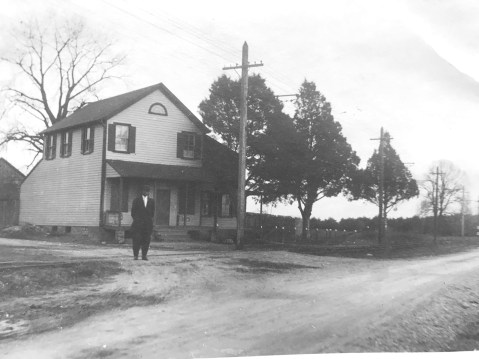
Halpine-Lenovitz General Store at Rockville Pike and Halpine Road, 1906. In this photo, there is a young African American man (unidentified) standing in front of the store. Note the telephone or telegraph poles running the length of the street. Photo by Lewis Reed
Clarksburg Main Street, 1913
In the early 20th century, Clarksburg was the third largest town in Montgomery County, after Rockville and Poolesville. Clarksburg had four general stores, two hotels, and an academy of learning. It also had a blacksmith, a doctor’s office, tanneries, shoemakers, winemakers, tailors, wheelwrights, fertilizer businesses, skilled farmers, master carpenters and two town bands.

Main street (Frederick Road Rt 355) Clarksburg, 1913. Photo by Lewis Reed
Unknown General Store, Early 1900s
While every store was different, there were similarities among them, including a front door that was often decorated by tin signs advertising for tobacco, cigars, shoes, hardware, and more. The sign in front of this unidentified mercantile advertises Battle Axe Shoes, Stephen Putney Shoe Company. Usually, general stores featured double doors that opened inward and lots of barrels that might contain any number of items — from pickles, to crackers, potatoes, flour and candies. The store was usually an unpainted, two- story frame building fronted by a raised porch for convenient loading and unloading.
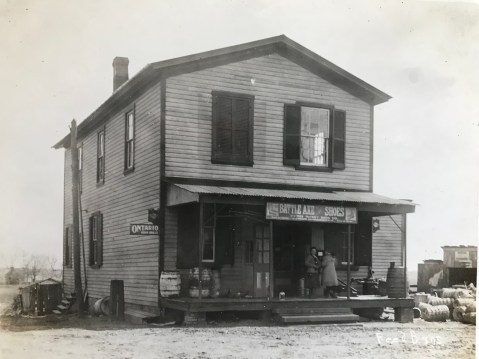
Circa 1900s country store on a dirt road. Note the sign advertising Battle Axe Shoes. Two ladies standing on the porch. Location Unknown. Photo by Lewis Reed
J.F. Collins General Store, 1914
On a bleak night in February 1921, a pistol shot was fired while others yelled, “Fire!”. From John Collin’s store on East Montgomery Avenue — beloved by local children for Cracker Jacks and penny candy — flames reached toward the sky. Volunteers arrived with buckets while others operated the hose reels and hook and ladder truck. The main street was saved with help from men and equipment of Washington, D.C., but Collins’s store was a smouldering ruin. A few weeks later, fifty concerned townspeople elected officers of the newly formed Rockville Volunteer Fire Department.
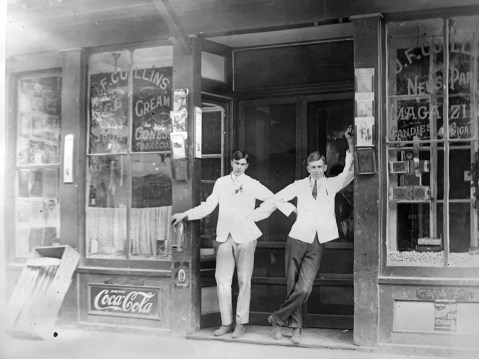
Clerks at J. F. Collins General Store on East Montgomery Avenue in Rockville, 1914. At left is A. F. “Seen” Beane, who bought this store from Collins in the 1920s and continued doing business in downtown Rockville until his retirement in the 1960s.
Find photos like these and much more on Montgomery History’s online exhibit, “Montgomery County 1900-1930: Through the Lens of Lewis Reed“.
Books

Related Resources


Copyright Notice

Reed Brothers Dodge History (1915-2012) by Jeanne Gartner is licensed under a Creative Commons Attribution-NonCommercial 3.0 Unported License.
 Reed Brothers Dodge History 1915 – 2012
Recent Comments