
The First Dodge Car
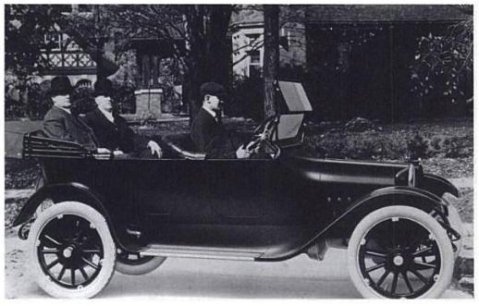
Horace Dodge (left rear) and John Dodge (right rear) in “Old Betsy” in front of John Dodge’s Boston Boulevard home, 14 November 1914.
One hundred and three years ago on this date – November 14, 1914 — the very first Dodge car, “Old Betsy”, rolled off the assembly line. On that day, the Dodge Brothers (Horace and John) were photographed riding in the rear seat of the first car to bear their last name. It cost $785, had a 110-inch wheelbase, and was powered by an L-head 4-cylinder engine that proved so reliable it was continued until 1920 with very little modification. Total production for 1914 was a mere 249 touring cars. The following year, Dodge offered a two-passenger roadster which also sold for $785 and the plant went into full production.
According to “The Dodge Brothers: The Men, the Motor Cars, and the Legacy” by Charles K. Hyde, here’s the full story:
The widely accepted history of the initial production of early Dodge Brothers automobiles in November 1914 is at odds with much of the evidence about the earliest Dodge Brothers cars. Automotive historians have thought that the first production car, later named “Old Betsy,” came off the assembly line at the Hamtramck factory on 14 November 1914. Guy Ameel, superintendent of final assembly for Dodge Brothers since the start of automobile production, served as John and Horace’s chauffeur that day. With the brothers in the back seat, Ameel stopped the first Dodge Brothers car in front of John Dodge’s mansion on Boston Boulevard in Detroit and a photographer recorded this important moment.
“Old Betsy” was more likely an experimental prototype car assembled several months before 14 November 1914 and not a production car at all…
The Dodge Brothers began an aggressive advertising campaign to promote their new automobiles and to attract potential dealers to sell their cars. Lewis Reed was an enterprising young man who put his future in the fledgling automobile industry. In 1915 he received his franchise to sell Dodge Brothers Motor Cars from John and Horace Dodge; less than one year after “Old Betsy” rolled off the assembly line. Lewis Reed and his brother Edgar, were the first to sell Dodge cars in Montgomery County, Maryland. That made Reed Brothers the oldest Dodge dealership under the same family ownership in Maryland, and one of the oldest in the entire nation.
Saylorsburg Lake House / Hotel of Horror

Saylorsburg Lake House, circa 1915. Photo by Lewis Reed
In anticipation of Halloween, I thought it would be fun to feature a photograph that Lewis Reed took of Saylorsburg Lake House Hotel, now the site of Hotel of Horror. The old Lake House Hotel, depicted in the photo above taken by Lewis Reed in 1915, was once a vibrant Poconos retreat and a popular hotel for tourists. According to local folklore, during World War II, many of the employees at the Lake House were called to assist in the Pennsylvania National Guard, leaving the local asylum with one lone security guard to watch over the entire building. The inmates escaped, made their way to the hotel and took it over. The insane patients performed experiments on the guests. What was once a renowned resort for the rich and famous, shown here in 2001, became a torture chamber.
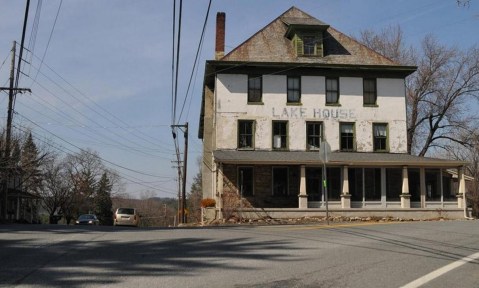
The Lake House Hotel in Saylorsburg, site of Hotel of Horror, 2001
Today it’s the site of the Hotel of Horror, a haunted-house attraction open during the Halloween season.
Happy Halloween to all the readers of this blog!
Calling All Memories!
 Share your memories and take a trip down memory lane with one of the nations oldest Dodge dealers.
I thought it would be fun to create a special blog post of employee, friends, and family memories of Reed Brothers. So far, I have already collected some great stories from a handful of people sharing their personal favorite highlights of Reed Brothers. If you have any favorite memories, stories, or even photos you would like to share, please send them to me via the “Contact Me” section at the top of this page or click on this link: https://reedbrothersdodgehistory.wordpress.com/about-2/contact-me/
I will compile and showcase them here in a special blog post. This really will tell a very personal story of our company from the perspective of those who contributed to its 97 years of success.
Let’s hear them!
Manufacturing Dodge Motor Cars, ca 1917
Get ready for a treat! Here is a film that the Dodge Brothers company made to promote their brand in 1917. Copied at 16 frames per second from a 35mm tinted print preserved by the Academy Film Archive from source material provided by the New Zealand Film Archive. Running Time: 28 minutes (silent, no music, incomplete).
In the 1900s, brothers John and Horace Dodge of Detroit became the major suppliers of drive trains to the Ford Motor Company. They achieved such a stellar reputation for quality that when they decided to manufacture their own automobiles, incorporating as the Dodge Brothers Motor Car Company in 1914, 13,000 dealers registered to sell the new vehicles before a single auto had been produced. In 1915, Reed Brothers was franchised as a Dodge dealership and service facility; less than one year after the first Dodge automobile rolled off the assembly line.
In 1916, the company created a film department to promote the Dodge brand. This film appears to be one of its first products. It shows the company’s assembly line in action, demonstrating to viewers the workmanship and care invested in each vehicle. The beginning is missing, lending credence to the hypothesis that the film may be the three-reel profile of the company’s production process distributed in 1917 to Dodge dealerships. The film finishes with close up looks at the Dodge Brothers’ models of the day: the Sedan, Coupe, Roadster and Touring Car. It also demonstrates Dodge’s capabilities in the snow and on steep hills (particularly fun to watch!).
If you have a half-hour to spare, kick back and enjoy this rare treat! You will get a true insider’s look at how the very first Dodge automobiles were made!
1922 Bus Stop Scene on Rockville Pike

1922 GMC Hagerstown Bus taking on passengers at a bus stop across the street from Reed Brothers Dodge in Rockville, Maryland
Vehicles from this era are fascinating and are often photographed with equally fascinating surroundings. The photograph above is a unique, early photograph of a Hagerstown Bus owned by Forsyth’s Garage & Transfer of Rockville. The bus is an early GMC. The tag on bus is dated 1922 and behind the bus on the left is the bus station with signs that say “Pay Gate” and “Pass Gate”. The banner across the road says “Montgomery County Fair, Rockville, MD” and the dates. Directly across the street is Reed Brothers Dodge. The photograph was found on WorthPoint.com, an online resource for researching art, antiques and collectibles, etc.
The photograph below was taken by Lewis Reed during the same time frame only from a different perspective. It is also dated 1922, and the bus stop would have been right in front of the boarded fence across the main road (later the Rockville Pike). The Rockville Fair Grounds are just beyond the boarded fence. Buses and trolleys used to go past Reed Brothers as they traveled up Rockville Pike. The Fairgrounds was one of the stops along the line.
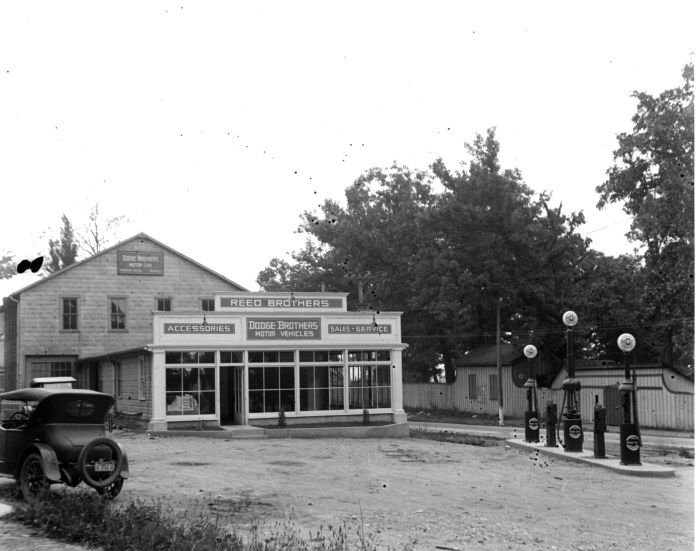
Reed Brothers Dodge, 1922. The original part of the garage was converted into a new car showroom and the service operation was moved out into the rear portion of the building. Note the “modern” gas pumps. The Rockville Fair Grounds are beyond the boarded fence.
I enjoy solving mysteries and digging deep to find information on vintage motor vehicles and today I am sharing what has turned up in my research.
I found an interesting article in the Motor Age, Volume 41, March 23, 1922 on page 16, titled – General Motors Develops Motor Bus, and I have extracted the article as follows:
A twenty-passenger motor bus was introduced by the General Motors Truck Company, Pontiac, Michigan, which is mounted on a chassis designed for this type of body. By combining a long wheelbase with long, flexible semi-elliptic springs together with 36 by 6 in. cord tires, easy riding qualities have been the result. The body overhangs the frame slightly which, it is said, eliminates much of the side-sway and whipping more or less common with buses mounted on a wheelbase length considerably shorter than the body. The frame on the chassis overhangs the rear axle but slightly.
The standard G.M.C. 2-ton powerplant is used and it is claimed that a road speed of 30 miles an hour, to which the bus is governed, is readily obtainable. In test, the bus fully loaded, was driven at 25 miles per hour up to a 4% grade on high gear. The G.M.C. 4 x 5 1/2 in. powerplant, which has been described in these pages, incorporates features such as removable cylinder sleeve, removable valve lifter assemblies, pressure lubrication, dual cooling, hot-spot vaporization, etc, and the governor equipment is a fly-ball type which has also been described.
The bus body for this new equipment is furnished with two seating arrangements, one adapted particularly to inter-urban bus operation and the other designed for city passenger work. The body is built of oak reinforced with metal and is finished outside in smooth paneled surfaces. In order to accommodate the narrow roads, the bus has been built to a width of 74 in. and the seating arrangement has been made to correspond with this width without sacrifice to comfort of balance.
The interior of the bus is finished in paneled oak with rattan seats. The equipment is complete including non-rattling adjustable windows, complete buzzer signal system, front entrance door controlled from the driver’s seat and rear emergency door. The equipment also includes a rear vision mirror, dome lights and an advertising card rack. The fuel tank is located outside and is filled from outside without inconvenience or fire risk. The fuel is fed to the engine by vacuum system.
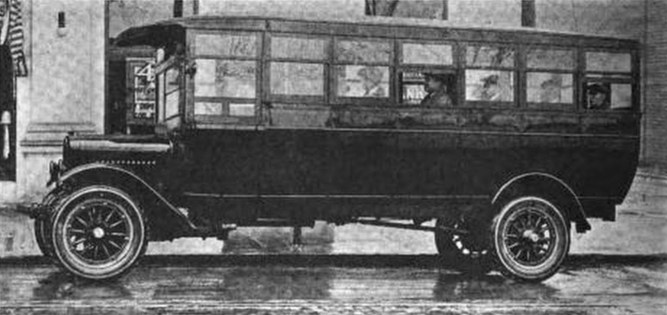
1922 GMC 20-passenger motor bus
Books

Related Resources


Copyright Notice

Reed Brothers Dodge History (1915-2012) by Jeanne Gartner is licensed under a Creative Commons Attribution-NonCommercial 3.0 Unported License.
 Reed Brothers Dodge History 1915 – 2012
Recent Comments