
A Family Photo Postcard Jackpot

Postcard front was taken by Lewis Reed at Pope’s Creek Maryland on the Potomac River ca. 1915

Postcard addressed to Ethlene Thomas from L. Reed. Note the cost of the postage stamp is just one penny.
Lewis Reed’s albums contain several hundred of these photo postcards dating from approximately 1907-1915. What makes this particular photo postcard so special is, it was sent from Lewis Reed to Ethlene Thomas. Lewis Reed married the former Ethlene Thomas of Frederick County on June 15, 1920. This is a real photo postcard — one in which the photographic paper on which the photo was developed was itself then sent as the postcard. The stamp is a one penny stamp with the image of Benjamin Franklin. The Benjamin Franklin series stamp was issued by the U.S. Post Office between 1908 and 1922.
What I love about the address is how it’s addressed merely to “Miss Ethlene Thomas, New Market, Frederick Co, MD. I have a feeling, however, that the postcard would have found it’s way even had “New Market” been left off the card.
The card reads:
Dear Friend,
You can look for me Friday afternoon between 6 and 7 o’clock or sooner, if it is not raining. I will be there sooner if I can.
As ever, L. Reed
Kodak made photo paper in standard 3 1/2 by 5 1/2 postcard size with “Post Card” printed on the back. Lewis Reed developed all of his own photographs. He had a darkroom in his house — in the kitchen, to be exact — and worked at night to develop the negatives. This gave him the ability to take the paper into his dark room and produce a real photo postcard. This one is definitely a treasure.
Stories From The Past By Friends & Employees
 A while ago, I put out a call for stories and memories from employees and friends of Reed Brothers. It has taken a while for me to compile them all, but I am delighted to share them with you now in this special post. Here is what they said.
John Hall – Mechanic
The mechanics at Reed brothers Dodge worked on the Flat Rate System of pay. That meant if there was no work, there was no pay. This was very difficult on a family man. There were times in the winter that we were lacking customers. Brownie, who was an excellent mechanic would bang a Torsion Bar on a metal trash can to get Phil Vetter’s, or one of the service advisers attention (a torsion bar is a steel bar that was used on Chrysler products in place of front springs.) The bar could be twisted to raise or lower the height of the vehicle. There was also no sick leave, or holiday pay offered through the dealership. I decided to write up a proposal to the president of the dealership, Lee Gartner via Phil Vetter. All of the mechanics signed the petition. After a period of negotiation back, and forth, Lee Gartner came back with an offer of 6 sick days a year at $20.00 a day, and the six major holidays at $40.00 a day. This does not seem like a lot of money now, but in the early seventies it was much appreciated. Reed Brothers was now one of very few dealerships at that time to offer sick, and holiday pay to flat rate mechanics.
When the state widened the roads in 1970, Reed Brothers relocated from its original facility at the intersection of Veirs Mill Road and Rockville Pike to new Dodge/Chrysler/Jeep service complex on Route 355 at 15955 Frederick Road. Many longtime customers followed them to the new location. One of them that I remember well is John Logan Seitz from his 1957 Dodge that he owned, and the spinner hubcaps were always getting stolen from the front of his house in Kensington, Md, before he moved to Potomac in 1971. He was still coming to Reed Brothers when I came back to work in 1999, and for many years after I left. He said all the Gartner’s were very nice, and the employees treated him well.
In the winter time when the doors were all shut in the shop, and the engines on more then one car was running, the fumes were so bad that we had to open the side employee entrance door and walk outside for some air. One morning Lee Gartner walked by, and said; What are you boys doing? Why aren’t you in the shop working? We said we needed some fresh air because of the fumes. After we complained about the fumes for awhile, OSHA came out, and measured the carbon monoxide level in the shop, and it was high. Shortly after that Lee Gartner installed a whole new exhaust vent system in the shop.
One time John Trammel drove a customers car through the front garage door because the brakes failed, and when he beeped the horn for someone to open the door, no one did. It was winter time. The Gartner kids were as young as me at the time, and I worked on all of their Demos. Lee used to water his plants, and read his newspaper usually standing up in the corner of the showroom, and then walk through the shop picking up trash. I think he controlled the heat in the shop for us. The shop was smaller then 30 bays in 1972. The building ended right behind the heavy truck lift. There was a radiator repair shop in the back of the Body Shop, and Nathan Howard used to repair many radiators there. He also kept a small garden in the field behind the shop. The body shop was much smaller then. Lee took us to Mealy’s restaurant in New Market for a Christmas dinner once in a Snowstorm. We were all dressed up. He said, “I didn’t know you boys could look so good.” There was a man named Robert who was the car painter. In those days painters had to breathe a lot of fumes. His beard was usually painted along with the car he was painting.
The shop was broken into in the 70’s and Ben McGowan’s tools were stolen, along with some other mechanics tools. Lee Gartner had us all inventory our tools, and in a few days replaced all the stolen tools.
Roger Camp – Mechanic
He said the shop was again broken into years later, and the thieves stole a box truck off the lot with a lift gate, and loaded all the tool boxes up in the shop into the truck. They also took a large sledge hammer out of the body shop, and tried to break open the office safe. They were never caught. Roger said Lee Gartner installed an alarm system shortly after, due to the insurance companies regulations.
Janice Beall Taylor
Both of my parents worked at Reed Brothers in the early 1930’s. My mother (Mary Anna Slater) was the book keeper, and my father (Leonard Beall) worked in the paint shop. At the beginning of WWII my dad was working in the Paint Shop at Reed’s, matching paint on cars that had been damaged. When the draft took place, Selective Service disqualified him because they said he was “colorblind”.
Daddy always told this story: In 1942, they only had one new car left to sell. It was up to him to back it into the showroom. He was in the driver’s seat, with the door open looking backwards to see where he was going, and he got too close to a support pole (and was probably going too fast!), and ripped the door right off the car! The last one! Maybe it wasn’t a coincidence that Daddy left Reed’s and took a War job at National Airport until he opened his own business in 1944. I also remember my mom telling stories about riding to work with Mr. Raleigh Chinn after they moved into their new house on Anderson Ave. in 1938.
When the Goodyear Blimp came to visit Reed Brother’s in 1938 to promote tires I went up for a ride!! My mother worked as a bookkeeper at Reed’s when the Blimp came, and she was 8 1/2 months pregnant with me! She called her doctor (Dr. Hartley) and asked if it would be okay for her to go on the Blimp, and he said, “…only if I can go, too”. So she and Dr. Hartley and I rode along. Of course, I wasn’t born until 2 weeks later, but my mother and Dr. Hartley went up! My kids always thought it was neat that I’d been up in a blimp!!!
Robert Higdon (Assistant Service Manager)
I came to Reed Brothers Dodge a little over a year after spending three years in the Army serving in Vietnam 67-68. Reed Brothers Dodge was a part of my early life, but we all move on and change with the times. I was very sorry to see you lose your franchise. It wasn’t fair that it happened and now the building is gone too. Longevity should have played a part in you keeping the business. You all have played a big part in my life during those years and from time to time I think and remember some of the best times in my life were being your friend and co-worker.
Other Stories on Social Media
Tim B. Used to go into the service bay after school at St. Marys and get a Dr. Pepper and some Lance peanuts. Poured the peanuts into the Dr. Pepper and guzzled it down while watching mechanics work on cars. And it was a cool place for boys to hang out and watch cars get fixed. Very cool to a 4th grader.
Mark T. On the left side of Reed Bros. Dodge there was a concrete ramp going up to the second level. I used to play on it while my mom (Marie Thompson) crossed school kids from St. Mary’s to Richard Montgomery. She crossed Veirs Mill and the Pike for 30 years. The only time she missed is when she was pregnant with me in 1956.
John M. The first car I bought was a Dodge Dart Sport from Reed Brother’s. My dad went along with me to pick it out. I remember him asking me if I was sure I could afford it. I had just gotten my first teaching job. Never had another new car for the next 40 years. I loved that car. When I worked at United Auto Parts, I mixed the paint that the body shop painter used to paint Riggs Schultz’s sweet Plymouth — Go Mopar.
Michael B. I remember when the new car models would be snuck into Rockville at night and covered up every fall until the “release date” … I think back then it was October 1 …
John W. B. My parents bought their strangest car at Reed Brothers. A 1962 dart with a watermelon shaped steering wheel and push-button shifting.
Sally M. My first new car, a 1980 Dodge Colt came from Reed Brothers. My ’69 Chevy Laguna blew up at Lake Forest Mall the day my car arrived and Reed Brothers still honored the trade in.
Izetta W. T. Jeanne T. Gartner, my dad is George Waters. I remember him talking about you! Reed Brothers was like a big family. He enjoyed working there and the relationship with everyone. He was well respected there, as he would tell me of one of the Brothers personally asking him to help on a difficult job because he knew my dad had the skills to do it. Great memories.
Minnie W. S. Wow, thanks for this story. I remember we were Reed Brothers’ emergency number, which is why we could never tie up the phone. He loved working at Reed Brothers, was like a second family for him.
Thanks to everyone who responded with memories of the good years. I would love to see more if anyone else has any.
Meet Lewis Reed, Photographer


Before opening his Dodge dealership in 1915, Lewis Reed was a well-known photographer in Montgomery County Maryland. At the turn of the century, before automobiles were even around, Lewis Reed toured up and down the East Coast on his motorcycle, taking photographs of landscapes, monuments, historic places, and people.
Some of the historic locations in his photograph collection includes the Black Rock Grist Mill, Smithsonian Institution, Montgomery County Maryland Almshouse, United States Capitol, Key Bridge, Union Station and other important sites in and around the Maryland, Virginia, and Washington, D.C. area. There are also photographs of many non-Maryland locations including Virginia, West Virginia, Pennsylvania, Georgia, New York, Boston, Georgia, North Carolina, and Canada. Especially stunning are images of the aftermath of the 1936 Gainesville Georgia tornado, one of the deadliest tornadoes in American history. As his photograph collection reveals, Lewis Reed was on the scene for some of the most important events in the history of the twentieth-century, and he always had his camera with him.
Lewis Reed developed all of his own photographs. He had a darkroom in his house — in the kitchen, to be exact — and worked at night to develop the negatives.
His photography has appeared in highly regarded history books such as, Montgomery County: Two Centuries of Change by Jane C. Sween, Rockville: Portrait of a City by Eileen S. McGuckian, and Gaithersburg: History of a City. His photographs have been featured in the Norris-Banonis Automotive Wall Calendar, on the national television show, American Pickers, and on television’s most watched history series, American Experience on PBS.
In a way, his photographs — more than 2500 in all — serve as an unwritten diary of his early adventures as an amateur photographer. My greatest pleasure now — more than 100 years later — is being able to share them.
Then & Now: Georgetown University and Potomac Aqueduct Bridge 100 Years Apart
Washington DC has a lot of history. The Smithsonian museums, the monuments, etc., but it is interesting to see just how much the city has changed over the years. I thought it would be fun to revisit an historic location using one of Lewis Reed’s original photographs for “then” and a stock image from today for “now” to see what differences are visible. In the following photographs, you can see how Washington, DC looks both the same and completely different from a century ago.
Georgetown University and Aqueduct Bridge (THEN): The Key Bridge was not the original connector between Georgetown and Virginia. Prior to that construction in the 1920s, there were two iterations of the Aqueduct Bridge. The second iteration of the bridge looked visibly different, but even that one suffered from deterioration and was only used between 1889 and 1918. The Aqueduct Bridge continued as a bridge for traffic until the Key Bridge opened in 1923.
Seen in the black & white photograph taken by Lewis Reed in 1913, is the Aqueduct Bridge over the Potomac River in Washington, DC. The spires of buildings at Georgetown University can be seen in the background.
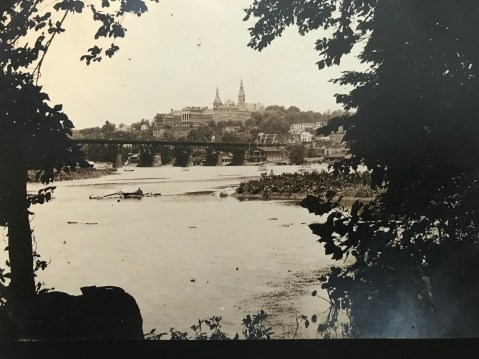
Potomac Aqueduct Bridge Washington DC 1913. Photo by Lewis Reed
Georgetown University and Key Bridge (NOW): The same view over a century later hasn’t changed much.

Georgetown University and Key Bridge Washington DC today
Historic Montrose School, Rockville (1909)
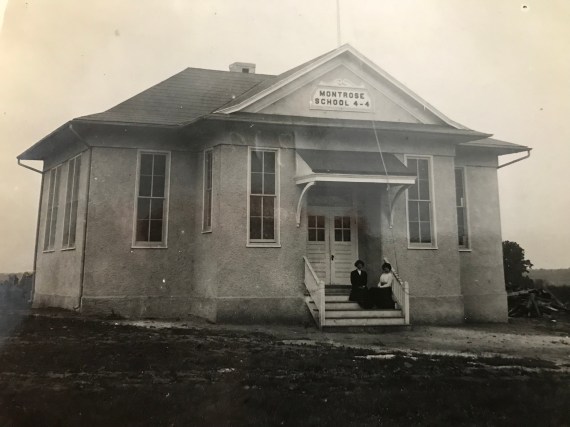
Montrose School, Photo by Lewis Reed, ca. 1909
Completed in 1909, Montrose School was designed as a two room schoolhouse and offered classes for first to seventh grade. Other modern amenities included kerosene hurricane lamps affixed to the walls and pot-bellied coal burning stoves in each classroom; an outside hand pump provided well water, and outdoor boys’ and girls’ rest rooms. Increased modernization, including electricity and indoor plumbing were added throughout the early to middle decades of the 20th century. One hundred students enrolled.
Below, is a photo of teacher and students taken by Lewis Reed circa 1909.
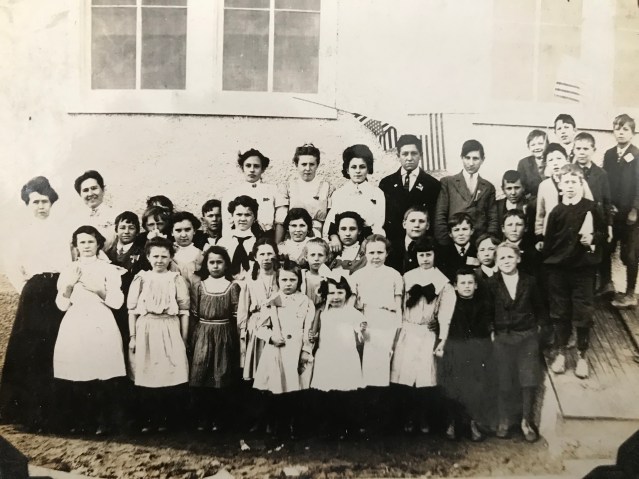
Montrose School Students, Photo by Lewis Reed, ca. 1909
Books

Related Resources


Copyright Notice

Reed Brothers Dodge History (1915-2012) by Jeanne Gartner is licensed under a Creative Commons Attribution-NonCommercial 3.0 Unported License.
 Reed Brothers Dodge History 1915 – 2012
Recent Comments