
Then & Now: Library of Congress
You might not realize how much Washington DC has changed until you look back and see what it looked like in the past. In this “Then & Now” feature, I have combined one of Lewis Reed’s original photograph’s for “then” and matched it with a corresponding contemporary shot for “now”.
Library of Congress (THEN): The Library of Congress was relocated to Washington, DC, in 1800, having previously been housed in New York and Philadelphia, which had each served as temporary capitals of the early United States of America. It is the research library serving the U.S. Congress as well as the national library of the United States, and it holds over 23 million volumes in its collection, making it the world’s largest library. The structure as it stands today was erected between 1888 and 1894, following the 1851 fire that destroyed 35,000 of the Library’s books (two-thirds of its holdings at that time), including much of Thomas Jefferson’s donated collection.
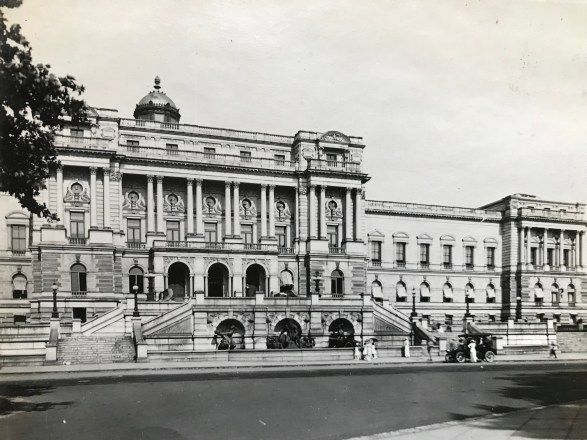
Library of Congress. Photo by Lewis Reed, ca. 1910
Library of Congress (NOW): The same view 108 years later. Now, the Library of Congress is one of the largest and best-equipped libraries in the world. It houses approximately 90 million items on 540 miles of shelves. The Library of Congress is physically housed in three buildings on Capitol Hill and a conservation center in rural Virginia. The Library’s Capitol Hill buildings are all connected by underground passageways, so that a library user need pass through security only once in a single visit.

Library of Congress today
Source: Wikipedia
Got Milk? Mrs Phillip Reed Endorses Cream Top Milk in This 1931 Ad
They say that the cream always rises to the top. What rose to the top of my internet search this week was this advertisement of cream top milk endorsed by Mrs Phillip Reed (Mary Zelda Reed) of Rockville. Phillip Reed was a brother of Lewis Reed and a part of the dealership’s first work force. Phillip came to work for the dealership as a mechanic in 1916. Characteristic is this compliment from Mrs. Phillip Reed of Rockville, MD:
I wish to tell you that I like your ‘Cream Top’ Milk better than any I have ever bought in the eleven years that I have been buying milk … The Cream whips wonderfully.
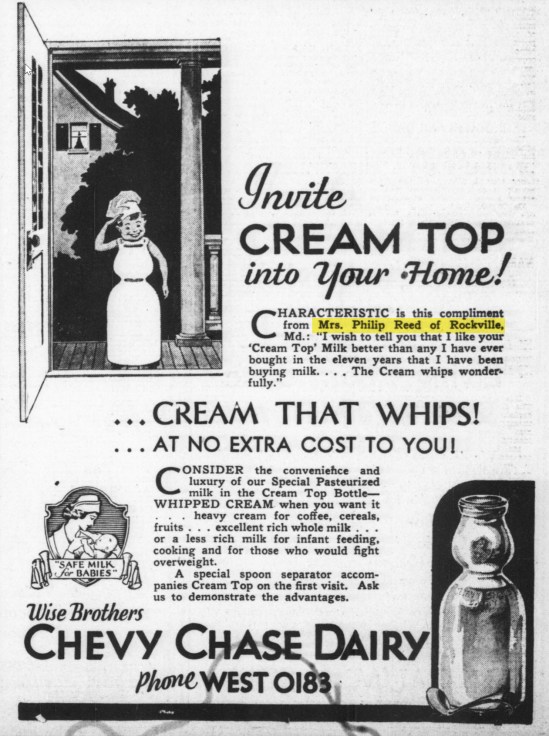
The Sunday Star, Washington D.C. March 8, 1931
The Chevy Chase Dairy resulted from the merger of two companies. Brothers George and Joseph Wise started Chevy Chase Dairy in 1885. The Dairy was utilized to supply milk to the Chevy Chase/Bethesda, Maryland and the Washington DC area with fresh milk. The dairy was started by H. G. Carroll who owned the farm in 1897. Sometime around 1913-1915 he sold the dairy to George, Joseph and Raymond Wise who added the “Wise Brothers” to the Chevy Chase Farm name. There first retail location in the District was at 3306 P Street NW. They later moved to 3206 N Street NW (adjacent to Martin’s Tavern which fronts Wisconsin Avenue in Georgetown) where it remained until it was sold to National Dairy Products in January 1931.
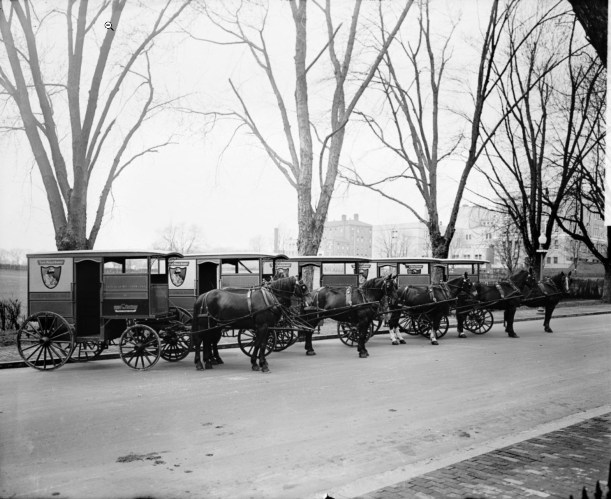
Chevy Chase Dairy delivery wagons, circa 1918-28. (LIBRARY OF CONGRESS PRINTS AND PHOTOGRAPHS DIVISION)
The Chestnut Farms, Chevy Chase Dairy may be gone, but an unexpected descendant remains. Dairies used to sponsor all sorts of extracurricular activities for employees, from baseball teams to orchestras. Chestnut Farms, Chevy Chase Dairy had a brass band. In 1938, the band played in the stands of Griffith Stadium during a football game. The owner of the team liked the idea of entertaining the fans so much that he signed them up to play regularly. The owner was George Preston Marshall, the team was the Redskins and the band became the Redskins Marching Band.
Source: The Washington Post
Then & Now: Clinton Zion AME Church, Rockville
In 1867, several of Rockville’s African American families left Jerusalem Methodist Episcopal Church to start the African Methodist Episcopal (A.M.E.) Zion Church under the leadership of Reverend Charles Pipkins. In 1890, Pipkins and his congregation cut timbers and erected. a frame church on Middle Lane. Taken approximately 100 years apart, these photos show the Clinton Zion A.M.E. Church then and now.
Clinton Zion A.M.E. Church (THEN): In 1904, the congregation moved to the brick church seen in this black & white photograph located on North Washington Street and today’s Beall Avenue. The church was named Clinton A.M.E. Zion in honor of Reverend George Wylie Clinton (1859-1921), a prominent member and editor of the church’s periodical, Star of Zion.

Zion A.M.E. Church, Rockville, Maryland. Photo by Lewis Reed, ca. 1912.
Clinton Zion A.M.E. Church (NOW): The congregation sold the brick church in 1955 to make way for a shopping center, dedicating their present church on Elizabeth Avenue in Lincoln Park in the fall of 1956. The growth of Clinton was the impetus for the most recent expansion effort. Construction of the new sanctuary began in 1989 and the newly renovated edifice was dedicated on Sunday, May 13, 1990.
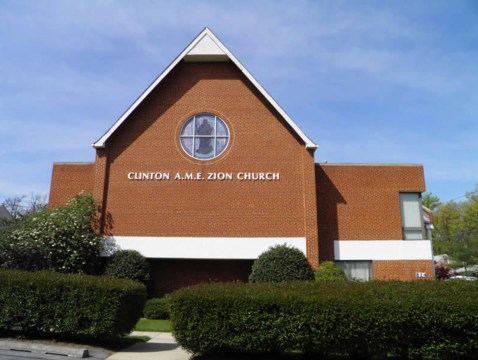
Zion A.M.E. Church, Rockville, Maryland. 2012
Source: Clinton AME Zion Church
Rockville Academy Basketball Team 1915-1916
Before opening his Dodge dealership in 1915, Lewis Reed was a well-known amateur photographer in Montgomery County. He would occasionally get phone calls local high schools asking him to take pictures of their athletic teams and graduating classes.
This photo taken by Lewis Reed depicts the Rockville Academy Basketball Team of 1915-1916. Finding photos and information of basketball teams before the 1920s is a difficult task. The only information on this team that I could find was in the May 1981 edition of “The Montgomery County Story” and the news clipping just below it from the Washington Times. From the newsletter:
In 1915, Rockville High School organized an athletic association. They planned teams in baseball, football, and basketball. They quickly lost their first game of basketball to Rockville Academy, 29 to 26.

Rockville Academy Basketball Team 1915-1916. Photo Lewis Reed
Back: Roy Hilton, Lester Witherow, Grubb, Hamilton, Edmonds
Middle: Lawrence Higgins, Joe Dawson, Brownell (Buck) Riggs, J. Vinson Peter, John McDonald
Front: John Dawson

The Washington Times January 24, 1915
The Montgomery County Historical Society has identified several people in the photograph. If anyone can help put a name to a face, please leave a comment.
Source: The Montgomery County Story
Lewis Reed Photo: Old Country Store

Circa 1900s country store on a dirt road. Note the sign advertising Battle Axe Shoes. Two ladies standing on the porch. Location Unknown. Photo by Lewis Reed
This early 1900s photo taken by Lewis Reed is a flashback to a time when the clip-clop of horses could be heard going down the street, kids would walk to school, and people took the time to care about and create things that would last. This old store would have been considered not very clean from modern standards and the roads outside were unpaved.
While every store was different, there were similarities among many, including a front that was decorated by tin sign advertising, tobacco, cigars, shoes, hardware, and more. The sign in front advertises Battle Axe Shoes, Stephen Putney Shoe Company. I did a little research and found out Samuel and Stephen Putney were father and son shoe manufacturers of Battle Axe Shoes in Richmond, Virginia.
Usually, country stores featured double doors that opened inward and lots of barrels that might contain any number of items — from pickles, to crackers, potatoes, flour and candies. The store was usually an unpainted, two-story frame building fronted by a raised porch for convenient loading and unloading.
One thing in this photo I can’t explain are the steps seemingly leading to nowhere on side of the building. And I wonder what the tall pole is for? It seems to be bracketed on the side of the building. Ideas, folks?
The Putney’s owned and ran Battle Axe Shoes, and had this factory on 2200 West Broad Street as touted by the 1909 Postcard below.
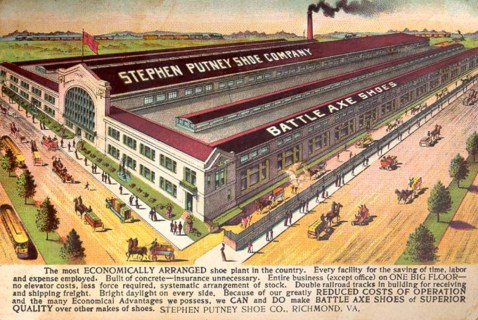
By the way, it appears as if the writer of this postcard was a big fan of CAPS-lock to get his point across.
Impressive….
And environmentally friendly to boot! (Pun intended)
The postcard reads:
“The most ECONOMICALLY ARRANGED shoe plant in the country. Every facility for the saving of time, labor and expense employed. Built of concrete – insurance unnecessary. Entire business (except office) on ONE BIG FLOOR – no elevator costs, less force required, systematic arrangement of stock. Double railroad tracks in building for receiving and shipping freight. Bridge daylight on every side. Because of our greatly REDUCED COSTS OF OPERATION and the many Economical Advantages we posses, we CAN and DO make BATTLE AXE SHOES of SUPERIOR QUALITY over other makes of shoes. STEPHEN PUTNEY SHOE CO., RICHMOND, VA.”
Books

Related Resources


Copyright Notice

Reed Brothers Dodge History (1915-2012) by Jeanne Gartner is licensed under a Creative Commons Attribution-NonCommercial 3.0 Unported License.
 Reed Brothers Dodge History 1915 – 2012
Recent Comments