
Step Into Christmas Past at Reed Family Home

Lewis Reed’s craftsman-style home, looking rather solitary on a snowy day. Photo by Lewis Reed.
The following photos from Lewis Reed’s collection are a fabulous glimpse into Christmas inside the Reed family home at 301 North Frederick Avenue in Gaithersburg, Maryland. It was not a huge house, a modest Sears and Roebuck craftsman-style home built in 1926. Some of my earliest memories are visits to this home as I spent a lot of time there during my childhood.
A lot of people assume that the traditions we follow have looked pretty much the same since their inception but, in most cases, like everything else in life, Christmas has definitely changed over the years.

Snow on the ground means it’s time for building a (presidential) snowman. This photo is Lewis Reed and the snowman he built of George Washington.
The trees were big back then and always fresh. They went right to the ceiling and were very wide. Early Christmas trees were generally fastened onto a flat board surrounded with fence-rails, snow villages and carpeted with cotton blankets of snow. Lots of tinsel and strings of popcorn garnish the trees.
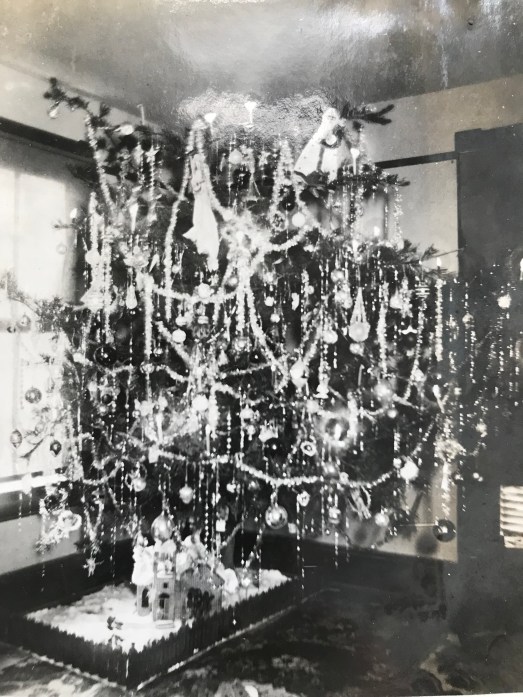
A small snow scene with what appears to be a miniature church is arranged at the foot of the Christmas tree. A popcorn garland adorns the tree. Photo by Lewis Reed
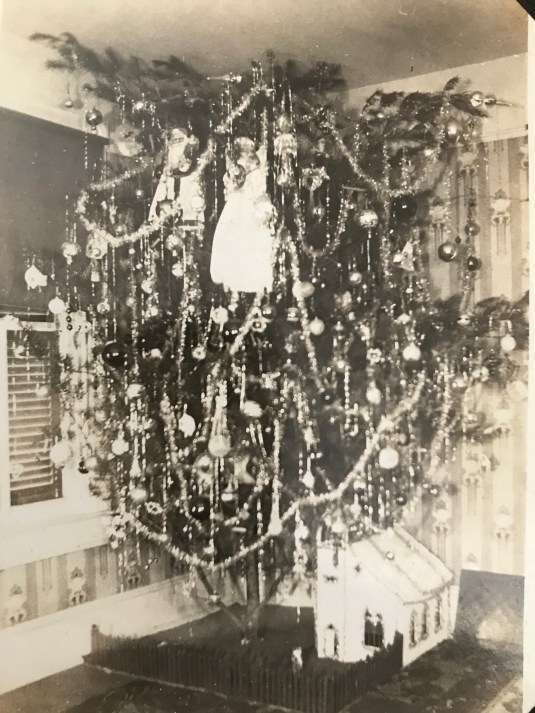
No room for a star on the top of this tree! And just look at those big Santa and Angel dolls. A miniature church with picket fence is arranged at the base of the tree. Photo by Lewis Reed
Below are photos of Lewis Reed’s snow village set up under the Christmas tree decorated with vintage ornaments, tinsel, and lights. I used to have a ton of fun helping my grandfather set up the miniature landscapes with the varied figures, little houses, and trees at Christmastime each year. It seemed like a holiday village right out of a storybook.

A rustic picket fence is used to set off the village display. Photo by Lewis Reed
The snow villages were set up in Lewis Reed’s basement on top of a big table beneath a small Christmas tree. He made the snow scenes entirely by hand using wire-covered cardboard and balled up paper to make hills and pathways. The little houses and figurines would fit into the landscape with cotton ‘snow’ all around; and lights would be wired underneath. It was just amazing to me.
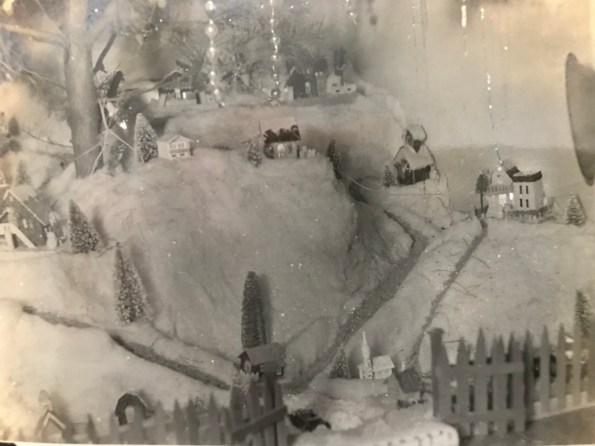
Little houses, churches, fences, trees, and pathways were added to the scene. Some of the houses have charming light effects in the windows. Photo by Lewis Reed
These Christmas villages were precursors of the Holiday Villages that were made popular by Dept. 56 that you see today.

Old-fashioned lights can be seen on the tree, along with lit windows in the houses. Photo by Lewis Reed
Looking back on these memories now in my adult mind is like watching my favorite Christmas movie. They are memories of my grandparents house at Christmastime, and are ones I will always treasure.
49 Years Ago Today: 55th Anniversary and Grand Opening
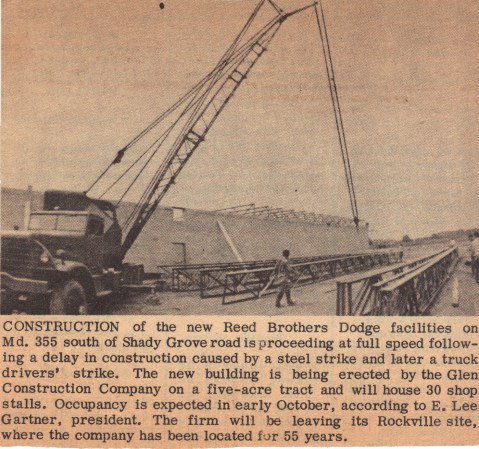
 Today marks 49 years since the Grand Opening of Reed Brothers Dodge new showroom and service facility. When the state widened the roads in 1970, Lee Gartner purchased 4.37 acres of land from Eugene Casey and relocated Reed Brothers Dodge to a new state-of-the-art showroom and Dodge/Chrysler/Jeep service complex on Route 355 at 15955 Frederick Road in Rockville Maryland.
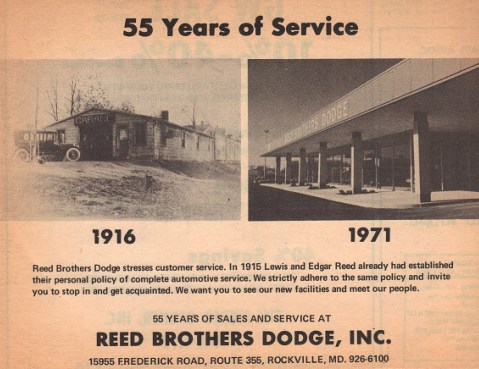
Turning out to honor the company were several hundred dignitaries, officials, businessmen and friends. The new building, a complete automotive sales and service facility marked Reed Brothers 55th year of selling Dodge’s. The state-of-the-art dealership contained the newest customer-focused features throughout which combined technology and comfort.


The new dealership provided a modern new vehicle showroom, 30 service bays, a comprehensive detail and car wash area, Parts Department, Body Shop, the newest technologies to service customer’s vehicles and provided customers with a convenient location to purchase and service their vehicle needs.

Design and construction of the new dealership was managed by the Glen Construction Company.
Have a Safe & Happy Thanksgiving
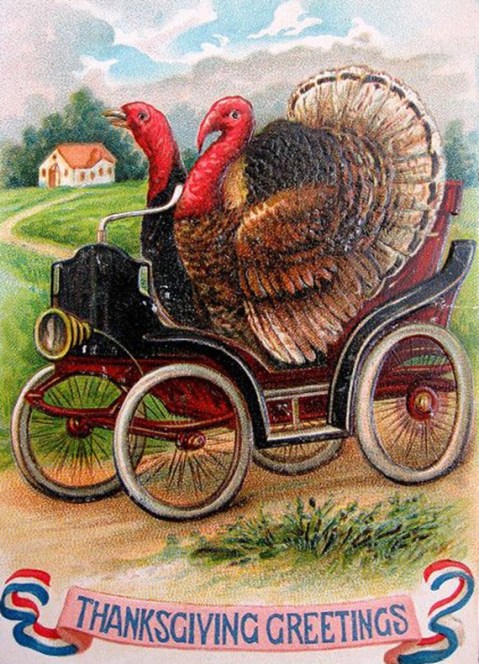 Ever seen two turkeys driving a car? 😀 It is probable that these guys know what’s coming and are leaving town in their classic automobile.
Wishing all my friends, followers, and visitors to this blog a warm and wonderful Thanksgiving with family and friends! For those who are traveling, I wish you a safe trip.
With best wishes,
Jeanne Gartner, Blog Author
Happy Birthday to Lewis Reed, Founder of Reed Brothers Dodge

This ca. 1965 photo of Lewis Reed was taken in the new car showroom at Reed Brothers Dodge original location at the triangle at Veirs Mill Road and Rockville Pike.
Lewis Reed was born in Darnestown, Maryland on November 25, 1887 and was the founder of Reed Brothers Dodge. When Lewis Reed opened his car dealership in October 1915, he never knew he was starting a family tradition that would be carried out for 97 years and three generations. He founded what would become the oldest Dodge dealership under the same family ownership in the state of Maryland, and one of the oldest in the entire nation.
Lewis Reed was just 27 years old when he started selling cars built by brothers Horace and John Dodge in Detroit. Few people jumped onto the Dodge Brothers bandwagon earlier than Lewis Reed, and not many have lasted longer. Reed Brothers was franchised as a Dodge dealership and service facility less than one year after the first Dodge automobile rolled off the assembly line.
Lewis Reed was the first to sell Dodge cars in Montgomery County, Maryland and his company was the first Gulf gas dealer in the Washington, D.C. area. During the early years, Reed Brothers represented several franchise nameplates along with Dodge, including Oldsmobile, Hudson and Essex. The Hudson and Oldsmobile were sold at Reed Brothers from roughly 1917 through 1923.
Before becoming interested in automobiles, Lewis Reed was one of the original employees of the Computing-Tabulating-Recording Company, a Georgetown-based manufacturing firm that eventually became International Business Machines, Inc. He received his automotive training at the Pierce-Arrow factory in Buffalo, New York, the Dodge Hamtramck and Hudson Motor Car factories in Detroit, Michigan and the Washington Auto College.
A Charter Member and Past President of the Gaithersburg-Washington Grove Volunteer Fire Department, Lewis Reed was also a member of the advisory board of the Rockville branch of the First National Bank of Maryland, and belonged to the Masonic Lodge of Rockville, the Pentalpha Chapter of the Eastern Star, and the Rockville Rotary Club.
At his death on January 28, 1967 at the age of 79, the Senate of Maryland passed Senate Resolution No. 10, expressing “the deepest regret and sympathy of every member of this body,” describing Reed as “a kindly and loyal person completely devoted to his duties” which he carried out “with fairness and human understanding.” The resolution was sponsored by Senator Thomas M. Anderson, Jr. and Senator Louise Gore.
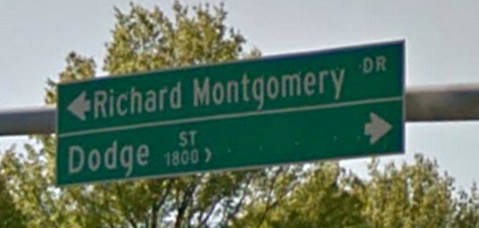 When you look back and consider what has taken place in the world in the past 100 years or so, you gain a perspective of what Lewis Reed faced. He overcame a lot of obstacles throughout his life. He steered his dealership through World War I, The Great Depression and World War II. When Reed Brothers had no new cars to sell for three and a half years and many dealers went bankrupt, he converted his car showroom into a display room and sold GE washing machines and other appliances. Reed Brothers Dodge occupied two locations, the original at the Veirs Mill Road and Rockville Pike intersection and the second at 15955 Frederick Road in front of the Shady Grove Metro.
Lewis Reed set an outstanding example through his success, but more importantly through his sacrifices and commitment to the community he served. Today, Bainbridge Shady Grove Metro Apartments pays homage to the oldest Dodge dealership in Maryland with commemorative art on the former site of the iconic Reed Brothers dealership.
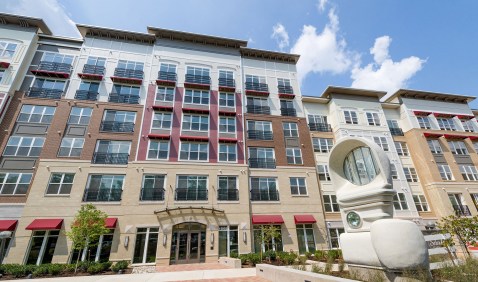
Bainbridge Shady Grove Metro Apartments now stands on the former site of the Reed Brothers Dodge dealership at 15955 Frederick Road. But a sculpture now installed on the property pays tribute to the oldest Dodge dealership in Maryland history. More than 20 feet high, and over 6 feet wide, the public art is inspired by 1939 Dodge headlamps, and the fender of a 1957 Dodge pickup truck.
The Dodge Brothers First Car

Horace Dodge (left, rear) and John Dodge (right, rear) take delivery of the first Dodge automobile on Nov. 14, 1914.
One hundred and five years ago on this date –November 14, 1914 — the very first Dodge car, “Old Betsy”, rolled off the assembly line. On that day, the Dodge Brothers (Horace and John) were photographed riding in the rear seat of the first car to bear their last name. It cost $785, had a 110-inch wheelbase, and was powered by an L-head 4-cylinder engine that proved so reliable it was continued until 1920 with very little modification. Total production for 1914 was a mere 249 touring cars. The following year. Dodge offered a two-passenger roadster which also sold for $785 and the plant went into full production.
According to “The Dodge Brothers: The Men, the Motor Cars, and the Legacy” by Charles K. Hyde, here’s the full story:
The widely accepted history of the initial production of early Dodge Brothers automobiles in November 1914 is at odds with much of the evidence about the earliest Dodge Brothers cars. Automotive historians have thought that the first production car, later named “Old Betsy,” came off the assembly line at the Hamtramck factory on 14 November 1914. Guy Ameel, superintendent of final assembly for Dodge Brothers since the start of automobile production, served as John and Horace’s chauffeur that day. With the brothers in the back seat, Ameel stopped the first Dodge Brothers car in front of John Dodge’s mansion on Boston Boulevard in Detroit and a photographer recorded this important moment.
“Old Betsy” was more likely an experimental prototype car assembled several months before 14 November 1914 and not a production car at all…

The Dodge Brothers
The Dodge Brothers began an aggressive advertising campaign to promote their new automobiles and to attract potential dealers to sell their cars. Few people jumped onto the Dodge Brothers bandwagon earlier than Lewis Reed, and not many have lasted longer.
Lewis Reed received his franchise to sell Dodge Brothers Motor Cars from John and Horace Dodge; less than one year after the first Dodge Model-30 rolled off the assembly line for $785. He was just 27 years old. Since then, the business grew and transformed into the oldest Dodge dealership in Maryland history and one of the oldest in the entire nation.
Books

Related Resources


Copyright Notice

Reed Brothers Dodge History (1915-2012) by Jeanne Gartner is licensed under a Creative Commons Attribution-NonCommercial 3.0 Unported License.
 Reed Brothers Dodge History 1915 – 2012
Recent Comments