
Batter Up! Reed Brothers Company Softball Team
From a distance, it looks and sounds like a regular baseball game: the crack of the bat, the cheering from the bench, the sliding into home plate. But a closer look at the field shows something is very different. They’re playing on a rough grass field, no one is using a batting helmet, fielding glove, or catcher’s mask.

Reed Brothers Softball Team playing on a field set up inside the Rockville Fair racetrack oval, circa early 1920s. Photo by Lewis Reed
From the 1920s through the 1940s, Reed Brothers had their own company softball team that played on the fields at the Rockville Fairgrounds where Richard Montgomery High School now stands. In 1939, the Rockville Fire Department and Reed Brothers Dodge, two top-ranking teams, inaugurated the Montgomery Softball Association championship series at the newly renovated Welsh Field in Rockville. Situated in the heart of Rockville’s business district, the field was renovated and illuminated in 1939.
Participating teams at the time included Pepco, Takoma Phil-Gas Company, Marine Barracks, Rockmont Motor Company, St Mary’s Boys’ Club, Lawyers and Businessmen, among others.

The Evening Star, 9 May 1939

Reed Brothers Dodge Softball Team playing on Welsh Field in Rockville, circa early 1920s. Photo by Lewis Reed
Note the player with the five finger glove in the photo above. Out of all of these photos, this is the only glove that can be seen on a player. The use of gloves wasn’t original to the first years of the game; needing a padded glove was viewed as pretty wimpy. (According to an article in the Smithsonian Magazine, one of the first players to wear a glove tried – and failed – to find one that would be invisible to fans.) By the 1880s gloves were accepted equipment, however, and soon inventors and manufacturers were coming up with new and improved gloves (more padding, deeper webbing…)

Reed Brothers Dodge Softball Team, circa early 1920s. This photo was taken at Welsh Field, which is the site of the County Office Building. The house in the background was in right field. Photo by Lewis Reed
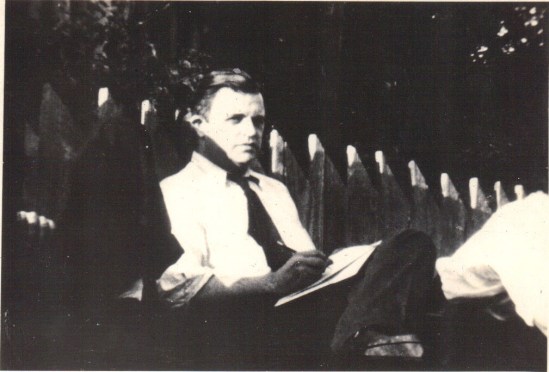
Leo (Pat) Murray, the company’s first Parts Department Manager, is keeping score on the sidelines. Pat worked at Reed Brothers for more than 21 years. Photo by Lewis Reed
From the about the 1920s through the 1940s, Reed Brothers Dodge also sponsored a bowling team that competed locally in the Rockville Duck Pin League. Participating teams at the time included Post Office, Chevrolet, Fire Department, Question Marks, Mechanics, Reed Brothers, Holy Rollers, and Potomac.

The Evening Star Feb 9, 1932
Happy Valentine’s (and Ferris Wheel) Day!

Ferris Wheel at Rockville Fair, circa 1920s. Photo by Lewis Reed
Did you know that February 14th is not only Valentine’s Day, but also Ferris Wheel Day? This unofficial national holiday is held on this day to honor the birth of the inventor of the Ferris Wheel, George Washington Gale Ferris, Jr. What better way to celebrate Ferris Wheel Day than enjoying this old photograph of the Ferris Wheel taken at the Rockville Fairgrounds, courtesy of Lewis Reed. The fairgrounds were just outside Rockville, about where Richard Montgomery High School is today. The Fair lasted four days, from August 21st to the 24th, and drew visitors from local counties, Washington, and Baltimore.
For the singles and the “enough already with the Valentines”, here is your perfect alternative excuse. Go wish all your friends and family a Happy Ferris Wheel Day!
Online Exhibit: Daily Life in 20th Century MoCo
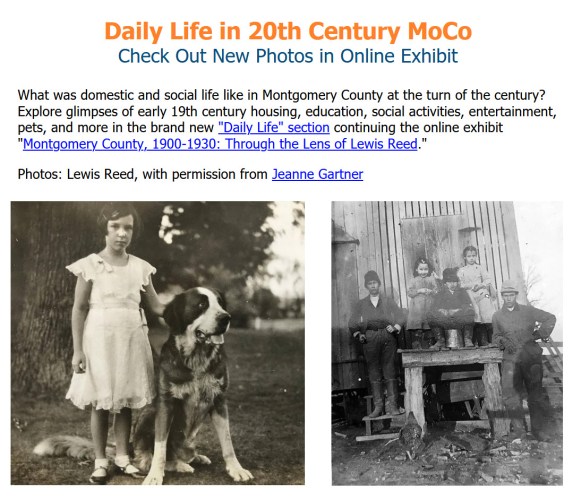 Montgomery History has launched a new “Daily Life“ section of their recent exhibit, “Montgomery County 1900-1930: Through the Lens of Lewis Reed“. A pioneering automobile dealer and one of the most prolific photographers in Montgomery County, Maryland at the turn of the 20th century. The photographs in this newly launched section reveal how residents lived, worked, played, and went to school in Montgomery County at the turn of the 20th Century. Categories include House & Home, Social Visits, Fun & Games, Family Pets, Music, and School Days. Visit https://sites.google.com/…/lewis-reed…/daily-life and immerse yourself in hundreds of photographs of days gone by! The majority of the photos in the “Fun and Games” section are of Lewis Reed’s daughter, Mary Jane. Like many parents, he never missed a chance to take a photo of his daughter, who frequently appears in many of his photos. This exhibit was co-developed by Blog Author, Jeanne Gartner and Montgomery History Librarian & Archivist, Sarah Hedlund.
Roots of a 97 Year Old Auto Business
Lewis Reed, founder of Reed Brothers Dodge, grew up on a farm in rural Darnestown and for much of his young life had no running water or electricity. He was the son of a Blacksmith, raised in a family that survived on knowledge and hard work. Philip (1845-1918), father of Lewis Reed was an early settler in Darnestown who came from the Medley’s District of Poolesville in 1880. The Reed family farmhouse was located west of the James Windsor Store and Post Office as indicated on the map. In 1880, Philip Reed bought this lot from Windsor on which he built his house. The house was later owned by Kelley Rice who ran the farm at “Pleasant Hills.”  In 1870, at age 25, Philip Reed’s occupation is listed as a Blacksmith and Cabinet Maker. Darnestown residents of that time included a doctor, a merchant, a blacksmith and a wheelwright. It seems Philip may not have considered his primary occupation as a wheelwright, but I do know he worked with both cabinetmaker and blacksmith skills. Blacksmiths were once important members of this thriving crossroads community. They provided a vital trade that continued up to the mid-20th century. It wasn’t until I traced the Reed family tree, that I found that the Blacksmithing trade goes back about four generations. Back then, it was commonplace for sons to follow their father’s professions.
“T. H. S. Boyd, The History of Montgomery County, Maryland, from Its Earliest Settlement in 1650 to 1879” gives a population of 200 in the Darnestown area in 1879. The inhabitants of the town at that time are recorded in G.M. Hopkins’ Atlas from which the map reproduced above is taken.
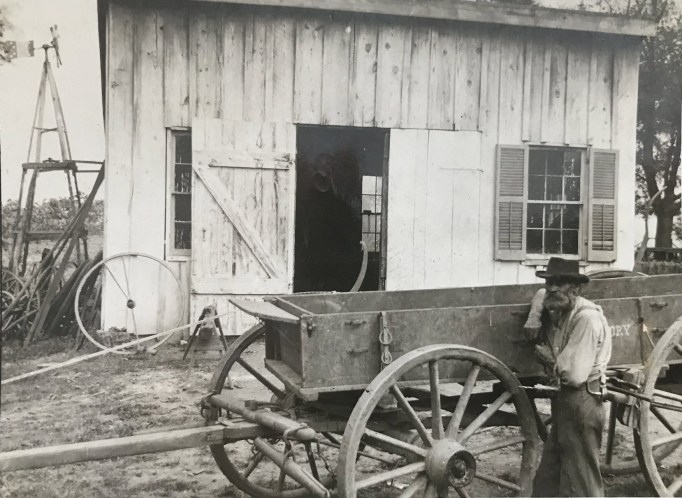
Formerly located on Darnestown Road near the intersection of Seneca Road, Lewis Reed’s father, Philip (1845-1918), operated a blacksmith, wheelwright, and cabinet making business next to his home. Photo by Lewis Reed.
Lewis Reed’s passion for cars began at a very early age. He was a young man full of curiosity, with an insatiable desire to know details, how things worked, and why. Early vehicles were terrifyingly loud and could be heard coming from at least a mile away on rural country roads. As a child, he would watch cars go past the family farm and then take off running across the fields to catch up with them until they would go out of sight. The “normal” speed during this time was so slow that drivers had difficulty keeping their cars from stalling out. It was my mother, Mary Jane Gartner (Lewis Reed’s daughter) who told me this story.

Philip Reed family farmhouse and blacksmith shop. Photo by Lewis Reed
At the beginning of the 20th century, farming was done with the power of horses and the skills of a blacksmith were important to the local economy. The shop was a popular destination, to wait for repairs of equipment, have horses shod and hear the latest news.
According to the 1910 U.S. Federal Census, Philip Reed worked as a Blacksmith in Darnestown until about age 65, after which time he moved his family to the Park Avenue community in Rockville. In July 1910, Philip purchased lot #3 of the east side of Park Avenue. In 1916, Lewis purchased lots 4-9 and started a garage and automobile dealership which became Reed Brothers Dodge. In 1923, he sold lots 4-7 to Edgar at which time Edgar then constructed a bungalow home and resided there until sold in 1947.

The Park Subdivision in Rockville, Lot #3 purchased by Philip Reed in 1910
From Miscellaneous For Sale Section: The Washington Post, (Washington, D.C.) April 21, 1910
 The classic anvil and hammer, in addition to tongs, forms, wedges, and chisels were all key tools of the Blacksmith; many of which were hand-made by each individual blacksmith. If they did not possess the tools required for a specific job, blacksmiths would make their own. Over the span of a blacksmith’s career, he could accumulate hundreds of different tools that existed solely for the completion of one particular item.

A young Lewis is shown inside his father’s Blacksmith Shop, ca. early 1900. The identity of the man on the right is unknown. Photo by Lewis Reed.
Special note: Lewis Reed’s love of photography began at a very young age, at a time when most families did not own a camera. The oldest photo in his collection is dated 1898, which would have made him around 11-12 years old when he started using a camera. I am relatively certain that Lewis took the photograph above himself by stabilizing the camera on a nearby tripod or some other object, and because of the long exposure times in early photography, he was able to run into the shot himself for a minute or more.
When the car was first invented there was no such thing as an automotive mechanic. When a car broke down, people turned to blacksmiths and bicycle mechanics for repair work. When using horses for farming and transportation came to an end, it forever changed the blacksmith’s role in the community. The traditional, small town blacksmith’s shop gradually went out of business, or evolved into the first automobile repair shops, as the horsepower of mechanical engines replaced the power of horses. Having grown up in a blacksmith family, Lewis Reed was well positioned to move to the new technology.

1916 – Rockville Garage first shop force. Lewis Reed, (first name unknown) Long and Phillip Reed. Photo by Lewis Reed.
One hundred years ago, the direction of the auto industry was uncharted territory to be explored by many people. Lewis Reed was an enterprising young man who put his future in the fledgling automobile industry. Although the specific motivation for Lewis to go into the automobile business is not clear, the 1910s was a period of exponential growth in the American automobile industry, and with a location on the major east-west route through Rockville, a town that was on its way to becoming a satellite community of Washington, D.C., he was well positioned for success. The 1910 census indicates that 23-year old Lewis Reed was working as a machinist.
In 1914, Lewis Reed became a partner in Rockville Garage with Robert L. and Griffith Warfield, a business he purchased in 1918. His brother Edgar joined the business in 1919 upon his return from World War I, and the name became Reed Brothers Dodge. In October 1915, Lewis Reed signed a franchise agreement with brothers Horace and John Dodge in Detroit. He was just 27 years old. Since then, the business grew and transformed into the oldest Dodge dealership in Maryland history and one of the oldest in the entire nation.
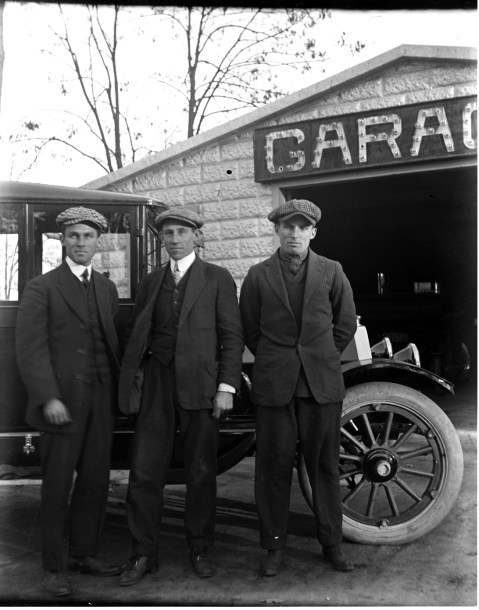
1916 – The original owners of Rockville Garage. From left: Roy Warfield – Lewis Reed – Griffith Warfield. Photo by Lewis Reed.
Over 100 years later, the only name that remains familiar to Rockville car buyers is Lewis Reed. Reed Brothers Dodge was one of the longest running automobile dealers in Montgomery County Maryland, serving Rockville and the area for over 97 years. Along with St. Mary’s Church (1813), King Farm (1925), Red Brick Courthouse (1891), and the B&O Railroad Station (1873) — Reed Brothers Dodge (1915) — became a “Peerless Place” in 2015, the year marking its 100th Anniversary. Today, Bainbridge Shady Grove Metro Apartments pays homage to the oldest Dodge dealership in Maryland history with commemorative art on the former site of the iconic Reed Brothers dealership.
Credit to: Jane C. Sween, The Montgomery County Story, “Darnestown, As It Was” (Feb 1982)
Other sources of information: Newspapers.com, Montgomery History, and Montgomery County Land Records
Life Before Ice in Montgomery County (1910)
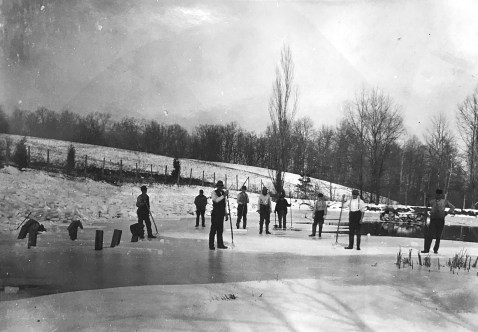
Men harvesting ice with pitchforks and hand saws in Darnestown, Maryland. Photo taken by Lewis Reed in 1910. Note the blocks of ice stacked up along the shoreline. The exact location of the pond is unknown.
Got ice? Usually, we don’t think about ice very often, unless there’s none in the freezer. Before the first successful ice-making machines were built, ice for refrigeration was obtained through a process called “ice harvesting.” Ice cutters used to risk their lives by going out onto frozen ponds with saws, tongs, and pitchforks and methodically cut and dragged blocks of ice which would be stored in hay-packed ice houses. But people did not put ice in drinks as we do now. The possibility of debris having been in the water as it froze – even a bug now and then – discouraged the idea.
Ice houses were dug into the ground to keep the temperature low; double-thick walls were often filled with sawdust for further insulation, and the blocks themselves were packed in sawdust or straw. When you wanted some ice for drinks or to make ice cream, you wouldn’t pull out a whole block; ice picks, chisels, hatchets and shavers were used to get just what you needed.

Same pond in summertime without ice. Photo by Lewis Reed, 1910.
I’m not exactly sure what the structure is in the middle of the pond, but “google” said it could be an outlet structure to keep the water surface in the pond at its optimum level, which usually coincides with the maximum water level designed for the pond. If anyone knows exactly what it is, please leave a comment.

Same pond in summertime from a different perspective. Photo by Lewis Reed, 1910.
From The Evening Star, Washington, D.C. December 22, 1904
ROCKVILLE AND VICINITY GENERAL NEWS
The cold weather of the past ten days has frozen the ponds and creeks throughout this county to a thickness of six or seven inches, and the ice harvesting is now the order of the day. The quality of the ice is not regarded as first-class, however, and for this reason many persons will defer filling their houses until later in the winter.
Next time you drop a few ice cubes into a glass or take out a frozen piece of meat from the freezer, perhaps give a momentary thought to how much we take for granted the ability to have ice cold drinks, preserved foods that can be stored for months, ice cream, cold frothy beer, and so many perishable food products. Refrigeration is a modern convenience that we just can’t live without and certainly one that I take for granted … or took for granted until I wrote this!
Books

Related Resources


Copyright Notice

Reed Brothers Dodge History (1915-2012) by Jeanne Gartner is licensed under a Creative Commons Attribution-NonCommercial 3.0 Unported License.
 Reed Brothers Dodge History 1915 – 2012
Recent Comments