
Heartiest New Year Greetings!
A simple, but straightforward, Happy New Year greeting from Edgar and Lewis Reed from 73 years ago.
May the year ahead be all you want it to be.
This blog author would like to wish all the visitors and subscribers to this blog a very Happy New Year and all the best for a happy, healthy, and successful 2023. Thank you all for your support and for being loyal readers throughout the past year.
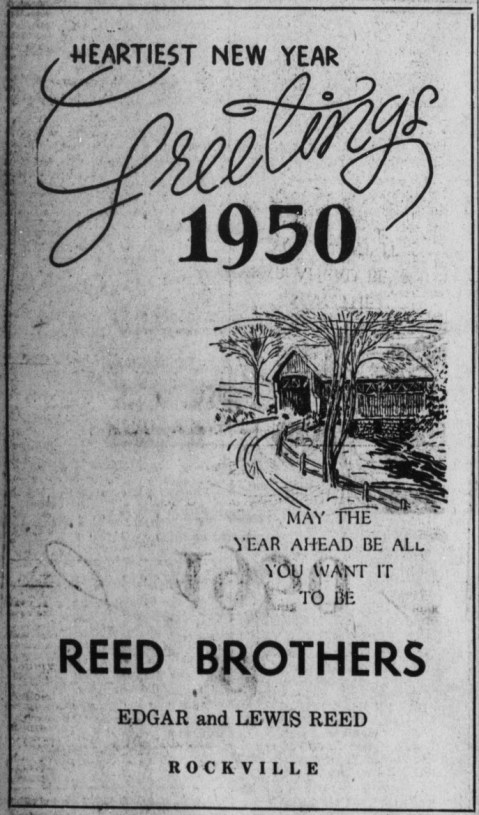
The Montgomery County Sentinel. December 29, 1949
Merry Christmas and Best Wishes for 2023!
Christmas 1944, exactly 78 years ago this holiday season, marked the last Christmas of World War II. The 1940s was a decade shaped by war, but the Christmas spirit and the act of good fellowship and kindness was still important to people even in times of hardship. The vintage holiday print ad below from Reed Brothers Dodge offers a window into how businesses of the 1940s pictured an idealized holiday season.

The Montgomery County Sentinel, December 21, 1944
I would like to wish everyone who finds time during the course of your day to visit this blog a very Merry Christmas and a safe and healthy Happy New Year in 2023.
Jeanne Gartner
Blog Author
Christmas Trees and Snow Villages from a Hundred Years Ago
With only a few days left until Christmas, I thought it might be fun to take a look at some photos from Lewis Reed’s collection that show us what Christmas trees used to look like 100 years ago. In those days, there was not wide-spread agreement on exactly what a tree should look like, which made for a lot of creativity. Not surprisingly, they were very different than the perfectly shaped tress we have on display today.
The trees were big back then and always fresh. They went right to the ceiling and were very wide. Early Christmas trees were generally fastened onto a flat board surrounded with fence-rails, snow villages and carpeted with cotton blankets of snow. The tree in the photo below has an abundance of tinsel, which grew in popularity to the point that, by the 1920s, it was common to nearly cover the tree in the decorative material.
So, what is tinsel (aka icicles) exactly? Originally made from strands of silver alloy, tinsel was in fact first used to decorate sculptures. It was only later that it became a Christmas tree decoration, employed to enhance the flickering of the candle flames. In the 1950s, tinsel became so popular that it was often used as a substitute for Christmas lights.
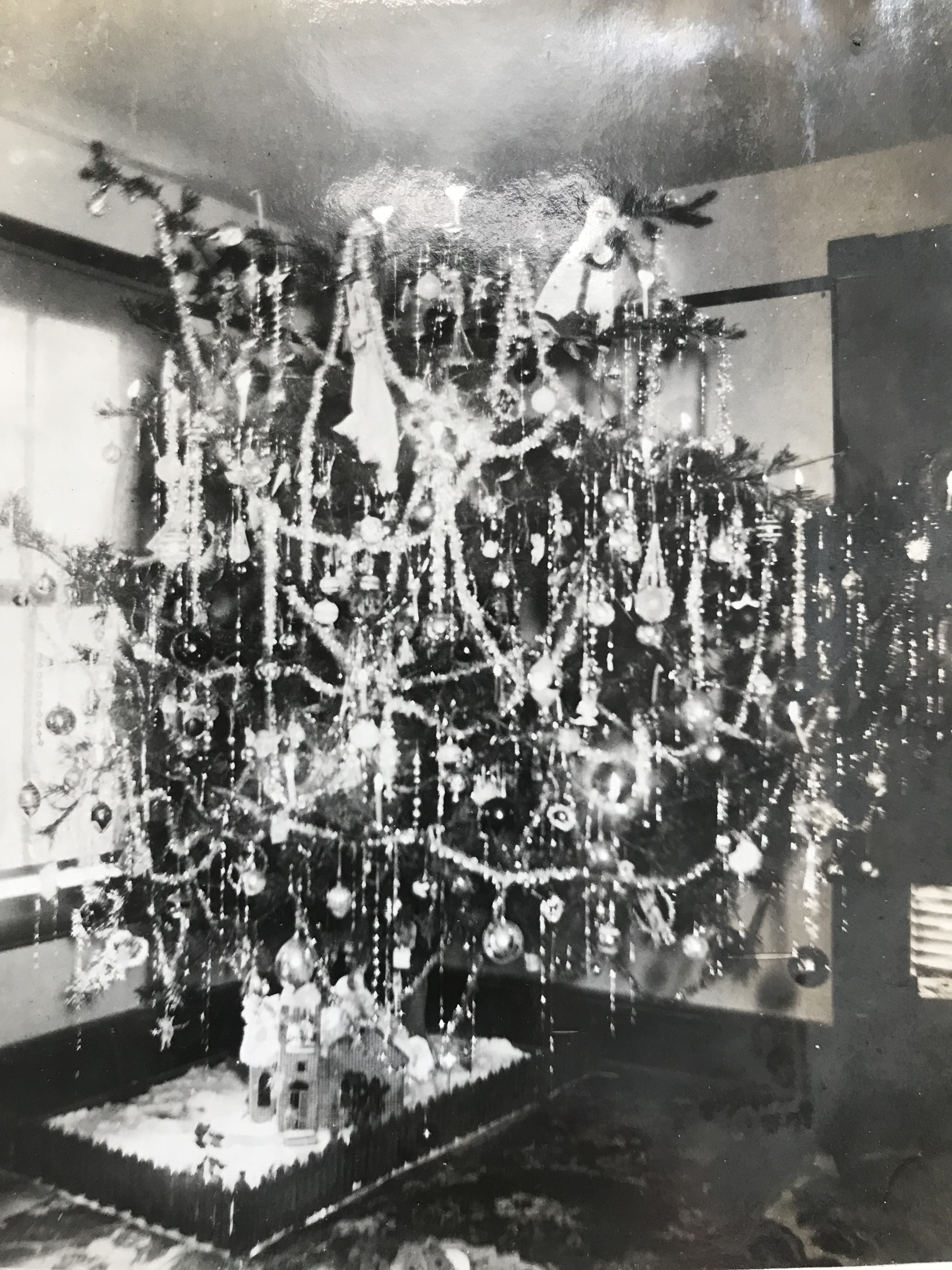
A small snow scene with what appears to be a miniature church is arranged at the foot of the Christmas tree. A popcorn garland adorns the tree. Photo by Lewis Reed
So, where did Washingtonians get their trees?
From The Evening Star, Washington, DC 23 December 1923:
Conduit Road on the long stretch between Glen Echo and Great Falls for many years has been a favorite hunting ground where hundreds and hundreds of families have customarily obtained scrub pine trees for Christmas week. Usually there is plenty of holly and some mistletoe to be found in the rugged and rolling hill lands which are the gateway to Great Falls.

No room for a star on the top of this tree! And just look at those big Santa and Angel dolls. Other fun little details are notable, including a miniature church with picket fence is arranged at the base of the tree. Photo by Lewis Reed
There’s a fine art to decorating Christmas trees that’s been developing since over 100 years ago. People consider lights, garland, ornaments, skirt, and more. But one thing that’s hard to resist sometimes is just filling every available space with decorations. Clearly, that was the case years ago too. What I like about these trees is that they are so randomly shaped and even misshapen. Folks back then didn’t trim them down to a more aesthetically pleasing symmetry like we do today.
The tradition of building miniature Christmas village landscapes, including houses, animals, and other hand-crafted wooden figures, began with the Pennsylvania Dutch in the late 1800s. Mass-produced cardboard houses, sold in dimestores, became popular in the mid-20th century. Today, these villages in good condition can be highly collectible.
Below are photos of Lewis Reed’s snow village set up under the Christmas tree decorated with vintage ornaments, tinsel, and lights. I don’t remember the odd-shaped Christmas trees, but I do remember having a lot of fun helping my grandfather set up the miniature landscapes with the varied figures, little houses, and trees at Christmastime each year. It seemed like a holiday village right out of a storybook.
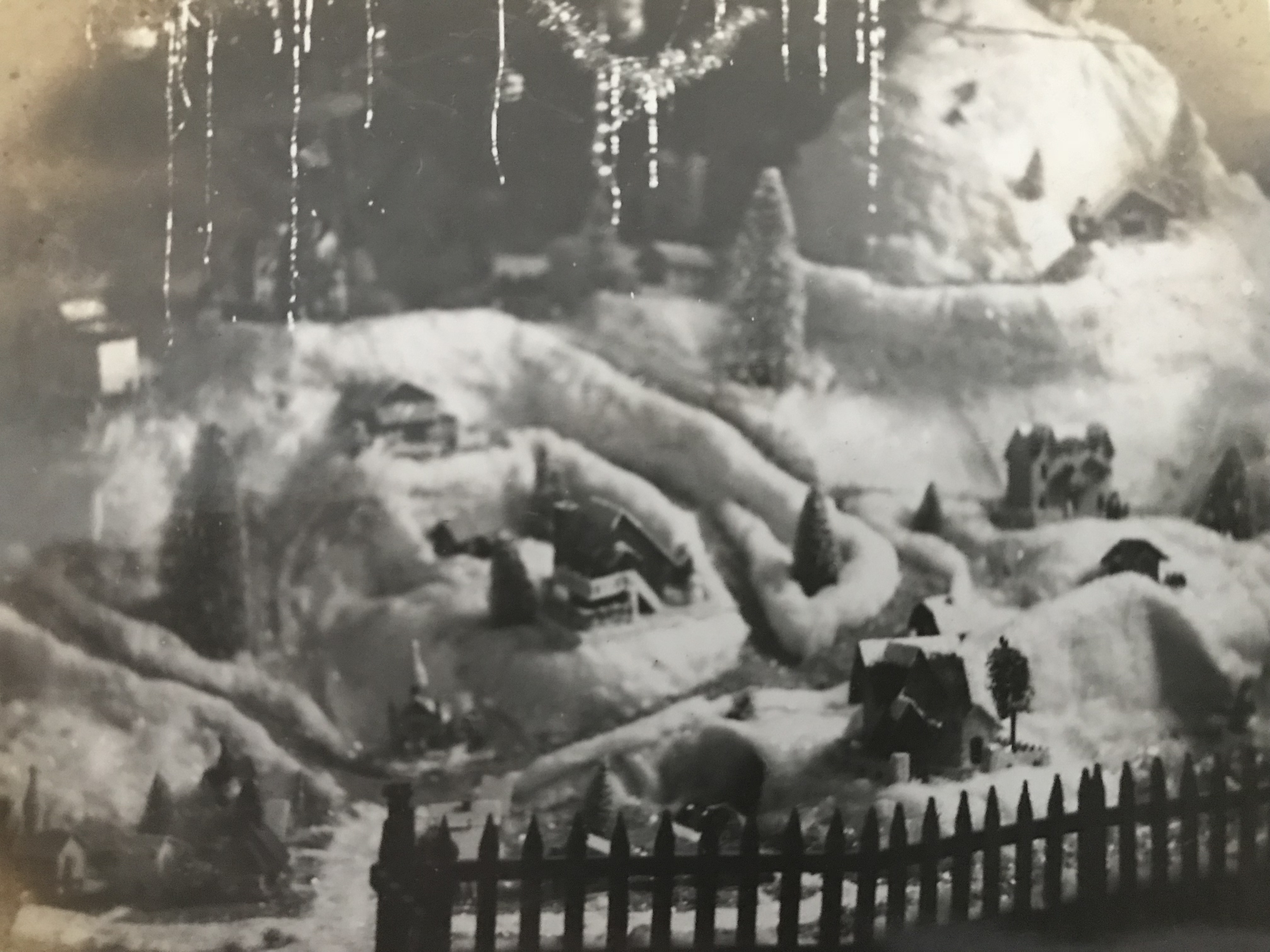
A rustic picket fence is used to set off the village display. Dangling strands of tinsel hang below the tree. Photo by Lewis Reed
The snow villages were set up in Lewis Reed’s basement on top of a big table beneath a small Christmas tree. He made the snow scenes entirely by hand using wire-covered cardboard and balled up paper to make hills and pathways. The little houses and figurines would fit into the landscape with cotton ‘snow’ all around; and lights would be wired underneath.

Little houses, churches, fences, trees, and pathways were added to the scene. Some of the houses have charming light effects in the windows. The roofs of the houses were decorated with fake snow. Photo by Lewis Reed
These Christmas villages were precursors of the Holiday Villages that were made popular by Department 56 that you see today.
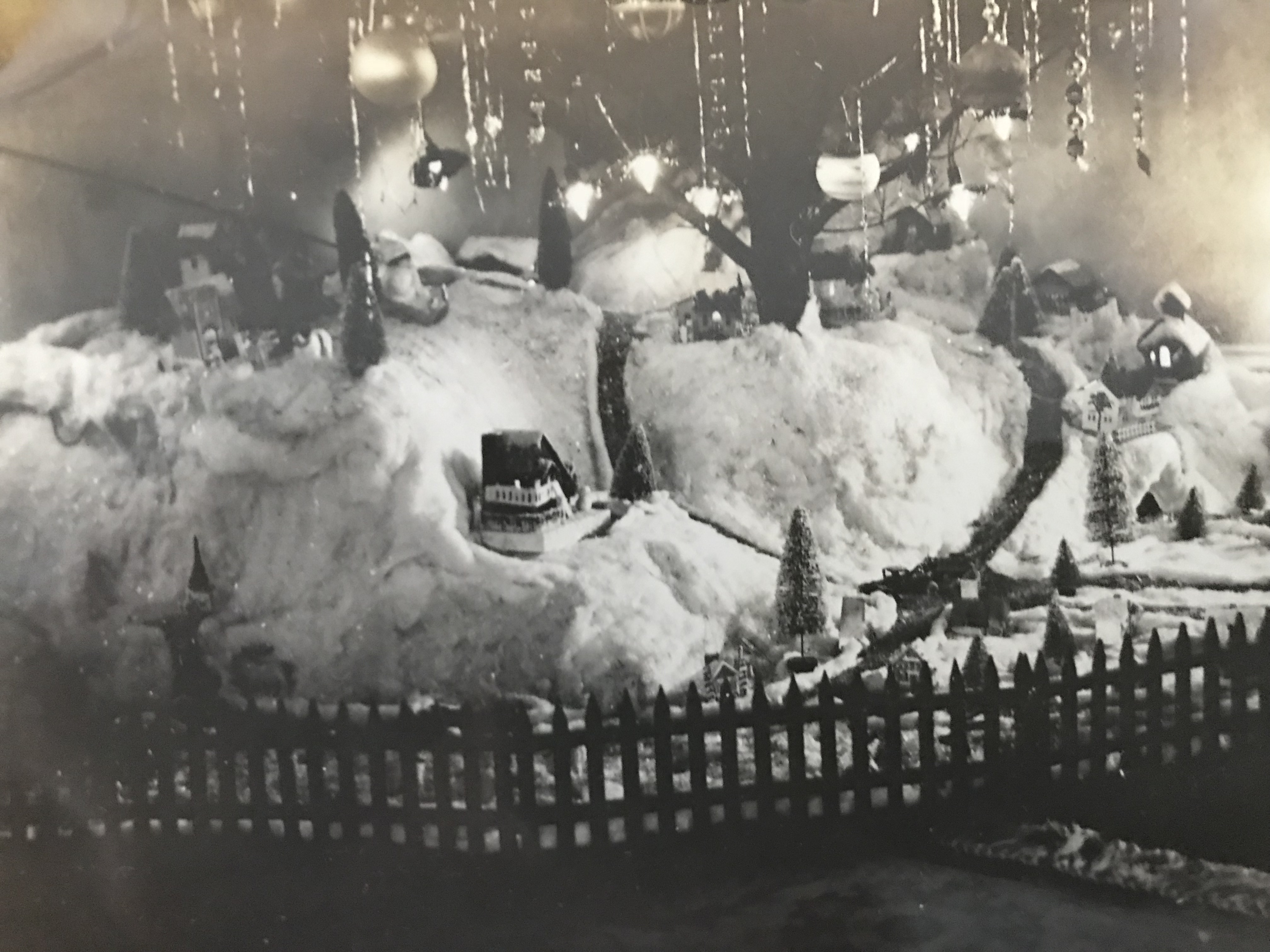
Old-fashioned lights can be seen on the tree, along with lit windows in the houses. The miniature houses usually had holes in the back or the bottom through which tiny lights were placed to provide illumination. Photo by Lewis Reed
Wishing all of you who have stopped in to visit a very Merry Christmas and Happy New Year! Stay safe and enjoy the holiday season with friends and family!

Dear Santa, Please Pause Here
This special post doesn’t have anything to do with Reed Brothers Dodge history, but it does have a lot to do with the founder’s daughter, Mary Jane (Reed) Gartner. In her younger years, Lewis Reed’s daughter (my mother) was a very talented ceramic and china painter. She painted the ceramic tray of Santa (below) for me Christmas of 2000 and entered it in the Montgomery County Agricultural Fair. Seventy-eight years old at the time, she won First Premium Prize. The tray is currently displayed in my dining room china cabinet and evokes memories of my childhood and makes me happy every time I look at it. I hope you enjoy this special post.

“Dear Santa, Please Pause Here” 2000 oil painting on ceramic tile by Mary Jane (Reed) Gartner.
Some background about the image
Have you ever heard of an artist named Haddon Sundblom? No? Well you’ve seen his work. You could say he’s one of the most famous character designers ever. He created the iconic Santa we all know and love. The image, “Santa, Please Pause Here” was originally created by Haddon Sundblom who was commissioned by Coca-Cola company to develop advertising images using Santa Claus. He may have been paid as much as $1,000 per painting—a lot of money at that time (you could buy a car for $700). Based on Clement Clark Moore’s descriptions of St. Nick in “’Twas the Night Before Christmas,” Sundblom’s Santa Claus emphasized the rosy cheeks and snow white beard along with the now familiar suit and hat. A wide leather belt and brown boots completed the look.
From 1931 to 1964, Sundblom’s creations for Coca-Cola had Santa pictured as doing everything from delivering toys (and playing with them!), pausing to read letters, visiting with children who had waited up to meet him on Christmas Eve, raiding the refrigerators of several homes, warming his feet by the fire, and other activities — always with a bottle of Coke in hand or nearby. The Sundblom Santa became so popular that the images spread from print ads onto billboards, posters, calendars, plush dolls, and more.
Below, is the original Coca-Cola Santa Claus painting and sketches by Haddon Sundblom.


In 2001, Haddon Sundblom’s Santa Claus was creatively brought to life in a Coca-Cola ad video tribute, animated by the Academy Award-winning animator Alexandre Petrov.
So the next time you envision Santa Claus and maybe even have a simultaneous unexplained craving for a Coca-Cola, please give a wink and nod to the artist Haddon Sundblom. He was instrumental in defining the image of Santa Claus for us all.
Wishing the very best of the holiday season to everyone, and of course, Merry Christmas!
Reference: Coca-Cola.com
Celebrating Lewis Reed’s 135th Birthday
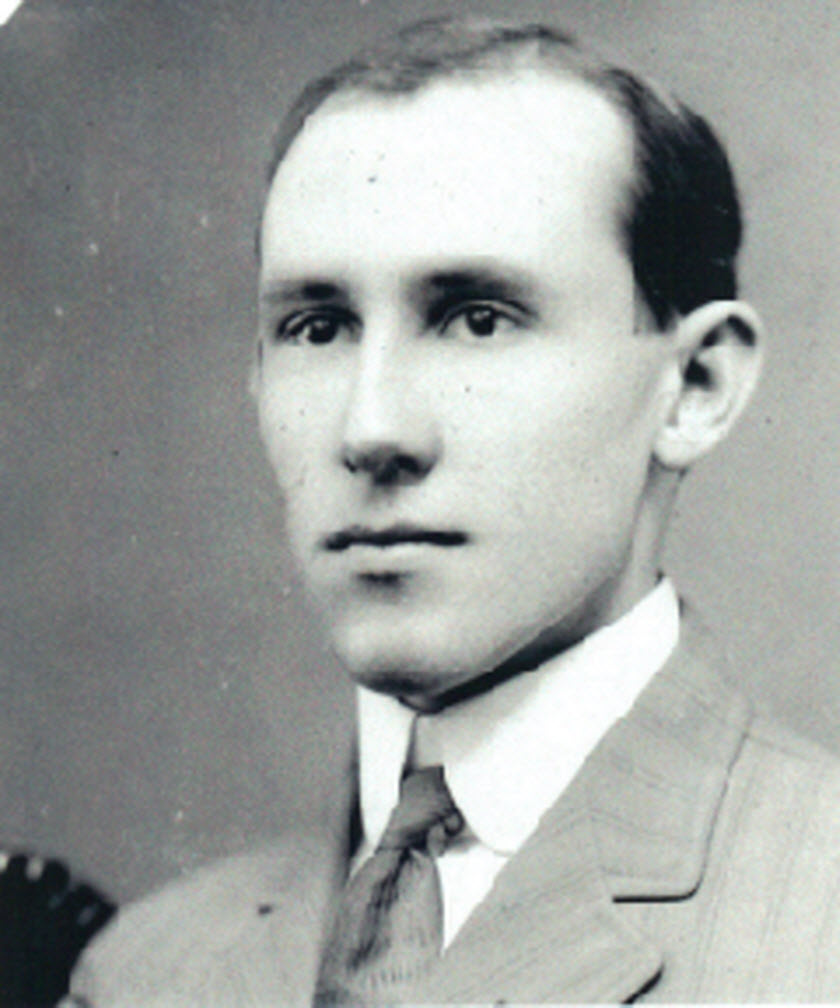
Lewis Reed (1887-1967)
Lewis Reed was born in Darnestown, Maryland on November 25, 1887 and was the founder of Reed Brothers Dodge. When Lewis Reed opened his car dealership in October 1915, he never knew he was starting a family tradition that would be carried out for 97 years and three generations. He founded what would become the oldest Dodge dealership under the same family ownership in the State of Maryland, and one of the oldest in the United States.
Success demands courage, dedication, perseverance and relentless hard work. As a young man, Lewis Reed apparently believed in the similar thought. He was the son of a blacksmith, raised in a large family that survived on knowledge and hard work. Tinkering with things and an interest in machines at an early age was probably encouraged by his father. The blacksmithing trade goes back about four generations in the Reed family. In those days, it was commonplace for sons to follow their father’s professions. The 1910 census indicated that 23-year old Lewis Reed was working as a machinist.
On the occasion of my grandfather’s 135th birthday, I thought I would revisit some interesting facts about him.
1. Lewis Reed’s passion for cars began at a very early age. He was full of curiosity, with an insatiable desire to know details, how things worked, and why. As a child, he would watch cars go past the family farm and then take off running across the fields to catch up with them until they would go out of sight. The “normal” speed during this time was so slow that drivers had difficulty keeping their cars from stalling out.
2. Lewis attended Darnestown School, a one-room schoolhouse which was located on Thomas Kelley’s Farm at Pleasant Hill. First through sixth grades were taught by one teacher to about thirty or more students. Few students went beyond sixth or seventh grade; in fact, Lewis Reed’s education stopped after the sixth grade. He would later be home-schooled by his wife, who was a teacher in the Maryland public school system.
3. Lewis Reed’s love of photography began at a very young age, at a time when most families did not own a camera. The oldest photo in his collection is dated 1898, which would have made him around 11-12 years old when he started using a camera. At the turn of the century, before automobiles were even around, he toured up and down the East Coast on his motorcycle, taking photographs of landscapes, monuments, historic places, and people. His entire collection spans more than six decades and showcases his love for people, automobiles, events, landmarks, and travel throughout the first half of the 20th century. Unsurprisingly, his love of both cars and cameras resulted in his taking numerous pictures of car culture all over the State of Maryland as it developed from infancy to supremacy.
4. Lewis Reed understood automobiles. He knew how they worked and how to fix them. He loved cars and anything associated with them. Prior to World War I, his love of automobiles led him to becoming a chauffeur. Lewis Reed worked as a chauffeur from roughly 1910-1914, before he became involved in the business of selling and repairing automobiles.
5. In October 1915, Lewis Reed received his franchise to sell Dodge Brothers Motor Cars with brothers Horace and John Dodge in Detroit; less than one year after the very first Dodge automobile was invented.
6. In 1941, the State of Maryland named the connector street behind the original dealership at the triangle, “Dodge Street,” commemorating Reed Brothers’ presence from 1915-1970. The connector street was so short that Lewis Reed always liked to joke, “if the state wanted to name a street after him, the street needed to be longer”. Hence the street was named, “Dodge Street”.
7. When the United States entered World War I, Lewis Reed worked at the Navy Yard in Washington DC as a torpedo tester.
Note: Interestingly, there’s nothing online that explains how torpedoes were tested during WWI. I was, however, able to find how they were tested during WWII. “Torpedoes produced by the Alexandria Torpedo Factory were transported to Piney Point on the shore of the Potomac River where they were fixed with dummy heads, fired from boats and then retrieved by men or tenders. The purpose of the facility was to see whether the torpedo could hold a straight course. Some of them are said to have sunk to the bottom of the Potomac where they now rest in mud.”
8. In the early 1930s, Lewis Reed inaugurated a new department of auto body and fender repair. He did this primarily because no other repair agencies were locally available to motorists. The new department enabled motorists to obtain this critical repair service locally in Rockville, whereas, in the past they had to travel to Washington, D.C. or Baltimore for such work.
9. During World War II, Reed Brothers Dodge had virtually no new cars to sell for three and a half years. But that didn’t stop Lewis Reed. When manufacturers halted car production and many dealers went bankrupt, Lewis Reed converted his car showroom into a display room and sold GE washing machines, Zuillen home freezers, Westinghouse radios, and other large appliances to fill the gap.
10. Active in the dealership daily until the day of his death, Lewis Reed passed on January 28, 1967 at the age of 79. Shortly after his death, the Senate of Maryland passed Senate Resolution No. 10, honoring the life and achievements of Lewis Reed. The resolution was sponsored by Senator Thomas M. Anderson, Jr and Senator Louise Gore.
Lewis Reed’s business philosophy was simple: “Treat your customer as your friend and always do what you promise.” These words aptly showcase his life and his passion for what would become his life’s work.
Books

Related Resources


Copyright Notice

Reed Brothers Dodge History (1915-2012) by Jeanne Gartner is licensed under a Creative Commons Attribution-NonCommercial 3.0 Unported License.
 Reed Brothers Dodge History 1915 – 2012
Recent Comments