
Martin Thompson House on Darnestown Road, 1907

Route 28, Darnestown Road Circa 1907 – Martin Thompson House, owned by Lewis Reed’s maternal grandfather. Photo by Lewis Reed.
The home in the photo was owned by James Martin Thompson (1825–1902), Lewis Reed’s maternal grandfather. It was then called “Pleasant Hills”, which was located just opposite of the Thomas Kelly farm. In the early days, it was common practice for a family to give a name to their property. The house was accessed from Darnestown Road by a long tree-lined drive.
Route 28, in Darnestown is depicted in this photo before paving. What is now Route 28 is one of the earliest roads in the county, and was one of the main ways farmers in Poolesville, Darnestown, Dickerson, and Barnesville reached the courthouse in Rockville. Darnestown Road has existed since before the Civil war, and it remained a mud path for years into the automobile age.
Most houses in the Darnestown “Pleasant Hills” area were not very large and most were made of wood rather than brick. According to the 1860 Federal Census, Martin Thompson’s occupations were listed as Carpenter and Farmer living in Darnestown, Montgomery County, Maryland.
This photograph won an honorable mention in a contest sponsored by Rotary International for Lewis Reed.
The Reed Family (Blacksmithing in Darnestown c. 1870)

Philip Reed outside of his Blacksmith Shop in Darnestown, Maryland c. early 1900s. Photo by Lewis Reed
Philip Reed (1845-1918), father of Lewis Reed, was an early settler in Darnestown, Maryland. He was a Blacksmith. Blacksmiths were once important members of the Darnestown community. They provided a vital trade that continued up to the mid-20th century. Born in Darnestown, Maryland on March 17, 1845, he was raised in a family that survived on knowledge and hard work. In 1870, at age 25, his occupation is listed as a Cabinet Maker and Blacksmith. Darnestown residents of that time included a doctor, a merchant, a blacksmith and a wheelwright. It seems Philip Reed may not have considered his primary occupation as a Wheelwright, but I do know that he had a Blacksmith shop on his land and he worked with both cabinet maker and blacksmith skills.
A blacksmith is a metal worker who creates objects from iron or steel by heating the metal and using tools to hammer, bend, and cut it. Civil war armies used blacksmiths to shoe horses and repair things such as wagons, horse tack, and artillery equipment.
A wheelwright is someone who makes and repairs wheels. Early wagon and cart wheels were made of solid wood, but increasingly had iron parts, such as hubs and rims. It would not be unusual for one man to be both a blacksmith and a wheelwright, for wheelwrights were sometimes described as a cross between a carpenter and a blacksmith.

Reed farmhouse and blacksmith shop in Darnestown, MD (Route 118). Photo by Lewis Reed
Saylorsburg Lake House / Hotel of Horror

Saylorsburg Lake House, circa 1915. Photo by Lewis Reed
In anticipation of Halloween, I thought it would be fun to feature a photograph that Lewis Reed took of Saylorsburg Lake House Hotel, now the site of Hotel of Horror. The old Lake House Hotel, depicted in the photo above taken by Lewis Reed in 1915, was once a vibrant Poconos retreat and a popular hotel for tourists. According to local folklore, during World War II, many of the employees at the Lake House were called to assist in the Pennsylvania National Guard, leaving the local asylum with one lone security guard to watch over the entire building. The inmates escaped, made their way to the hotel and took it over. The insane patients performed experiments on the guests. What was once a renowned resort for the rich and famous, shown here in 2001, became a torture chamber.
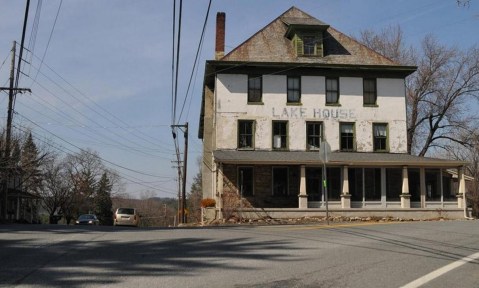
The Lake House Hotel in Saylorsburg, site of Hotel of Horror, 2001
Today it’s the site of the Hotel of Horror, a haunted-house attraction open during the Halloween season.
Happy Halloween to all the readers of this blog!
Featured Photo: 1914 Indian Motorcycle With Sidecar

Photo by Lewis Reed
This is a photograph taken by Lewis Reed of an Indian motorcycle with his brother, Edgar, seated in the sidecar next to Uncle Bernie Hanshew. From what I’ve been able to research, I believe it’s a 1914 Indian. The handle bars on a 1913 had no cross bar, the 1914 model had a cross bar that can be seen on this one. The tool box was mounted on the rear of the carrier in 1913 and moved to the top of the fuel tank in 1914. If anyone can help to date or confirm the identity of this machine please leave a comment.
In the early days, motorcycles were a staple of transportation, and both Lewis and Edgar Reed rode them.
Motorcyclists in the 1920s were more likely to wear a tie, goggles, and a sporty little cap than the leather of today.

A 1915 advertisement for the Indian Motocycle (spelling motocycle without the “r”)
Books

Related Resources


Copyright Notice

Reed Brothers Dodge History (1915-2012) by Jeanne Gartner is licensed under a Creative Commons Attribution-NonCommercial 3.0 Unported License.
 Reed Brothers Dodge History 1915 – 2012
Recent Comments