
The Great Frederick Fair Parking Lot Shot, 1914

This fascinating scene of hundreds of cars parked in the Frederick Fair parking lot was taken by Lewis Reed in 1914. What is fascinating to me is, with all of these early cars painted in black, how on earth would you find your car in the parking lot?
This week (September 14-22) marks the 156th edition of the Great Frederick Fair, the largest and greatest county fair in the State of Maryland. There have been many changes since the first fair was held in 1822 when it was known as the Cattle Show and Fair: that was a two-day event, now it’s nine days. The location has changed and so has the name. Today, the Frederick County Fair is officially named the Great Frederick Fair. It’s been held in May, October and November, but now (and for many years) takes place in September — rain or shine.
Fair entertainment has certainly evolved over the years. In 1888, May Lillie, an “expert girl shot with a rifle” from the back of a running mustang, performed. In the early 1900s, acrobatic bears and monkeys, high-wire acts and vaudeville performers took the stage. In 1950, the highlight of the “Irish Horan and the lucky Hell Drivers” show was a “stock convertible catapulted from a giant cannon.” In 1965, it was Jack Kochman’s Hell Drivers performing stunts with cars.
The Thursday of the 1911 fair was noted as a record day with 15,000 people in attendance, 100 autos and 1,000 carriages, according to “The Great Frederick Fair” book. Today, fair attendance can range from 210,000 to 250,000 people during the nine-day fair.
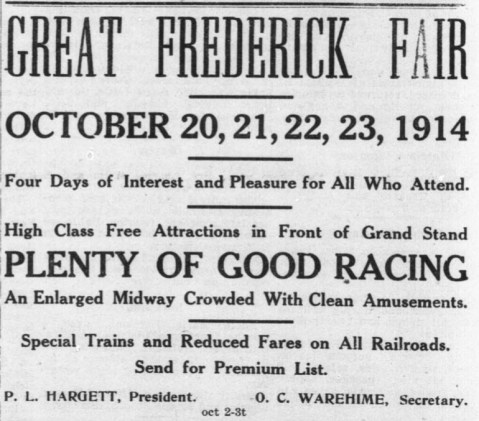
Newspaper ad advertising The Great Frederick Fair. THE DEMOCRATIC ADVOCATE OCTOBER, 1914
Source: Frederick News-Post
Photo Manipulation Without a Computer
If you take a look at the state of photography today, such as the advances of digital cameras and the artful image manipulation by Photoshop, it is easy to forget that back in the 1900s photographers couldn’t just go into a computer program and change their images any way they wanted. Instead of retouching an image on a computer, as it’s done now, it originally took place on the negative.
Photo manipulation was one tool Lewis Reed had in his photography tool belt. He was 100 years ahead of his time by creating special effects to images long before the convenience and efficiency of digital photography and Photoshop were ever imaginable.
I was hugely interested in how this was undertaken, and by the fact that the modification looked so seamless in the printed image. Spotting these manipulated photos in his extensive collection has been both easy and difficult. Some were simple double exposure images or hand colored images. The addition of these hand-drawn backgrounds was a little more difficult. It wasn’t until I viewed the high resolution scan that this modification jumped out at me.
Reading up on the subject I have become aware that retouching is in fact an art that evolved right alongside the birth of photography. The photographs below were retouched by hand (also known as “handwork”) on the glass negative using a hard graphite pencil and pieced together in the darkroom from separate photographs. The two photographs, one of the people standing on the edge of a cliff, and the other of the hand-drawn mountains, appear to be joined at the edge of the cliff where the mountains begin. All of this required a degree of artistic skill and access to a darkroom. Lewis Reed developed his own photographs in a darkroom in his house — in the kitchen, to be exact — and worked at night to develop the negatives.
The photographs below show two unknown people posing on a cliff in front of a hand-drawn background of mountains.

An original photograph retouched with hand-drawn mountains by Lewis Reed

Same photo as above, different angle, retouched by Lewis Reed.
Today, we can look back and appreciate the time and creativity it took to edit these photos without Photoshop.
Montgomery County Maryland Almshouse aka Poor Farm

The Montgomery County Maryland Almshouse aka Poor Farm was established in 1789 and torn down in 1959. A modern jail is on its site on Seven Locks Road near Falls Road. Photo taken by Lewis Reed.
A Poor Farm in Montgomery County? Yep. Although a lot of people have never heard of “poor farms,” they were once common across the nation. Various terms have been used to describe the “house for the poor,” and often the titles were unique to the part of the country where the house was located.
This is the Almshouse (aka Poor Farm). The 50-acre tract which includes the pauper’s graveyard was once part of the Montgomery County Poor Farm, established in 1789 as a place where the poor and homeless went to live, work, and, if they died, to be buried.
At the time, the farm was located well beyond the bounds of what was then the town of Rockville. But growth eventually caught up with the property. The farm house was razed in 1959 to make way for a county jail, and another chunk of property was dedicated for I-270. At least 75 graves were identified during a 1983 survey of the property by state archeologists, but according to George R. Snowden, funeral director, there may be as many as 500 people buried in the potter’s field.
Although the county’s poor farm existed for almost 170 years, virtually nothing has been documented about it, said Jane Sween, a librarian with the Montgomery County Historical Society. The property was deeded to the county in 1789 and expanded in 1825. After the Civil War, the farm’s almshouse was rebuilt, and until it was razed a century later it was home to an average of 40 indigent people, she said. The state paid for burial but did not pay for grave markers or upkeep on the property.
The Montgomery County Poor Farm Cemetery is no longer in existence. The National Park Service conducted an archaeological dig in 1987, which resulted in the removal of 38 bodies to Parklawn Cemetery in Rockville, Maryland. Montgomery County sold the land to a private developer.
Lewis Reed Shows Off His “Photoshopping” Skills… 100 Years Ago
If you take a look at the state of photography today, such as the advances of digital cameras and the artful image manipulation by Photoshop, it is easy to forget that back in the 1900s photographers couldn’t just go into a computer program and change their images any way they wanted. They did what they could with the tools they had. Double image exposure was one tool Lewis Reed had in his photography tool belt. He was doing crazy things to images and creating humorous effects over 100 years ago. With double exposure technique, you could create certain effects like placing the same person on both sides of a picture simultaneously. Photographs were pieced together in the darkroom from separate photographs.
Below are eight (circa 1920s) photographs from Lewis Reed’s collection that will make you do a double take. No digital manipulation here. (click on photos to enlarge)

A double exposure image of Lewis Reed’s brother, Edgar, seated on both sides of a table.
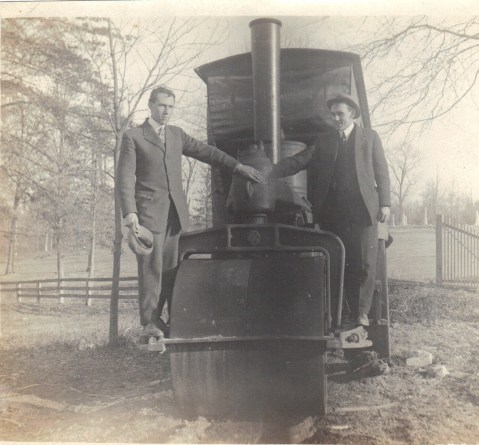
Lewis Reed standing on both sides of a steamroller

Another double exposure wonderment. Wanna Fight?

Oh No! What on earth are they doing? I don’t know, but this one is epic.
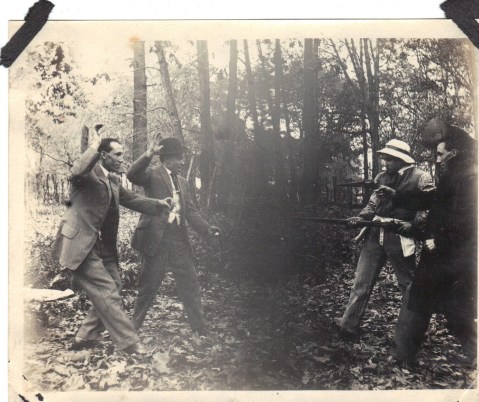
Don’t Shoot! Lewis Reed is standing both front left and front right in this photo
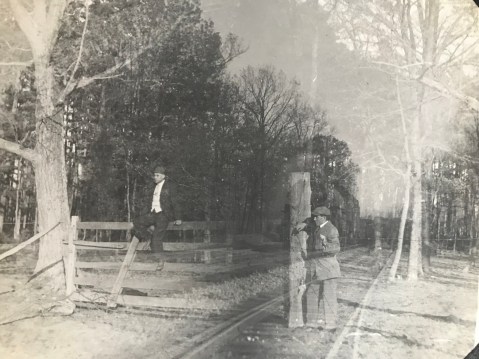
Surrealistic, ghost-like effect of Lewis Reed standing next to a tree in the middle of train track.

More “photoshop” fun. Lewis Reed pushing the same man in baby carriage on both sides of the photo.
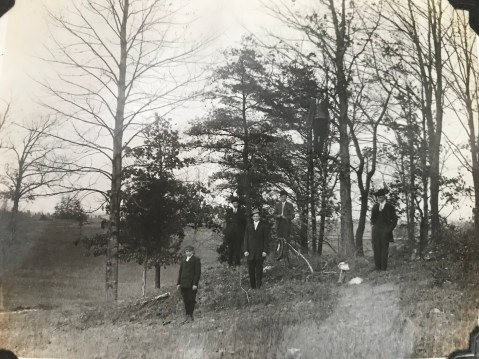
It’s a bird, it’s a plane .. no, it’s a man up in a tree!
Early Car Starters: How Did Old Cars Start?

Lewis Reed hand cranking an old car. The hammer in Lewis Reed’s right hand is for straightening the hand crank. Apparently they can bend when starting big engines. The license plate is MD 10307 dated 1913.
Today, we take the starting of automobiles for granted. Simply place the key in the ignition, turn, and VROOM, the engine starts. Vintage cars from from the 1900s and 1910s were comparatively archaic and limited in their mechanical features. Even starting these old relics was difficult because the process involved a number of complicated steps that the driver had to perform in the correct order.
However, this was not always the case. Hand cranks were the most common type of engine starters in the early days of the automobile. Cars in the early parts of the century had to be started by hand. This was accomplished by turning a crank, usually located in the front of the automobile. The driver would literally “crank the engine” by turning the handle, which would allow the process of internal combustion to begin. After a given number of cranks, the engine would begin to run on its own, and the crank could be removed.
Although hand crank starters were simple and reliable, they suffered from a handful of drawbacks. The main issue with this method of starting an engine is that it is inherently dangerous to the operator. For instance, if an engine kicks back during the cranking process, the operator could get TKO’d by the hand crank. Although many of these cranks used overrun mechanism, there was also a potential for injury if the handle continued to turn after the engine started running.
The other main issue with hand crank starters is that it took a certain degree of physical effort to turn them. That meant anyone who lacked the necessary physical strength or dexterity was incapable of starting a vehicle equipped with this type of starter.
By 1920, nearly all manufacturers were producing cars equipped with starters making it easy for anyone, regardless of physical abilities, to start a car by pressing a button mounted on the dash or floor. An ignition on and starter engage switch operated by a key was introduced by Chrysler in 1949.
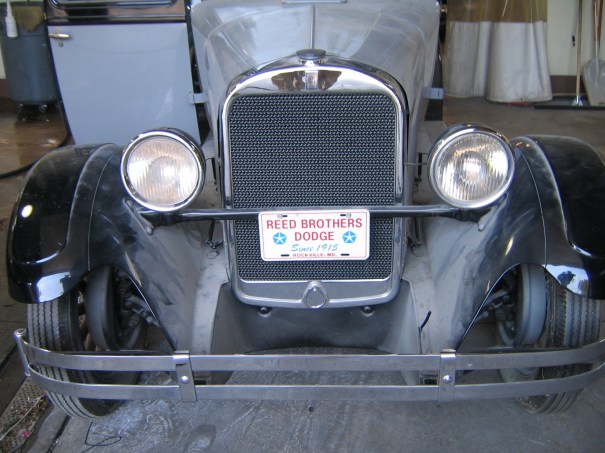
1928 Dodge Brothers Standard Six had both hand crank and starter. I’m assuming the crank was a backup in case the starter failed. The crank hole cover can be seen just below the front grill. Photo by Reed Brothers Dodge
Several new mechanical innovations were included in the 1946 Dodge Deluxe models. Among them were the introduction of the famous Fluid-Drive, a push-button starter system. The dash-mounted button on the 1946 Dodge Deluxe pictured below activated a solenoid, which in turn engaged the starter. For the first time since 1928 there was no provision made to manually hand crank the engine.

The push button starter on this 1946 Dodge Deluxe Fluid Drive was located on the far left, below the instrument gauges. Photo by Reed Brothers Dodge.
Books

Related Resources


Copyright Notice

Reed Brothers Dodge History (1915-2012) by Jeanne Gartner is licensed under a Creative Commons Attribution-NonCommercial 3.0 Unported License.
 Reed Brothers Dodge History 1915 – 2012
Recent Comments