
SECO, 1914: Rockville’s First Movie Theater
Around the turn of the century, people began to think about places filled with seats where movies could be shown. Budding exhibitors took existing stores, gutted them, decorated the fronts, and installed seats. They added screens, sat a piano player under the screen and built tiny booths for the primitive projectors. With a staff made up of friends and family as cashiers, doormen, ushers, and projectionists, they were ready to make their fortunes.
The Seco, Milo, Arcade, and Villa Theaters presented movies in buildings on the main street in Rockville, Maryland from the 1920s through the 1960s.

This image of the Suburban Electrical Company (SECO) shows how it looked in 1914. The upper story of the building was the living quarters of Mr and Mrs B. F. Hicks. The building was later acquired by W. Valentine Wilson, who tore it down and replaced it with the “SECO” Theater. The ground floor was made into a moving picture theater. Posters can be seen displayed on the front of the building. Photo by Lewis Reed.
The SECO theater in Rockville was opened for silent films and vaudeville shows around 1915 in what had been a general store dating back to Civil War days by W. Valentine Wilson. Prior to its opening, impromptu showings of films were held around the county at various stores and commercial buildings. It was perhaps the earliest movie house in Montgomery County and drew patrons from as far away as Mt. Airy in Frederick County.
Mr Wilson had operated an electrical business in the building and the SECO got its name from that business, the Suburban Electrical Company. The earliest ad for the SECO is in the Montgomery County Sentinel of October 22, 1915:
Shows four times a week – Monday, Tuesday, Thursday, and Saturday. Our Monday night feature shows are the finest ever exhibited in Rockville and the management will continue to give nothing but the best of film service to the town.
On Saturday, October 23, we will feature Sally Crute and Augustus Phillips in a strong three-reel drama entitled, “Her Vocation,” with two other reels of laughter and side-shakes. … You never waste time by enjoying SECO moving pictures.
The SECO ran 10 films days after the first-run theaters in downtown Washington and had protection over the rival Takoma, Tivoli, and York theaters. A July 1916 advertisement read, “Paramount pictures at the SECO Theater three times every week, Monday, Thursday, Saturday, starting at 7:30 P.M.”
By the mid-1920s, the SECO had moved to 509 Commerce Lane. Sidney Lust took over the operation of this theater between 1931 and 1935 and renamed it the Arcade Theater. He installed a sound system in the Arcade for $2,250 in 1932 and closed it down on April 21, 1935. He opened the new Milo later that year.

North side of Commerce Lane near the courthouse. Right to left: H. Reisinger Bakery, W. Hicks General Store, Suburban Electrical Company (SECO), and a two-story dwelling. Note the trolley car on the left. Photo by Lewis Reed, 1914.
Wilson also owned the SECO in Silver Spring that opened on November 7, 1927. Costing $60,000 to build, Silver Spring’s SECO had 500 seats and featured a 12×16 ft. screen and a projection system “said to be the latest word in motion pictures machines.”
Several Rockville businesses closed their doors during the depression. Some suffered from modern competition, and the economic downturn finished them off. Val Wilson’s 1929 purchase of a new organ to accompany silent movies at his SECO Theatre was the final straw for an enterprise losing ground to the “talking pictures” or “talkies”.
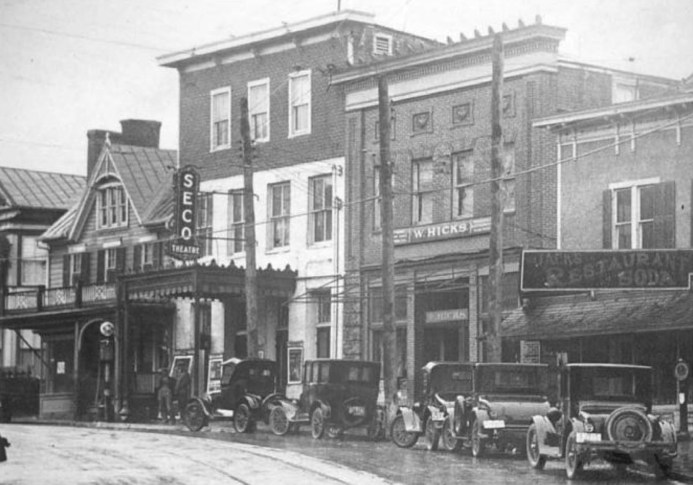
This image of W. Valentine Wilson’s Seco Theater shows how it looked after its move from 402 Montgomery Ave to 310/509 Commerce Lane. Date unknown. (The Robert A. Truax Collection)
From The Evening Star, Washington, DC 25 Jul 1935:
One of the most modern theater, store and office buildings in this section of the country will be opened here September 1 when work is completed on the new Milo Theater on the site of the old Lincolnway Inn.
The structure is being erected by Rufus E. Milor of Rockville, contractor and owner, at a cost of $100,000, and it will contain two stores and 14 office rooms in addition to the theater, which is named for the owner of the building. The two stores, Peoples Drug Store and Sanitary Grocery, Co. will flank the theater lobby.
A two-story building with a modernistic, white limestone front, the new structure will be an attractive addition to Rockville’s business section. In addition to the main structure, Milor is building a new restaurant on an adjoining lot.
A paved parking area large enough to accommodate 300 cars will be opened at the rear of the main building.
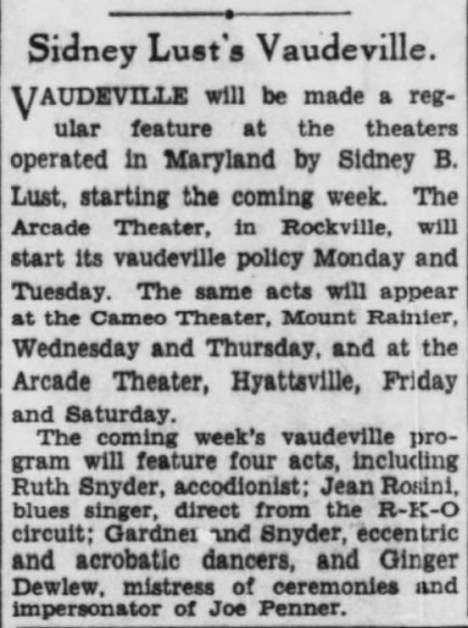
Sidney B. Lust, owner of a chain of theaters in and around Washington, will operate the Milo. A stage to take care of any vaudeville requirements will be built, and the theater will seat 750.
The Evening Star, Washington, DC 12 August 1934

The Milo Theater (120 Commerce Lane) was designed by John J. Zink and named after its owner, Rufus E. Milor. It opened in October 1935 and lasted until 1969. Sidney Lust operated it until 1955. The name was changed to the Villa in 1956. Google Image
The theatre continued through to the late 1960s. Seating about 700+, in the mid 1950s, the name was changed to the Villa by new owners. The old movie house has since been torn down years ago, and the site built over. In a 1914 Theatre Guide, the Rockville Opera House was found listed, with theatre seating on the second floor of the building.
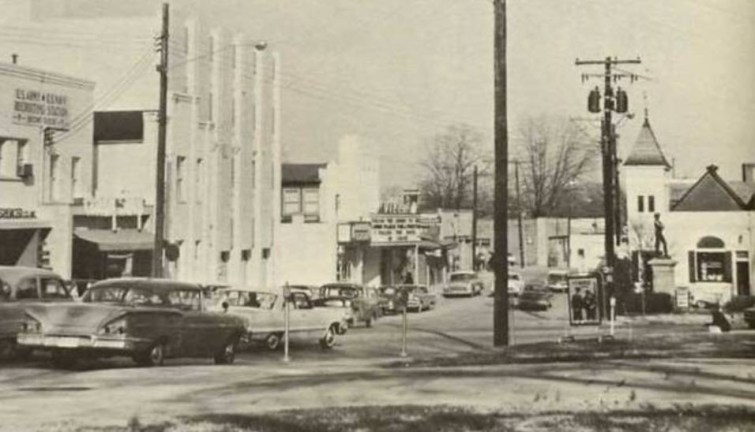
A 1963 photo of the Milo Theatre when it went by the name of the Villa. Google Image
Sources: Motion Picture Exhibition in Washington, DC: An Illustrated History of Parlors, Palaces and Multiplexes in the Metropolitan Area, 1894-1997
Newspapers.com online archive
“Maryland’s Motion Picture Theaters” Images of America Series
Rare Images of Early Rockville from Lewis Reed’s Collection
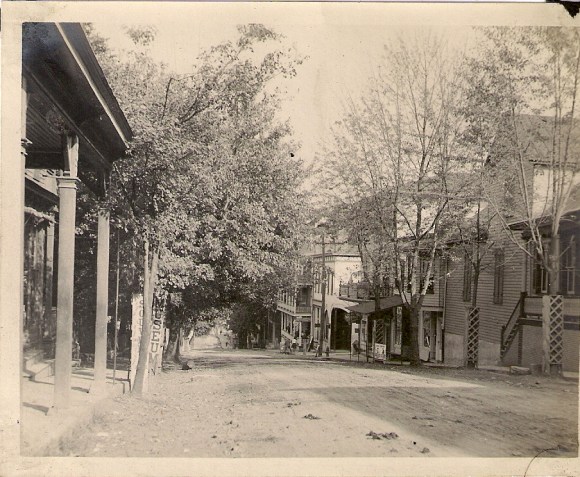
This photograph was marked only “Rockville.” Note that the sidewalks are board planks elevated from street level. Photo by Lewis Reed ca, 1912
What makes Rockville such an interesting place? It’s interesting history! Old photos have an amazing way of showing us what life was like years ago and depicting how our communities once looked. You might not realize how much things have changed until you look back and see what it looked like in the past.
A bit of Rockville history: More than 250 years ago, land grants to European settlers formed the nucleus for today’s Rockville, Maryland. By the 1750s local farmers were transporting tobacco to market in Georgetown down a road formerly used by Indians. The tiny settlement was designated as the seat of the new Montgomery County in 1776. Known as Rockville by 1803, the town’s life centered on Courthouse activity. More homes and shops were built, and the town of nearly 600 was incorporated in 1860. The dynamics that created Rockville in the 18th and 19th centuries are still the same ones attracting newcomers today: the presence of county government, a favorable location close to the nation’s capital, converging transportation routes that bring people here, and identity as an independent municipality.
Take a journey back in time through the lens of Lewis Reed and see what Rockville looked like more than one hundred years ago. As always, click the photos to get a better look.

North side of East Montgomery Avenue near the courthouse, ca. 1914. Note the trolley car on the left. Photo by Lewis Reed
Shops sold groceries, baked goods, sewing machines, hats, lumber, and hardware. Families lived above their stores, renting rooms to others.

Court House Triangle. The large white house behind the Confederate Statue is the Hicks House. The Montgomery House Hotel is to the right of the Hicks House, just out of the image. Photo by Lewis Reed, 1914
On September 28, 1917 a draft for World War I began and the first 40 men reported for duty at the Montgomery County Court House in Rockville, Maryland. In the photograph below, cars are parked around the court house during the speech-making in the court room to drafted men. Montgomery County’s first recruits left Rockville by train for Camp Meade, Maryland on this same day. They each received a package of smoking tobacco and a rousing send-off from two thousand people after speeches at the courthouse, dinner at the Montgomery House Hotel, and a parade to the depot. About 160 Rockville men served in the eighteen-month war. One of those men was Rockville resident, Edgar Reed. Edgar was fortunate enough to survive World War I and to settle back in Rockville and enjoy a successful life and career in the automobile business.

Montgomery County Court House. Photo by Lewis Reed, 1917.
Notice that most of the cars in the above photo have two license plates: at this time, you needed a separate tag to drive a car in the District of Columbia. There is also horse dung in the dirt road (E. Montgomery Avenue), suggesting buggies had been by recently as well. Barely visible in the background left is the Maryland National Bank building, which was demolished during urban renewal in the late 1960s.

Suburban Electrical Company on Montgomery Avenue in Rockville. Photo by Lewis Reed, ca.1914
The upper story of this building was the living quarters of Mr and Mrs B. F. Hicks. The building was later acquired by W. Valentine Wilson, who tore it down and replaced is with the “SECO” for Mr Wilson’s Suburban Electric Company. The ground floor was made into a moving picture theater.

W. Hicks General Store on Montgomery Avenue Rockville. Photo by Lewis Reed, ca. 1914
Washington Hicks operated this general or dry goods store in Rockville from the late 19th century until 1940. His son W. Guy Hicks continued to run the store until his retirement in the late 1950s. The photo above shows the storefront in 1914.

H. Reisinger Lunch Room on Montgomery Avenue Rockville 1914. Photo by Lewis Reed, ca. 1914
H. Reisinger Bakery, Confectionery, Ice Cream and Lunch Room, 5 and 10-cent Bargain Store on Montgomery Avenue, Rockville.
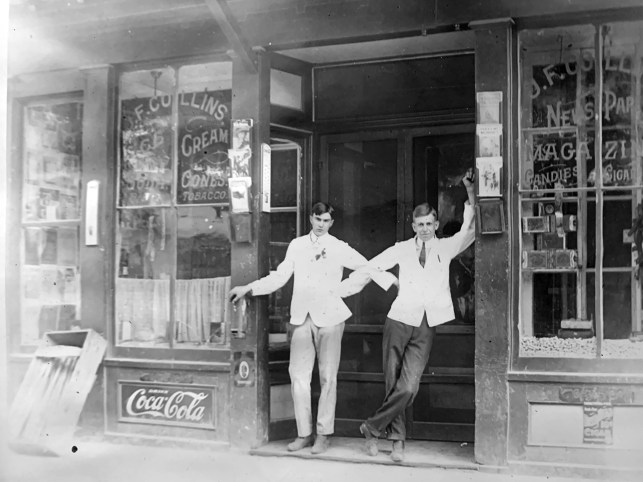
Clerks at J. F. Collins General Store on East Montgomery Avenue. Photo by Lewis Reed, ca, 1914
On a bleak night in February 1921, a pistol shot was fired while others yelled, “Fire!”. From John Collin’s store on East Montgomery Avenue — beloved by local children for Cracker Jacks and penny candy — flames reached toward the sky. Volunteers arrived with buckets while others operated the hose reels and hook and ladder truck. The main street was saved with help from men and equipment of Washington, D.C., but Collins’s store was a smouldering ruin. A few weeks later, fifty concerned townspeople elected officers of the newly formed Rockville Volunteer Fire Department.

Rockville looking east down Montgomery Avenue at Perry Street (now Maryland Avenue); Vinson’s Pharmacy is on the corner. Photo by Lewis Reed, ca. 1906.
Most roads in Montgomery County, even those running though towns, were dirt. In the photo above, taken in downtown Rockville, a delivery wagon can be seen at the curb, as well as advertisements for Coca-Cola, which would have been a product only 20 years old at that time, having been invented and trademarked in 1887. Trolley tracks bisect Montgomery Avenue. Today, the view down this street ends with stairs to the pedestrian overpass, which leads over Hungerford Drive into the Rockville Metro Station.
The drugstore was built in the 1880s and was run by Robert William “Doc” Vinson from 1900 until his death in 1958. The drugstore was also a popular gathering place for city politicians, and that President Woodrow Wilson once personally traveled there to buy Wolfhound tablets. The building was torn down in 1962, and replaced with an office building during Rockville’s “urban renewal”.

Vinson’s Drug Store Fearon’s Pharmacy (as named in the window; also Owen’s and Vinson’s at other times). L to R Tom Talbott, Wardlow Mason, Otho Talbott, unknown, Dr. Fearon. Photo by Lewis Reed, ca. 1898.

Rockville Town Hall. Photo by Lewis Reed, 1912
Rockville Town Hall was incorporated in 1881 to “improve the educational, moral, scientific, literary and social condition of the community. Stock sold at ten dollars per share raised most of the six thousand dollars needed to erect a handsome two-story brick building on Montgomery Avenue. The Town Hall opened on Tuesday evening, July 18,1882. For the next half century, the Town Hall operated as a small-town cultural center, with a four hundred-seat auditorium on the second floor, a stage, balcony, and dressing rooms, a ticket office on the lower level and seven leased offices. The community used the facility for visiting lectures, theatrical and musical performances, dances, and other suitable “instruction and amusement”.

Rockville Court House. Photo by Lewis Reed, ca. 1914
For most of Montgomery County’s history, a single building, familiarly known as “The Courthouse,” served all functions of local government. The Red Brick Courthouse is the county’s third on this site, constructed in 1891 at a cost of $50,000. Roads were crude, daily trains connected county commuters and farmers with the nation’s capital, and trolley tracks were planned between Rockville and Georgetown. The county’s 27,185 residents visited the courthouse as litigants and jurors, to pay taxes, buy dog tags, probate wills, obtain marriage and business licenses, record deeds, speak to County Commissioners, and request law enforcement from the Sheriff. Designated a historic building on July 19, 1965 by the Montgomery County Historical Society.

St Marys Catholic Church. Photo by Lewis Reed, c. 1914.
Founded in 1813, historic St. Mary’s Church led the way for Catholics in Montgomery County. The cemetery in front of the chapel is the final resting place of literary legend F. Scott Fitzgerald and his wife Zelda.
Sources:
75 Years of Rockville, Maryland
As remembered by William F. Prettyman
Rockville: Portrait of a City by Eileen S. McGuckian
Books

Related Resources


Copyright Notice

Reed Brothers Dodge History (1915-2012) by Jeanne Gartner is licensed under a Creative Commons Attribution-NonCommercial 3.0 Unported License.
 Reed Brothers Dodge History 1915 – 2012
Recent Comments