
October 1915: The Birth of a Rockville Automobile Legacy
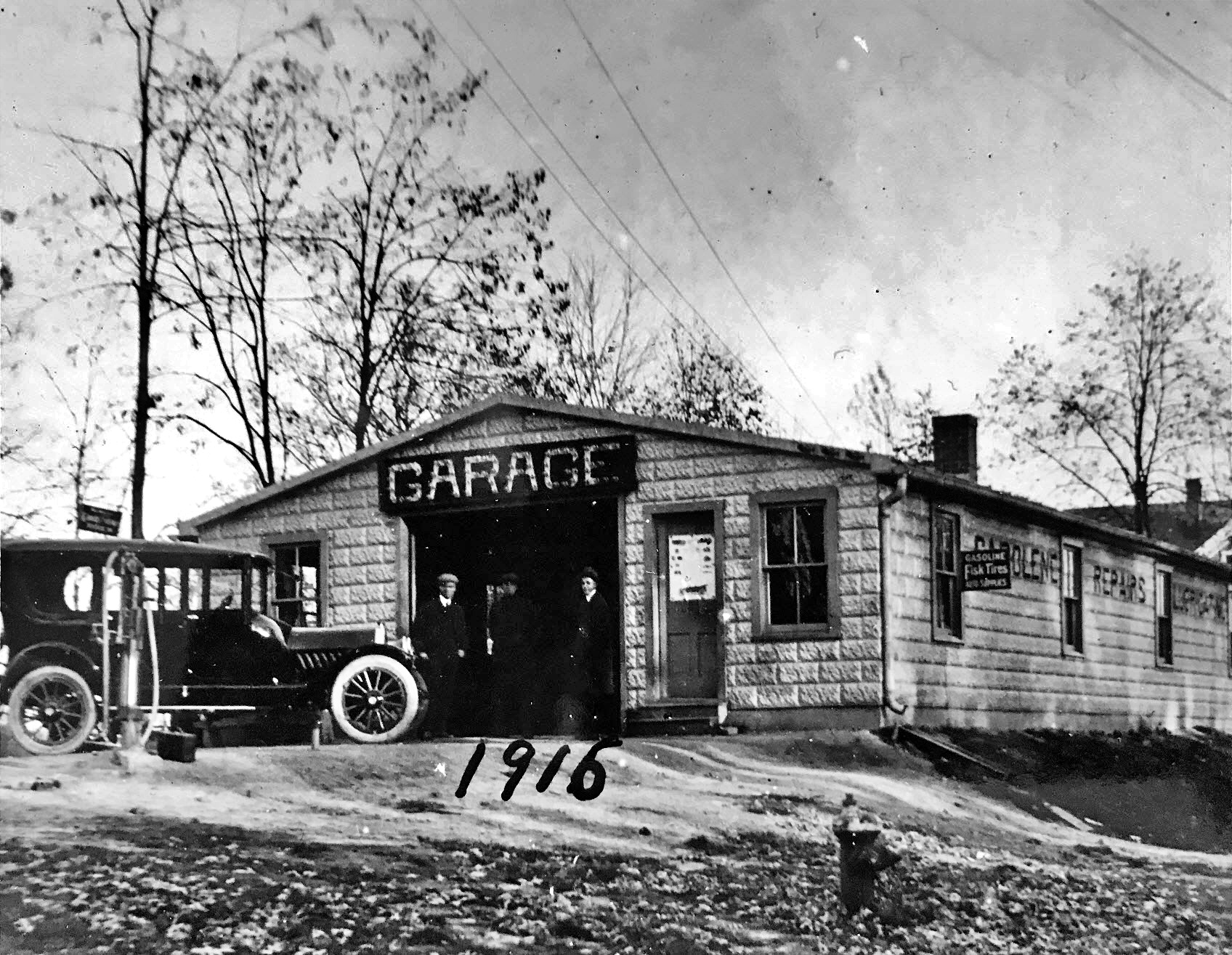
Rockville Garage, 1916. The early automobile garage at the intersection of Rockville Pike and Veirs Mill Road, where Lewis Reed and his partners were building the business that would soon become Reed Brothers Dodge.
111 Years Ago This Month, Reed Brothers Dodge Began Its Remarkable Journey
In October 1915, automobiles were still something of a novelty on the roads of Montgomery County. Horses and wagons remained common, many rural roads were unpaved, and owning a motorcar was far from an everyday experience. Yet the automobile was beginning to change how Americans traveled, worked, and connected with the world beyond their own communities.
It was against this backdrop, 111 years ago this month, that the story of Reed Brothers Dodge began.
Only a few months earlier, in July 1915, Lewis Reed had entered the automobile business with Roy and Griffith Warfield in a newly established enterprise known as Rockville Garage. The business operated at the busy intersection of Rockville Pike and Veirs Mill Road, an important crossroads at the edge of Rockville.
The location already had a brief connection to the automobile trade. In 1914, Lee Ricketts and his sons had operated an Overland automobile agency there, one of the earliest automobile sales operations in the area. Lewis Reed was not involved with the Overland agency, but the activity at the site reflected just how quickly the automobile was beginning to find a place in everyday life.
A New Automobile Company Comes to Rockville
The decisive moment came in October 1915, when Rockville Garage secured a franchise to sell Dodge Brothers Motor Cars.
The timing was remarkable.
John and Horace Dodge had introduced their first automobile only the year before, in late 1914. The brothers were already highly respected within the automobile industry, having supplied engines, transmissions, and other components to some of Detroit’s leading manufacturers before placing the Dodge name on a car of their own.
Their new automobile quickly earned a reputation for sturdy construction and reliability.
Far from Detroit, in the small county seat of Rockville, Lewis Reed and his partners recognized an opportunity.
The arrival of the Dodge Brothers franchise gave Rockville Garage an automobile line that would ultimately define the business for nearly a century.
At the time, no one could have known what that decision would become.
There was no sprawling dealership, no large showroom filled with rows of new cars, and certainly no modern service department. Early automobile dealers were often mechanics, salesmen, gasoline merchants, tire repairmen, and problem-solvers all at once. Keeping the early motorist on the road could be as important as selling the automobile itself.
Rockville Garage grew out of that pioneering era.
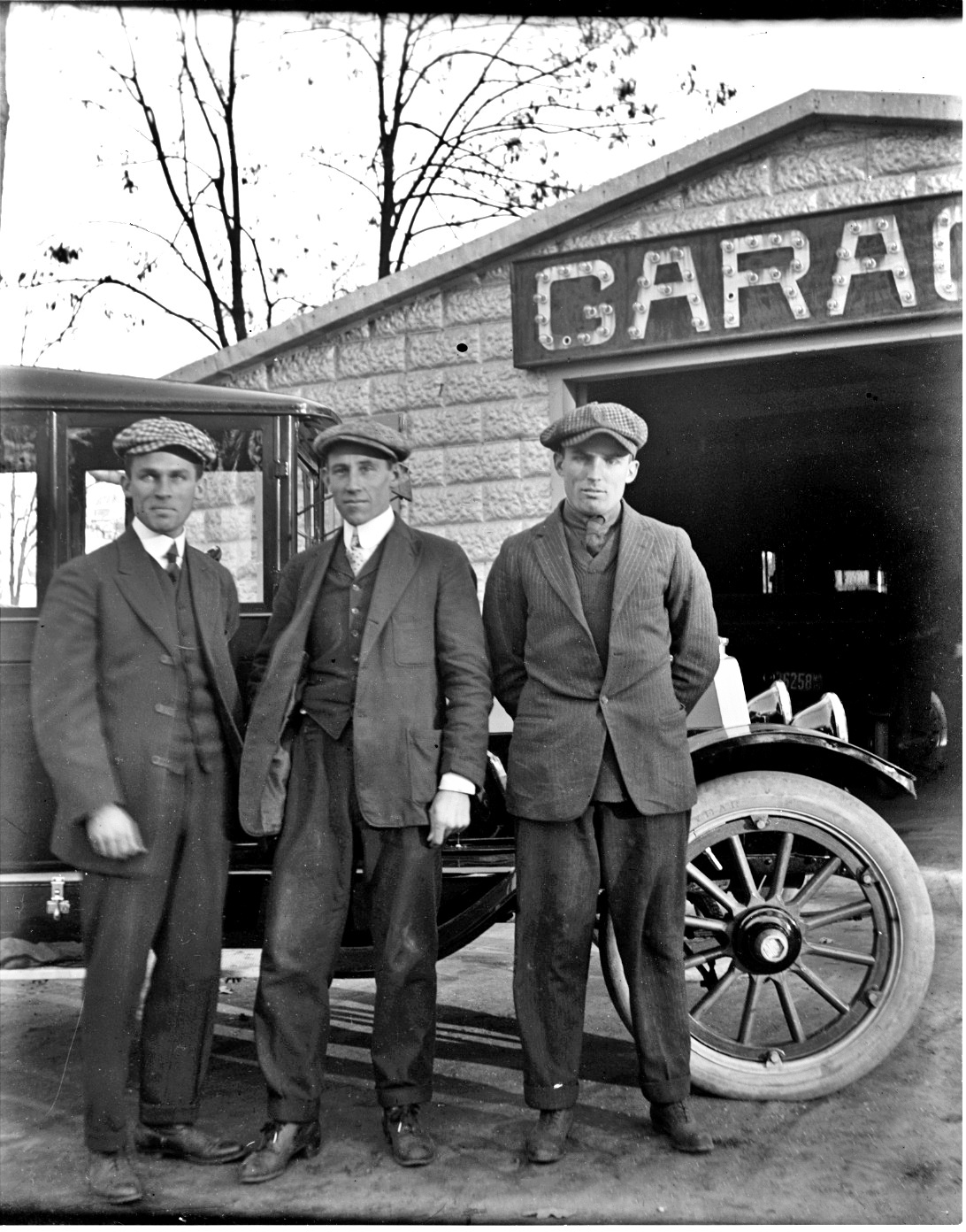
Original Owners of Rockville Garage, 1915. Lewis Reed with Roy and Griffith Warfield, the original partners in the Rockville automobile business that would become Reed Brothers Dodge.
Building a Business in the Early Automobile Age
Lewis Reed was a skilled mechanic as well as a businessman, an important combination when automobiles still required frequent adjustments and repairs. During the early years, the garage represented several makes in addition to Dodge, a common practice among automobile dealers of the period.
But Dodge gradually became the name most closely associated with the business.
The garage also sold gasoline, tires, accessories, and even farm equipment. Automobile dealerships of the 1910s were rarely limited to the sale of passenger cars. They served a community that was only beginning to discover what motorized transportation could accomplish.
The automobile was changing Montgomery County one road and one family at a time.
Farmers could travel farther to market. Doctors could reach patients more quickly. Businesses could move goods over greater distances. Families could visit relatives and neighboring towns without relying entirely on railroads or horse-drawn transportation.
Rockville Garage became part of that transformation.
From Rockville Garage to Reed Brothers Dodge
In 1916, Lewis Reed purchased a one-third interest in the business. Three years later, in 1919, he bought out the Warfield brothers.
That August, Lewis’s brother Edgar Reed joined him as a partner.
The business then took the name by which generations of Montgomery County residents would come to know it:
Reed Brothers Dodge.
Although the Reed Brothers name arrived in 1919, the foundation had already been laid four years earlier. The Dodge franchise obtained in October 1915 established the relationship with the automobile manufacturer that would endure through extraordinary changes in both the company and the community surrounding it.
The dealership survived the Great Depression, automobile shortages during World War II, changing highways, suburban growth, dealership relocations, corporate changes within Chrysler, and dramatic changes in the automobile itself.
Through it all, the Reed family remained connected to the business.
Three generations would ultimately guide the dealership.
An October Decision That Lasted Nearly a Century
What began at a modest roadside garage in 1915 eventually became one of Maryland’s oldest Dodge dealerships under continuous family ownership.
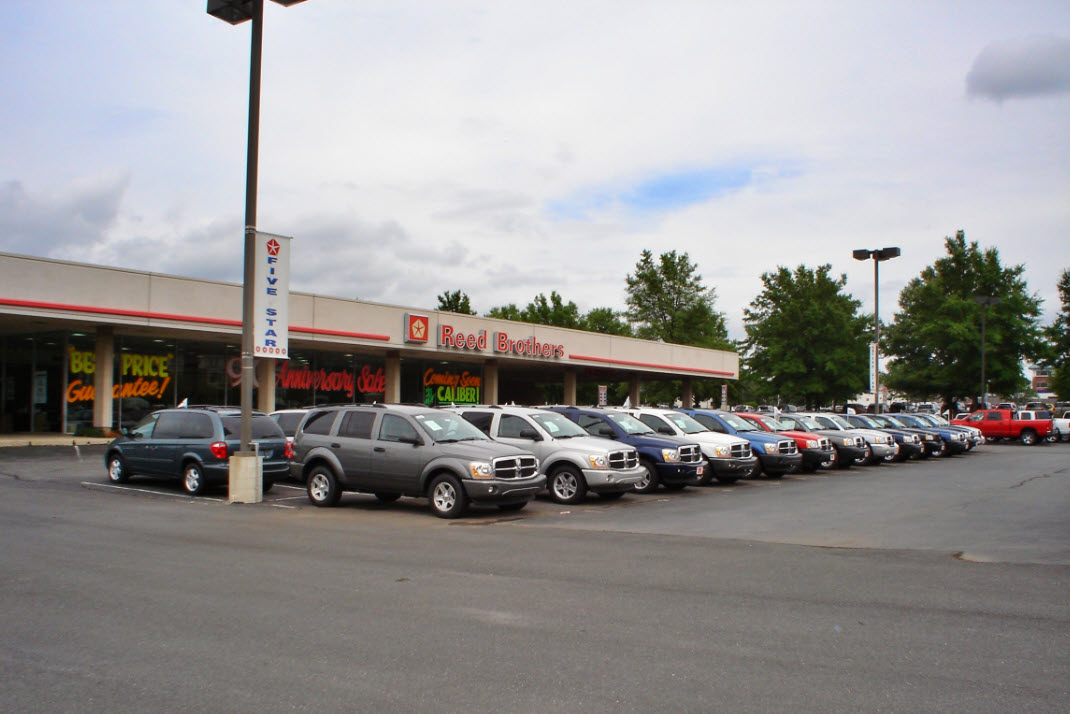
Reed Brothers Dodge in its later years on Frederick Road. From the modest Rockville Garage of 1915 to a modern automobile dealership, the family business grew and changed with Rockville while remaining under continuous Reed family ownership until its closing in 2012.
Reed Brothers Dodge remained in business until May 1, 2012, nearly ninety-seven years after Rockville Garage first began selling Dodge Brothers automobiles.
By then, the world surrounding the dealership bore little resemblance to the one Lewis Reed had known in October 1915.
The dirt and gravel roads had become highways. Rockville had grown from a small county seat into a major suburban community. The simple open touring cars of the early automobile age had evolved into vehicles filled with technology that the first motorists could scarcely have imagined.
Yet the thread connecting those two eras remained remarkably intact.
It began with a small garage, an emerging automobile company from Detroit, and a young businessman willing to place his future in a machine that was changing America.
One hundred eleven years ago this month, in October 1915, Rockville Garage became a Dodge Brothers dealer.
That moment marked the beginning of a relationship that would span nearly a century and become the foundation of Reed Brothers Dodge.
What may have seemed at the time like a promising new business opportunity became something much larger: a family legacy, a Rockville institution, and an enduring chapter in Montgomery County’s automotive history.
Remembering My Mother on Her Birthday
Every year when September 24 arrives, my thoughts turn to my mother, Mary Jane (Reed) Gartner. This year, rather than simply remembering her birthday, I find myself thinking about something that has become increasingly meaningful to me: how much of the history I have spent years preserving grew out of the many conversations we shared and the memories she passed along to me.
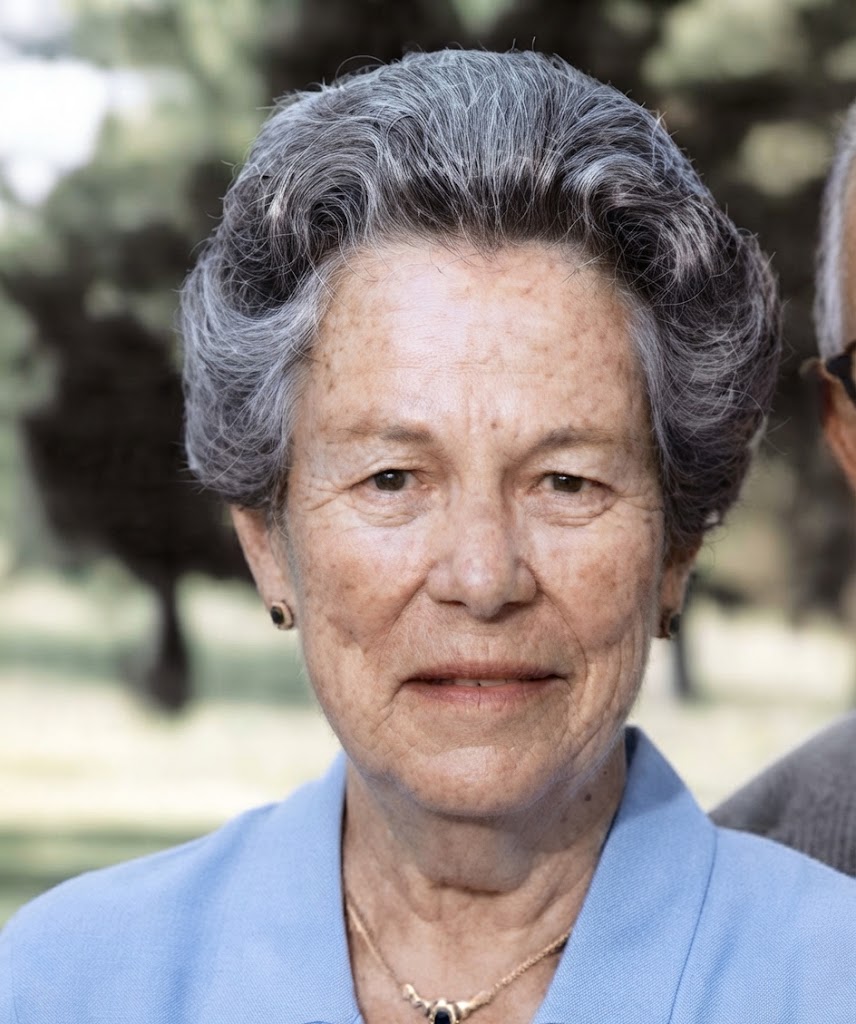
Mary Jane (Reed) Gartner (1922–2019).
My mother was the daughter of Lewis Reed, founder of Reed Brothers Dodge, and she grew up surrounded by a family business that became part of Rockville history. Long before I understood how valuable her memories would become, she was my connection to an earlier generation of the Reed family. During countless afternoon visits, we would sit together and go through boxes and albums filled with old photographs. Many had no names, dates, or locations written on them. I would hold up a photograph and ask, “Who is this?” or “Where was this taken?”
More often than not, she knew.
A face that meant nothing to me would bring back a name. A house, automobile, storefront, or familiar stretch of road would trigger a story. Sometimes one photograph led to another memory, and before long I was hearing about people and places that otherwise might have disappeared from our family history.
At the time, I don’t think either of us realized just how important those afternoons would become.
Years later, as I began researching and writing the history of Reed Brothers Dodge and organizing my grandfather’s enormous photographic collection, I repeatedly returned to the information my mother had shared with me. Her memories helped put names to faces, places to photographs, and stories into context. They became part of the foundation for this blog, my books, and the historical exhibits that followed.
In many ways, she became one of my most important historical sources.
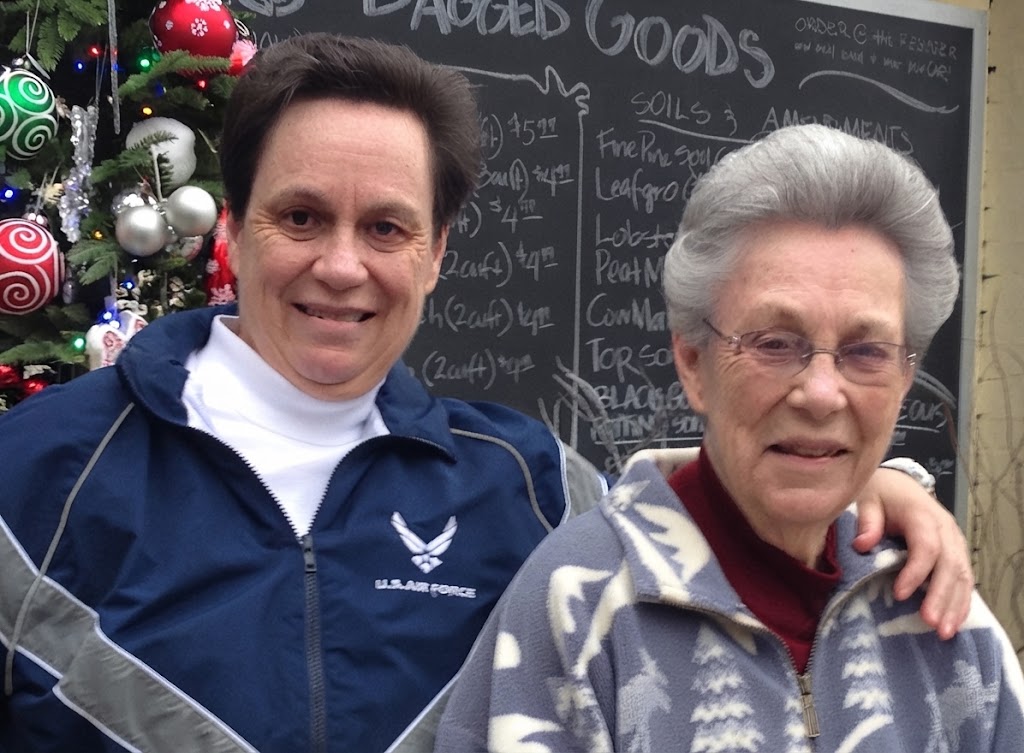
A special Christmas memory with my mother, Mary Jane (Reed) Gartner, in 2004.
But what I inherited from my mother went far beyond family history.
She taught me to approach life with determination and curiosity. One of her favorite sayings was, “Anything worth doing is worth doing well.” She also refused to accept the word “can’t”. If there was a problem, her instinct was to look for a way around it rather than a reason to give up.
That philosophy stayed with me throughout my life.
Perhaps that is also why she never allowed age to dictate what she could learn. At 90, she joined Facebook. She learned to Skype and text, used an iPhone and a Windows PC, and approached new technology with the same curiosity she brought to so many other things. Instead of saying something was too complicated or that she was too old to learn it, she simply learned it.
She was also my greatest supporter.
One memory I especially treasure is seeing her in the audience at Glenview Mansion in 2016 when I received the Arthur M. Wagman Award for Historic Preservation Communication from Peerless Rockville. I was being recognized for documenting and sharing Rockville history, but so much of that work had been made possible by the woman sitting in the audience.
When I saw the pride on her face, I knew the moment belonged to both of us.
My mother died on September 10, 2019, just two weeks before her 97th birthday. Yet in a very real sense, she remains present in the work I continue to do. Every time I identify another photograph, uncover another piece of family history, or share another story from the Reed Brothers Dodge archives, I am building upon something she helped preserve.
Historical preservation is often thought of in terms of photographs, documents, newspapers, and artifacts. But some of our most valuable history lives only in people’s memories. If we are fortunate enough to ask the questions while those people are still with us, their memories can become part of the permanent record.
I was fortunate.
I asked the questions.
And my mother told me the stories.
Today, on what would have been her 104th birthday, I remember my mom not only as Lewis Reed’s daughter or as part of the Reed Brothers Dodge story, but as my mother, my greatest supporter, and the person who helped me understand that preserving history often begins with simply sitting down, listening, and remembering.
Happy Heavenly Birthday, Mom.
The stories you shared with me are still being told.
104 Years Ago, Six Men and Five Motorcycles Launched Montgomery County’s First Police Department

The first Montgomery County Police Department Motor Unit, photographed outside Reed Brothers Dodge in Rockville on July 4, 1922. Chief Charles Cooley (center) stands with Officers Earl Burdine, Lawrence Clagett, Guy Jones, Leroy Rodgers, and Oscar Gaither beside their Harley-Davidson motorcycles on the day the department officially began operations. Photograph by Lewis Reed.
On the morning of July 4, 1922, a small group assembled outside Reed Brothers Dodge in Rockville to mark the beginning of a new era in Montgomery County’s history. Chief Charles Cooley and five motorcycle officers had been appointed to form the county’s first organized police department. Before they departed on their inaugural patrols, local photographer Lewis Reed preserved the moment with his camera.
The photograph captures Officers Earl Burdine, Lawrence Clagett, Guy Jones, Chief Charles Cooley, Leroy Rodgers, and Oscar Gaither standing beside their Harley-Davidson motorcycles. More than a century later, it remains one of the earliest surviving images of the Montgomery County Police Department and a remarkable record of law enforcement in its infancy.
New Police Force Installed
As reported in the Montgomery County Sentinel, July 7, 1922
The officers of the Montgomery County Police Department were installed in office at the Court House on Tuesday, July 4, 1922. A goodly number of persons were present to witness the ceremony. This new force is a novelty now upon trial, introduced by an Act of the last Legislature for Maryland, and it is the general impression that it will prove to be a worthy innovation in behalf of peaceful government.
The force is composed of six members: Chief Charles T. Cooley and Privates Oscar T. Gaither, Leroy Rodgers, Earl Burdine, Guy L. Jones, and Lawrence Clagett. They filed into the courtroom wearing their new uniforms of gray whipcord cloth and their weapons, taking their seats in a line facing the Judge’s bench.
The program began with the police officers taking their oaths, administered by Mr. Ray, followed by the presentation of certificates of appointment by President Benjamin Perry of the Board of County Commissioners.
The ceremony concluded with brief speeches by Judge E. C. Peter and State’s Attorney Thomas L. Dawson.
Judge Peter addressed the new force, congratulating them on their appointment but warning them sternly against bribery, petty jealousy, and “winking at crime.” He encouraged them to uphold order, peace, and dignity in the county by strictly enforcing police laws against all offenders without fear or favor. He emphasized that the State stood behind them in their work, and that their duty was to maintain their honor and make the laws “masters of this land”.
State’s Attorney Dawson advised the officers to keep detailed records of all dates and circumstances in cases they dealt with, which he noted would lead to the “economizing of time” and the “swift and indubitable conviction of offenders”.
It was established that the new police force would work in harmony with, rather than interfere with, the work of the Sheriff’s office. Regarding compensation, the Chief of the force was to receive $1,800 a year, while each private was set to receive $1,500. Additionally, each officer was allowed $300 a year for the upkeep of his motorcycle.
The Montgomery County these officers served was a rural community of fewer than 35,000 residents. Modern police communications did not yet exist. Officers relied on telephones at the courthouse and local firehouses, while a flashing signal light atop the Red Brick Courthouse summoned them when emergencies arose. It was a simple but effective system for an era before radios and patrol cars became standard equipment.
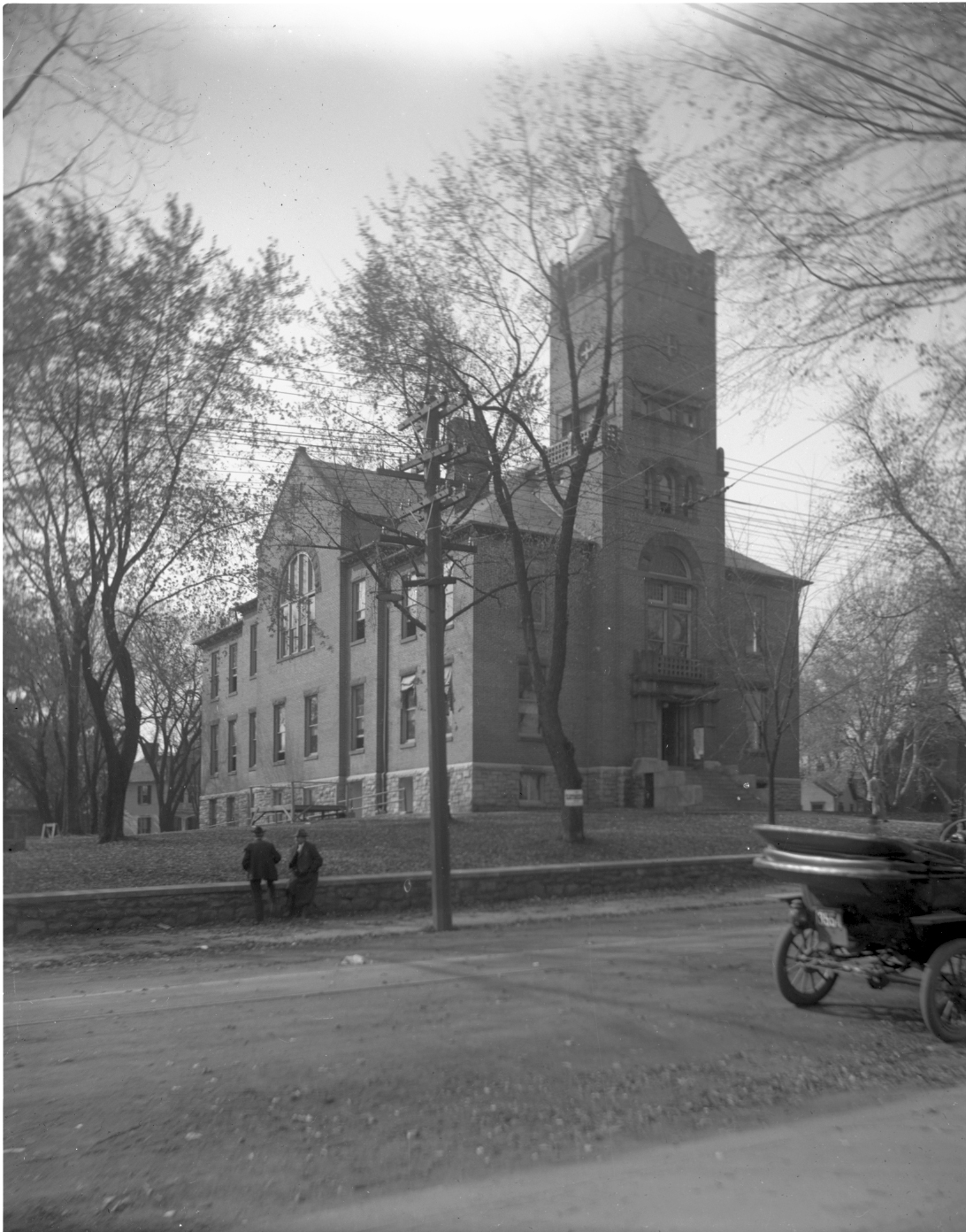
The Red Brick Courthouse in Rockville, photographed by Lewis Reed in 1914. Just eight years later, the courthouse became the headquarters of Montgomery County’s newly established Police Department, where officers reported for duty and received emergency calls before the era of police radios.
Lewis Reed’s 1922 image records the birth of Montgomery County’s Police Department at a time when motorcycles replaced horses, rural roads linked isolated communities, and professional law enforcement was becoming an essential public service.
Today, this remarkable photograph remains an enduring testament to both the officers who answered the county’s first call to duty and the photographer whose work continues to preserve Montgomery County’s rich history.
Introducing the Second Edition of The Lewis Reed Photograph Collection (1898-1960)
Some photographs simply capture a moment. Others capture an entire world.

New Cover – Second Edition. An expanded 384-page volume featuring more than 2,500 historic photographs preserved by Lewis Reed, many published for the first time. A remarkable visual record of the early 20th century.
I am pleased to announce the release of the Second Edition of the Lewis Reed Photograph Collection (1898–1960), an expanded and refined visual archive documenting over six decades of life, landscape, and community in Montgomery County, Maryland and the surrounding Mid-Atlantic region.
More than a century ago, Lewis Reed began photographing the towns, farms, roads, and people around him with a camera and a deep curiosity about a world in rapid transition. What began as the hobby of a young motorcycle enthusiast traveling the back roads of Maryland soon grew into one of the most remarkable visual records of the region’s history.
Many of the photographs in this collection were created from glass-plate negatives and early prints; preserving rural crossroads, bustling town centers, early automobiles sharing roads with horse-drawn wagons, and landscapes that look entirely different today. These are images that might otherwise have been lost to time.
What’s New in the Second Edition
This expanded edition presents Lewis Reed’s photographs in thematic sections that highlight the full breadth of his work; from Maryland towns and landscapes to family portraits, travel scenes, and the early history of Reed Brothers Dodge, which Lewis founded in Rockville in 1915. The collection draws from more than 2,500 digitized photographs, each carefully researched to identify the places and people they depict.
Many images were identified through long conversations with Lewis Reed’s daughter, Mary Jane Reed Gartner, whose recollections helped bring these photographs back to life and restore the stories behind them.
Lewis Reed is remembered locally as the founder of Reed Brothers Dodge, but photography was a lifelong passion alongside his business career. His images document everything from the C&O Canal in operation to small-town parades, churches, farms, and early roadways. Taken together, they form one of the most extensive visual archives of Montgomery County during the period when rural communities were giving way to the modern suburban landscape we know today.
A Note on Pricing
This is a photo-intensive volume, approaching four hundred pages, and is printed on demand through Blurb.com, meaning each copy is produced individually rather than in large commercial print runs. The pricing reflects the actual cost of producing such a large photographic archive. This project was created primarily to preserve and share Lewis Reed’s historic photographs, not as a commercial publication.
Get Your Copy
The Lewis Reed Photograph Collection (1898–1960), Second Edition is available now through Blurb.com’s print-on-demand bookstore.
Or visit the collection page for more information: reedbrothersdodgehistory.com
To stay up to date with new posts and historical discoveries, subscribe to the Reed Brothers Dodge History blog and follow along as the story of Lewis Reed and Montgomery County’s past continues to unfold.
Off-Season at the Montgomery County Fairgrounds, 1910
These winter photographs, taken around 1910 by Lewis Reed, offer a rare glimpse of the Montgomery County Fairgrounds during its off-season; long before crowds, exhibitions, and midway sounds returned each year. Covered in snow and largely still, the fairgrounds appear almost contemplative, preserving a moment in time that contrasts sharply with the bustle normally associated with the annual fair.
The Montgomery County Fair was held in Rockville from 1846 until 1932, serving as one of the county’s most important agricultural and social gatherings. Farmers, merchants, families, and visitors from across the region—including Washington, D.C.—came together to celebrate livestock, crops, craftsmanship, and community. Yet photographs of the fairgrounds outside the fair season are uncommon, making these images particularly significant.
Lewis Reed’s photographs show the grounds at rest. Snow blankets the open spaces, softening the outlines of fences and walkways. Buildings stand closed for the winter, including the Poultry House, which would have been a hive of activity during fair time. In these images, the structures themselves take center stage, revealing their form and placement without the distraction of crowds.
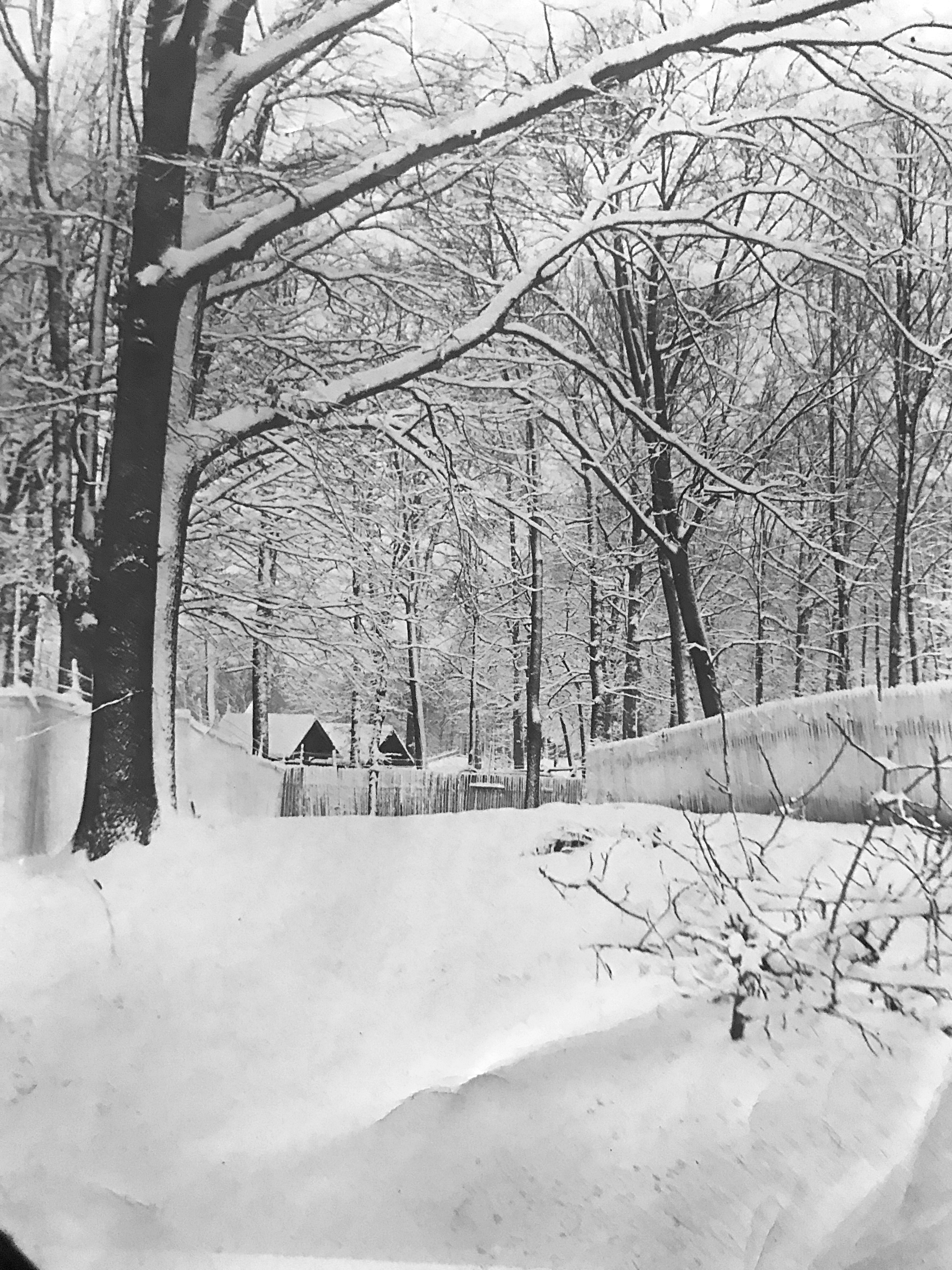
Snow blankets the fairgrounds in this early 20th-century photograph by Lewis Reed. Images such as this offer a rare view of the fairgrounds outside the fair season, documenting the site as it appeared in everyday use.
Reed’s work is notable not only for its subject matter, but for its documentary value. At a time when photography was still a deliberate and technical process, his images captured everyday scenes that might otherwise have gone unrecorded. Today, they provide visual evidence of how the fairgrounds looked and functioned in the early twentieth century, as well as a reminder of the role photography played in preserving local history.
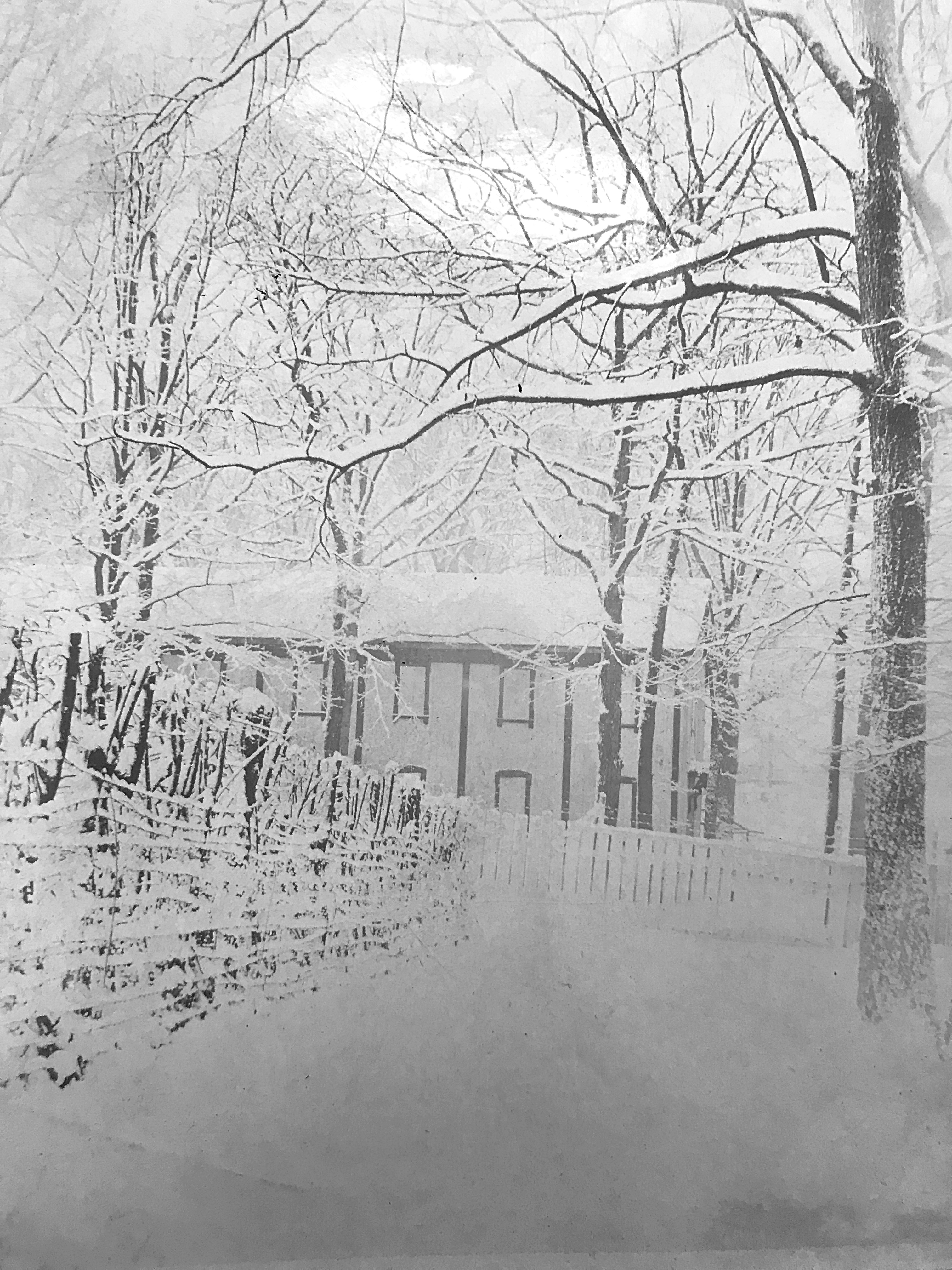
The Poultry House at the Montgomery County Fairgrounds, photographed by Lewis Reed during the winter of 1910. Closed for the season, the building would later host livestock exhibits during the annual Montgomery County Fair.
Viewed more than a century later, these snowy scenes connect us to a slower pace of life and to a Montgomery County that was still largely rural. Thanks to Lewis Reed’s careful eye and willingness to document the ordinary as well as the celebrated, these winter moments at the old fairgrounds endure.
Books

Related Resources


Copyright Notice

Reed Brothers Dodge History (1915-2012) by Jeanne Gartner is licensed under a Creative Commons Attribution-NonCommercial 3.0 Unported License.


Recent Comments