
Dodge Made a Car Just for Women
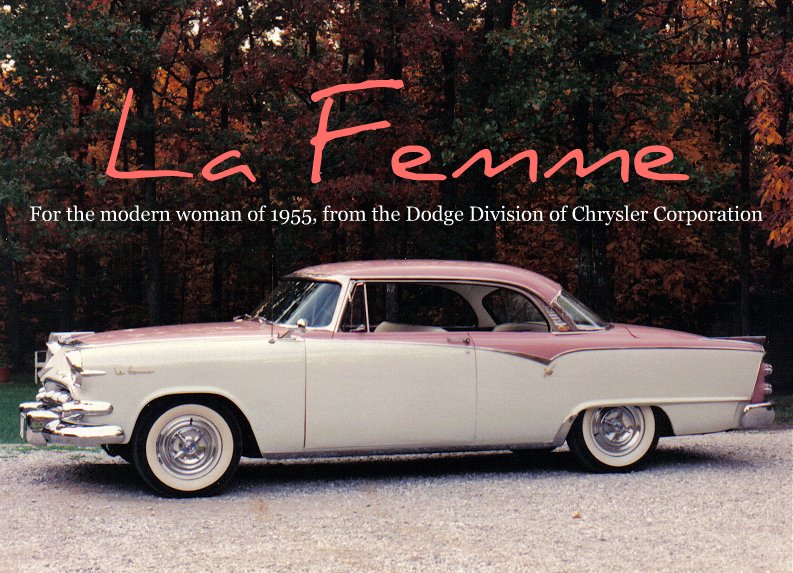 The Dodge La Femme stemmed from Chrysler’s marketing department’s observation that more and more women were taking an interest in automobiles during the 1950s, and that women’s opinions on which color car to buy was becoming part of the decision making process for couples buying an automobile. The La Femme was an attempt to gain a foothold in the women’s automobile market.
Dodge introduced the new La Femme option package in 1955: For $143, you could have the Custom Royal Lancer feminized, with rose paint, gold script, and a nauseating shade of Pepto-pink interior complete with rosebuds.
The accessories which came with the car as standard equipment were where things started getting weird. The car came with a calfskin purse in the same shade of pink as the car’s interior. There was a special compartment behind the passenger seat for this purse, where it could sit with the buckle facing outward. This buckle was large enough for owners to have their name engraved on them, and this is what they were encouraged to do. Inside the purse there was a makeup compact filled with pale pink powder, a lipstick holder, a gold-toned cigarette lighter and case, an imitation tortoiseshell comb, a cigarette lighter, a vanity mirror and silk change purse.
These accessories were all finished in gold-color metal and (you guessed it) pink. For those who wanted them, Dodge also offered an umbrella, boots, a cape (seriously?) and a hat, all matching the seat upholstery.
It went nowhere. La Femme became La Flop. Women stayed away in droves and men weren’t about to be seen driving around in the darling Rosebud. The Dodge La Femme was sold for two years in the U.S. — 1955 and 1956
(Line from a long-lost episode of “Leave it To Beaver”)
“Gee Wally…. all the guys are callin’ me a sissy…. a pink and white car and it says La Femme on the side …. I just can’t be driven to school in mom’s new car anymore …. Yeah, Beave …. I know what ya mean …. that’s why I ride with Eddie …. and besides, mom’s not all that thrilled with the car either!”
Info Source: Dodge La Femme Wikipedia
Featured Photo: 1914 Indian Motorcycle With Sidecar

Photo by Lewis Reed
This is a photograph taken by Lewis Reed of an Indian motorcycle with his brother, Edgar, seated in the sidecar next to Uncle Bernie Hanshew. From what I’ve been able to research, I believe it’s a 1914 Indian. The handle bars on a 1913 had no cross bar, the 1914 model had a cross bar that can be seen on this one. The tool box was mounted on the rear of the carrier in 1913 and moved to the top of the fuel tank in 1914. If anyone can help to date or confirm the identity of this machine please leave a comment.
In the early days, motorcycles were a staple of transportation, and both Lewis and Edgar Reed rode them.
Motorcyclists in the 1920s were more likely to wear a tie, goggles, and a sporty little cap than the leather of today.

A 1915 advertisement for the Indian Motocycle (spelling motocycle without the “r”)
July 4, 1922: First MCPD Posing in Front of Reed Brothers Dodge

This photograph is the first known photograph of the entire MCPD. Pictured left to right: Earl Burdine, Lawrence Clagett, Guy Jones, Chief Charles Cooley, Leroy Rodgers, and Oscar Gaither. Photo by Lewis Reed
This blog entry is posted today to commemorate the anniversary of the Montgomery County Police Department. It was 95 years ago on July 4, 1922 that the MCPD was first established. In those days, Montgomery County was farm country, sparsely populated, automobiles sharing dirt roads with horse-drawn wagons. But it was changing into a proper suburb, and there needed to be a police department.
Posing in front of Reed Brothers Dodge on July 4, 1922 Chief Charles Cooley, center, and his men of the first mounted unit of the Montgomery County Police Force, were on their first day of duty. For several years, since there was no police station, the officers would meet for “roll call” on the steps of the red brick courthouse at 2:00 p.m. every day to let each other know they were alive and well. Chief Cooley was given the privilege of a Model T Ford. Each of the officers was issued a Harley-Davidson motorcycle, a .38 Smith & Wesson handgun, a black jack, law book and was allotted $300.00 a year for the upkeep of their motorcycle. Jones patrolled Silver Spring, Rodgers the Bethesda-Chevy Chase area and Burdine, Clagett and Gaither the Upper County areas.
Source: Montgomery County, Two Centuries of Change by Jane C. Sween
A Father’s Day Tribute

In honor of Father’s Day, I would like to dedicate this blog to the memory of my dad who passed away eight years ago on June 13, 2009. He was a young 88 years old and worked up until just two weeks before he died. Ernest Lee Gartner, who married Lewis Reed’s daughter, Mary Jane, joined Reed Brothers Dodge in 1949.
When Lewis Reed passed away on January 28, 1967, my dad continued the business as Dealer Principal making Reed Brothers Dodge a second generation dealer. Representing the 2nd generation, he took on a new set of challenges. When the state widened the roads in 1970, he purchased 4.37 acres of land from Eugene Casey and relocated Reed Brothers Dodge from its original location at the intersection of Veirs Mill Road and Rockville Pike to a new state-of-the-art showroom and Dodge/Chrysler/Jeep service complex on Route 355 at 15955 Frederick Road Rockville Maryland.
In comparison to Lewis Reed, whose dealership survived through World War I, The Great Depression and World War II, Lee Gartner successfully navigated Reed Brothers Dodge through numerous Chrysler setbacks during the 1970’s and 80’s, including the first Chrysler Bailout, the sale of Chrysler to Daimler, and the sale to the private equity firm Cerberus. He applied his 30+ years experience with Reed Brothers to meet the challenges of gasoline shortages, high interest rates, severe inflation, and weakening consumer confidence which drove Chrysler into financial crisis. This survival is testimony that he not only conquered setbacks, but often rebounded to reach new levels of success. These are pretty remarkable things.
My dad succumbed to metastatic melanoma on June 13, 2009, just four days after the loss of the family’s Dodge franchise. Though he later ceded control to his sons, he rarely missed a day of work. Until his untimely death, he was a fixture at the dealership and could be seen around just about every day watering flowers, reading his newspaper, walking through the shop, and greeting friends and customers in the showroom. The word “retirement” was not in my dad’s vocabulary. He showed no signs of stepping away from the dealership that he helped build for more than 60 years. He remained Chairman of the Board until his death.
I will always remember my dad as a successful businessman whose persistent energy was always there for family first, but in equal measure for the public he served. He was smart and also honest and dependable – characteristics that kept Reed Brothers Dodge at the pinnacle of auto dealerships throughout his career.
I never had a chance to tell my dad how much I admired him, but I remain proud of him and his accomplishments. Lee Gartner continued what Lewis Reed built from the ground up and helped make Reed Brothers Dodge into a successful family business that lasted almost a century.
I think of you, Dad, every day. For all who read this post, if you are lucky enough to still have your father with you, honor and treasure him, if not, remember him with a happy thought and a prayer for all he gave you.
Happy Father’s Day.
Offutt’s General Store, with a 1919 Dodge Truck Purchased from Reed Brothers Dodge Parked in Front
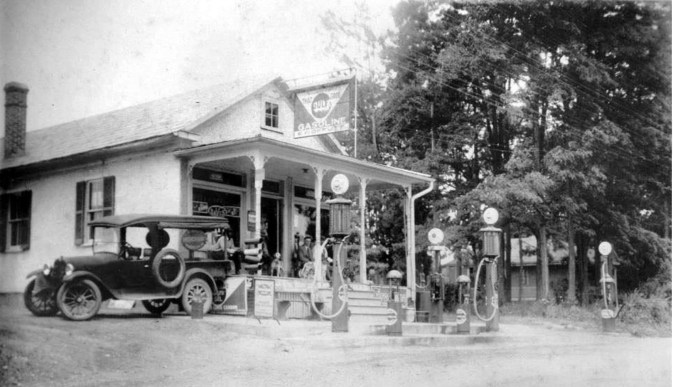
Offutt’s General Store, with a 1919 Dodge delivery truck purchased from Reed Brothers Dodge parked in front. Photo courtesy of Mary Offutt Stubbs, Edward Offutt’s daughter
Offutt’s General Store and filling station in the building that is now Hank Dietle’s Tavern on Rockville Pike. Edward Offutt, a landowner, first constructed the building as a general store in 1916 selling groceries, animal feed, penny candy, food and drinks, according to Montgomery County Historical Society records.
The building was constructed in 1916, and first housed a general store, with two gas pumps outside. It was owned and operated by Edward Offutt; he and his family lived in a house next door. The actual bar in the tavern predates the building. In the 1940s, a fire destroyed the original bar. So, the owner at the time — prior to Hank Dietle — traveled to Baltimore to buy a “new” bar. He found one about 100 years old and it was sawed down to fit where it sits today. Tony Huniak, who began going to the tavern in the 1970s, purchased Dietle’s in the 1990s to save the neighborhood bar from closing.
The photo of the original Offutt’s General Store shows a 1919 Dodge Screenside delivery truck purchased from Reed Brothers Dodge parked in front. Notice the screens on the side with roll up canvas covers. Commercial users of these units preferred Dodges because they had an all steel body. Four large visible pumps dispensing That Good Gulf Gasoline can be seen in front. Its Class D beer and wine license, numbered 001, was the first issued in Montgomery County Maryland after the end of Prohibition.
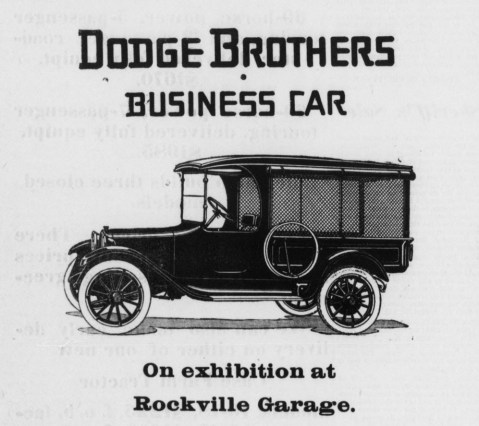
Montgomery County Sentinel, March 14, 1919
Dodge Brothers did not have a truck line, though Dodge would later be known for their trucks. Horace and John Dodge reluctantly agreed to develop a commercial vehicle in 1917 after their sales associates lobbied for a work truck that could be sold to small businesses that made deliveries of fruit, beer, and other goods. The result was a vehicle based on the first Dodge passenger car. The vehicle eventually became the screen-side Dodge business truck, with a thousand-pound payload, selling for $885.
Books

Related Resources


Copyright Notice

Reed Brothers Dodge History (1915-2012) by Jeanne Gartner is licensed under a Creative Commons Attribution-NonCommercial 3.0 Unported License.


Recent Comments