
Celebrating Agriculture in Montgomery County Since 1846

The Washington Times. August 20, 1922
The Agricultural Fair has been a community institution in Montgomery County at summer’s end since 1846. These photographs taken by Lewis Reed offer a visual history of the first incarnation of the fair, held in Rockville by the Montgomery County Agricultural Society and often known simply as the “Rockville Fair.”
The Rockville Fair was held for the last time in the fall of 1932, after which financial difficulties experienced by its owners (likely related to the Great Depression) led to the public sale of the buildings and grounds. However, the Montgomery County Agricultural Fair was reborn on June 4th, 1949 when hundreds of volunteers participated in an old-fashioned barn raising, constructing twelve outbuildings in one day on the new fairground site off Frederick Avenue in Gaithersburg. It has been an annual event ever since—even today the Montgomery County Fair is one of the largest county fairs in the State of Maryland.
Montgomery County Fair History
In 1846, James K. Polk was President of the United States, the U.S. flag had only 28 stars on it, and less than 1,500 people lived in Rockville. It also was the year that the Montgomery County Agricultural Society was organized, that began the tradition of the Montgomery County Fair in Rockville. A 12-member board of directors was chosen, headed by John P. C. Peter, President. The Montgomery County Fair opened two years later on the Pike in 1848, about where Richard Montgomery High School is today.
Discussions about farm improvements led to organized agricultural efforts. In 1846, Rockville farmers helped to establish the Montgomery County Agricultural Society. Two years later, Court House Square overflowed with displays of agricultural implements at the first county fair. The register of will opened his office for exhibits of household manufacturers. and the county clerk’s place teemed with fruits and vegetables. Women competed for cash prizes in the categories of homespun fabrics, fancy handwork, pickles, preserves, butter, cheese, and honey. Men exhibited livestock on the grounds of the Beall-Dawson House.
In a few years, the fair moved to Samuel T. Stonestreet’s woodlot adjacent to Saint Mary’s Church. The annual fair became a week-long gathering to showcase innovation, compete, and socialize. The property on the Rockville Pike was used until 1932, after which much of the land became Richard Montgomery High School.
From The Baltimore Sun Newspaper on September 20, 1848:
The Montgomery County Agricultural Fair held at Rockville, Maryland on Thursday and Friday last, the Journal of that place says, fully met the most sanguine expectation of its friends. The concourse of people was very large, and the stock, implements, and other articles exhibited, were the most perfect and beautiful. The Journal designs to publish the various reports of the committee—and the very able and interesting address of R. J. Bowie, Esq., and the other appropriate remarks submitted on the occasion, and says:
The exhibition was highly credible to the officers and members of the club, and to our country. We must reserve, for a more lengthy notice, the beautiful stock and implements of agriculture sent by gentlemen residing out of our county. We are gratified, indeed, that every thing went off gloriously, and the occasion will be long remembered by all who were present.
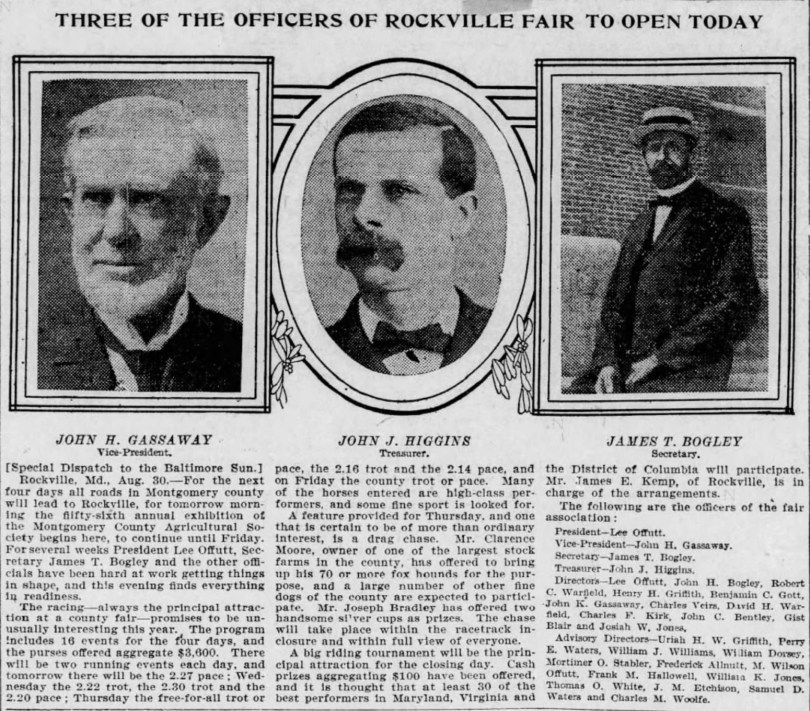
The Baltimore Sun, Sunday 31 August 1909
All the latest improved machinery in farm and garden implements were there, together with wagons, carriages, automobiles, trucks, and tractors. The display of cattle, sheep and hogs had long been one of the leading features at the Rockville Fair. Many fine herds of cattle, including Jerseys, Guernseys and other varieties were on exhibition. Two hundred of the finest horses in Montgomery County, along with many from the District of Columbia, nearby Virginia, and elsewhere were on exhibition.

Fair-goers in their finest stroll along the midway. Hats were a fashion requirement at the time, as were long flowing dresses and suits. Photo by Lewis Reed, ca. 1910
Many other attractions were provided, including the midway, merry-go-round, Ferris wheel, side shows, free exhibitions in front of the grandstand, horse racing, pony races, mule races, automobile contests, a parade of stock, horse show, dog show, poultry show, an automobile show, and clay pigeon shoots. The clay-pigeon shoot was one of the biggest events of its kind ever held in Maryland.

Ferris Wheel at the Rockville Fair. Photo by Lewis Reed, ca. 1910

Agricultural and various farm equipment exhibits. Photo by Lewis Reed, ca. 1910
The various departments were filled to overflowing with high-class exhibits. The main exhibition hall was devoted to farm products and garden products, household displays, flowers, fruits, etc. The household department had an endless array of preserves, jellies, canned fruits, bread, cakes, candles, pies, fancy articles, and works of art. Sanders & Stayman and E. F. Droop & Co. of Washington, had excellent displays of musical instruments in this hall. Examples of locally grown produce were abundant in the main hall. Peaches, apples, plums, damsons, cantaloupes and watermelons were piled up in tempting array. The poultry show was also a place of interest. Many fine chickens, turkeys, geese, ducks and pigeons were being shown.

Fair-goers meander through exhibits. Photo by Lewis Reed, ca. 1910

Can you hear me now? Photo by Lewis Reed, ca. 1910

Hundreds of cars parked in the fair parking lot. Photo by Lewis Reed, ca. 1910.
The Fair was always attended by large numbers of out-of-town visitors from other Maryland counties like Frederick, Howard, and Carroll counties, as well as attracting out-of-state fair-goers from the District of Columbia and neighboring counties in Virginia. Vehicles were assigned places all around the fairgrounds, and the park was completely surrounded. What is fascinating to me is, with all of these early cars painted in black, how on earth would you find your car?

Montgomery County Fairgrounds in the snow. Photo by Lewis Reed, ca. 1910
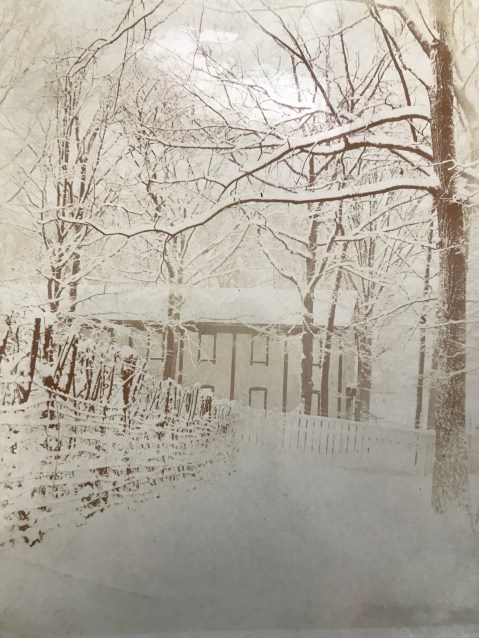
Montgomery County Fairgrounds Poultry House boarded up for the winter. Photo by Lewis Reed, ca. 1910

Sign on the left side of the building reads, “The Beautiful Caverns of Luray Souvenirs”. Photo by Lewis Reed, ca. 1910
The Race Track
If only the grandstands at the Rockville Fairgrounds could talk. The stories it could tell – it would tell stories of great racing – first on horses, bicycles and motorcycles, and then in cars. This grandstand could talk about the rich history of racing that took place on the one-third of a mile long dirt track which attracted high-power cars operated by some of the most noted speed kings of the country.
When Lewis Reed took these photographs in the early 1900s, the Rockville fairgrounds had undergone a significant upgrade. The grounds were enlarged by the addition of about five acres, allowing for the construction of a one-third of a mile race course along with a new grandstand, and improvements were made to the buildings and grounds, bringing them up-to-date in every respect. Montgomery County could well boast one of the nicest fairgrounds in the state.
Below is a previously unpublished Program of Speed Contests held in Rockville, Maryland, dated September 4 and 5, 1890. The program is from Lewis Reed’s collection. (click on photos for larger images)

Front cover of a racing program from the 1890 Montgomery County Agricultural Society Fair. From Lewis Reed’s Collection.

Racing program from the 1890 Montgomery County Agricultural Society Fair. From Lewis Reed’s Collection.
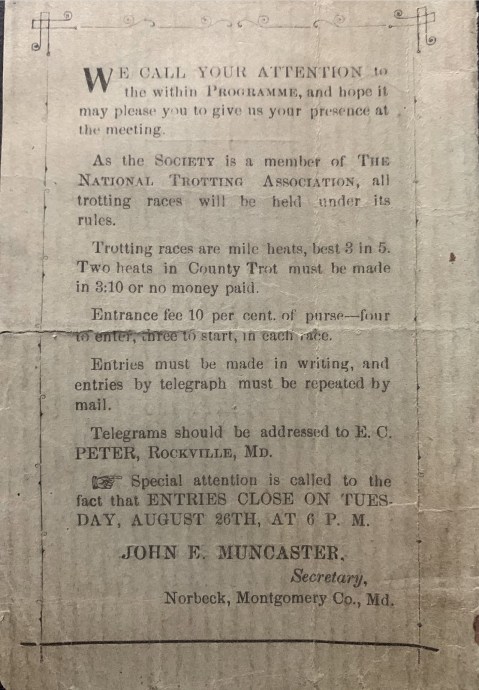
Back cover of racing program from the 1890 Montgomery County Agricultural Society Fair. From Lewis Reed’s Collection.
Bicycle Races
Bicycle races became very popular throughout the country and were a novel event at the Rockville Fairgrounds as early as 1915. The track was a one-third of a mile dirt racing oval with wide, sweeping curves and a grandstand for spectators, which made for clear views. Notice the riders are in shirts and ties. In the background: according to the 1903 Sanborn Fire Insurance Atlas of the fairgrounds, these structures near the track were used as cattle pens.

This circa 1915 photo of an early bicycle race at the Rockville Fairgrounds gives a sense of just how popular the sport was at the time. Photo by Lewis Reed
Harness Races
Harness racing was one of the main attractions at the new race track before the introduction of the automobile and the subsequent popularity of racing cars. Horses were harnessed to lightweight one-seater buggies called sulkies, and would race around the track at a trot, as opposed to the galloping gait of horses ridden by jockeys.

Rockville drew huge crowds for harness races. Photo by Lewis Reed, circa 1910
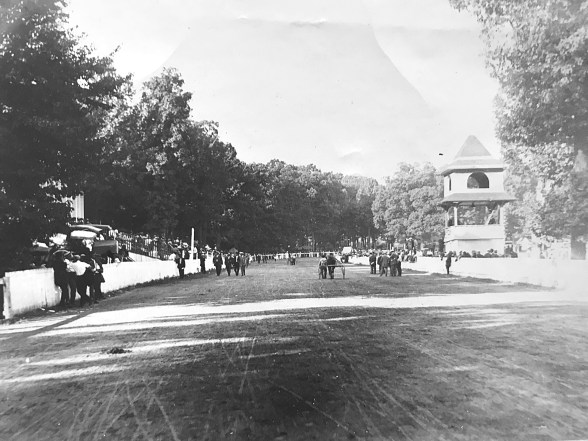
Harness race at the Rockville Fair, circa 1910. All those throngs of people had plenty to see. Photo by Lewis Reed

Harness racers rounding the bend on the racetrack, Rockville Fairground circa 1910. Photo by Lewis Reed

Bend on the harness racetrack, Rockville Fairground circa 1910. Photo by Lewis Reed
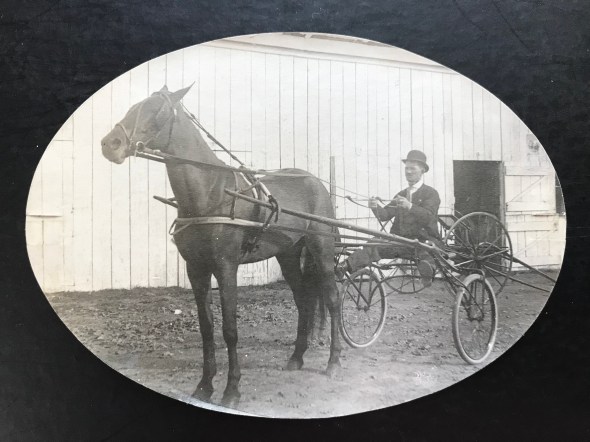
Race horses and two-wheeled sulkies (for trotting races) at the Rockville Fairground stables, Photo by Lewis Reed, ca. 1910.

Race horse and two-wheeled sulkies (for trotting races) at the Rockville Fairground stables. Photo by Lewis Reed ca. 1910
First Auto Races at Rockville Fair Speedway
From The Baltimore Sun, August 27, 1923:
This is the first year that a Rockville Fair has continued through Saturday. The extra day was added this time as an experiment, the management believing that by substituting new features the additional day could be made a success. Automobile races, the first ever held at Rockville, were the day’s principal attraction and they attracted a good-sized crowd.
Early action shots like the ones below are rare, however, Lewis Reed was there to capture six epic moments of race history through the lens of his camera that day.

Rockville drew huge crowds for auto races. Rockville Fair, August 25, 1923. Photo by Lewis Reed

Dusty Action – 1923 photo of the exciting auto races at Rockville Fair. Five racers are just coming around the bend on this dirt track with their tires spinning up dust in their wake. Photo by Lewis Reed

Race car drivers deep in dust round a turn at the Rockville Fair auto races. Print made from a Lewis Reed glass negative.
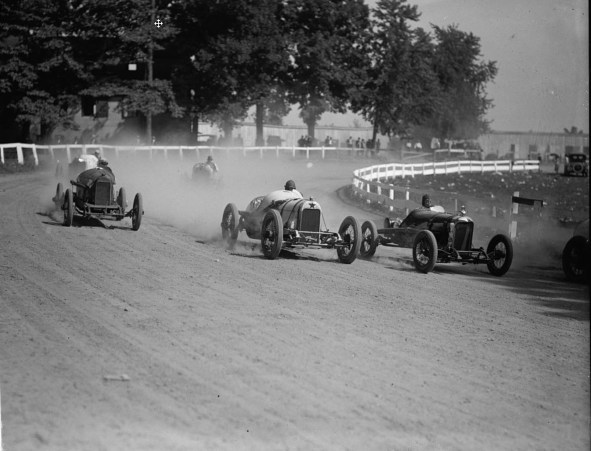
High-powered race cars rounding a wide, sweeping curve at the Rockville Fair auto races, August 25, 1923. Print made from a Lewis Reed glass negative
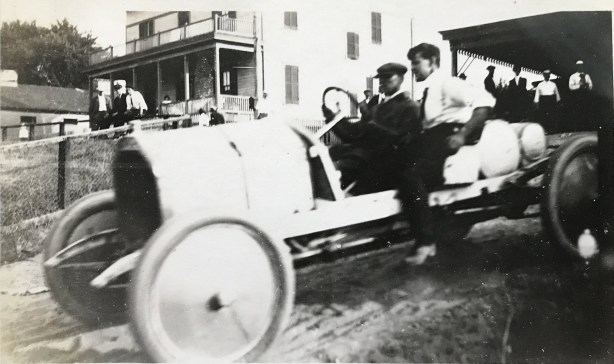
Two-man race car. Some early race cars included both a driver and a ‘riding mechanic’. One of the key jobs of the second man in a race car was to look backward and alert the driver to what was going on behind him. Photo by Lewis Reed
Early race car drivers were required to have a riding mechanic, otherwise it was voluntary. Riding mechanics, who in addition to being lookouts, kept an eye on tire wear and would even hop out of the car and run back through the infield to get fuel. Special note: The above photograph was featured as a part of the London Array Series of “Impossible Engineering,” broadcast on January 24, 2019 on Discovery’s Science Channel. The photograph was used on the program that featured a segment on the development of the race car.

More dirt track action. Skinny tires make for slippery turns. Photo by Lewis Reed
Rockville Garage Displaying New Model Cars at the Rockville Fair Grounds, 1918
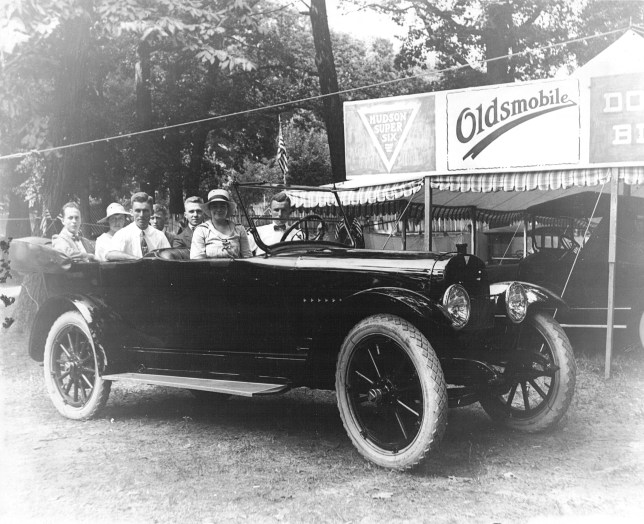
Anybody for a demonstration drive? Identified by the triangle logo on the grill and the number of passengers seated in it, the car appears to be a 1918 Hudson Super Six Seven Passenger Touring. Photo by Lewis Reed

Hudson Super Six, Oldsmobile, and Dodge Brothers Motor Cars on display. Lewis Reed in drivers seat.

Rockville Garage displaying their new models at the Rockville Fair Grounds. Photo by Lewis Reed

At Your Service Rockville Garage. Lewis Reed on the left
Reed Brothers Company Softball Team at the Rockville Fairgrounds, late 1920s
From a distance, it looks and sounds like a regular baseball game: the crack of the bat, the cheering from the bench, the sliding into home plate. But a closer look at the field shows something is very different. They’re playing on a rough grass field, no one is using a batting helmet, fielding glove, or catcher’s mask. From the 1920s through the 1940s, Reed Brothers Dodge had their own company softball team that played on the fields at the Rockville Fairgrounds where Richard Montgomery High School now stands.
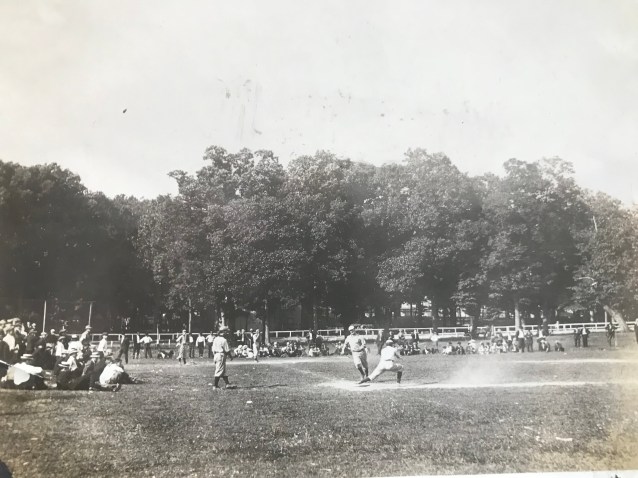
Reed Brothers Softball Team playing on a field set up inside the Rockville Fair racetrack oval, circa late 1920s. Photo by Lewis Reed
Fair Now History
From The Daily Mail (Hagerstown, Maryland) 23 Aug 1933:
The historic Rockville Fairgrounds, scene of many harness race programs, will be sold at a sheriff’s sale Friday afternoon at Rockville. The property consists of 26 acres, a dwelling and numerous stables, exhibition buildings and other structures. The sale is being made to satisfy a claim of a bank. It is rumored that the Montgomery County Board of Education will try to buy the grounds as a site for an elementary school and a future location for the entire Rockville educational plant.
Fair Ground Auctioned
From The Evening Sun (Baltimore, Maryland) 26 Aug 1933:
The Montgomery County National Bank submitted the only bid for the historic Rockville Fair Grounds at a public auction on August 25, 1933 to satisfy a bank’s claim. Its bid was $19,500.00 subject to a mortgage held by the Sandy Spring Savings Institution, and unpaid interest and taxes.
The Montgomery County Fair was reborn in 1949 and again started holding its annual Fair in Gaithersburg. On June 4th, 1949, close to 1,000 volunteers participated in an old-fashioned barn raising and 12 outbuildings were constructed in one day. The site of the new Montgomery County Agricultural Center was created.

June 4, 1949 – Construction of the cattle barns along the railroad tracks. Photo courtesy of Montgomery County Agricultural Fair photo archives.
End of An Era
While many things about the fair have changed over the years, its mission has remained the same.
This event provides the opportunity for 4-H and FFA members to exhibit their livestock, homemaking and craft projects. We also focus on promoting the science and preservation of agriculture in Montgomery County and educating Fair patrons and the community regarding agricultural related topics.
To that end they have been successful since 1846. The Montgomery County Agricultural Fair is now today, one of the largest county Fairs in the State of Maryland.
Special note: According to Helen Caulfield Madine Gregory of The Woodlands, the Fair was held in Clopper at The Woodlands, home of the Huttons and Caulfields for several years before the current fairgrounds were built in Gaithersburg. O.W. Anderson wanted to purchase land from her father, John P. Caulfield, but he allowed fences for tethering the cattle, and pens for smaller animals to be built. There were also horse pulling contests. The Montgomery County Sentinel estimated about 3,000 people attended.
Find photos like these and much more on Montgomery History’s online exhibit, “Montgomery County 1900-1930: Through the Lens of Lewis Reed“.
References:
Chronicling America: Historic American Newspapers. Library of Congress
Newspapers.com: the largest online newspaper archive
Rockville, Portrait Of A City, Eileen S. McGuckian
Ag Center History
Helen Caulfield Madine Gregory
May 28, 1928 – Chrysler Buys the Dodge Brothers Company

1928 Chrysler logo
May 28, 1928 marks an important milestone in the history of Chrysler. It was on this day in 1928 that Dodge Brothers, Inc. became a part of Chrysler. It was on this same date that Lewis Reed, founder of Reed Brothers Dodge in Rockville, Maryland also became an original member of the Chrysler family.
During 1920, the Dodge Brothers company lost its founding fathers. John Dodge died in January, and his younger brother Horace succumbed the following December. A New York investment banking firm paid the brothers’ widows, in a single cash payment, $146 million for the Dodge Brothers firm. Within three years, the bankers initiated negotiations, and on May 28, 1928, Walter P. Chrysler purchased Dodge Brothers, Inc. for $170 million, making it, at the time, the largest business transaction in history. When the transaction was complete, the Chrysler Corporation had grown five-fold overnight to become the third of Detroit’s “Big Three” automakers.
The first Plymouth was built in 1928 and Plymouths were sold at Reed Brothers until 1969, when the Plymouth brand was given to the Chrysler dealers.
April 6, 1936 Gainesville Tornado Aftermath
One of the deadliest tornadoes in American history hit Gainesville, Georgia on April 6, 1936. And Lewis Reed was there to capture the aftermath. On the 88th anniversary of this epic tornado, I have posted eleven original snippets of history that Lewis Reed captured through the lens of his camera that day.
It all started as part of a storm system that hit Tupelo, Mississippi on April 5th, 1936. The Tupelo tornado, which registered as an F5 on the Fujita Scale, emerged from a complex system of storm cells and created a monster soon known as the fourth-deadliest tornado in U.S. history. It tore through houses, killed entire families and was even said to have left pine needles embedded into trunks of trees. One of the survivors of that storm in Tupelo was none other than a one-year-old Elvis Presley.
Unfortunately, the tragedy of that storm didn’t stop there. The system moved east overnight.
Take a look at some of the sobering aftermath photos of the deadliest tornado to ever hit Georgia … through the lens of Lewis Reed. As always, click the photos to get a better look.

View of part of the damage done to the Pacolet Manufacturing Company when a tornado struck the area. This textile mill had been established in 1901. New Holland was a community located just north of Gainesville. Photo by Lewis Reed
The devastating tornado continued beyond Gainesville, next striking New Holland, about two miles to the east, where it heavily damaged the massive Pacolet Mill, a major producer of textiles (as well as nearly 100 homes). The Digital Library of Georgia states that the Pacolet Mill was heavily damaged. Remarkably, no one in the mill was injured, as the workers saw the storm coming and evacuated from the upper floors, then ran to the building’s northeast end which remained intact after the tornado struck. (They knew where to take refuge as a result of an earlier tornado which struck in 1903, killing about 50 people in the mill.) After extensive repairs, Pacolet Mill resumed operation.

Another view of Pacolet Mill. Photo by Lewis Reed
The overall destruction was barely able to be tallied. Department stores collapsed killing dozens of people, residential areas were devastated with nearly 750 homes destroyed and more than 250 were badly damaged. Buildings caught fire, trapping people inside. It was even reported that the winds were so high that letters from Gainesville were blown almost 70 miles away and found in Anderson, South Carolina.
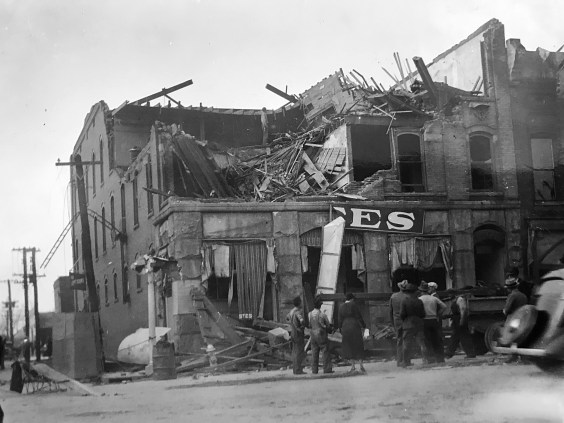
A man stands on second floor piles of rubble amidst the ruins of a demolished business. Only a few partial walls and floors were able to withstand the tornado strike. Photo by Lewis Reed
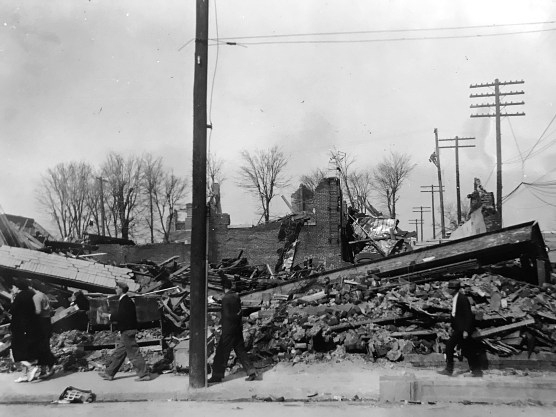
Stunned survivors survey what’s left of their town in this view of the widespread damage in the city streets. Photo by Lewis Reed

A man stands by piles of rubble amidst the ruins of a house. Photo by Lewis Reed

The storm that struck with ‘lightning swiftness’ hit the Royal Theatre straight on, also doing major damage to train cars and train tracks running through town. Utility poles were blown over and hung with twisted metal. Photo by Lewis Reed.

This photo documents the power of the tornado to toss around even massive railroad cars. Photo by Lewis Reed

Shambles of homes struck by the tornado. The twister stripped trees of their leaves and left branches hung with twisted metal. Photo by Lewis Reed.

Eight to ten feet of debris piled up along a street while a few houses remain erect despite having sustained damage. Photo by Lewis Reed

Many of the businesses experienced extensive damage. Some stores later offered “tornado sales” to dispose of the damaged goods. Photo by Lewis Reed
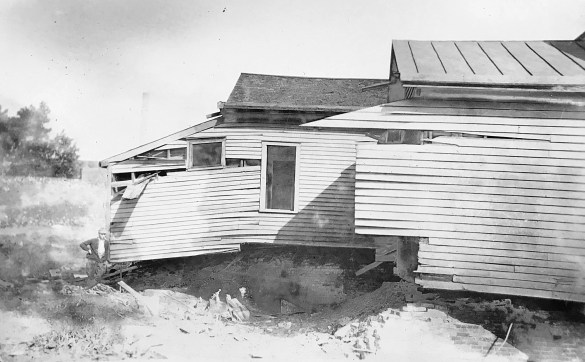
House leaning at a precarious tilt after having apparently been moved from its foundation. Photo by Lewis Reed
The death toll in Gainesville was officially 203, though some accounts place it higher. Property damage was in excess of $13 million dollars, or what would be $1.3 billion in damage by today’s standards. More than 1,600 persons were injured and more than 750 homes were damaged or destroyed. The storm that hit Gainesville on April 6, 1936 remains the fifth deadliest tornado in U.S. history. President Franklin Roosevelt toured the city three days later, and returned in 1938 to rededicate the courthouse and city hall after a massive citywide rebuilding effort.
Sources:
Wikipedia – 1936 Tupelo–Gainesville tornado outbreak
The Digital Library of Georgia
Rockville’s First Manual Training School, 1913

Manual Training work on display in Rockville High School classroom. Photo by Lewis Reed, 1913.
One of my favorite things to do is explore details in old photos and to try and figure out what things are and what the picture is. I was immediately intrigued by this photograph when I saw it in one of my grandfather’s albums. The caption on the photo was, “Manual Training Work at R.H.S. 1913”.
What first struck me about the photo is, it appears to be what used to be the inside of an old school classroom. My eye was first drawn to the chalkboard that runs across the front of the room and down the side. When I looked at the details by enlarging it, the writing on the chalkboard reveals a M-F weekday class schedule. I can just barely make out, Algebra and Latin. The rest of the subjects are illegible.
But I was also intrigued by the caption… what exactly is “manual training” in education, anyway? According to google, the Manual Training movement was the precursor to the vocational training programs in our schools today. First used in the United States in the 1870s in the training of engineers, the movement spread rapidly to general public education. The student would learn to skillfully use tools in drafting, mechanics, wood or metal working, and then would be able to transfer this knowledge to almost any kind of tool or setting.
The Rockville Manual Training School opened on January 21, 1901, with over 50 students admitted.

Montgomery County Sentinel, March 22, 1901
From “The Montgomery County Story” Vol. 24, No. 2, May 1981 by E. Guy Jewell
At a meeting held on January 8, 1901, the Rockville Manual Training School was established by order of the Board of County School Commissioners. On February 21, 1902, Wilson S. Ward became instructor in Manual Training and remained for several years to develop a course noted as outstanding in the State. In 1908, the School Commissioners opened the Business School in the Rockville High School Building. Prof. Neely Graham, a graduate of the Westchester Normal School and of the Wilmington Business College, was appointed principal of this school. One of the large basement rooms was equipped with business desks and typewriters for the business students.
The classes that were introduced in 1902 eventually grew into the Vocational Course in the High School; the other courses were Academic, General, and Commercial.
Rockville High School/Montgomery County High School, pictured around the time of completion in 1906. Photo by Lewis Reed
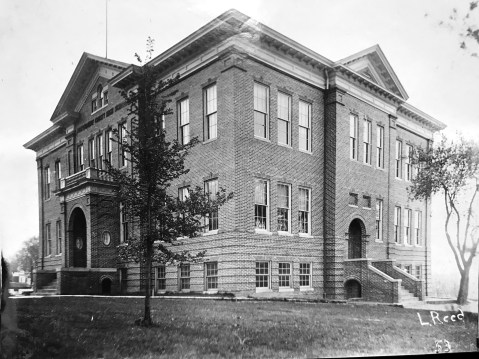
Located in Rockville, the school now named Richard Montgomery High School is the oldest public high school in Montgomery County. In 1892, the Board of School Commissioners approved an addition to the existing elementary school in Rockville to create a new “Rockville High School,” serving students from grades one to eleven. The first class of twelve seniors graduated in 1897.
The Montgomery County Sentinel
Snowy Day in 1910 at the Old Montgomery County Fairgrounds
As we’re currently experiencing cold, snowy, icy weather, what better time than now to post these snowy pictures of the old Montgomery County Fair. These snowy images of the Fairgrounds were taken by Lewis Reed in 1910.
From 1846-1932, the Montgomery County Fair took place in Rockville with competitions, entertainment, and food that attracted people from Montgomery County and Washington, DC.

Montgomery County Fairgrounds. Photo by Lewis Reed, ca. 1910
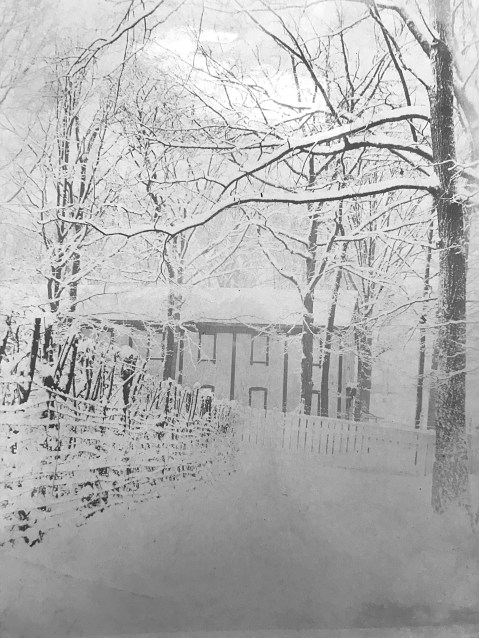
Montgomery County Fairgrounds Poultry House boarded up for the winter. Photo by Lewis Reed, ca. 1910
Books

Related Resources


Copyright Notice

Reed Brothers Dodge History (1915-2012) by Jeanne Gartner is licensed under a Creative Commons Attribution-NonCommercial 3.0 Unported License.


Recent Comments