
Rockville Garage Hudson Motor Car Ads (1919-1920)
The advertisements in this post do more than just simply pitch a product, they capture a moment in history. A moment in history when Lewis Reed’s Rockville Garage represented several franchise nameplates along with Dodge, including Oldsmobile, Hudson, and Essex. The Hudson and Oldsmobile were sold at Reed Brothers from roughly 1917 through 1923.
Hudson introduced the Essex brand in 1919. The Essex was intended to compete with Ford and Chevrolet for budget-minded buyers. The Essex offered one of the first affordable sedans and by 1925 the combined Hudson and Essex sales made Hudson the third largest automobile manufacturer in the United States.
Prior to the advent of television and radio advertising, print media was the most popular form of advertising and most car ads were black and white. The following ads distributed by the Lambert Automobile Company in The Baltimore Sun newspaper advertises the Hudson and Essex automobiles.
In addition to franchise car dealers, there were also factory stores. In the early days, the factory stores did the national advertising. A factory store, also known as a branch store or branch dealer, was a dealership owned and run by the manufacturer. A list of area Dealers was placed in fine print at the bottom of the ads. Rockville Garage, Rockville, Md, is highlighted in yellow on each of these ads.

The Baltimore Sun 2 March 1919
By the 1920s, Hudson and Essex Motor Car advertisements featured elegant architectural borders with static drawings of their cars; some ads never pictured people during this period.

The Baltimore Sun 30 May 1920

The Baltimore Sun 29 Aug 1920
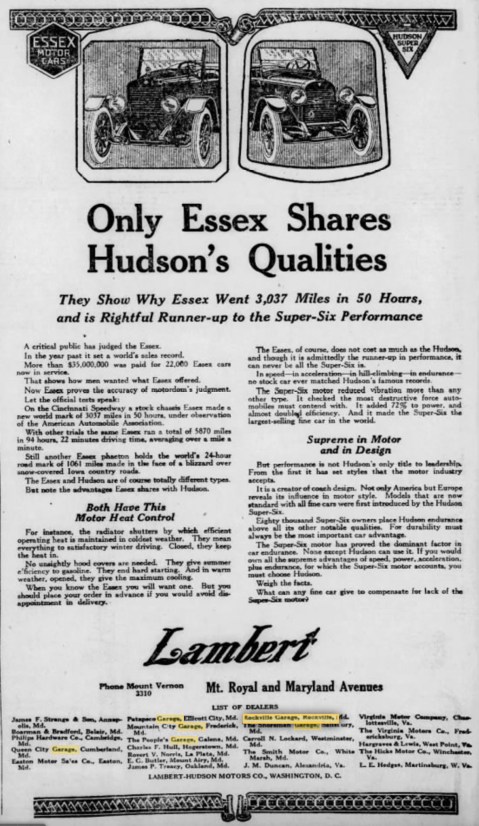
The Baltimore Sun 25 Jan 1920
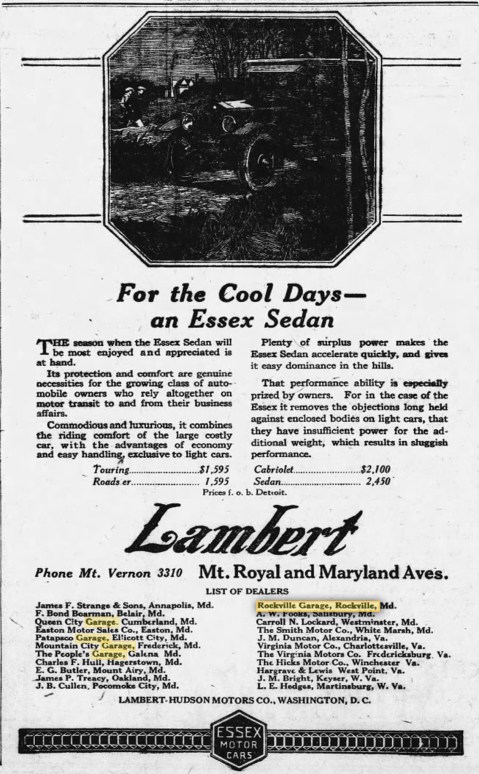
The Baltimore Sun 24 Oct 1920

The Baltimore Sun 21 Nov 1920

The Baltimore Sun 17 Oct 1920

The Baltimore Sun 13 Jun 1920

The Baltimore Sun 10 Oct 1920

The Baltimore Sun 1 Feb 1920

The Baltimore Sun 3 Oct 1920
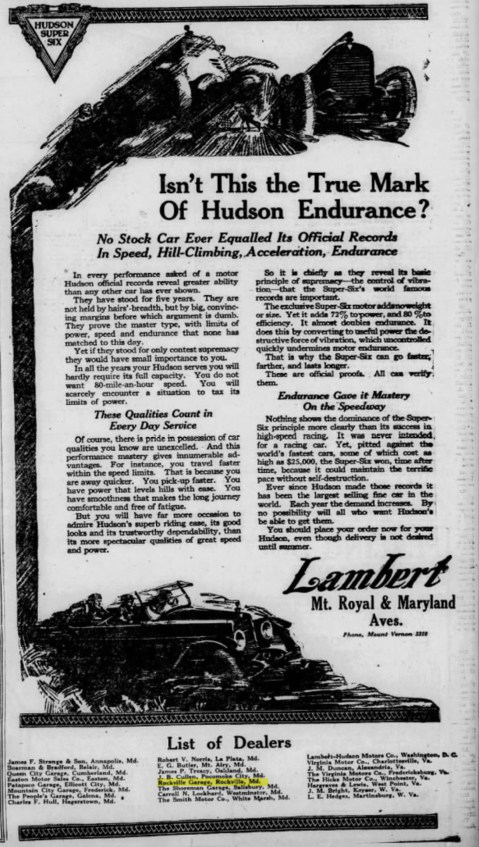
The Baltimore Sun 28 Mar 1920
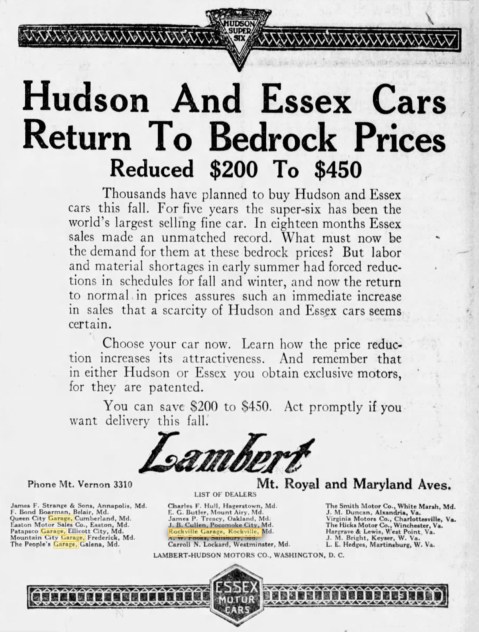
The Baltimore Sun 30 Sep 1920

The Baltimore Sun 5 Mar 1922
A lot of old newspapers have found their way online and with digital archival, it’s easier to take a trip back through old newspapers than ever before. These ads were found on NewspaperARCHIVE.com, the largest historical newspaper database online.
1929 Montgomery County F3 Tornado: Aftermath Photos

Spectators view the destruction at the Benson farm, May 1929. Photo by Lewis Reed
One of the worst tornadic outbreaks in area history occurred on May 2, 1929. At about 9 p.m. on Thursday, May 2, 1929, northeastern Montgomery County was struck by an F3 tornado, part of a large storm system that caused devastation from Florida to Ohio. The weekly Montgomery County Sentinel reported on May 10th that the “wind storm of cyclonic power . . . was of limited width and serpentine on its course. Everything in its path met with destruction.” These previously unpublished photographs were taken by Lewis Reed “after the tornado of May 2, 1929”.

May 1929. Photo by Lewis Reed
The damage in the county was limited to the rural Unity area, north of Brookeville. The Sentinel article detailed each affected farm, noting that “thousands of persons from far and near visited the scene for several days to look upon the indescribable wreckage.”

May 1929. Photo by Lewis Reed
From the Sentinel: “The storm showed its first violence upon the farm of Mr. J. William Benson. There it destroyed every building – the dwelling house, large barn, 117 feet long, including an attached shed, and all other outbuildings.” The farm was unoccupied, but furniture belonging to “a prospective tenant” was destroyed. Mr. Benson’s apple orchard was also significantly damaged, and the article claimed that “many [trees] were lifted into the air, carried over woods and landed several miles away.”
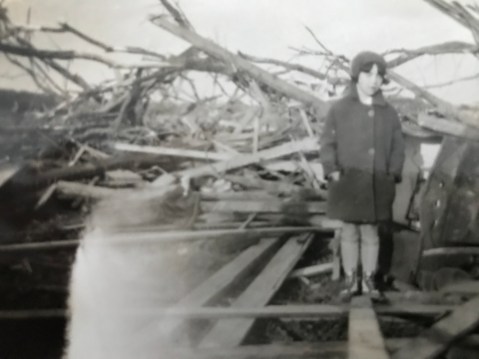
Lewis Reed’s daughter, Mary Jane, May 1929. Photo by Lewis Reed
The fire departments of Rockville, Gaithersburg and Sandy Spring responded to the call made by farm worker James Leizear, who “extricated himself from the wreckage” and ran half a mile to a neighbor’s house to summon help.
The Post reported on May 4th that 28 people in Maryland and Virginia had been killed by tornadoes during the storm; most of the casualties were in Virginia, where an elementary school was struck full-force and at least 18 children died. In Montgomery County, the local Red Cross Chapter formed a citizen committee to raise funds “for relief of the sufferers.”

May 1929. Photo by Lewis Reed
Note: These photographs were undated and unlabeled in my grandfather’s collection. My mother, Mary Jane (Reed) Gartner, who is seen above when she was almost 7 years old, positively identified these photographs and just about pinpointed the location! She is almost 96 years old! It’s amazing the things you remember from your early childhood.
Information Source: A Fine Collection
Then & Now: New Occidental Hotel Washington, DC
In this “Then & Now” feature, I have combined one of Lewis Reed’s original photograph’s for “then” and matched it with a corresponding contemporary shot for “now” to see how the location has changed or remained nearly the same through the years. I started doing this as a research tool, now I mostly do it because of my passion for history and fascination with the subject. In the following photographs, you can see the difference 100 years can make.
New Occidental Hotel (THEN): The New Occidental Hotel was built by Henry Willard (of Willard Hotel fame) in 1906. If any of 2,500 celebrities — including four presidents — forgot who they were, they could stop by the Occidental Restaurant on Pennsylvania Avenue and check their picture on the wall. Within a few years the Occidental became known as the place “Where Statesmen Dine”.
After the restaurant closed in 1971, the wall-to-wall collection of paintings and photographs of the famous was auctioned off. The new Occidental Restaurant re-opened at 1475 Pennsylvania Ave. NW, almost on the old site, as part of the Willard Collection of buildings.
Looking from the Treasury Building directly at the United States Capitol, this 1912 photograph taken by Lewis Reed shows the first floor retail shops and the Occidental Hotel, which has an Electric Grill Room, on the left. On the right are office buildings and the Old Post Office. The magnificent Raleigh Hotel held a commanding position on Pennsylvania Avenue across from the Old Post Office Building. The Occidental Hotel was located at 1411 Pennsylvania Avenue NW.

Historic street view of Pennsylvania Avenue. Photo by Lewis Reed, 1912
New Occidental Hotel (NOW): Google Street View from approximately the same perspective in 2018.
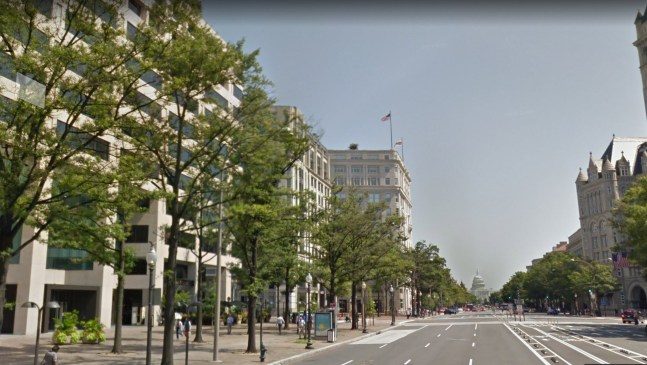
Screenshot of Google Street View 2018
Lewis Reed’s ‘Ghost’ Photograph

Surrealistic, ghost-like effect of Lewis Reed (right) standing next to a tree in the middle of train track. From Lewis Reed’s Photograph Collection
Lewis Reed had a passion for photography and had the know-how to try out a few of the trick shots that were popular at the time — including creating double exposures that made it look as if there were ghosts in the picture.
When I saw this photograph — which is slick enough to fool anyone not paying attention to detail — I became curious. How on earth did he do that? So I did some research to get some information on what went into this type of photography. This technique often left a telltale vertical line along the center of the image — a fuzzy stripe separating the two exposures.
Supernatural effects were mainly accomplished using double exposure. When developing the photos, a pre-prepared glass plate would be used which already had the image of a person on it. This would be the ‘ghost’. It would then be inserted into the camera in front of an unused plate which was used to shoot the photo. The developed negative comes out with both images on it — an incompletely exposed ghostly image as well as a sitter, looking perfectly unaware.
I think it’s really amazing how Lewis Reed’s early photography shows such versatility and creativity.
Reed Brothers Memorabilia
Dealers have always produced a wide array of promotional giveaways. These items are rare finds, because most get thrown away when the doors are closed. Some of the more difficult collectibles to obtain are awards given to the salespeople for outstanding sales performance, including neckties, cuff links, pen and pencil sets, and award plaques. Unique items were often given to salesmen to promote a new model being released that year. Each year at new car introduction, dealers created an entirely new set of collectibles. A few items were provided by the factory to promote a theme for the new models, but most of the others were created uniquely by the dealer.
Most of the memorabilia in this special post belonged to Marvin Shultz, Reed Brothers longest tenured employee. Marvin worked for 43 of the company’s 97 years of existence before retiring in 1984 as a new car salesman. A few others are from my own personal collection.
I would like to express my thanks to the Shultz family for sending me these mementos!

1970s Dodge emblem neckties. Courtesy the Shultz family

Sales Meeting left to right: Dorsey Howes (Sales Manager), Dale Reed (Salesman), Marvin Shultz (Salesman), Lee Gartner (President). In the 1970s, the sales staff wore red blazers with the Dodge emblem on the pocket. Note the neckties.

1970s Reed Brothers Dodge Service Department Pen – Quaker State Motor Oil. Courtesy the Shultz family.


Reed Brothers Dodge license plate. J. Gartner collection
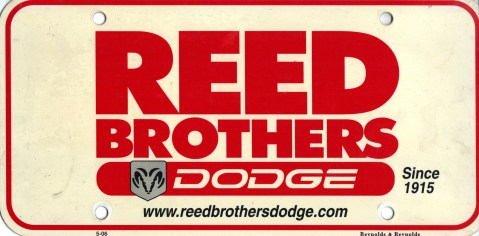
Reed Brothers Dodge license plate. J. Gartner collection
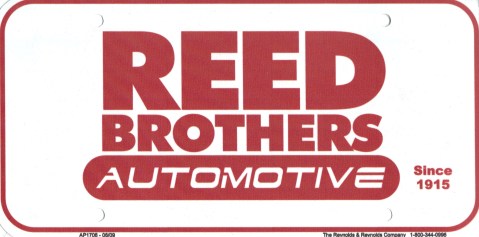
Reed Brothers Automotive license plate. J. Gartner collection
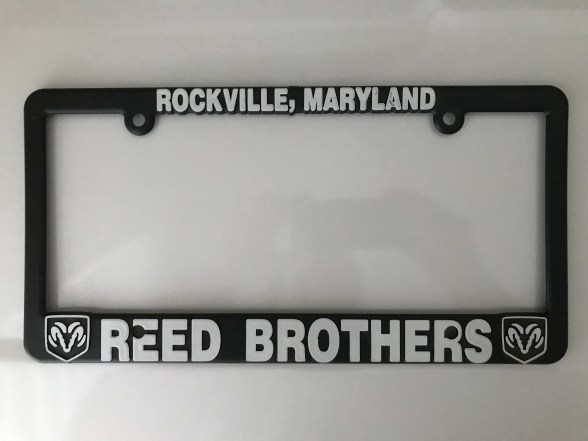
Reed Brothers license plate frame. J. Gartner collection

Reed Brothers Dodge Polo Shirt with original logo. J. Gartner collection

Reed Brothers Dodge Hat. J. Gartner collection

Reed Brothers Dodge T-Shirt. J. Gartner collection
Books

Related Resources


Copyright Notice

Reed Brothers Dodge History (1915-2012) by Jeanne Gartner is licensed under a Creative Commons Attribution-NonCommercial 3.0 Unported License.
 Reed Brothers Dodge History 1915 – 2012
Recent Comments