
Lewis Reed: Enters 1936 Amateur Photo Contest
The Star published a series of pictures reproduced from photographs taken by local amateurs. The pictures were selected and judged each week and the best one chosen on its merits and published the following Sunday. Lewis Reed submitted his photo, “Sunset Over the River”, in the Washington Star Best Snapshots of the Week in The Star’s Amateur Contest. There was no indication where the photo was taken, but I’m guessing it was probably on the Potomac River, Maryland. At the time, Lewis Reed would have been 49 years old. There was no mention of whether or not he won a prize for his photograph, but I’m not surprised he entered this contest. He was a passionate photographer and always had his camera with him.
The full page image below is from the Sunday Gravure Section of The Washington Star newspaper. When looking at the top of the page, I wondered what the term “Gravure” meant, so I “googled” it. Turns out gravure refers to the special newspaper sections of photographs which were printed with this process starting around the late 1800s. In the 1930s, newspapers published relatively few photographs and instead published separate gravure sections in their Sunday editions. These sections were devoted to photographs and identifying captions, not news stories.

Full page image from The Sunday Star, Washington, D.C. – Gravure Section – June 28, 1936.

“Sunset Over the River” taken by Lewis Reed in 1936
Lewis Reed was a well-known photographer in Montgomery County and many of his photographs are now part of the Montgomery County (Maryland) Historical Society photo archives. His photography has appeared in highly regarded history books such as, “Montgomery County: Two Centuries of Change” by Jane C. Sween, “Montgomery County (Then & Now)” by Mark Walston, “Montgomery County (MD) Images of America”, by Michael Dwyer, “Rockville: Portrait of a City” by Eileen S. McGuckian, and “Gaithersburg: History of a City”. His photographs have been featured in the Norris-Banonis Automotive Wall Calendar, on the national television show, American Pickers, and on television’s most watched history series, American Experience on PBS.
Happy 96th Birthday, Mom!

Mary Jane (Reed) Gartner
Today is a very special post in honor of my mother, Mary Jane (Reed) Gartner – 96 years young today! Not everyone lives long enough to celebrate their 96th birthday, so I’m thrilled to report that my mother is marking this momentous occasion today.
One of the most important things that I ever adopted to help me in achieving my goals were those I learned from my mother (Lewis Reed’s daughter). My mom taught me that I can do anything I set my mind to and that anything worth doing is worth doing well. With her as my inspiration, I have been able to fearlessly reinvent myself as my life and times have changed. I cannot express my gratitude for her in words, whose unconditional love has been my greatest strength. My mom has always motivated me to be successful, encouraged me in all of my pursuits, and instilled in me the belief that I can achieve whatever it is that I desire. Her motto is one that I still live by to this day, “There is no such thing as can’t.” Instead of giving myself reasons why I can’t, I give myself reasons why I can.
Thanks mom, for showing me that anything is possible through hard work and perseverance, and for the 68 years of love and support you have given me.
Happy Birthday Wishes from your eldest! I love you!!!
Evolution of Reed Brothers Gas Stations
Before the advent of the service station more than a century ago, fueling up was an adventure for our ancestors. Pioneering motorists had to take a bucket to the general store, hardware dealer, drugstore or local refinery and fill up from a gasoline barrel. In 1905, gas pumps begin to replace the bucket and funnel method for refueling. Early gas pumps were generally deployed curbside in front of general stores, pharmacies, hardware shops and even blacksmith shops.
Reed Brothers Dodge was the first Gulf gasoline dealer in the Washington, D.C. area. In 1915, they began selling gas at their original location in Old Rockville at the triangle at Veirs Mill Road and Rockville Pike. Their first “gas station” consisted of a single pump. Motorists in Rockville could stop at Lewis Reed’s Rockville Garage to buy Fisk tires and auto supplies, and then fill up at the single pump at the curb. Later, in addition to gas, they carried a full line of Gulf lubricants, Firestone and Goodyear tires, Willard batteries, complimentary road maps, free air and water, and many other well known brands of merchandise to meet their patrons needs.

1915 — Motorcyclists filling up at Rockville Garage first “gas station” – a single pump. Photo by Lewis Reed
In circa 1917, Reed Brothers became an authorized Texaco Filling Station and sold Texaco gasoline, also from a single pump. The photo below is the original Rockville Garage located at the intersection of Veirs Mill Road and Rockville Pike. To the right is a Texaco Gasoline Filling Station sign. One very tall Texaco branded fuel pump can be seen in this photo along with two Texaco Petroleum refueling trucks.

1917 — Original Rockville Garage with 2 story addition. Note the Texaco Filling Station signage and the Texaco Petroleum fuel truck refilling the single pump in front. Photo by Lewis Reed
At some point prior to 1920, Reed Brothers Dodge changed over from selling Texaco and became a Gulf Gasoline dealer. By this time, gasoline retailers had determined that placing gas pumps on an “island” in front of the station, where drivers could approach from either side, provided the most efficient station layout. Reed Brothers got a new facelift and remodel in 1921, and an island with three new modern gas pumps were added. Visible pumps like these, used a graduated glass cylinder to show customers the quality and quantity of gas being purchased. Glass globes, like Good Gulf, usually topped the pumps and advertised the company’s brand and name.

1921 — Reed Brothers Dodge got a new facelift and remodel. Note the island with three new Gulf gas pumps. Photo by Lewis Reed
The first uniformed gas station attendants appeared at Reed Brothers around 1920. The Gulf station included a manager and four attendants. Attendants worked long hours in all weather, possessed a thorough knowledge of service requirements for various automobile makes and models, improvised quick repairs on the spot, provided directions to lost travelers, and did it all with a smile. The four men dressed in uniforms and caps in the photo below were Gulf Gasoline Station attendants. Three of the original gas station attendants were Walter (Bud) Beall, Otis Beall and John Burdette.

Rockville Garage Sales & Service Staff circa 1920s. Photo by Lewis Reed
In the 1920s, the Gulf Refining Co. adopted a brick and tile roof station with canopy supported by four brick columns covering two front driveways. Below are architectural changes in the Reed Brothers Dodge front that were taken in the late 1920s. A modern drive-through canopy was added along with new gasoline pumps. A close-up view can be seen of the new gasoline pump-island with four pumping units along with the motor oil dispensers used at that time. The old pump island can be seen to the left along with a new “That Good Gulf Gasoline” sign.

Late 1920s — That Good Gulf Gasoline drive-through filling station with canopy and gasoline pumps were added in the late 1920s. Photo by Lewis Reed
Below is a circa 1940 photo of Reed Brothers Dodge full service Gulf Gasoline Station with two gas station attendants standing in front. Professional service was very important in the first half of the twentieth century, so it was common for gas station attendants to wear the company uniform.
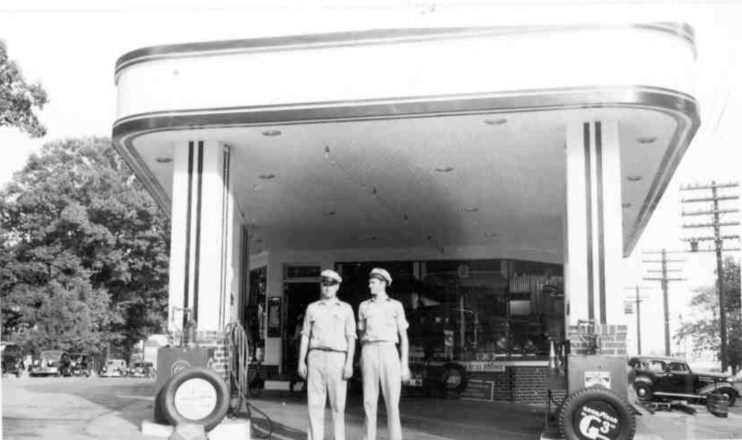
1940 — Reed Brothers Dodge canopied full service Gulf Gas Station. Photo by Lewis Reed
Reed Brothers Service Station provided restrooms for the traveling public. Patrons wanted clean and safe facilities. In addition to the Gulf signage there is a small, barely visible sign below that promotes, “Clean Rest Rooms” which assured the traveler that the restrooms were well maintained.

1936 — Reed Brothers Dodge canopied Gulf Gas Station. A closer look reveals the price of gasoline as 15 cents. On the right attached to a telephone pole is a sign pointing the way to Olney. In addition to the Gulf signage there is a small, barely visible sign below that promotes, “Clean Rest Rooms”. Photo by Lewis Reed
Due to changes in the highway, Reed Brothers began an extensive remodeling and rebuilding program. Two-thirds of the original location at the junction of then Route 240 and Veirs Mill Road was razed and a modern Gulf Service Station was erected.
The photo below is a circa 1968 photo of the Reed Brothers Dodge Gulf Gasoline station. The famous Gulf “ice box” design dates back to late 1930’s and there were probably more of these built than any single one of the later Gulf designs. A Coca Cola machine is visible in front of the white Dodge Dart parked in front of the service bay. The sign in the grass to the right of the blue ’58 Plymouth (Belvedere?) reads, “We’re Making Deals on Gulf Tires”.
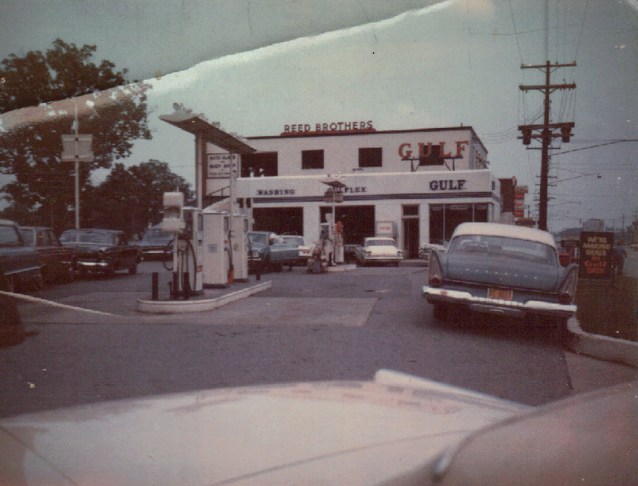
1960s — Reed Brothers Dodge Full Service Gulf Station. Photo by Lewis Reed
Reed Brothers Dodge discontinued offering Gulf Gasoline when they relocated to their new facility in November 1970.
Wright Flyer Test Flights at Fort Myer, VA
On this day in September 17,1908, the first military airplane in the world, built by the Wright brothers for the Army Signal Corps, made its first flight at Fort Myer, Virginia. Less than a thousand people witnessed the first flight at Fort Myer, because the general public was still doubtful that powered flight had been achieved. But Lewis Reed was there… and to commemorate that milestone, I have posted six original snippets of history that Lewis Reed captured through the lens of his camera that day.

Wright Brothers Military Flyer in its hangar at Fort Myer, Virginia. Photo by Lewis Reed
Five years after the first successful flight at Kitty Hawk, Orville Wright and Thomas E. Selfridge test flew the Wright Flyer in a demonstration for the U.S. Army at Fort Myer, VA. The Army was considering contracting Wright’s aircraft to use as a military airplane, but, in order to win the contract, he needed to demonstrate the plane’s ability to carry a passenger. Twenty-six-year-old Lt Thomas E. Selfridge volunteered to be a passenger that day. Orville Wright succeeded in keeping the Wright Flyer aloft for one minute and 11 seconds. After more than four minutes in the air, the airplane crashed to the ground from a height of about seventy-five feet after a propeller blade broke and the machine went out of control. Orville Wright was severely cut and bruised and his passenger, Lt. Thomas Selfridge, became the first powered-aviation fatality.

Another early aircraft from 1909 was the Bleriot XI monoplane. Photo by Lewis Reed

Curtiss Model D. Photo by Lewis Reed

Curtiss Model D with tricycle undercarriage. Photo by Lewis Reed

Wright Model B with skids. Photo by Lewis Reed
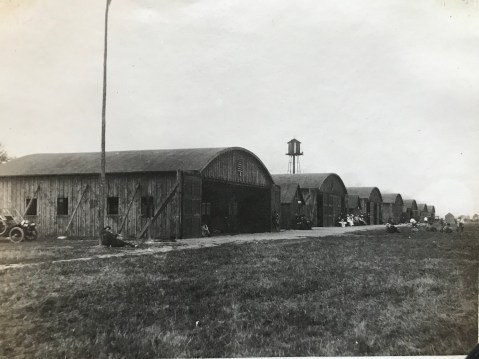
Airplane Hangars at Fort Myers, Virginia. Photo by Lewis Reed
The Wrights would prove their machine’s qualifications at Fort Myer. They met or exceeded all of the Army’s specifications, including flying at 40 miles per hour, carrying a combined passenger weight of 350 pounds, maneuvering in any direction in the air, landing without damage, and flying for at least an hour non-stop, which was a world record at the time.
Montgomery County Saw & Grist Mills (1905-1910)
A key part of Montgomery County’s agricultural economy in the 18th and 19th centuries, grist mills ground wheat and corn into flour and meal for local farmers. Today, besides the more than 30 streets that are named for mills, all that is left are the remains that have been uncovered in our parks. All of the mill structures are in various stages of ruin and are barely visible today. The following photographs are a collection of fascinating historical images of Montgomery County Saw & Grist Mills taken by Lewis Reed from 1905-1910.

An unidentified lady poses in front of Black Rock Mill, circa 1905. Photo by Lewis Reed
Black Rock Grist & Saw Mill
Black Rock Mill was built by Thomas Hillary and has stood along the banks of Great Seneca Creek as a landmark since its construction in 1815-1816. The mill was in working operation for over a hundred years until a flood in 1920 destroyed a dam on Seneca Creek and damaged the mill. Today, it is a unique survivor of the many mills in Montgomery County harnessing the water-power of the creeks to grind wheat and corn into flour. It is one of only two mills standing in Montgomery County Maryland. As far as can be determined, Lewis Reed’s collection of about 20 Black Rock Mill photographs are some of the earliest known in existence.

Muncaster Mill. Photo by Lewis Reed
Muncaster Saw & Grist Mill 1760s
Joseph Elgar built saw and grist mill on Rock Creek, later known as Muncaster Mill. Muncaster Mill was built in the early 1800s and closed in 1925 due to competition from modern milling practices. It was burned to its foundation in 1935. At one time, as many as 12 other mills operated along Rock Creek but most disappeared before the Civil War. Muncaster Mill was the last mill to operate in what is now Rock Creek Park. During its lifetime, the mill served 30–50 farmers in the area. There were three millstones, each designed for a specific grinding job. One ground unshelled corn for animal feed; one coarsely ground wheat, barley, and oats; and one ground fine flour. For many years, there was also a sawmill, operated by a water turbine. The sawmill foundation was about 75 feet west of the grist mill site. The old miller’s house stood on Emory Lane near Muncaster Mill Road.
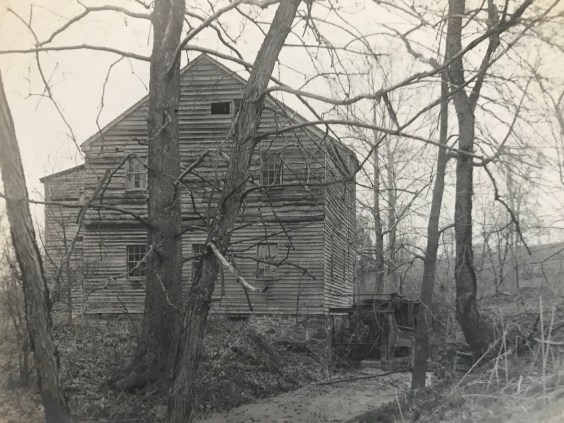
1910 Veirs Mill on Rock creek south of Veirs Mill Road operated from 1838-1880. Photo by Lewis Reed
Veirs Mill
The original Veirs Mill was built by Samuel Clark Veirs sometime after 1838 on the 400 acre farm which Veirs acquired in that year about two miles south of Rockville, on Rock Creek; the farm was part of an original land grant called “Prevention”. The sixth mill to be built on Rock Creek, Veirs Mill operated for approximately 80 years. The mill is identified as “Rock Creek Mills” and was located to what is now the intersection of Aspen Hill and Veirs Mill Roads. There are no above-ground remains of the Veirs Mill.

Hickerson Brothers Flour & Grist Mill 1910. Photo by Lewis Reed
Hickerson Brothers Grist Mill
Hickerson Brothers Grist Mill on Rock Creek south of Veirs Mill Road operated from 1838-1880. In 1925, Hickerson Brothers Lindsay and Clarence, operated a steam-powered grist mill near the B&O tracks until 1928-1929.

Clopper’s Mill. Photo by Lewis Reed
Clopper’s Mill
Clopper’s Mill was most active between 1850 and 1880, the arrival of the railroad and steam-powered mills had put an end to the water powered mills by the early 20th century. On April 15, 1865 Clopper’s Mill became part of national history when would-be assassin of the vice-president of the United States, George Atzerodt, spent the night there while fleeing from Washington D.C. after the assassination of President Lincoln. George was part of the gang assembled by John Wilkes Booth to eliminate the heads of the U.S. government. He was supposed to kill Vice-president Johnson at the Willard Hotel at the same time as Booth assassinated the President. But Atzerodt ran out of courage and instead made his way to Germantown. The mill was purchased by the state in 1955. The Clopper’s Mill ruins are significant as one of the few remaining distinguishable mills in the county. The ruins consist of stone and brick walls with no roof.

Liberty Mill. Photo by Lewis Reed
Liberty Mill. The Bowman Brothers built a steam-powered mill in 1888. When this mill burned down in 1914, an electric-powered mill was built and bought by the Liberty Milling Company in 1917. “Feed the Liberty Way” was the slogan for the mill which became the second largest mill in Maryland and supplied flour for the army during World War II. Cornmeal and animal feed were also made at the mill, and a mill store sold specialty mixes like pancake and muffin mix. After the war the mill went into decline, and was burned by arson May 30, 1972.
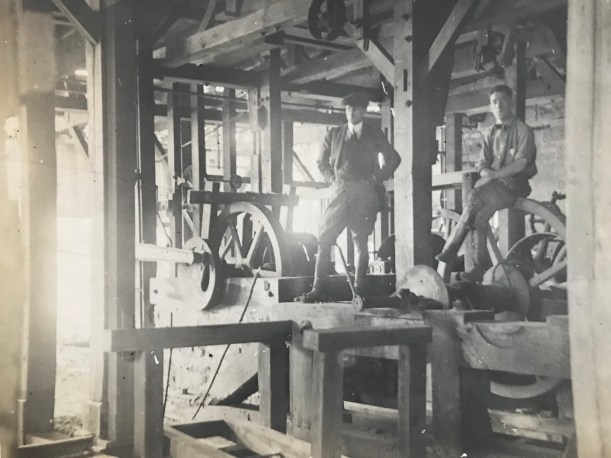
Rare peek at the inside of an old mill. Photo by Lewis Reed.
Source: Maryland Historical Trust
Books

Related Resources


Copyright Notice

Reed Brothers Dodge History (1915-2012) by Jeanne Gartner is licensed under a Creative Commons Attribution-NonCommercial 3.0 Unported License.
 Reed Brothers Dodge History 1915 – 2012
Recent Comments