
Early 1900s Photograph Taken at Stoneyhurst Quarries

Edgar Reed (front) and unidentified companions pose for a photograph at Stoneyhurst Quarries, Bethesda, Maryland. Photo by Lewis Reed, ca. early 1900s
The Stoneyhurst Quarry on River Road in Bethesda Maryland has been supplying stones since the 1920s for some of the great landmarks of Washington, DC, including the National Cathedral. The quarry was first opened in 1924 by the aptly named Lilly Stone. She was a widow in her 60s at the time and her family had owned multiple quarries but were also farmers. When the farm was busy, the quarries lay dormant. However after World War I, the family needed money after their farm had been destroyed in a disastrous fire. She once said that her father had told her, “Lilly, if you are ever in need, open the quarries.” And thus, she decided to open the quarry business on a full-time basis and personally oversaw operations until the mid 1950s.
Lilly didn’t hand the reigns over to her son Dunbar until she was in her mid 90’s! Quite an accomplishment for anyone, but also considering the culture of the times, a strong woman operating a large, notable business was quite unusual. She was the only female quarrier in the country that anyone knew of and quite an interesting character to say the least. Described as a “feisty lady” she once was arrested for speeding in a truck and hitting the officer on the head with a cane when she was ticketed.
During her spare time, Lilly researched Maryland’s historical roots and helped establish the Montgomery County Historical Society. She was also instrumental in organizing the Maryland State Historical Society and even designed Montgomery County’s original flag.
Source of Information: Montgomery History
1915 Street Scene in Middlesex VA

Motorcyclists and cars getting gas at a curbside pump at Middlesex Ford Agency, circa 1915. Photo by Lewis Reed
It is always interesting to see photos from days gone past. The interesting street scene above was taken by Lewis Reed in Middlesex, Virginia. All of the cars in the view are late model vehicles. The Middlesex Garage, which appears to be a Ford Agency that advertises gasoline, oils and lubricants for sale, is also visible. A closer look reveals the price of gasoline as 15 cents. Also visible in the photo are trolley tracks running down the middle of the dirt road.
Below are motorcyclists posing on the street in Middlesex. Edgar Reed is shown on the left on his Excelsior motorcycle.
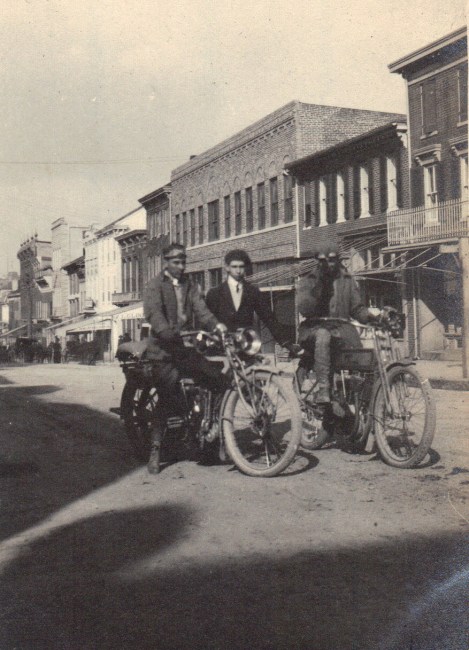
Motorcyclists in Middlesex VA, circa 1915. Edgar Reed is on the left. Photo by Lewis Reed
Middlesex County is located on the Middle Peninsula in the U.S. state of Virginia. Middlesex has remained largely rural over the years with farming, forestry, fin and shell fishing and tourism providing the principal elements of its economic base. Its geographical location has helped it to retain its rural character while also making it the perfect place to recapture childhood memories of summer days spent on a boat, catching crabs and water skiing.
105 Years Ago: Rockville’s First Gulf “Gas Station”
Curbside gasoline pumps were the predecessor to today’s contemporary fuel pumps. Before the advent of curbside pumps, gasoline was pumped from storage barrels, then hand poured into the automobile from tins. In 1901, a new underground container system was patented. The system used underground holding tanks which allowed the storage and subsequent distribution of gasoline to the surface via a curbside pump. It is considered the first vehicle fuel dispenser.
One hundred and five years ago, Rockville Garage began selling gas at their original location in Old Rockville at the triangle at Veirs Mill Road and Rockville Pike. It was a perfect site for the filling station due to being on a high visibility corner which gave the dealership maximum visibility to the largest volume of cross traffic. Their first “gas station” consisted of a single pump and one small tank. Rockville Garage dispensed gasoline produced by the Gulf Oil Co. and later offered Texaco gasoline as well. Reed Brothers is credited as the first Gulf gasoline dealer in the Washington, DC area.
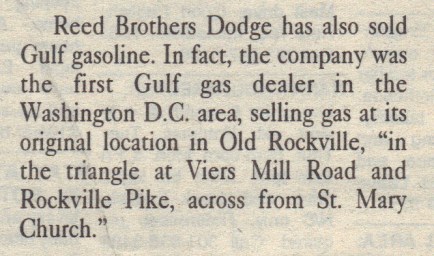
Clipped from The Frederick News-Post, Thursday, May 8, 1997
Rockville’s First Gulf “Gas Station” – A Single Pump
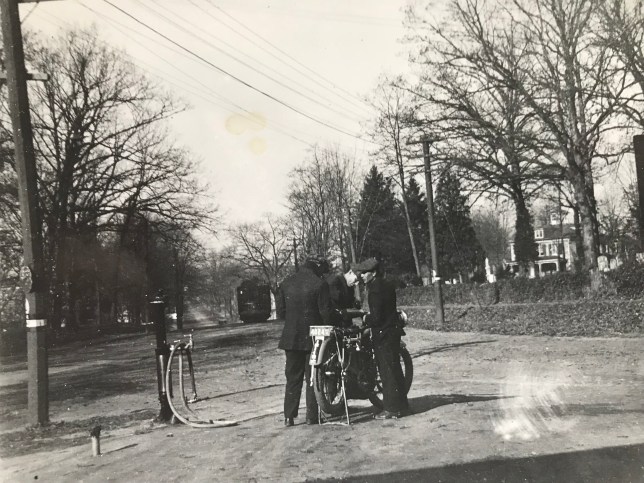
1915 Rockville Garage First Gas Station – A Single Pump. View looking west on Main Street of Rockville showing early trolley car. Originally printed from one of Lewis Reed’s glass negatives, this 1915 black-and-white photograph provides insight for understanding and preserving early U.S. petroleum history.
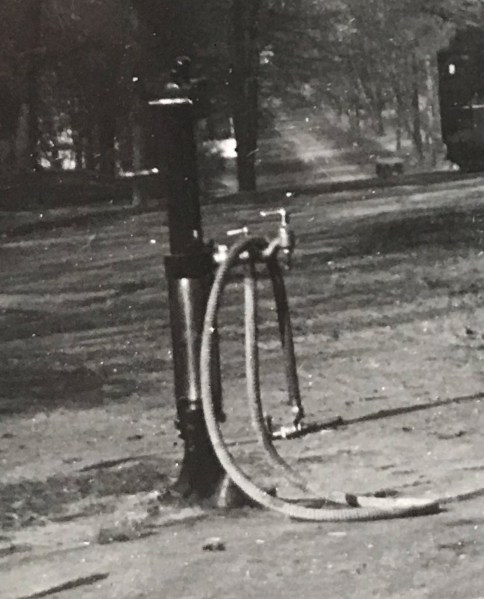
Close-up of the curbside pump in front of Lewis Reed’s Rockville Garage. The pump was mounted just inside the entrance and was served by one small storage tank buried beneath the ground.
The close-up image above illustrates the utilitarian design of the early gas pumps. These early pumps were roughly four feet tall and were supplied with a hose for dispensing fuel directly to the automobile. Although hardly an ideal system, pumps and underground tanks along the curb were an improvement over the earliest filling stations where gasoline was poured from hand containers. This curbside pump would remain in use until roughly 1917.

November 1915 Rockville Maryland Sanborn Map, Sheet 5 (zoomed in)
The zoomed-in image of the November 1915 Sanborn map shows the one-story Rockville Garage at the junction of Rockville & Georgetown Turnpike and Washington Road. These maps are quite specific, not only in representing graphically the dimensions of buildings and spaces around them, but also in the details of the construction materials and activities that took place there. Notes on this map indicate that the garage had a 15-car capacity as well as a single gasoline pump. They also noted the buried gas tank and where it was located with a small circle.

The same view today, fondly known as “the mixing bowl.”
Then & Now: Point of Rocks Station
Looking at old photographs is like peering through an open window back into history. Not only do they give you a sense of wonder from traveling back in time, but also a staggering feeling of awe from seeing just how much things have changed. For this post, I have used one of Lewis Reed’s original photographs for “then” and a Google stock image for “now”.

Point of Rocks Station. Photo by Lewis Reed, ca. 1911.
Point of Rocks Station (THEN): Point of Rocks is the location of an important railroad junction and the site of one of the most picturesque and best known of the historic stations of the former Baltimore and Ohio Railroad. At this junction, the ex-B&O Old Main Line from Baltimore, one of the oldest lines in the country, and the ex-B&O Metropolitan Branch from Washington, D.C., opened in 1873, come together and continue west as one line to Cumberland, Pittsburgh, and Ohio. A little known fact is that the station was struck by lightning in the late afternoon of June 27, 1931 and gutted. We can be thankful that the B&O ordered its full restoration.
Point of Rocks Station (NOW):

Point of Rocks Station today.
A Tribute To My Father On His Birthday

Today marks the birthday of my late father, Ernest Lee Gartner. If he were still around he would be 99 years old today. Much of my passion and drive stems from the life and business lessons I learned from my father. In this special post, I thought I would take a moment to reflect on his influence in my life that has helped make me into the person I am today.
My father was a kindhearted, stubborn, difficult, witty, and an amazingly savvy businessman. My dad gave me his strong points and showed me the blueprint for how to be successful: including a strong work ethic and instilling within me the belief that I can achieve whatever it is that I desire.
I learned from his example and internalized his high expectations. He went to work every day until the day he died. Some people might have called him a workaholic, but he never gave anything less than 100% to his job. He has handed down his natural leadership abilities, which have helped me achieve a number of career “firsts” while I was in the Air Force, and ultimately reach the top enlisted position as the first female Command Chief of a premier Air Force unit.
What I learned from my father that made me a better person was his example of always trying to learn more. He was invested in self-improvement and always read books, magazines and newspapers. This was a great influence growing up and helped me put ongoing time into learning. Ask questions when you don’t understand something and don’t be afraid to seek out more information. Looking back, researching solutions to problems was a completely natural process for me thanks to my father’s example.
My father taught me that I can do anything I set my mind to and that anything worth doing is worth doing well. It’s great advice I still live by today. His example made a lasting impact on me and I have to credit him for my constant quest for knowledge and excellence.
My father’s greatest gift to me was the drive to persevere. He taught me courage in the face of adversity, more than any other human being I have ever met. Lee Gartner successfully navigated Reed Brothers Dodge through numerous Chrysler setbacks, including the first Chrysler Bailout, the sale of Chrysler to Daimler, and the sale to the private equity firm Cerberus. He applied his 30+ years experience with Reed Brothers to meet the challenges of gasoline shortages, high interest rates, severe inflation, and weakening consumer confidence which drove Chrysler into financial crisis. This survival is testimony that he not only conquered setbacks, but often rebounded to reach new levels of success. He was a hard worker, he was the type that persevered.
I will always remember my dad as a successful businessman whose persistent energy was always there for family, but in equal measure for the public he served. He was smart and also honest and dependable – characteristics that kept Reed Brothers Dodge at the pinnacle of auto dealerships throughout his career.
I never had a chance to tell my dad how much I admired him, but I remain proud of him and his accomplishments. Lee Gartner continued what Lewis Reed built from the ground up and helped make Reed Brothers Dodge into a successful family business that lasted almost a century.
My dad set a standard of excellence and provided a set of values for my life that I still follow today. Dad, this is for you.. Happy Birthday!
Books

Related Resources


Copyright Notice

Reed Brothers Dodge History (1915-2012) by Jeanne Gartner is licensed under a Creative Commons Attribution-NonCommercial 3.0 Unported License.
 Reed Brothers Dodge History 1915 – 2012
Recent Comments