
11/14/1914: First Dodge Off Assembly Line
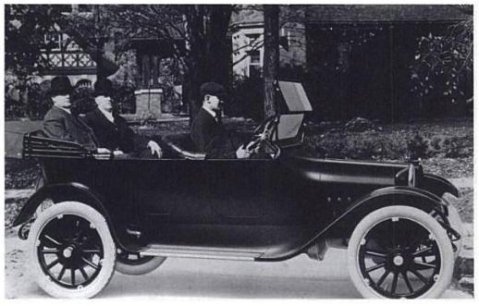
John & Horace Dodge in one of their 1914 Tourers
One hundred and two years ago on this date –November 14, 1914 — the very first Dodge car, “Old Betsy”, rolled off the assembly line. On that day, the Dodge Brothers (Horace and John) were photographed riding in the rear seat of the first car to bear their last name. It cost $785, had a 110-inch wheelbase, and was powered by an L-head 4-cylinder engine that proved so reliable it was continued until 1920 with very little modification. Total production for 1914 was a mere 249 touring cars. The following year. Dodge offered a two-passenger roadster which also sold for $785 and the plant went into full production.
According to “The Dodge Brothers: The Men, the Motor Cars, and the Legacy” by Charles K. Hyde, here’s the full story:
The widely accepted history of the initial production of early Dodge Brothers automobiles in November 1914 is at odds with much of the evidence about the earliest Dodge Brothers cars. Automotive historians have thought that the first production car, later named “Old Betsy,” came off the assembly line at the Hamtramck factory on 14 November 1914. Guy Ameel, superintendent of final assembly for Dodge Brothers since the start of automobile production, served as John and Horace’s chauffeur that day. With the brothers in the back seat, Ameel stopped the first Dodge Brothers car in front of John Dodge’s mansion on Boston Boulevard in Detroit and a photographer recorded this important moment.
“Old Betsy” was more likely an experimental prototype car assembled several months before 14 November 1914 and not a production car at all…
The Dodge Brothers began an aggressive advertising campaign to promote their new automobiles and to attract potential dealers to sell their cars. Lewis Reed was an enterprising young man who put his future in the fledgling automobile industry. In 1915 he received his franchise to sell Dodge Brothers Motor Cars from John and Horace Dodge; less than one year after “Old Betsy” rolled off the assembly line. Lewis Reed and his brother Edgar, were the first to sell Dodge cars in Montgomery County, Maryland. That made Reed Brothers the oldest Dodge dealership under the same family ownership in Maryland, and one of the oldest in the entire nation.
October 1915: The Beginning of a Legacy
Woodrow Wilson was President of the United States; the Green Bay Packers did not yet exist; the United States was two years away from joining World War I; the cost of a stamp was two cents, and Reed Brothers Dodge in Rockville, Maryland was founded.
This is when it all began. It was 101 years ago in October 1915 that Rockville automobile pioneer Lewis Reed, founder of Reed Brothers Dodge, signed a franchise agreement with Horace and John Dodge in Detroit; less than one year after the first Dodge automobile rolled off the assembly line. Since then, the business grew and transformed from a small-scale garage and dealership into one of the largest and most recognized commercial enterprises on Rockville Pike.
This photograph of the original 1915 Rockville Garage shows a 1916 model 44 Oldsmobile with V8 and sedan body parked in front. The original owners of Rockville Garage are standing in front. From left: Roy Warfield – Lewis Reed – Griffith Warfield. (click on photo to enlarge)
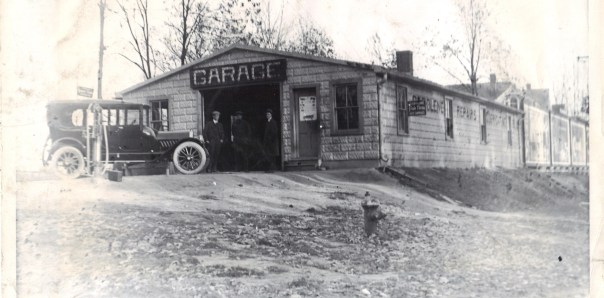
In 1914, Lewis Reed became a partner in Rockville Garage, a business he purchased in 1918. His brother Edgar joined the business in 1919 upon his return from World War I, and the name became Reed Brothers Dodge. Initially, Reed Brothers sold Oldsmobile and Hudson along with Dodge. The first Plymouth was built in 1928 and Plymouths were sold at Reed Brothers from 1930 until 1969, when the Plymouth car was given to the Chrysler dealers. In 1928, when Walter P. Chrysler took over after Horace and John Dodge died, Lewis Reed became an original member of the Chrysler family. By 1929, when the stock market crashed and Great Depression began, nobody could afford to buy cars. Like most other businesses, the Great Depression hit hard and Reed Brothers had to rely on its Service Department to make ends meet.
Reed Brothers faced another setback during World War II. All U.S. car manufacturers stopped production in order to concentrate on military equipment. Reed Brothers had no new cars to sell for three plus years. Many car dealers went bankrupt at this time. Lewis Reed converted his car showroom into a display room and sold GE washing machines and other large appliances. The brothers operated their own full service Gulf gasoline and service station. In fact, the company was the first Gulf gas dealer in the Washington, D.C. area, selling gas at its original location in Old Rockville at the triangle at Veirs Mill Road and Rockville Pike.
The dealership survived two World Wars, the Great Depression, the first Chrysler Bailout, the sale of Chrysler to Daimler and the later sale to the private equity firm Cerberus. Reed Brothers has, in fact, survived everything but Chrysler itself. Regrettably, loyalty was not enough to keep the dealership open when Chrysler cut dealership ranks during their 2009 bankruptcy process. After almost 95 years selling Dodges, Reed Brothers was notified by Chrysler that their franchise agreement would not be renewed. Reed Brothers Dodge occupied two locations, the original at the Veirs Mill Road and Rockville Pike intersection and the second on 355 near Shady Grove Metro.
Today, Bainbridge Shady Grove Metro Apartments pays homage to this history by celebrating the golden era of the automobile with commemorative art on the former site of the iconic Reed Brothers dealership.

Bainbridge Shady Grove Metro Apartments now stands on the former site of the Reed Brothers Dodge dealership at 15955 Frederick Road. But a sculpture now installed on the property pays tribute to the oldest Dodge dealership in Maryland history. More than 20 feet high, and over 6 feet wide, the public art is inspired by 1939 Dodge headlamps, and the fender of a 1957 Dodge pickup truck.
Early 1900s Frederick Fair Parking Lot

Frederick Fair Parking Lot, circa 1914. Photo by Lewis Reed
This fascinating scene of hundreds of vintage cars parked in the Frederick Fair parking lot was taken by Lewis Reed. What is fascinating to me is, with all of these early cars painted in black, how on earth would you find your car in the parking lot?
The Frederick County Fair is one of the oldest agricultural fairs in the state of Maryland dating back to 1822 when it was known as the Cattle Show and Fair. Over the years the fair has changed names several times. Today, the Frederick County Fair is officially named the Great Frederick Fair. The GREAT Frederick Fair is celebrating 154 years in 2016 (Sept. 16-24).
Lewis Reed Photos: Steam-Powered Engines
Looking back at photography from the past is a fascinating experience for me. Since I started this blog, I have had the opportunity to look through my grandfather’s extensive collection of photographs from locations all across the country. The majority of his photos are more than 100 years old and, unfortunately, are lacking labels and/or dates, which requires quite a bit of research and a little photo detective work on my part. Adding up the clues can help solve the mystery, date, and help identify the images. Google sometimes surprises me with its capabilities.
The below previously unpublished photos (dated 1909) from Lewis Reed’s album are what appears to be some of the early machines that helped build America. Steam traction engines, or steam rollers and road locomotives as they were sometimes called, were the predecessor to today’s modern farm tractor. They could plow, they could haul, and you could put a big belt on the fly wheel and drive a saw mill; whatever you wanted to do. They were also used as a transportable power source. The engines would normally run on coal, wood, or even straw, or whatever would build a fire. The photos shown here were dated 1909.

1909: SAWMILL POWERED BY STEAM TRACTION ENGINE – photograph by Lewis Reed
As a Michigan farm boy, Henry Ford recorded his first sight of a traction engine: “I remember that engine as though I had seen it only yesterday, for it was the first vehicle other than horse drawn that I had ever seen. It was intended to drive threshing machines and power sawmills and was simply a portable engine and a boiler mounted on wheels.” It was the steam traction engine that inspired Ford to design and manufacture automobiles.
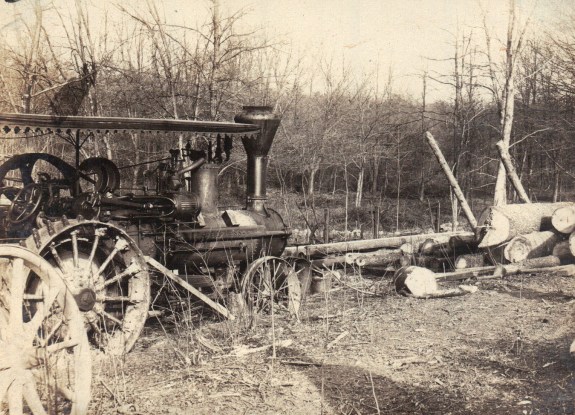
1909: SAWMILL POWERED BY STEAM TRACTION ENGINE – photograph by Lewis Reed
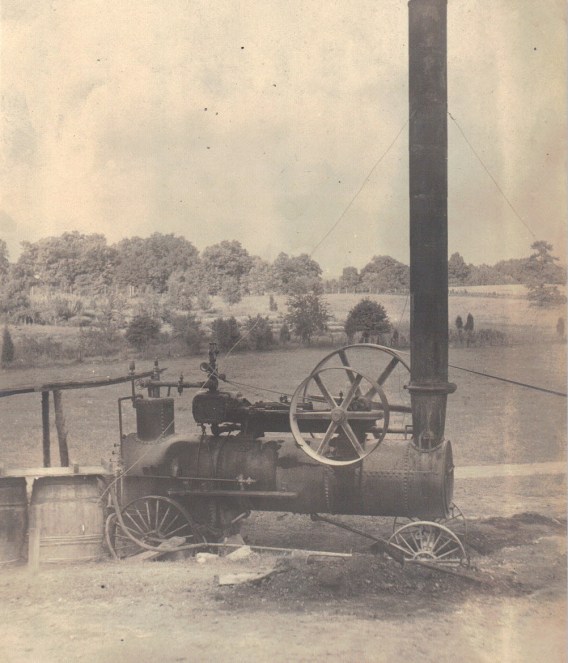
PORTABLE ENGINE WITH CHIMNEY SHOWING THE LACK OF SELF-DRIVEN WHEELS – photograph by Lewis Reed
A portable engine is a type of self-contained steam engine and boiler combination that may be moved from site to site. Although bearing a strong family resemblance, in both appearance and (stationary) operation, the portable engine is not classed as a traction engine as it is not self-propelled.

STEAM ROAD ROLLER – photograph by Lewis Reed
Steam Road Roller: This take-off of the steam traction engine was designed specifically for road building and flattening ground mimicking today’s modern rollers used for compacting road surfaces. A single, heavy roller replaced the front wheels and axle and a smoother rear wheels replaced larger wheels without strakes. (strake – name for the diagonal strips cast into or riveted onto the wheel rims to provide traction on unmade ground).
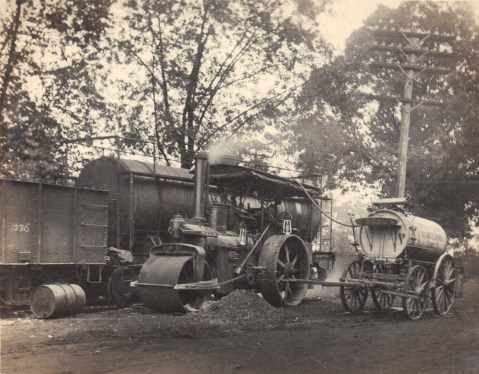
STEAM ROAD ROLLER – photograph by Lewis Reed
Photos cannot convey the raw power of a steam tractor: the way its pistons, valves, gears, and wheels are locked in constant motion. You really have to see this machinery in action.
Watch video of a 1916 Case steam engine tractor power a sawmill.
May 14, 2009 Timeline: How Chrysler Crashed
On May 14, 2009, Chrysler left 789 dealerships, about a quarter of its dealer base, out in the cold by rejecting their franchise agreements and giving them about a month to sell all their remaining new cars, factory parts and service equipment. After almost 95 years selling Dodges, Reed Brothers was one of the 15 dealerships in Maryland and 789 dealerships nationwide notified by Chrysler that their franchise agreement would not be renewed.
Here is a timeline on how Chrysler crashed:
1920s
Walter P Chrysler purchased the Dodge company and swiftly built a portfolio of auto brands including Plymouth and Chrysler. Within five years he was competing with Ford and General Motors.
1970s
After the 1973 energy crisis Chrysler’s range of big gas-guzzling cars and a couple of recalls left it with big problems. The legendary Lee Iacocca was hired in 1978. With the help of government loans, the former Ford executive rescued the firm and rebuilt it during the 1980s, buying Jeep along the way.
1990s
Iaccoca retired in 1992. In 1998 Chrysler merges with Daimler-Benz in a $37bn deal to become DaimlerChrysler, based in Germany. It was supposed to be a merger of equals, but Daimler was in the driving seat and Chrysler swiftly fell into losses.
2007
February 13,000 job cuts announced. Daimler says its open to offers for Chrysler.
April Activist investor Kirk Kerkorian tables a bid for Chrysler.
May Daimler sells 80% of Chrysler to private equity group Cerberus for $7.4B. The German group retains a 20% stake.
2008
October General Motors reported to be in merger talks with Chrysler. Nissan considers bidding for 20% of Chrysler to add to its alliance with Renault. Chrysler announces 5,000 job losses. Daimler says its 20% stake is worthless.
November Chrysler boss Bob Nardelli says the firm needs merger or bailout to survive. Sales down 35% in a year. GM asks US treasury department for $10bn so that it and Chrysler can merge. Cerberus demands $7B from Daimler to cover post-acquisition losses. German group says claims are baseless.
December The Senate refuses the bail-out. Chrysler says it is short of cash and likely to file for bankruptcy. All plants to close for a month. President George Bush finally approves a $13B rescue loan for the big three US carmakers.
2009
January US government provides $4B cash. Chrysler reported to be in talks to sell assets, maybe the Jeep brand, to Renault. Fiat proposes taking 35% stake in return for access to technology and overseas distribution networks
March Nardelli backs Fiat plan to save jobs and asks government for another $5B. Obama gives Chrysler 30 days to do a deal with Fiat – or go bankrupt.
April Chrysler’s banks talk to US government about debt for equity swap
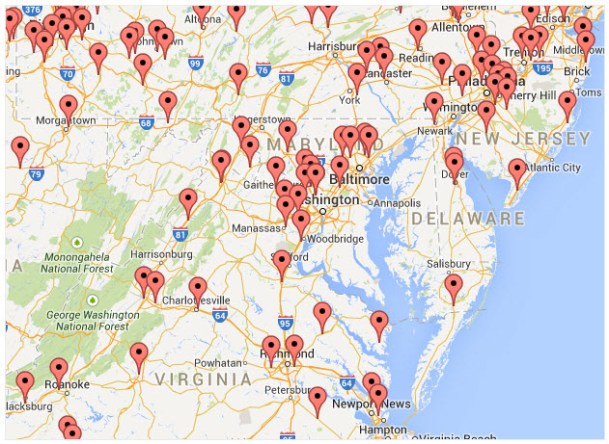
Maryland Dealers shut down
Via: theguardian
Books

Related Resources


Copyright Notice

Reed Brothers Dodge History (1915-2012) by Jeanne Gartner is licensed under a Creative Commons Attribution-NonCommercial 3.0 Unported License.
 Reed Brothers Dodge History 1915 – 2012
Recent Comments