
Can’t Find Your Car? Frederick Fair Parking Lot, 1914
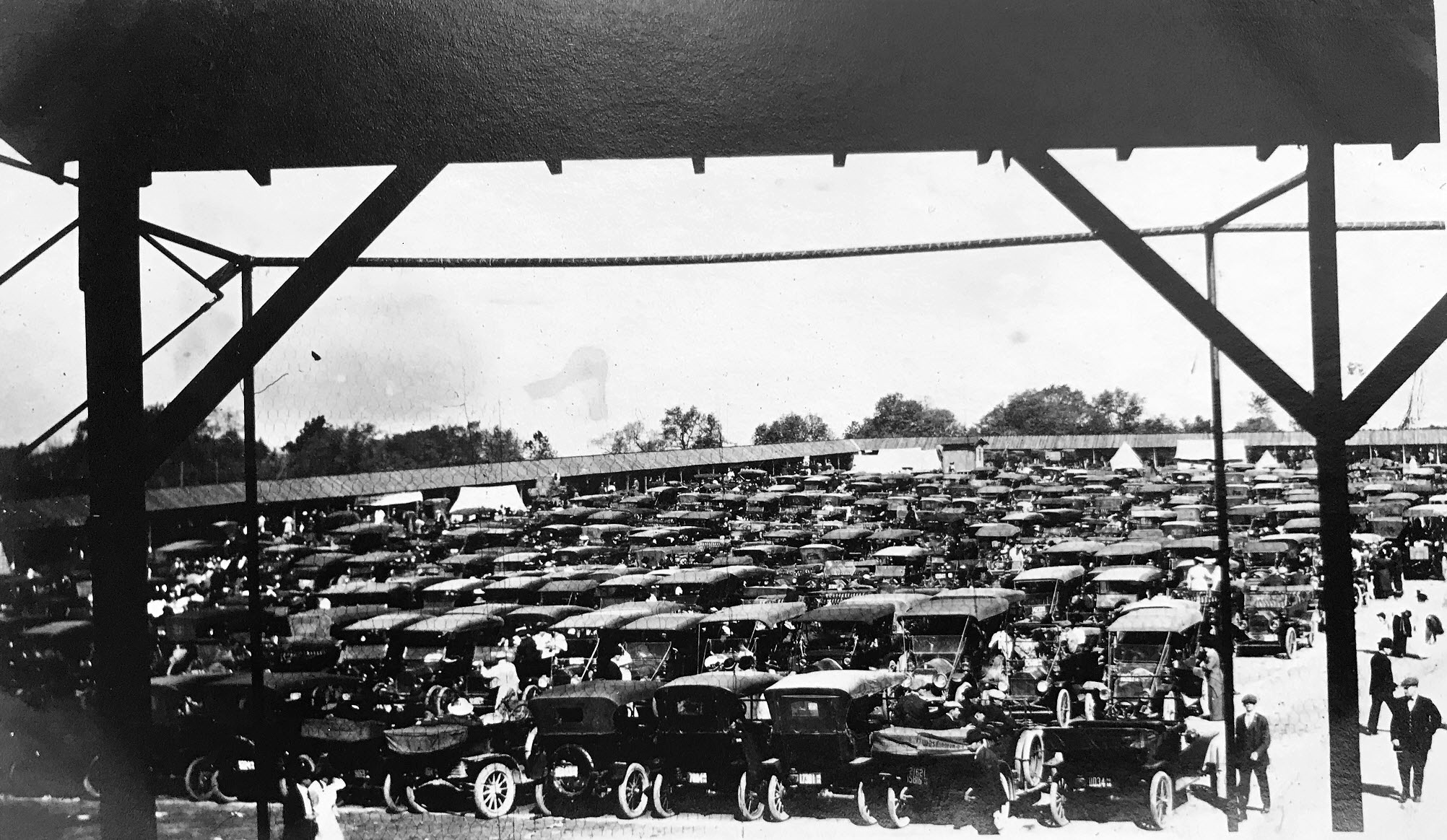
This fascinating scene of hundreds of cars parked in the Frederick Fair parking lot was taken by Lewis Reed in 1914. What is fascinating to me is, with all of these early cars painted in black, how on earth would you find your car?
Can’t find your car? Apparently not a new phenomenon as seen in this 1914 photo of the Great Frederick Fair parking lot, especially since the majority of cars were of only one paint color, your basic black.
This week (September 13-21) marks the 162nd edition of the Great Frederick Fair, the largest and greatest county fair in the State of Maryland. There have been many changes since the first fair was held in 1822 when it was known as the Cattle Show and Fair: that was a two-day event, now it’s nine days. The location has changed and so has the name. Today, the Frederick County Fair is officially named the Great Frederick Fair. It’s been held in May, October and November, but now (and for many years) takes place in September — rain or shine.
Fair entertainment has certainly evolved over the years. In 1888, May Lillie, an “expert girl shot with a rifle” from the back of a running mustang, performed. In the early 1900s, acrobatic bears and monkeys, high-wire acts and vaudeville performers took the stage. In 1950, the highlight of the “Irish Horan and the lucky Hell Drivers” show was a “stock convertible catapulted from a giant cannon.” In 1965, it was Jack Kochman’s Hell Drivers performing stunts with cars.
The Thursday of the 1911 fair was noted as a record day with 15,000 people in attendance, 100 autos and 1,000 carriages, according to “The Great Frederick Fair” book. Today, fair attendance can range from 210,000 to 250,000 people during the nine-day fair.
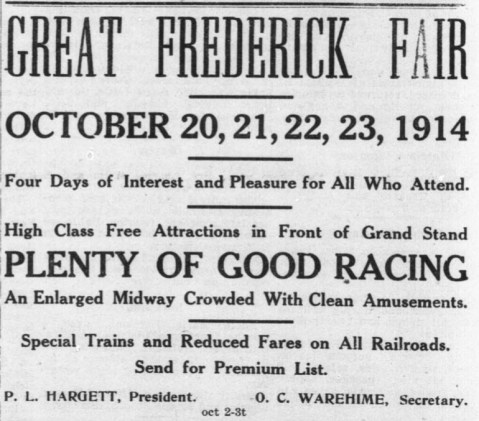
Newspaper ad advertising The Great Frederick Fair. THE DEMOCRATIC ADVOCATE OCTOBER, 1914
Source: Frederick News-Post
Back in Time: Roadside Springs
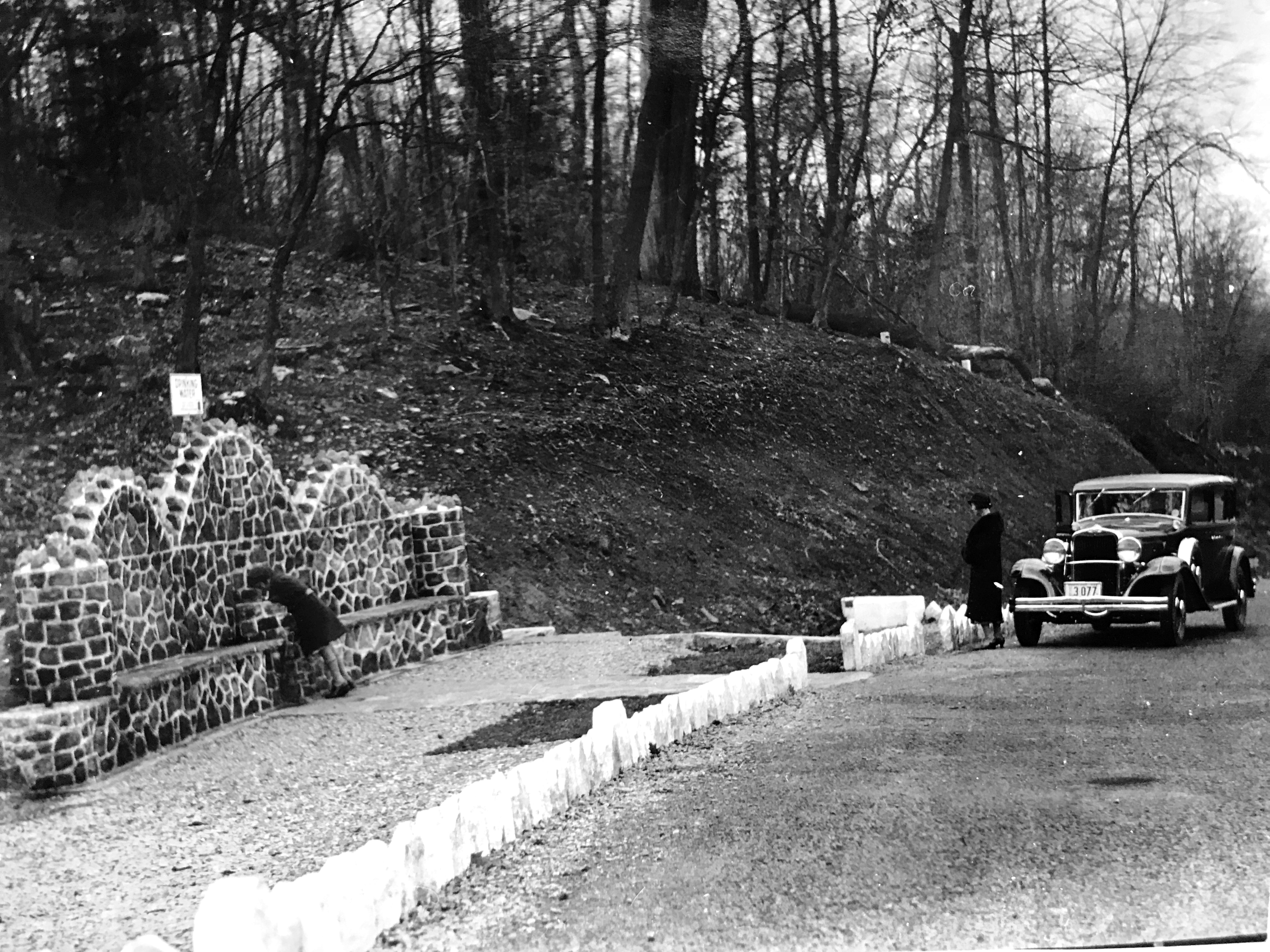
Early 1930s roadside spring. The sign above the wall reads, “drinking water”. Fountains like these were placed along roads to give motorists an opportunity to stop for a drink. The child at the fountain is Lewis Reed’s daughter, Mary Jane, and the woman standing next to the circa 1930s Dodge Sedan is his wife, Ethelene. Photo by Lewis Reed.
Imagine a time when automobiles lacked air conditioning, highway travel was young and life moved at a much slower pace. Back in the day, it was more about the journey than the destination. As better roads allowed motorists to travel increased distances it became apparent that they would need places to stop along the way. The model of place that led to the establishment of waysides and roadside parks was initiated by the traveling public. Stopping sites emerged in rural areas where commercial establishments were not available. Often they appeared in areas of scenic interest or merely in places where there was room for a car to pull off the roadway. These earliest waysides materialized out of necessity, when motorists needed to wanted to stop they pulled off and parked along the roadside.
The photo was taken by Lewis Reed on one of his many cross country road trips. This unknown roadside rest area with water fountain gives us a real sense of a bygone era. We don’t travel like this anymore. Now we’re just trying to get from point A to point B as quickly as possible.
During the 1930s, the State Road Commission was engaged in a program to improve the road infrastructure, which included beautification efforts as well as road paving and bridge construction. Numerous roadside fountains were constructed across the state. No statewide inventory exists.
May 28, 1928 – Chrysler Buys the Dodge Brothers Company
1928 Chrysler logo
May 28, 1928 marks an important milestone in the history of Chrysler. It was on this day in 1928 that Dodge Brothers, Inc. became a part of Chrysler. It was on this same date that Lewis Reed, founder of Reed Brothers Dodge in Rockville, Maryland also became an original member of the Chrysler family.
During 1920, the Dodge Brothers company lost its founding fathers. John Dodge died in January, and his younger brother Horace succumbed the following December. A New York investment banking firm paid the brothers’ widows, in a single cash payment, $146 million for the Dodge Brothers firm. Within three years, the bankers initiated negotiations, and on May 28, 1928, Walter P. Chrysler purchased Dodge Brothers, Inc. for $170 million, making it, at the time, the largest business transaction in history. When the transaction was complete, the Chrysler Corporation had grown five-fold overnight to become the third of Detroit’s “Big Three” automakers.
The first Plymouth was built in 1928 and Plymouths were sold at Reed Brothers until 1969, when the Plymouth brand was given to the Chrysler dealers.
1924 Auto Wash Bowl – A Piece of Automobile History
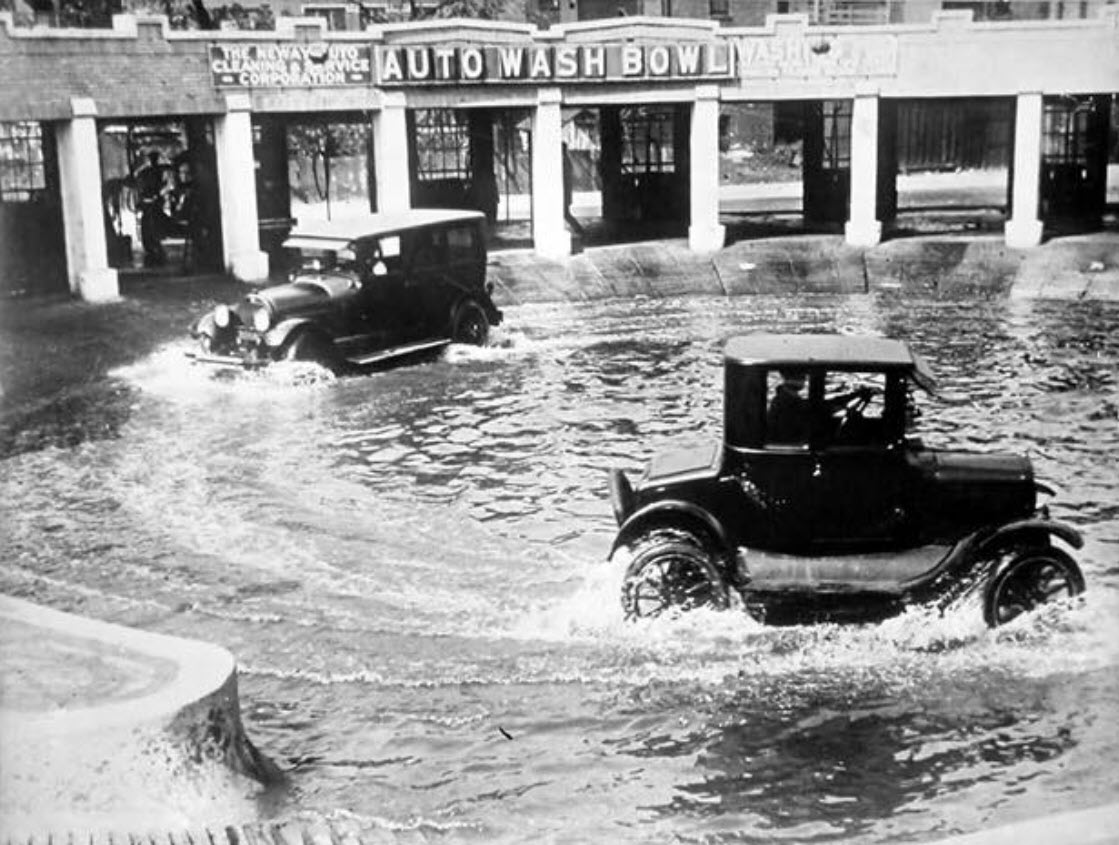
This once innovative car wash stood at the northwest corner of Chicago’s 42nd Street and South Michigan Avenue. This is how the operation appeared in 1924.
This photo made me realize that this was another one of those things that I’d just never thought of, but found fascinating. In the days before modern conveniences like power washes, they had much worse things to wash off their cars. Back in this early age of motoring, roads were often unpaved and muddy, and that mud would get caked on the underside of the car and the wheels – but a spin in the nifty Auto Wash Bowl took care of that.
The nearly 80-foot-wide, ridged concrete bowl was about 16 inches at its deepest point in the center. Customers paid 25 cents to an attendant who strapped a protective rubber cover over the radiator. Patrons would then enter the bowl via a ramp and drive their cars around and around the bowl at a speed of about 10 miles per hour. The ridges in the concrete would vibrate the car and the water, creating a sloshing action that helped wash away all the mud from the chassis and wheels. The whole process took about 3 or 4 minutes.
Sadly, the Auto Wash Bowl wound up being little more than a novelty as car-washing technology evolved. Just two years later, the North Side wash bowl was bought by a local realtor, the South Side wash bowl was gone by the ‘30s, and the Auto Wash Bowl went down the drain.
Merry Christmas!
Christmas 1944, exactly 79 years ago this holiday season, marked the last Christmas of World War II. The 1940s was a decade shaped by war, but the Christmas spirit and the act of good fellowship and kindness was still important to people even in times of hardship. The vintage holiday print ad below from Reed Brothers Dodge offers a window into how businesses of the 1940s pictured an idealized holiday season.

Montgomery County Sentinel, December 21, 1944
I would like to wish everyone who finds time during the course of your day to visit this blog a very Merry Christmas and a safe and healthy Happy New Year in 2024.
Jeanne Gartner
Blog Author
Books

Related Resources


Copyright Notice

Reed Brothers Dodge History (1915-2012) by Jeanne Gartner is licensed under a Creative Commons Attribution-NonCommercial 3.0 Unported License.
 Reed Brothers Dodge History 1915 – 2012
Recent Comments