
Looking Back 50 Years Ago Today: 55th Anniversary and Grand Opening
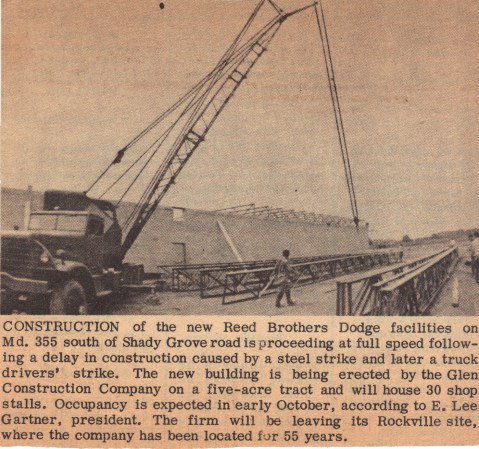
 Today marks 50 years since the Grand Opening of Reed Brothers Dodge new showroom and service facility. When the state widened the roads in 1970, Lee Gartner purchased 4.37 acres of land from Eugene Casey and relocated Reed Brothers Dodge to a new state-of-the-art showroom and Dodge/Chrysler/Jeep service complex on Route 355 at 15955 Frederick Road in Rockville Maryland.

Turning out to honor the company were several hundred dignitaries, officials, businessmen and friends. The new building, a complete automotive sales and service facility marked Reed Brothers 55th year of selling Dodge’s. The state-of-the-art dealership contained the newest customer-focused features throughout which combined technology and comfort. (click on any photo to scroll through gallery)


The new dealership provided a modern new vehicle showroom, 30 service bays, a comprehensive detail and car wash area, Parts Department, Body Shop, the newest technologies to service customer’s vehicles and provided customers with a convenient location to purchase and service their vehicle needs.

Design and construction of the new dealership was managed by the Glen Construction Company.
 After 42 years of serving Rockville at this location, the dealership property went to settlement on August 30, 2012. Reston, Virginia-based Silverwood Companies put the former Reed Brothers Dodge dealership under contract, then won annexation into the City of Rockville, and ultimately conveyed the property to apartment builder, The Bainbridge Companies. Today, Bainbridge Shady Grove Metro pays homage to almost a Century of history by celebrating the golden age of the automobile with commemorative art on the former site of the iconic Reed Brothers Dodge dealership.
Peerless Rockville/Glenview Mansion Speaker Series
The Peerless Rockville/Glenview Mansion Speaker Series continues on-line. Join me Thursday, October 8 at 7:00pm on WebEx for my presentation on The History of Reed Brothers Dodge. My PowerPoint presentation will follow the dealerships historic timeline which showcases how Reed Brothers Dodge came into being, and how the company overcame the inevitable changes and challenges throughout almost a century of being in business. More than 150 photos will be featured, 90 of them historic images taken by the dealership’s founder, Lewis Reed. Click the link for free registration >> https://www.eventbrite.com/e/the-history-of-reed-brothers-dodge-1915-to-2012-tickets-122409759887

No New Cars During WWII, But That Didn’t Stop Lewis Reed
During World War II, Reed Brothers Dodge had virtually no new cars to sell for three and a half years. Tires and parts were rationed. Strict price ceilings governed used-car sales. Used cars were really hard to find, because people couldn’t afford to give them up. So, most dealerships had to rely on their service and parts departments to fix the cars people couldn’t replace. Empty showrooms were a problem. When manufacturers halted car production and many dealers went bankrupt, Lewis Reed converted his car showroom into a display room and sold GE washing machines, Westinghouse Radios, and other large appliances to fill the gap.
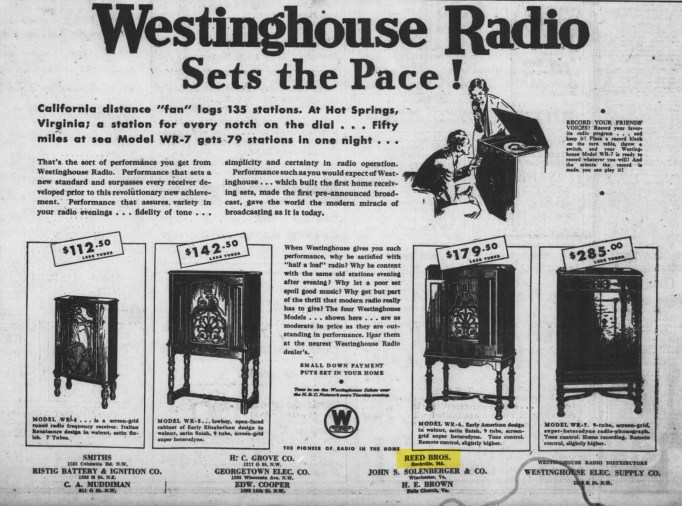
Newspaper ad for Westinghouse Radios with Reed Bros, Rockville, MD listed in fine print at the bottom
Reed Brothers Dodge lost eight employees to the draft. One former employee, Philip Frank, a member of the Air Corps in World War II was in killed in combat in the South Pacific. Raleigh S. Chinn of Rockville, Salesman, who started with Reed Brothers in 1920, resigned in 1942 due to lack of automobiles to sell. Edward R. Brosius of Barnesville, Salesman, started with the company in 1938. He, too, resigned in 1942 when cars were unavailable. Guy Merry of Rockville started in 1937 as a mechanic. He entered the armed forces in World War II and served for three years. When he was released, he returned to his old job. John Burdette of Gaithersburg, Gas Station attendant, started in 1940 and worked for about one year and then entered the armed services. He served four years in World War II and returned to his old job when he was released. Richard C. Burdette, Rockville, mechanic, started in 1941 and also worked at Reed Brothers until he entered the service. He served two years and then returned to work.
Car salesmen back in the 1940s would drive as far as 35 miles to deliver cars to their spread-out farmer customers. Lewis Reed allotted specific sales territory to his salesmen in four different directions from the dealership. The salesmen spent all day in the outlying areas, because the farmers in Poolesville, Rockville, Barnesville and Spencerville had no time to go to a showroom. Lee Gartner (Lewis Reed’s son-in-law) spent his summers on his grandfather’s farm and it was Mr. Lewis Reed who brought his grandfather’s car to him. Three of the four salesmen at the time were Francis O. Day, Raleigh S. Chinn and Benjamin Thompson.
At that time, Reed Brothers was selling about eight new cars a month and most sales resulted from knocking on people’s doors. After the end of World War II, the car boom came and the automobile assembly lines were back in action. The first car after the war was the1946 Dodge, which sold for about $800.
Sept 17, 1908: Testing the Wright Military Flyer at Fort Myer, VA
On this day in September 17,1908, the first military airplane in the world, built by the Wright brothers for the Army Signal Corps, made its first flight at Fort Myer, Virginia. Less than a thousand people witnessed the first flight at Fort Myer, because the general public was still doubtful that powered flight had been achieved. But Lewis Reed was there… and to commemorate that milestone, I have posted six original snippets of history that Lewis Reed captured through the lens of his camera that day.

Soldiers at Fort Myer prepare to pull the Wright Military Flyer out of its temporary hangar. Photo by Lewis Reed
Five years after the first successful flight at Kitty Hawk, Orville Wright and Thomas E. Selfridge test flew the Wright Flyer in a demonstration for the U.S. Army at Fort Myer, VA. The Army was considering contracting Wright’s aircraft to use as a military airplane, but, in order to win the contract, he needed to demonstrate the plane’s ability to carry a passenger. Twenty-six-year-old Lt Thomas E. Selfridge volunteered to be a passenger that day. Orville Wright succeeded in keeping the Wright Flyer aloft for one minute and 11 seconds. After more than four minutes in the air, the airplane crashed to the ground from a height of about seventy-five feet after a propeller blade broke and the machine went out of control. Orville Wright was severely cut and bruised and his passenger, Lt. Thomas Selfridge, became the first powered-aviation fatality.

Curtiss Model D with tricycle undercarriage. Photo by Lewis Reed

Curtiss Model D. Photo by Lewis Reed

Wright Model B with skids. Photo by Lewis Reed

Another early aircraft from 1909 was the Bleriot XI monoplane. In the background a Rex Smith Aeroplane Company School is advertised on the side of a building. Photo by Lewis Reed
A Rex Smith Aeroplane Company School can be seen on the side of the building in the background. The founder, Rex Smith, was an inventor and a patent attorney. The Rex Smith Biplane was used in the successful April 3, 1911 U.S. Army Signal Corps experiments in wireless communications. The Signal Corps did not buy any Smith Biplanes, they did however use them from time to time to train pilots to fly the Curtiss aircraft at the same field.

Airplane Hangars at Fort Myers, Virginia. Photo by Lewis Reed
The Wrights would prove their machine’s qualifications at Fort Myer. They met or exceeded all of the Army’s specifications, including flying at 40 miles per hour, carrying a combined passenger weight of 350 pounds, maneuvering in any direction in the air, landing without damage, and flying for at least an hour non-stop, which was a world record at the time.
Today, the Wright brothers are legends, with their accomplishments being the storybook example of American perseverance and ingenuity.
September 7, 1979: The First Chrysler “Bailout”
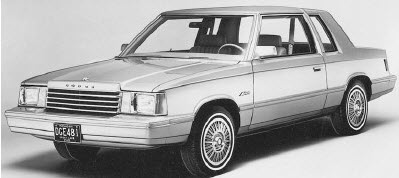
In the early 1980s, the Dodges Aries-K inspired Chrysler’s renaissance.
In 1979, Chrysler was at death’s door and petitioned the U.S. government for $1.5 billion in loan guarantees to avoid bankruptcy. It made gas guzzlers that nobody wanted to buy and it asked for $1.5 billion to keep itself going until a fleet of more fuel efficient cars could take up the sales slack. It was by far the largest government bailout in US history. On September 7, 1979 Chrysler formally petitioned the U.S. government for the loans, and on December 20, 1979 Congress ratified the appropriation in the “Chrysler Corporation Loan Guarantee Act,” which President Carter subsequently signed into law. It was an extremely painful period for Chrysler, but Reed Brothers survived the first Chrysler Bailout and resurgence under Lee Iacocca.
The K-Cars, the Dodge Aries and Plymouth Reliant, were, quite literally, the cars that saved Chrysler from the abyss in 1980. Their only real savior other than the K-Car was a government bailout. Though it came after bankruptcy, they managed to save the company with it by 1983. The K-Cars were inexpensive, reliable, and they delivered economical transportation for 6 people at an affordable price. Sales from the K-Car enabled Chrysler to emerge from bankruptcy and evolve into a profitable company.
Reeling from the combined effects of a recession and a global energy crisis, in 1979 Chrysler was forced to seek government loan guarantees. Meanwhile, Chrysler chairman Lee Iacocca took the company’s case straight to the people in a series of television commercials. Looking straight into the camera, the legendary auto executive pitched the company’s new K-cars with total conviction, asserting, “America, if you can find a better car, buy it.”
Buyers took up Iacocca’s challenge, flocking to the showrooms to buy their own K-cars. Nearly one million Aries were sold (and another million Reliants), allowing Chrysler to pay off its loans a full seven years early. Soon Iacocca was back on the airwaves with another ad campaign. This one was called “The Pride Is Back.”
These models were soon followed by what would become a home run product for Chrysler: minivans.
Nearly thirty years later, in 2008, Chrysler would receive billions in a new bailout from the U.S. government in the aftermath of the financial crisis that decimated automotive sales over the following few years. In 2009, Chrysler files for Chapter 11 bankruptcy protection. On May 14, 2009, Chrysler left 789 dealerships, about a quarter of its dealer base, out in the cold by rejecting their franchise agreements and giving them about a month to sell all their remaining new cars, factory parts and service equipment.
Whether a franchise is run by a second- or third-generation dealer, or is older than even Chrysler itself, didn’t seem to matter when Chrysler decided to cut dealerships ranks during their 2009 bankruptcy process. After almost 95 years selling Dodges, Reed Brothers was one of the 15 dealerships in Maryland and 789 dealerships nationwide notified by Chrysler that their franchise agreement would not be renewed. Chrysler was acquired in total by Fiat in 2014.
Source: Chrysler
Books

Related Resources


Copyright Notice

Reed Brothers Dodge History (1915-2012) by Jeanne Gartner is licensed under a Creative Commons Attribution-NonCommercial 3.0 Unported License.
 Reed Brothers Dodge History 1915 – 2012
Recent Comments