
Peerless Rockville Newsletter Feature
It was 100 years ago in October 1915, that Lewis Reed signed a franchise agreement with brothers Horace and John Dodge in Detroit. Since then, the business that Lewis Reed founded grew and transformed into Rockville’s oldest family-owned and operated Dodge dealership.
Last October, I was invited to write a feature article for the Winter issue of Peerless Rockville’s Newsletter highlighting the 100th anniversary of Reed Brothers Dodge. Peerless Rockville Historic Preservation, Ltd. is an award-winning nonprofit, community-based organization founded in 1974 to preserve buildings, objects, and information important to Rockville’s heritage. Their official website can be found here.
Pictured below is page 3 of the newsletter of the Peerless Places series highlighting Reed Brothers Dodge. (click image to enlarge)

History of Dodge Logos
Many fascinating and mysterious logos have been used by Dodge throughout the past 100 years. Dodge used different logos depending on the model and vehicle purpose. Trucks, passenger cars and performance vehicles typically held different logos on grills. Below are the most notable emblems used by Dodge since its inception.
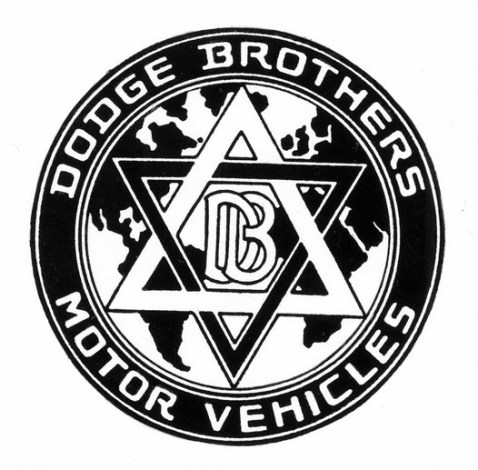
Dodge Brothers logo used from 1914 to 1927
Six-Pointed Star (1914-1938): When the Dodge brothers, Horace and John, built their first automobile in 1914, their final touch was a small enamel badge on the radiator with their company logo: a circle with two interlocking triangles forming a six-pointed star in the middle; an interlocked “DB” was at the center of the star, and the words “Dodge Brothers Motor Vehicles” encircled the outside edge. Although similar to the Star of David, the Dodge brothers were not Jewish. Although the “Brothers” was dropped from the name for trucks in 1929 and cars in 1930, the DB star remained in the cars until the 1939 models were introduced.
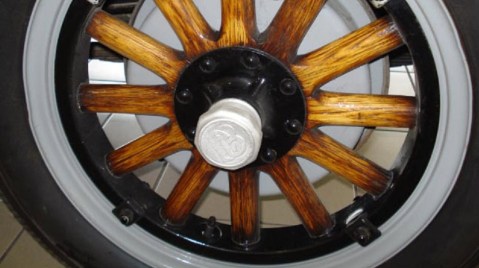
From 1928 Dodge Brothers Standard Six (intertwined “D” and “B”). Photo by Reed Brothers Dodge
 Ram: For 1932, Dodge cars adopted a leaping ram as the car’s hood ornament. Starting with the 1940 models the leaping ram became more streamlined and by 1951 only the head, complete with curving horns, remained. The 1954 model cars were the last to use the ram’s head before the rebirth in the 1980s. Dodge trucks adopted the ram as the hood ornament for the 1940 model year with the 1950 models as the last.
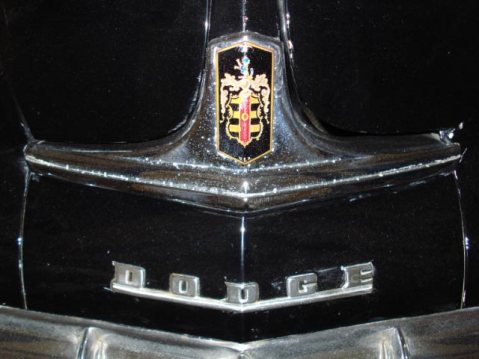
The hood of this 1946 Dodge Deluxe Fluid Drive Sedan is stamped with the Dodge coat of arms and “DODGE”. Photo by Reed Brothers Dodge
Crest: For 1941, Dodge introduced a crest, supposedly the Dodge family crest. The design had four horizontal bars broken in the middle by one vertical bar with an “O” in the center. A knight’s head appeared at the top of the emblem. Although the head would be dropped for 1955, the emblem would survive through 1957 and reappear on the 1976 Aspen. The crest would be used through to 1981 on its second time around, being replaced by the Pentastar for 1982. The knight’s head without the crest would be used for 1959.
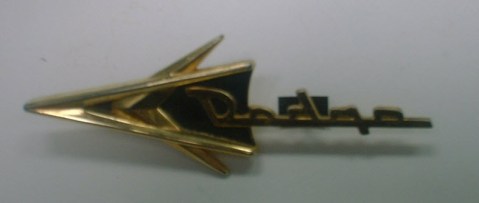
Forward Look
Forward Look (1955-1962): After the Dodge family crest was used between 1941-1957, Virgil Exner designed Dodge’s “Forward Look” logo: two overlapping boomerang shapes that suggested progress and forward motion. The design was heavily influenced by developing rocket propulsion technology and was named after the redesign campaign being used on the Chrysler Corporation’s vehicles.
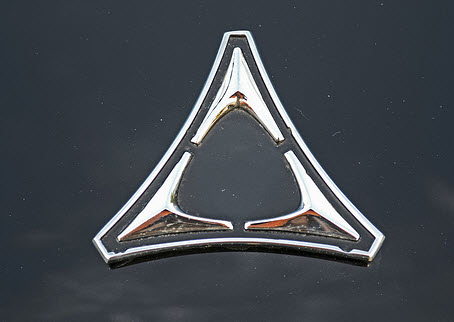
Fratzog
Fratzog (1962–1981): From 1962 to 1981, the Dodge emblem had a colorful internal label: It was called a fratzog. If you’re wondering what that word means (it sounds German, doesn’t it?), it’s totally meaningless. Three arrow shapes pointed inward to form a three-sided star. Not knowing what else to call the imaginative design, a Dodge designer made up the whimsical name.

Red Dodge Pentastar
Pentastar (1982-1992): For a decade, Dodge adopted Chrysler’s Pentastar logo on its vehicles, which had been used for corporate identification since 1962. To differentiate itself, Dodge’s Pentastar was red, while Chrysler-Plymouth’s was blue.
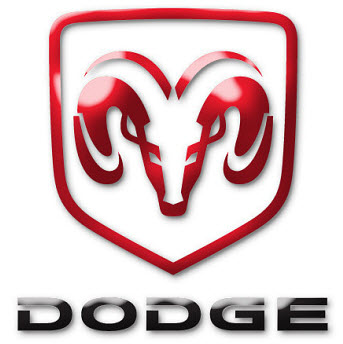
The Ram logo, used 1993–2010
Ram’s head (1993–2010): Dodge reintroduced the ram’s head hood ornament on the new 1973 Dodge Bighorn heavy duty tractor units. Gradually the ram’s head began appearing on the pickup trucks as Dodge began to refer to their trucks as Ram. The present iteration of the Ram’s-head logo appeared in 1993, standardizing on that logo in 1996 for all vehicles except the Viper, which uses the Viper’s Head.
 New Dodge logo (2010): When Ram Trucks was relaunched as its own brand in 2009 and used Dodge’s logo, Dodge was forced to replace its own. The present Dodge logo features several shades of silver and red colors. The Dodge inscription is all silver, but has a light hue at the top and dark, or rather grey, at the bottom. It stands for grandeur, dignity and sophistication. The two inclined stripes at the right side of the logo are painted red to symbolize passion and excitement, associated with the company’s vehicles. The new logo was unveiled in late May 2010.
Sources: Cartype, Wikipedia, Allpar, Dodge Brothers Club
Lewis Reed Photos: Rockville’s First Water Tower

1906 historic view of Rockville Maryland’s first pipestem water tower. (1897-1946)
Photograph by Lewis Reed, founder of Reed Brothers Dodge
This 1906 photograph taken by Lewis Reed depicts Rockville Maryland’s very first water tower. I wanted to share this photograph, because it offers a visual history for its role in the development of public utilities in the City of Rockville. My grandfather picked up the hobby of photography even before automobiles were around. He was a well-known photographer in the county and many of his early photographs are now part of the Montgomery County Historical Society photo archives.

View of Rockville Water Tower and Baltimore Road B&O Railroad Crossing circa 1909. Photo by Lewis Reed
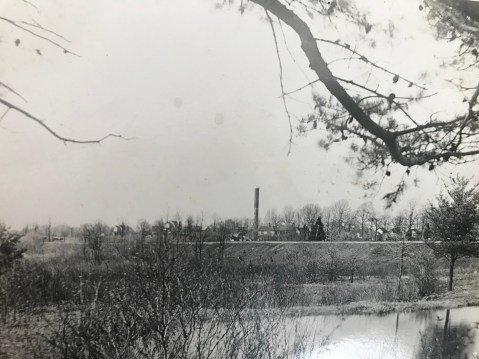
Another view of Rockville Water Tower. Photo by Lewis Reed
The pipestem tower was an element of the 1897 pumping station known as the “Rockville Electric Lights and Water Works,” located in Rockville Park and the future Croydon Park. In the 1890s, Rockville grew both as a resort and as a town. With substantial residential appeal, the need for services grew. In about 1899, Rockville got its first water tower at a cost of about $20,000. Its construction signaled the dawn of local municipal water service. Prior to the tower’s construction water in the city was primarily drawn from private wells. Concern for water quality in the 1880s led to the decision to develop a municipal system. The stand pipe was a typical shape for a water tower at the turn of the century. From this high point, water could be piped throughout the town. The chimney stack originally extended to a height of 50’, as documented in the Sanborn maps 1908, 1915.

Rockville Pump House, circa 1912. Photo by Lewis Reed
Built in 1879, the Pump House at Croydon Park is a historic building in Rockville and the site of the first municipal water supply. Once known as the “Rockville Electric Lights & Water Works.” the building was the City’s first public water system and supplier of electricity for street lights and private homes.
Sources:
National Register of Historic Places, Rockville Pumping Station
Peerless Rockville
Rockville Nights: Sculpture commemorates Rockville’s legendary Reed Brothers Dodge (Photos)
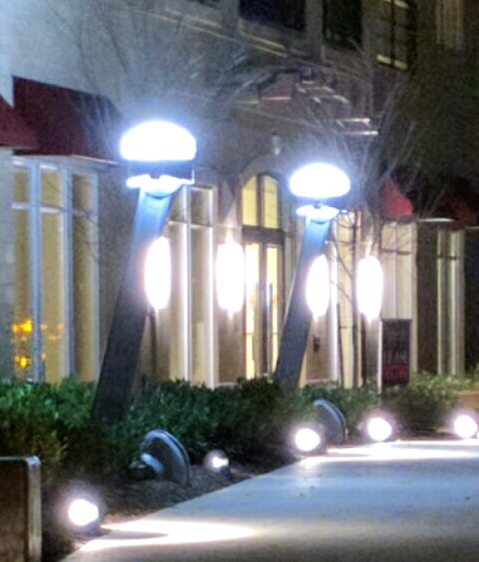
I would like to take this opportunity to offer a special thank you to Rockville Nights blogger Robert Dyer, for sending new visitors our way via a link on his blog post: http://www.rockvillenights.com/2015/12/sculpture-commemorates-rockvilles.html.
Source: Rockville Nights: Sculpture commemorates Rockville’s legendary Reed Brothers Dodge (Photos)
November 14, 1914: The First Dodge Car

Horace Dodge (left rear) and John Dodge (right rear) in “Old Betsy” in front of John Dodge’s Boston Boulevard home, 14 November 1914.
One hundred and one years ago on this date –November 14, 1914 — the very first Dodge car, “Old Betsy”, rolled off the assembly line. On that day, the Dodge Brothers (Horace and John) were photographed riding in the rear seat of the first car to bear their last name. It cost $785, had a 110-inch wheelbase, and was powered by an L-head 4-cylinder engine that proved so reliable it was continued until 1920 with very little modification. Total production for 1914 was a mere 249 touring cars. The following year. Dodge offered a two-passenger roadster which also sold for $785 and the plant went into full production.
According to “The Dodge Brothers: The Men, the Motor Cars, and the Legacy” by Charles K. Hyde, here’s the full story:
The widely accepted history of the initial production of early Dodge Brothers automobiles in November 1914 is at odds with much of the evidence about the earliest Dodge Brothers cars. Automotive historians have thought that the first production car, later named “Old Betsy,” came off the assembly line at the Hamtramck factory on 14 November 1914. Guy Ameel, superintendent of final assembly for Dodge Brothers since the start of automobile production, served as John and Horace’s chauffeur that day. With the brothers in the back seat, Ameel stopped the first Dodge Brothers car in front of John Dodge’s mansion on Boston Boulevard in Detroit and a photographer recorded this important moment.
“Old Betsy” was more likely an experimental prototype car assembled several months before 14 November 1914 and not a production car at all…
The Dodge Brothers began an aggressive advertising campaign to promote their new automobiles and to attract potential dealers to sell their cars. Few people jumped onto the Dodge Brothers bandwagon earlier than Lewis Reed, and not many have lasted longer. Lewis Reed was an enterprising young man who put his future in the fledgling automobile industry. In 1915 he received his franchise to sell Dodge Brothers Motor Cars from John and Horace Dodge; less than one year after “Old Betsy” rolled off the assembly line. Lewis Reed and his brother Edgar, were the first to sell Dodge cars in Montgomery County, Maryland. That made Reed Brothers the oldest Dodge dealership under the same family ownership in Maryland, and one of the oldest in the entire nation.
The Beginning of Dodge | Chrysler Historical Video
Source: “The Dodge Brothers: The Men, the Motor Cars, and the Legacy“
Books

Related Resources


Copyright Notice

Reed Brothers Dodge History (1915-2012) by Jeanne Gartner is licensed under a Creative Commons Attribution-NonCommercial 3.0 Unported License.
 Reed Brothers Dodge History 1915 – 2012
Recent Comments